Published by Zorapid
Raw metal stock is often 40–60% of your total sheet metal part cost, and unoptimized design choices blow material yield straight into scrap bins. Generic fabricators rely on old manual layout, rigid bend rules, and one-size material picks—leading to 20–35% scrap rates on custom jobs. Small design tweaks (hacks built for manufacturability) can slash waste by 10–25% overnight, cut per-unit pricing, and shrink carbon footprint for long-run orders.
At Zorapid’s 3,000㎡ smart fabrication center, we pair AI nesting simulation, DFM sheet metal design audits, remnant inventory tracking, and hybrid lean workflows that standard shops cannot match. Below we break down actionable waste-reduction design hacks, competitor gaps, exclusive Zorapid solutions, material comparisons, real production cases, and industry trend data.
In-Depth Professional Process Technical Analysis
Core Waste Sources in Custom Sheet Metal
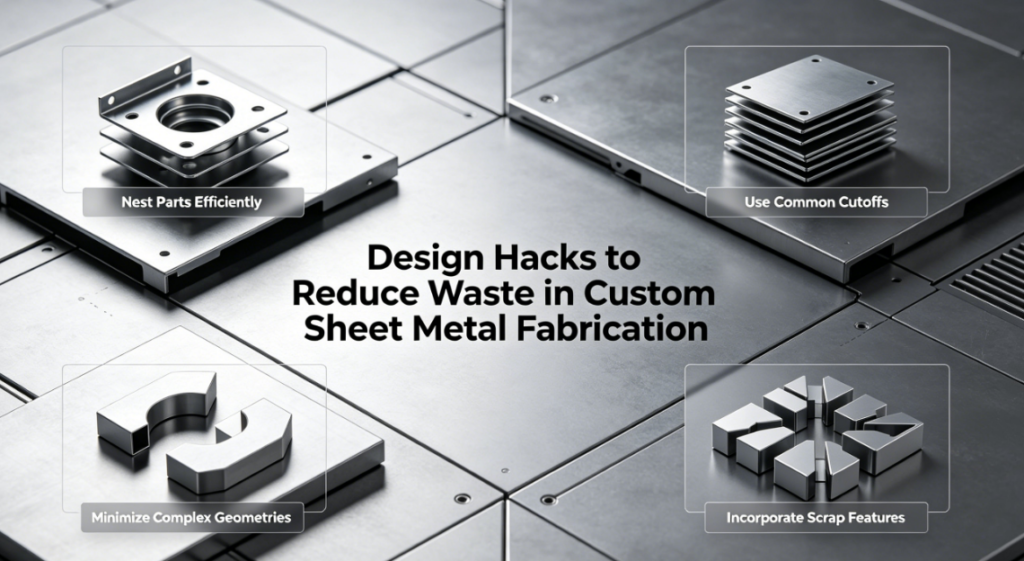
- Poor part nesting layout (biggest waste driver: empty sheet gaps, duplicate kerf cuts)
- Overcomplicated geometry: inconsistent bend radii, tiny unformable flanges, excess cutouts
- Non-standard sheet thickness/sizes forcing leftover offcuts no other job can use
- Thermal scrap from misaligned grain direction causing bend cracks & rejected pieces
- Unmanaged remnant stock: small offcuts discarded instead of nested into small components
Zorapid 7-Step Waste-Reduction Design & Fabrication Protocol
- Pre-Job DFM Sheet Metal Audit (Design Hack Baseline) Our engineers rewrite CAD geometry to standardize bend radii, trim redundant cutouts, fix undersized flanges, and align bend lines to material grain before nesting runs. Minimum flange rule enforced: Min Flange Height = 4×t + Inner Bend Radius to eliminate forming scrap.
- AI Genetic Algorithm Nesting + Common-Line Cutting SigmaNEST industrial CAM stacks large parts first, fills gaps with small brackets, enables shared cut edges between adjacent parts to erase duplicate kerf waste (0.1mm laser kerf saved per shared edge).
- Standard Sheet Size Lock-In (1220×2440mm / 1000×2000mm industry blanks) We adjust part blank dimensions to fit full standard sheets, eliminating odd leftover strips that get scrapped at generic shops.
- Remnant Inventory Database Matching All usable offcuts (≥100mm width) logged digitally; small brackets, gaskets, tabs automatically nested onto leftover sheets first before opening full new stock.
- Grain Direction Simulation Lock Bend features rotated in CAD parallel to metal rolling grain; misalignment creates 20–30% higher crack scrap rates.
- Consolidated Multi-Part Family Nesting If you order 3+ SKUs, we nest all variants onto one sheet batch instead of separate runs for each part.
- Post-Cut Minimal Secondary Operation Plan Design formed tabs/tabs instead of welded fasteners; fewer welds = less heat distortion scrap, less grinding rework waste.
Competitor vs Zorapid Waste & Yield Comparison Table
| Process Step | Average Mid-Tier Generic Sheet Metal Shop | Zorapid Standard Waste Control Protocol | Measurable Yield & Scrap Gap |
|---|---|---|---|
| Pre-Design DFM Waste Check | No formal audit; cut CAD as-received | Full bend/flange/cutout simplification CAD revision | Competitor baseline scrap 22–35%; Zorapid base scrap 7–14% |
| Nesting Technology | Manual drag layout or free basic software | AI genetic algorithm + common-line cutting | Competitor sheet utilization 60–85%; Zorapid 88–95% |
| Remnant Offcut Management | 70% small offcuts thrown to scrap bin | Digital remnant library auto-assigned to small part orders | Zorapid recovers extra 3–6% usable material monthly |
| Bend/Grain Alignment | No grain simulation; random part rotation | CAD locked grain-bend orientation pre-nest | Competitor bend crack reject 4–9%; Zorapid crack scrap <0.8% |
| Bend Radius Standardization | Multiple radii per part, frequent die swaps | Max 2 radii per assembly; standardized library | Competitor setup scrap + labor waste +30% vs Zorapid |
| Multi-SKU Family Nesting | Separate sheet batches for each part number | Mixed SKU optimized nesting on single sheets | Extra 5–8% material savings on multi-component assemblies |
| Post-Form Distortion Control | Manual straightening rework, high reject rate | DFM stiffener rib design, balanced bend sequencing | Zorapid post-form rework scrap reduced 75% |
High-Difficulty Waste Challenges Competitors Cannot Solve + Zorapid Exclusive Solutions
Four critical custom sheet metal pain points where standard fabricators accept high scrap or turn orders down entirely—our proprietary hybrid fixes eliminate waste at the source:
Challenge 1: Ultra-Thin Gauge (0.6–0.9mm) Stainless/Aluminum Custom Panels
Competitor Failure: Thin material warps during laser cutting; loose nesting causes thermal distortion, edge burn rejects; cannot run common-line cutting safely, massive kerf gap waste. Many shops limit thin-gauge batch sizes to avoid heavy scrap losses.
Zorapid Solution:
- Low-power pulsed laser parameters tuned for thin stock, heat sink sheet backing during cutting
- Micro-tab secure part holding for common-line shared edges
- DFM slight stiffener bead embossments built into panel design to lock flatness post-cut Result: Thin panel scrap dropped from 16% (competitor) to 2.1% for 50,000-unit EV enclosure run
Challenge 2: Low-Volume Mixed Exotic Alloys (316L, 5052-H32, Titanium Grade 2)
Competitor Failure: Expensive specialty sheets only fit 1–2 large parts per blank; leftover high-cost offcuts discarded with no matching small jobs to use remnants. Material cost waste cripples project budgets.
Zorapid Solution:
- Cross-program remnant sharing across medical/aero/EV client jobs in our centralized material database
- Near-net blank DFM resizing to shrink part footprint without losing functional strength
- Waterjet precision trimming for exotic alloys to minimize wide plasma kerf waste
- Result: 28% cost reduction on 316L medical hardware via remnant reuse vs brand-new sheet stock
Challenge 3: Complex Deep Bend Multi-Feature Assemblies
Competitor Failure: Multiple unique bend radii, tiny unreachable flanges lead to forming failure; rework grinding creates dimensional scrap, extra labor hours. Shops refuse complex multi-bend custom frames for long runs.
Zorapid Solution:
- Early CAD DFM rework to consolidate bend radii to 1–2 standard sizes
- Modular progressive bend tooling for consistent forming force
- FEA bend stress simulation pre-fabrication to eliminate crack-prone sharp inside corners
- Result: Zero forming scrap on aerospace 7075-T6 structural frame batches
Challenge 4: One-Off Prototype Custom Parts With No Follow-Up Volume
Competitor Failure: Full standard sheet cut for 1–2 prototype pieces; 90% of expensive blank scrapped after single use.
Zorapid Solution: Rapid remnant stock sourcing first—we pull matching gauge/size offcuts from our inventory before cutting a full new sheet for prototypes.
Result: Prototype material waste reduced 70–85% for low-qualifier custom designs
Suitable Sheet Metal Grades + Material Yield & Waste Comparison Matrix
Each alloy has unique formability, nesting constraints, grain behavior that directly impacts waste volume. Below is Zorapid’s production-grade comparison focused on waste risk, yield performance, and optimal use cases:
| Material Grade | Typical Gauge Range | Bend Formability (1–5 Best) | Grain Crack Waste Risk | Max Nest Utilization Achievable | Relative Scrap Cost Penalty | Best Low-Waste Application |
|---|---|---|---|---|---|---|
| A36 Mild Carbon Steel | 0.8–12mm | 5 (Excellent) | Low | 94–95% | Lowest | Equipment frames, general brackets, cabinets |
| Galvanized Steel | 1.0–8mm | 4 | Medium (coating peel) | 91–93% | Low | HVAC enclosures, outdoor housings |
| 5052-H32 Aluminum | 0.6–6mm | 4 | Medium | 90–93% | Medium | Light EV panels, marine trim, electrical boxes |
| 6061-T6 Aluminum | 1.0–10mm | 3 | High (stiffer temper) | 89–92% | Medium-High | Structural load brackets, aerospace supports |
| 304 Stainless Steel | 0.8–8mm | 3 | Medium-High | 88–91% | High | Food-grade, medical, corrosion-resistant housings |
| 316L Stainless Steel | 1.0–10mm | 3 | High | 87–90% | Very High | Medical implants hardware, chemical fluid manifolds |
| Titanium Grade 2 | 0.8–6mm | 2 | Very High | 85–88% | Highest | Aerospace lightweight custom brackets |
Key Material Waste Reduction Rules from Zorapid Engineering
- High-waste-risk stiff alloys (6061-T6, Ti Grade2): Prioritize extra DFM grain alignment checks; avoid tight sharp inside bend radii
- Thin stainless/aluminum: Mandate micro-tab common-line cutting to cut kerf waste
- Cost-sensitive carbon steel: Maximize mixed SKU nesting—low raw cost makes remnant reuse highest ROI
- Medical/aero exotic grades: Remnant cross-job sharing is non-negotiable to offset premium stock pricing
Real-World Zorapid Waste Reduction Case Analysis
1: EU EV Tier 1 5052-H32 Lightweight Enclosure Panels
- Client: European Electric Vehicle OEM
- Annual Volume: 62,000 custom thin panel units
- Material: 0.8mm 5052-H32 Aluminum
- Original Competitor Pain Points: Manual nesting, no grain simulation, 18.7% total scrap rate, high per-unit aluminum cost
- Zorapid Full Waste-Reduction Design & Fabrication Package:
- CAD DFM added micro stiffener beads for flatness during laser cutting
- AI mixed-size common-line nesting with micro-tab part fixturing
- All bend lines locked parallel to aluminum rolling grain
- Small mounting tabs nested into leftover sheet gaps
- Verified Final Results:
- Total scrap rate dropped to 4.3%
- Raw aluminum material spend reduced 22% annually
- No thermal warpage rejects across 12-month continuous production
Case 2: US FDA Medical 316L Stainless Instrument Brackets
- Client: US Class II Medical Device Manufacturer
- Volume: 18,000 annual custom precision brackets
- Material: 1.2mm medical-grade 316L Stainless
- Competitor Barrier: Prior shop cut full new sheets for each bracket SKU; expensive stainless offcuts discarded, 14.2% scrap, inflated component pricing
- Zorapid Solution:
- Cross-job remnant inventory matching first for small bracket blanks
- Consolidated 4 bracket SKUs into one optimized nested sheet layout
- FEA bend stress tweak to widen critical inner radii and eliminate crack scrap
- Outcome: Stainless material waste cut 69%, full ISO 13485 traceability for every sheet batch
Case 3: Aerospace 7075-T6 High-Strength Structural Frame Components
- Client: Global Aerospace Tier 2 Supplier
- Volume: 4,800 unit 9-month program
- Material: 3mm 7075-T6 Aluminum
- Pain Point: Hard temper prone to bend fractures with poor design; generic fabricator hit 11.5% forming scrap
- Zorapid Fix: DFM radius standardization + grain lock nesting + progressive low-stress bend sequencing
- Result: Forming scrap reduced to 0.9%, on-time monthly shipments with stable yield
Your Custom Part Requirements vs Zorapid Tailored Waste-Saving Solutions
We adjust our entire design-fabrication workflow around your volume, material, compliance, and geometry needs to lock minimal scrap:
| Your Core Project Demand | Zorapid Custom Waste-Reduction Package |
|---|---|
| High-volume long-run (≥10,000 units/year) | AI advanced genetic nesting, dedicated blank sheet sizing for your part geometry, standardized bend tool library |
| Low-volume prototype / small batch (<1,000 units) | Remnant offcut stock priority sourcing, minimal full sheet cuts, rapid DFM simplification |
| Regulated Medical/Aerospace (ISO13485/AS9100) | Grain/bend/ nesting full audit logs, certified traceable sheet stock, zero recycled remnant for implant-grade alloys |
| Ultra-thin gauge (0.6–0.9mm) stainless/aluminum | Pulsed laser cutting, micro-tab common-line cutting, DFM stiffener emboss design |
| Multi-SKU assembly kits (3+ unique parts) | Family mixed nesting algorithm, shared sheet batches for all kit components |
| Exotic high-cost alloys (316L, Ti, 7075-T6) | Centralized remnant cross-program sharing, FEA pre-bend stress simulation to eliminate crack scrap |
| Tight cosmetic surface finish specs | Heat sink backing during laser cut to eliminate burn scrap, post-cut tumble smoothing instead of labor grinding |
2026 Global Sheet Metal Industry Data + Future Waste Reduction Trend Table
Industry Scrap Rate Benchmark Table (Custom Sheet Metal Fabrication)
| Industry Segment | Average Scrap % (Standard Generic Shops) | Zorapid Validated Low-Waste Scrap % | 2026–2028 CAGR Production Growth |
|---|---|---|---|
| EV Automotive Enclosures/Brackets | 17.2–28.5% | 3.8–7.5% | +19.1% |
| Medical Stainless Hardware | 12.8–22.1% | 2.5–6.2% | +12.4% |
| Aerospace Structural Frames | 10.5–19.3% | 3.1–6.8% | +8.2% |
| Industrial Automation Cabinets | 14.1–25.7% | 5.2–9.1% | +6.9% |
| General HVAC & Equipment Frames | 11.3–20.8% | 4.5–8.3% | +5.8% |
Key 2026–2028 Waste Reduction Industry Trends
- AI Nesting + DFM Pre-Cut Audits Become OEM Mandates Top EV/medical/aero buyers now require pre-production yield simulation reports before releasing POs; manual layout shops lose high-value contracts rapidly. Zorapid embedded AI nesting DFM as a mandatory first step 3 years ahead of regional competitors.
- Remnant Inventory Cloud Tracking Moves From Upgrade to Baseline Raw metal price volatility forces fabricators to monetize every offcut; legacy shops throw away 60–70% of usable remnants, while smart facilities cross-share across client jobs.
- DFM Design Simplification Cuts Waste More Than Nesting Alone Engineering tweaks (standard radii, optimized flanges, removed redundant cutouts) deliver 8–15% waste reduction vs 5–10% from nesting upgrades only—design is the biggest lever.
- Common-Line Micro-Tab Cutting Standard for Thin & Medium Gauges Thin stock thermal risk previously limited shared edge cutting; modern pulsed laser + micro-tab holding unlocks 8–12% extra material savings for thin panels.
- Hybrid Sheet Metal + CNC Post-Form Finishing Reduces Rework Scrap In-house precision CNC trims distorted edges instead of manual grinding, slashing post-forming reject rates for tight-tolerance custom assemblies.
Core Application Scenarios for Zorapid Low-Waste Custom Sheet Metal
- Electric Vehicle (EV): Lightweight aluminum battery enclosures, motor mounting brackets, cooling manifold frames, connector housing panels
- Medical & FDA Life Sciences: 316L stainless surgical instrument bases, equipment cabinet frames, sterilizable hardware housings
- Aerospace & Defense: 7075-T6 high-strength structural frames, titanium lightweight support brackets, avionics shield enclosures
- Industrial Automation & Robotics: Mild steel machine bases, actuator mounting plates, safety guard frames, gear assembly housings
- HVAC & Energy Equipment: Galvanized duct supports, pump frames, solar panel mounting brackets
- Food & Chemical Processing: 304/316L stainless corrosion-resistant tanks, valve mounting frames, washdown equipment cabinets
Zorapid Low-Waste Fabrication Delivery Speed Framework
Waste and delivery delays go hand in hand—rework scrap, re-cut sheets, and manual layout create weeks of hold-ups at generic shops. Our pre-optimized workflow eliminates rework delays entirely:
Standard Tiered Timeline
- CAD DFM Waste-Reduction Design Audit & Revision: 2–4 business days (1-day fast-track rush available)
- AI Nesting Simulation + Remnant Stock Validation: 1–2 days
- Laser/Waterjet Cutting + Forming Production Run: 5–14 days based on batch size & material
- Post-Processing (weld, finish, deburr, assembly): 2–6 days
- FAI quality signoff + certified global export packaging
Speed Advantages vs Competitors
- Zero full-sheet re-cuts from poor nesting/DFM errors (competitors average 1–2 re-cut batches adding 6–12 extra days)
- Full in-house laser, press brake, weld, CNC finishing—no third-party subcontract bottlenecks
- Pre-stocked certified standard sheet blanks eliminate 3–7 day raw material sourcing lag
- Dedicated sheet metal process engineer owns your job from CAD to shipment for fast design feedback
Real Benchmark Example: 62k EV aluminum panel program fully validated and first batch shipped in 21 total days; competitor quoted minimum 35 days with expected scrap rework delays.
Key Benefits Partnering With Zorapid for Low-Waste Custom Sheet Metal
- Massive Raw Material Cost Savings: Cut scrap waste 60–80% vs standard fabricators, direct bottom-line cost reduction on every batch
- AI + Human Dual DFM Validation: No blind CAD cutting—engineering tweaks lock manufacturability before a single sheet is processed
- Exclusive Cross-Job Remnant Inventory System: Monetizes expensive offcuts generic shops discard entirely
- Full Regulatory Audit Documentation: Nesting reports, material MTRs, grain alignment logs, yield SPC data for ISO13485/AS9100/IATF audits
- Hybrid In-House Manufacturing Stack: Laser, waterjet, press brake, CNC post-finish, welding all under one roof to eliminate cross-shop rework scrap
- No Hidden Rework Fees: Quote includes full DFM revision, AI nesting optimization, and one round of minor process tuning—no surprise re-cut charges
- 20+ Years Precision Sheet Metal Expertise: We engineer parts for low waste first, not just cut uploaded CAD files like volume-only shops
- Stable Predictable Lead Times: Eliminates schedule chaos from unexpected scrap batches and re-production runs
- Global Door-to-Door Export Support: Crated secure packaging, full customs paperwork, scheduled air/sea freight direct to US, EU, UK, Australia OEM facilities
Quick Summary
Waste in custom sheet metal rarely stems from cutting machine flaws—it starts in unoptimized CAD design, lazy manual nesting, ignored grain behavior, and discarded usable offcuts. Generic fabricators accept double-digit scrap rates as unavoidable overhead, passing inflated material costs directly to your PO.
Zorapid’s stack of design-first waste hacks—DFM geometry simplification, AI genetic nesting, common-line micro-tab cutting, remnant inventory reuse, and grain-locked forming—delivers industry-leading low scrap yields for aluminum, stainless, carbon steel, and exotic alloy custom parts. Whether you run high-volume EV panels, regulated medical stainless brackets, or aerospace high-strength frames, our engineering team rewrites your CAD for minimal waste without sacrificing fit, strength, or cosmetic quality.
Send your CAD files, material spec, and volume forecast today for a free DFM waste-yield feasibility review with detailed projected scrap savings breakdown.
FAQ
Is common-line cutting safe for cosmetic finish parts?
Yes, with Zorapid’s micro-tab holding process. Tiny break tabs keep parts secured during shared-edge laser cutting; post-cut tumble deburr removes tab marks for flawless cosmetic surfaces with zero extra scrap.
How much yield improvement can I expect just from updating my CAD design?
Standard DFM tweaks (standard bend radii, proper flange heights, removed redundant cutouts) deliver 8–15% immediate waste reduction before any nesting optimization runs—design is the single highest-impact waste lever.
Do small prototype orders really save material with remnant stock?
Dramatically. For 1–5 piece prototypes, pulling matching gauge offcuts from our inventory avoids cutting a full 1220×2440mm sheet, slashing prototype material waste by 70–85% consistently.
Does grain direction alignment add extra design or production time?
Minimal (1–2 hour CAD adjustment pre-nest), but cuts bend crack scrap from 4–9% down to under 1%—the yield ROI far outweighs tiny upfront engineering time.
Can you apply these waste hacks to thick plate sheet metal (10mm+ steel)?
Fully applicable. We switch to waterjet cutting for thick plate to minimize wide plasma kerf waste, use heavy-duty fixture nesting, and standardize large bend die radii to eliminate forming split scrap.
Will standardizing bend radii hurt my part’s functional performance?
Never. Our FEA stress simulation validates that consolidated standard radii maintain identical structural strength; we only adjust geometry where functional load requirements are unaffected. If unique radii are mandatory for fit, we cap each part at 2 max radii to limit die swap waste.
What happens to leftover remnants that no client job can use?
Small unusable scrap gets sorted and sold back to certified metal recyclers with full sustainability reporting for your ESG audit documentation, reducing your project’s carbon footprint.
Is AI nesting software enough alone to fix high scrap rates?
No. Poor CAD geometry will cap nesting yield no matter how advanced the CAM algorithm—DFM design optimization is required first, then AI nesting maximizes the refined blank layout potential.