Published by Zorapid Precision Manufacturing
If you run a CNC workshop, you’ve definitely felt this frustration:
Your machines clock 10 full scheduled hours every shift, your team clocks in on time, jobs are loaded onto the schedule… yet your spindle-on time stays stuck at 50–65%. Margins shrink, lead times slip, and customers keep pushing for faster deliveries.
You check the big breakdowns—spindle crashes, blown servo motors, hydraulic failures—and those only eat up a tiny slice of your lost production. The real profit killer? Hidden downtime.
These tiny, unrecorded micro-stops, idle windows, and process bottlenecks fly under your ERP’s radar every single shift. Operators brush them off as “normal daily delays,” managers never log them, and month after month, all those lost minutes add up to thousands of wasted machining hours annually.
At Zorapid, our 3,000㎡ precision CNC facility runs 24/7 multi-axis mills, Swiss lathes and turning centers for medical, aerospace and EV OEM clients across Europe and North America. We’ve audited dozens of partner CNC shops and found hidden downtime accounts for 30–45% of total planned production time.
Today, we’re breaking down every overlooked hidden downtime root cause, plus actionable, low-cost improvement strategies you can roll out this week—no massive equipment upgrades required.
What Exactly Is Hidden CNC Downtime?
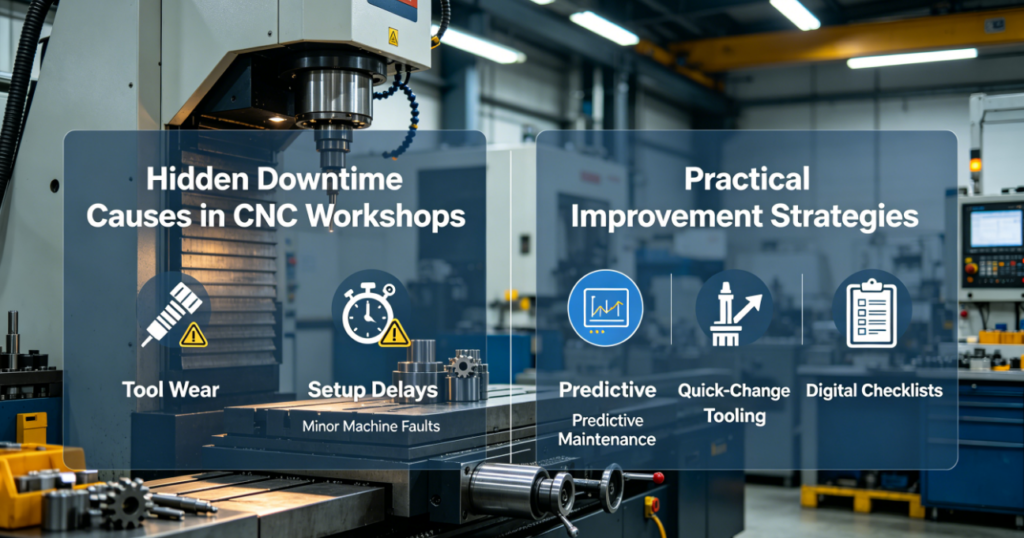
Let’s keep it simple for shop teams. Hidden downtime is any unlogged, short-duration idle time where your CNC spindle sits stationary, but the machine isn’t marked as “broken down” in your tracking system.
It’s not major catastrophic failures. It’s death by a thousand tiny cuts:
- 2–10 minute setup gaps between batches
- Repeated probe errors, re-probing offsets mid-job
- Operators hunting for tools, gages, raw material or fixtures
- Slow chip clearing, coolant filter clogging mid-run
- Unattended micro-alarms teams ignore daily
- Waiting on CMM inspection sign-off before next batch
- Offline CAM programming delays holding up machine cells
- Tool wear stoppages that trigger emergency regrinds
Most shops only track full machine breakdowns, so these incremental losses never show up on your weekly downtime report. That’s why your OEE looks artificially high on paper, but your output never matches your machine capacity.
6 Major Hidden Downtime Root Causes (Shop-Floor Verified by Zorapid Engineers)
We grouped the most common unseen production losses by category, with real workshop examples your team will instantly recognize.
1. Unoptimized Changeovers & Unstructured Setup Waste (Largest Hidden Loss Source)
This is the hidden downtime culprit for 80% of CNC job shops.
Teams treat job changeover as an unavoidable machine-down task, with zero separation between internal and external work. While the spindle sits idle, operators scramble to pull tools, edit programs, hunt for vises, and manually calibrate offsets.
Common hidden delays here:
- No pre-kitted tooling, raw stock or fixture hardware ahead of job switch
- Custom one-off fixturing that requires full re-tramming every batch
- All program editing, tool presetting and gage checks done on the machine
- No standardized setup checklists, so operators repeat trial-and-error probing
At Zorapid’s facility, we once audited a 5-axis cell with 90-minute average changeovers—65 minutes of that time was purely avoidable hidden idle time from unorganized setup workflows.
2. Ignored Micro-Stops & Normalized Machine Alarms
Every CNC machine throws small, repeat warnings: low lube pressure, coolant concentration drift, chip conveyor overload, minor axis following errors.
Here’s the costly hidden downtime trap: Shop crews grow desensitized to routine alarms. Instead of resolving the root issue, they hit “reset” and restart the cycle. Each reset creates a 30-second to 3-minute micro-stop, dozens of times per shift. Over a week, that adds up to hours of lost cutting time.
Other micro-stop triggers:
- Tool wear triggering dimensional drift, forcing mid-run re-probing
- Clogged coolant screens cutting flow, causing temporary thermal shifts
- Loose air lines dropping pressure, pausing clamping cycles
- Thermal expansion drift requiring mid-batch zero re-homing
3. Reactive Tool Management & Last-Minute Tool Failures
Catastrophic broken end mills make downtime logs, but gradual, unmonitored tool wear creates constant hidden idle time no one tracks.
Operators run cutting tools far past their recommended service life to “save tool change time.” The outcome:
- Mid-cycle pauses to adjust feed/speed for worn cutters
- Extra probing to fix offset drift from dull tools
- Emergency offline regrinding that holds up the next batch
- Unplanned tool inventory shortages mid-shift
Glass-filled nylon, titanium and Inconel accelerate tool degradation—shops running high-performance alloys suffer 2x more tool-related hidden downtime than aluminum-only facilities.
4. Delayed Material, Fixture & Inspection Workflow Bottlenecks
Your CNC spindle can’t cut metal if the next job’s raw stock, custom fixture or CMM quality sign-off isn’t ready. These waiting periods rarely get logged as downtime.
Typical hidden workflow delays:
- Material handlers delivering bar stock/aluminum plates late after a batch finishes
- WIP piling up at inspection stations, holding machines idle waiting for first-part approval
- Missing spare vises, zero-point pallets or custom fixture inserts stored across the shop
- Slow internal part transport between mills, lathes and deburr stations
5. Deferred Preventive Maintenance (Silent, Gradual Idle Time)
Most shops only service machines when something fully breaks. Skipping small daily/weekly checks creates recurring, invisible idle losses that build week over week.
Hidden downtime from neglected maintenance:
- Dirty electrical cabinets triggering random servo communication faults
- Uncleaned spindle tapers causing tool runout and repeated re-probing
- Unmonitored coolant bacteria growth clogging nozzles mid-cycle
- Worn ball screws/guides creating backlash, requiring frequent offset corrections
- Dead machine memory batteries losing work offsets every power cycle
A $50 monthly filter replacement avoids 4–6 hours of cumulative hidden downtime per spindle monthly, our maintenance data confirms.
6. Skill Gaps & Disconnected Offline Engineering Support
Many hidden delays stem from siloed CAM, design and shop floor teams.
Programmers finish toolpaths hours late, or deliver unoptimized G-code with untested tool paths that force operators to edit code on the machine while the spindle sits still.
Additional human-factor hidden downtime:
- New operators lacking standardized setup SOPs, taking twice as long to dial in jobs
- No shared digital library of proven offsets, fixture layouts and cutting parameters
- No dedicated engineering support during night shifts to resolve program errors
7 Practical, Low-Cost Improvement Strategies to Eliminate Hidden CNC Downtime
All tactics below are deployed daily inside Zorapid’s CNC workshop, with measurable OEE gains visible within 2–4 weeks. No six-figure automation investment required.
Strategy 1: Roll Out SMED to Split Internal & External Setup Work
SMED (Single-Minute Exchange of Die) is the fastest fix for changeover hidden downtime. The core rule: move every possible task offline while the machine is still cutting parts.
Zorapid standard SMED implementation steps:
- Build pre-job kits: stage raw material, tools, gages, fixture hardware and printed setup sheets at a dedicated offline prep station
- Use offline tool presetters to measure length/radius offsets away from spindles
- Standardize zero-point pallet systems and modular quick-change vises to cut tramming time
- Create visual one-page setup checklists for every recurring part number
- Batch jobs with matching material/fixture requirements to minimize full changeovers
Real Zorapid Result: SMED cut average changeover time on our 5-axis cells from 88 mins to 26 mins, reclaiming 12+ hours of monthly spindle time per machine.
Strategy 2: Log Every Micro-Stop & Eliminate Alarm Normalization
You can’t fix what you don’t measure. Implement a simple 1-click downtime logging workflow for operators:
- Install touchscreen dashboards at every machine to tag every idle pause (alarm, tool wear, waiting for material, re-probing)
- Host daily 10-minute standups reviewing the top 3 micro-stop causes from the prior shift
- Create a permanent maintenance log for recurring alarms; resolve root causes instead of hitting reset
- Schedule mid-shift quick inspections to clear chip buildup, clean coolant screens and top off lubrication
Strategy 3: Build a Predictable Tool Lifecycle & On-Site Tool Inventory
Stop emergency tool regrinds and last-minute shortages with structured tool management:
- Document maximum cut time for every tool/material combination in a shared digital log
- Set hard shift limits for tool replacement (swap tools before wear triggers dimensional drift)
- Maintain a critical spare tool stock of high-use end mills, drills and taps at each cell
- Assign a dedicated tool room lead to handle regrinding offline during active machining shifts
Strategy 4: Streamline Material & Inspection Workflow to Remove Waiting Idle Time
Align your material handling and quality schedule to match CNC run rates:
- Schedule material delivery 15 mins before a batch finishes, not after
- Run parallel CMM inspection: inspect finished parts while the machine cuts the next batch
- Standardize fixture storage racks at each machining cell to eliminate cross-shop hunting
- Add visual WIP status boards so supervisors spot material bottlenecks instantly
Strategy 5: Tiered Preventive Maintenance Program (Daily → Quarterly)
Shift from reactive breakdown fixes to condition-based maintenance to erase gradual hidden idle time. We split maintenance into three simple tiers for every CNC machine:
| Tier | Frequency | Operator/Maintenance Tasks | Hidden Downtime Risk Addressed |
|---|---|---|---|
| Daily Operator Check | Start of every shift (5–10 mins) | Coolant concentration, lube levels, chip removal, visual leak scan, spindle noise check | Clogged coolant, low lubrication micro-stops |
| Weekly Maintenance | End of Friday shift | Clean filters, air pressure calibration, spindle taper wipe, chip conveyor full breakdown | Filter clogging, air pressure faults, tool runout |
| Quarterly Technician Service | Every 3 months | Backlash testing, hydraulic fluid change, cabinet deep clean, sensor calibration | Axis drift, electrical random alarms, servo faults |
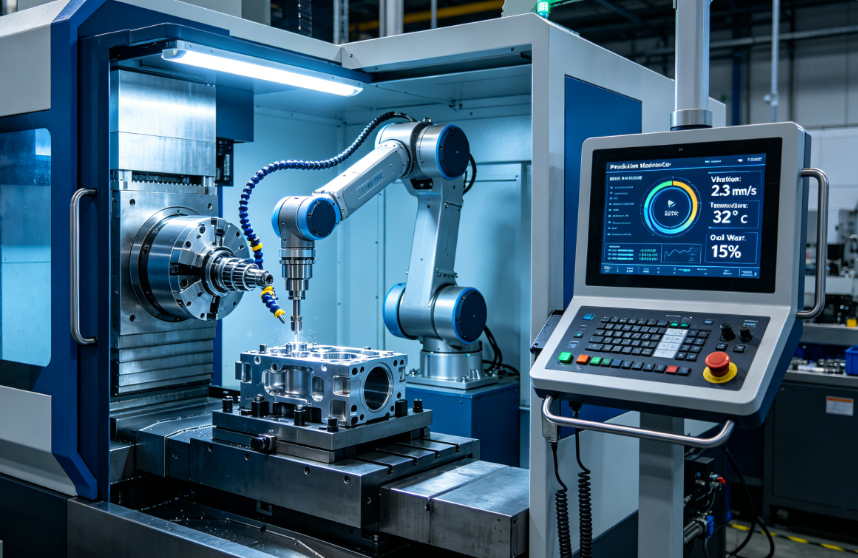
Add basic IIoT vibration/temp sensors on spindles for high-volume machines to predict bearing wear weeks before failure.
Strategy 6: Unify CAM, Engineering & Shop Floor Digital Workflows
Break down silos between programmers and machinists to eliminate on-machine code editing downtime:
- Mandate full Vericut simulation for all new programs before sending to the shop floor
- Build a shared cloud library of proven cutting parameters, fixture layouts and zero offsets
- Assign a night-shift engineering on-call to resolve program errors without halting full cells
- Document all successful process tweaks digitally so new operators don’t waste time testing parameters
Strategy 7: Track OEE Weekly to Quantify Hidden Time Wins
Install basic machine monitoring software to capture spindle-on runtime, cycle counts and idle events automatically.
- Post live OEE dashboards visible to every operator and supervisor
- Set monthly incremental OEE targets (5–8% gain per month) focused on hidden downtime reduction
- Run monthly Pareto analysis to isolate the top 2–3 idle time causes and prioritize improvement sprints
Zorapid Real-World Case Study: Hidden Downtime Reduction for EV Component CNC Cell
A European EV tier-1 supplier partnered with Zorapid to audit their 4-VMC machining cell producing aluminum motor housings.
Original Hidden Downtime Pain Points
- Unstructured changeovers averaging 72 mins, all setup work done on-machine
- 40+ repeated coolant/air pressure micro-alarms logged daily, no root-cause fixes
- No offline tool presetting; all offset probing ran while spindles sat idle
- Material delivery lagged batch completion by 20–30 mins every cycle
Zorapid Implemented Fixes
- Full SMED overhaul with offline prep stations and zero-point pallets
- Tiered daily/weekly maintenance checklist for all four machines
- Offline tool presetters and standardized tool life tracking sheets
- Scheduled material kitting aligned to batch finish timelines
Measurable Outcomes After 6 Weeks
- Total hidden downtime reduced by 41% across the cell
- OEE climbed from 58% to 76%
- Monthly finished part output increased by 32% without purchasing new CNC equipment
- Emergency tool regrind downtime dropped by 68%
Common Mistakes Shops Make When Tackling Hidden Downtime
Avoid these costly missteps that stall your improvement progress:
- Only tracking major breakdowns, ignoring all short micro-stops
- Treating maintenance as low-priority work that gets pushed aside for production
- Attempting full plant-wide overhauls at once instead of piloting one cell first
- Skipping digital logging and relying on operator memory to estimate idle time
- Separating CAM programming from shop floor feedback, leading to untested G-code
- Understocking critical spare tools, sensors and filter parts
- Normalizing repeated alarms as just how this machine runs
FAQ
How much hidden downtime does the average CNC workshop lose every month?
Most mid-sized job shops lose 30–45% of planned production time to unlogged hidden idle events. For a 10-machine facility running two shifts, this equals hundreds of lost machining hours monthly—equivalent to leaving 3–4 CNC machines fully idle each week.
Do I need expensive Industry 4.0 software to track hidden downtime?
No. You can start with simple touchscreen downtime tags, printed operator logging sheets and weekly manual OEE tracking before investing in full machine monitoring platforms. Small, consistent process changes deliver bigger ROI than costly software alone.
How long until I see tangible spindle time gains after implementing these strategies?
SMED setup improvements and micro-stop logging deliver visible gains within 1–2 weeks. Full maintenance and tool management workflows hit peak efficiency in 4–6 weeks, with permanent OEE lifts lasting long-term.
Can hidden downtime be eliminated completely, or just reduced?
Full elimination is unrealistic, but Zorapid’s client data shows structured process fixes cut hidden idle time by 35–50% on average, massively boosting throughput and part margins without capital equipment spends.
Final Wrap-Up
Major machine breakdowns grab all the attention, but hidden downtime is the quiet profit killer draining your CNC workshop’s capacity. Every unlogged micro-stop, slow changeover, ignored alarm and waiting period chips away at your spindle-on time, delivery reliability and customer trust.
The good news? All these hidden losses stem from fixable process gaps, not faulty machinery. By rolling out SMED, tiered preventive maintenance, structured tool management and real-time idle time tracking, you unlock massive extra production capacity from your existing CNC equipment.
At Zorapid, we build downtime reduction, standardized setup workflows and predictive maintenance into our full NPI and precision machining service for global OEMs. If your workshop struggles with untraced idle time and stagnant OEE, reach out to our production engineering team for a free hidden downtime audit today.