
Bridge the Gap From Prototype to Production – Global delivery in 10 days or less
Vacuum Casting Services
We offer metal & urethane vacuum casting. All processes run in sealed vacuum to eliminate air impurities. One-stop service: molds, casting, finishing, testing & delivery.
- 100+ Prototype Molding
- Million+ Production Molding
- Over 100 thermoplastics
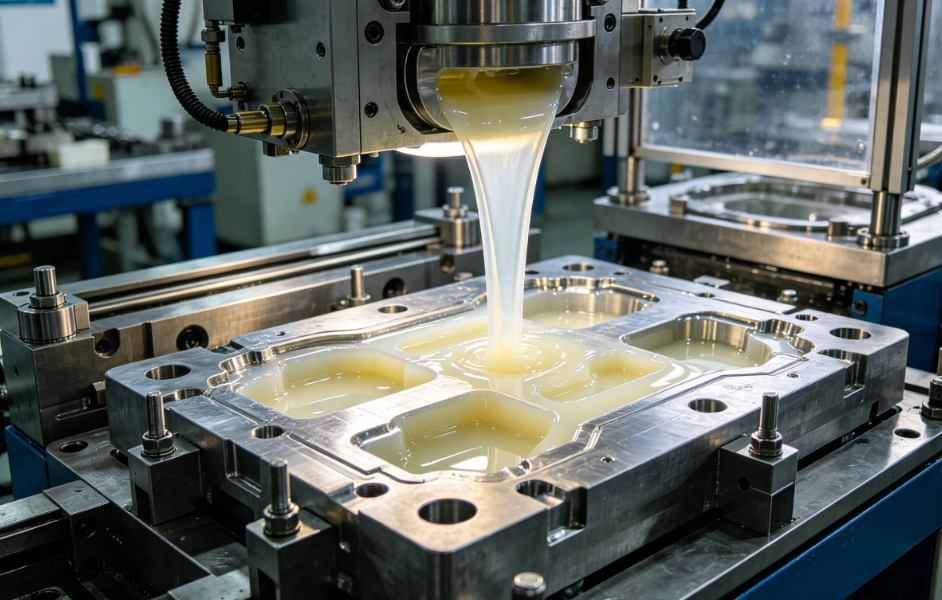
How Does Urethane Casting Work?
he urethane casting process involves three key stages: master pattern creation, mold preparation, and casting.
1:Master Pattern Development
Urethane casting precision and finish depend directly on master model quality. Choose CNC for tight tolerance, glossy and clear parts; SLA 3D print for complex intricate shapes. We apply textures and satin finishes to match final look. Silicone molds replicate all details perfectly, saving extra post-processing work.
2:Silicone Mold Production
Durable high-performance RTV silicone molds feature low shrinkage and high detail replication. Mold making includes:
- Fix master model in box, set gates & vents for smooth resin flow.
- Add parting tape for easy mold split after curing.
- Vacuum pour silicone, cure 8-16hrs at 40°C for stable molds
3:Urethane Casting Process
We follow strict quality guidelines to guarantee consistent, high-performance urethane parts. The process involves:
- Preheat molds 60-70°C for fluent resin flow.
- Vacuum blend PU resin at 40°C briefly to avoid bubbles.
- Oven cure resin 1-6 hours as needed.
Focus on high-density, high-precision and high-purity castings
What is vacuum casting?
Vacuum casting is a precision casting technology that realizes metal smelting, pouring and solidification under vacuum or negative pressure. Its core advantages lie in air isolation, elimination of oxidation and porosity, as well as improved mold filling capacity and material density.
Core principle
Vacuum castingis a high-precision process.We make silicone molds from 3D printed masters, then inject PU resin in vacuum.Vacuum eliminates bubbles for solid, flawless finished parts.It matches injection molding strength and surface finish with faster lead times and lower costs, perfect for prototypes and low-volume durable parts.
Key advantages
Zorapid vacuum casting ensures low ±0.1% shrinkage and high precision for parts up to 25 inches. It fits complex shapes and works with clear, flexible, heat-resistant PU materials. We embed metal threads & sensors, plus offer UV coating and textured finishing to meet all your needs.
Typical applications
Zorapid vacuum casting eases prototype to mid-volume production, cutting high injection mold costs and long lead times. Fast delivery plus strict quality control deliver affordable production-grade parts for automotive, consumer electronics and more.
Application Guide for Urethane Casting
Best for low-volume manufacturing: 1–50 pieces per mold.
Cost-effective for pre-production prototypes and small-batch orders. Not economical for mass production.
Typical Accuracy
Standard tolerance: ±0.15 mm per 100 mm
High-precision control: ±0.05 mm for tolerance-critical components
ilicone Mold Lifespan
Standard silicone molds: 15–20 quality parts
Complex/clear urethane parts: 10–12 parts per mold
Standard Lead Time
Fast turnaround: 50 parts delivered in 7–10 daysLead time varies.
With part complexity and batch volume.
Surface Finishes
Full range of finishes: color matching, surface textures, gloss or matte coating, insert molding, overmolding, and optically clear polishing.
Maximum Part Dimensions
Maximum mold dimensions: 1.8m × 1.0m × 0.8m. Perfect for large‑format prototypes and high‑performance functional parts.
Minimum Wall Thickness
Recommended wall thickness: 1.5mm–2.5mm. Minimum achievable thickness: 0.6mm for thin and detailed features.
Why Vacuum Casting is Better
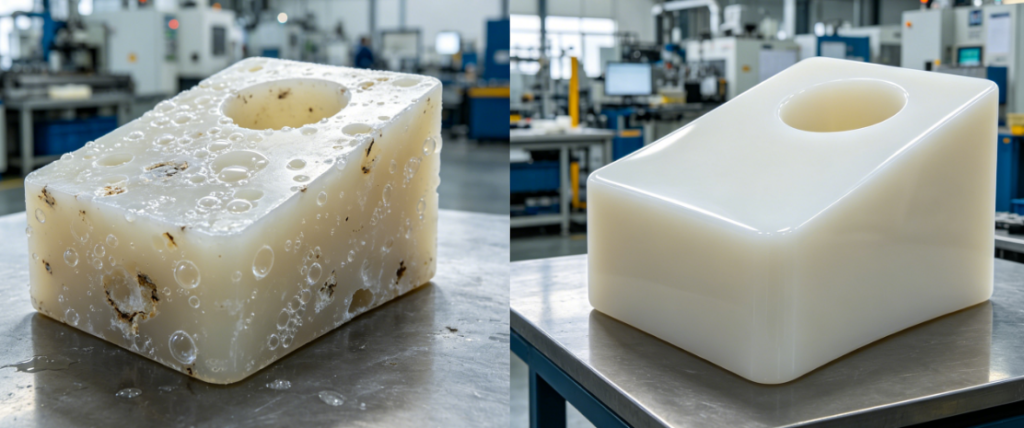
The vacuum environment completely removes trapped air. This eliminates bubbles, voids and porosity inside urethane parts. Components achieve dense structure and smooth surfaces equivalent to injection molding, which ordinary open casting cannot match.
High Precision and Detail Replication
We deliver production-grade precision on complex shapes and micro-details. Our casting holds tight tolerances, with consistent performance in lab tests and field use.
Superior Surface Finishes
Our urethane casting delivers crisp details and flawless surfaces with minimal post-finishing. It cuts time and cost vs. CNC and 3D printing for both prototype display and functional parts.
Cost-Effective Silicone Molds
Urethane casting employs affordable silicone molds instead of costly metal tooling, enabling fast, accurate production of functional prototypes and low-volume end-use parts with minimal upfront cost.
Rapid Turnaround Times
Achieve fast lead times of 10–15 days for up to 50 functional urethane parts, enabling faster validation and shorter time-to-market for your prototypes and low-volume production runs.
Diverse Material Options
Benefit from a broad portfolio of polyurethane materials, such as flexible, rigid, impact-resistant, and optically clear options, formulated to achieve realistic functional and mechanical properties.
Typical Uses for Vacuum Casting
Vacuum casting is widely applied to make functional prototypes and low-volume batches for automotive interiors, electronic housings, medical fixtures, aerospace test parts and custom plastic & rubber components.
Automotive Industry
Interior trim, instrument panel housings, decorative covers and custom automotive spare parts.
Medical Equipment
Non-sterile instrument shells, testing fixtures and custom medical device housings with food-safe resin options.
Consumer Electronics
Phone accessories, device casings, Bluetooth housings and cosmetic enclosures with fine surface details.
Industrial Hardware
Custom jigs, inspection fixtures, soft gaskets, bumpers and elastic rubber components.
Toys & Consumer Goods
High-detail figurines, transparent parts and custom plastic merchandise with complex contours.
Aerospace R&D Parts
Lightweight test components used for lab testing without expensive tooling investment.
Why Choose Zorapid for Vacuum Casting?
- Zero bubble control: Full vacuum processing eliminates internal porosity and surface blemishes.
- Strict dimensional accuracy:We hold tolerance within ±0.05mm for most small precision components.
- Low tooling cost:Silicone molds cost 75% less than aluminum or steel injection tooling.
- Fast turnaround:We finish mold making and casting within 3–7 working days. No long waiting time for prototype verification.
- Complex geometry support:Deep undercuts, thin walls and intricate textures can be fully replicated.
- Complete post finishing:Every batch gets dimensional inspection before delivery.
FAQ
Why should I choose vacuum casting over other methods?
How many times can you use the silicone mold?
What’s the minimum order? Can I just get 1 piece?
Lorem ipsum dolor sit amet, consectetur adipiscing elit. Ut elit tellus, luctus nec ullamcorper mattis, pulvinar dapibus leo.