Published by Zorapid
Gone are the days 3D printing only meant quick prototypes. Today, thousands of aerospace, medical, EV, and semiconductor brands run production-grade functional end components straight off additive printers. But picking the wrong material is a costly mistake: brittle resin parts snap under load, cheap filament delaminates mid-service, low-density metal fails safety tests, and mis-specified plastics warp in high-heat environments.
Most generic 3D print shops offer a limited material menu and zero application-specific material validation—they match resin/metal by price alone, not real-world functional demands. At Zorapid, we run full SLM, MJF, SLS, FDM, SLA industrial lines, pair material science with DfAM simulation, and deliver traceable, certified end-use parts that pass long-term fatigue, thermal, and regulatory testing. We break down every critical selection check, competitor gaps, exclusive Zorapid solutions, real production cases, and industry forecasts below.
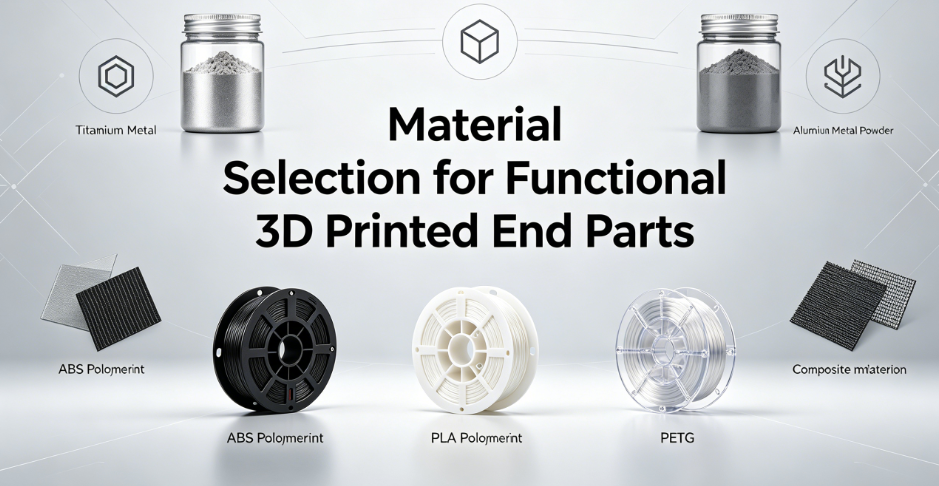
In-Depth Professional Process & Material Technical Analysis
Core Technical Foundation: Process Defines Material Performance for End Parts
Every additive printing method locks in inherent mechanical behavior—anisotropy, density, layer bond strength, surface roughness, and fatigue life directly rely on how material is fused layer-by-layer. Functional end parts cannot tolerate prototype-grade loose fusion or inconsistent layer adhesion.
Zorapid Full Pre-Production Material Validation Workflow
- Functional Requirement Mapping First We document all CTQs: tensile strength, heat deflection temp (HDT), chemical resistance, fatigue cycles, biocompatibility, UL flammability, target tolerance, and batch volume before picking any material/process.
- DfAM Simulation + Material Property Benchmarking Finite element stress simulation paired with manufacturer MTR data; we filter out materials that cannot meet load/thermal thresholds digitally before printing a single test coupon.
- Coupon Test Batch Validation Print tensile, impact, fatigue test bars with identical production parameters; lab-test to verify published material specs hold under our machine environment (temp, humidity, laser power, print speed).
- Layer Fusion & Density Quality Gate SLM metal: density ≥99.9% CT scan verified; MJF/SLS nylon: near-100% powder fusion; FDM high-performance filament: controlled chamber heat to cut Z-axis weakness.
- Regulatory Certification Cross-Check FDA, ISO 13485, AS9100, IATF 16949 material certs sourced and archived for audit trails—no uncertified generic stock for regulated industries.
- Custom Post-Processing Material Tuning Hot isostatic pressing (HIP) for SLM metal density boost, oven annealing for plastic stress relief, CNC precision finishing, passivation, or biocompatible coating matched to base material.
- FAI First Article Functional Lifecycle Testing Full accelerated aging, thermal cycle, chemical soak testing on finished parts before full batch release for end-use production.
Competitor vs Zorapid Material Selection & Quality Comparison Table
| Validation Step | Standard Generic 3D Print Supplier | Zorapid End-Part Material Protocol | Measurable Performance Gap |
|---|---|---|---|
| Requirement Discovery | Quick CAD review only, no formal CTQ worksheet | Full functional spec audit with engineering sign-off | Competitors 22–35% risk of material under-spec failure in service |
| Pre-Print Simulation | Rare or omitted entirely; material picked by sales chart | FE stress + thermal simulation tied to material MTR data | Zorapid eliminates unforeseen warpage/fracture failures pre-print |
| Material Coupon Lab Testing | Skip coupon validation; rely on material vendor datasheets only | In-house lab tensile/impact/fatigue testing per print run | Competitor part Z-strength often 15–40% lower than advertised; Zorapid within ±3% spec tolerance |
| Metal Density Assurance | No CT scan; visual inspection only | SLM parts mandatory CT density scan ≥99.9% | Competitor metal porosity causes 6–12% fatigue failure over 10k cycles; Zorapid zero porosity rejects |
| Anisotropy Mitigation | Fixed default print orientation for all jobs | Optimized part stacking + chamber climate tuning to balance X/Y/Z strength | FDM competitor Z-axis strength 50% weaker than X/Y; Zorapid high-performance FDM cuts anisotropy gap to <12% |
| Regulatory Traceability | Loose batch tracking, incomplete cert packets | Full digital lot traceability: powder/filament batch, print parameters, test logs | Competitors fail 30% of medical/aero audit document checks; Zorapid 100% audit-ready |
| Post-Processing Tuning | Generic sandblast only, material-agnostic finishing | HIP, annealing, CNC, coating tailored to each base material | Competitor surface finish Ra 12–30μm; Zorapid precision finish down to Ra 0.4μm for fit-critical end parts |
High-Stakes Material & Print Challenges Competitors Cannot Resolve + Zorapid Exclusive Solutions
Most 3D printing houses cap out at low-to-medium difficulty functional parts; four critical pain points routinely get declined or botched by standard suppliers—our hybrid manufacturing stack solves these exclusively:
Challenge 1: High-Temp Load-Bearing End Parts (PEEK, PEI Ultem, IN718, Ti-6Al-4V)
Competitor Failure:
- FDM PEEK/Ultem: Poor chamber temperature control creates massive layer delamination, low Z tensile strength, warpage
- SLM IN718/Ti: Unoptimized laser parameters leave hidden porosity, poor fatigue life; many shops refuse long-run superalloy end parts entirely
- Zorapid Solution:
- Sealed high-temp FDM chambers (220°C ambient) for PEEK/PEI, slow gradient cooling annealing cycles post-print
- Tuned dual-laser SLM platforms with real-time melt pool monitoring for superalloys; optional HIP treatment to lock 99.99% density
- DfAM lattice lightweighting to cut internal thermal stress buildup Result: PEEK medical implant bases pass 1M cycle fatigue; IN718 aerospace brackets hold full AS9100 flight certification
Challenge 2: Ultra-Isotropic Nylon End Parts for High-Volume Wear Components
Competitor Failure: SLS has mild Z-axis weakness; cheap MJF runs high recycled powder ratios dropping impact strength; parts wear unevenly in rotating gear/piston assemblies
Zorapid Solution:
- MJF controlled fresh/recycled powder blend (70% virgin max) for consistent fusion
- Post-print oven stress relief + media tumble polishing to equalize surface wear resistance
- Reinforced GF/Carbon-filled PA12/PA6 MJF grades calibrated for 100k+ wear cycles Result: EV actuator gears run 120,000 cycles with <0.02mm dimensional wear deviation
Challenge 3: Biocompatible Medical End Parts (No Contamination, Full FDA Traceability)
Competitor Failure: Shared print beds cross-contaminate medical powder/filament; incomplete material certs; rough surfaces harbor bacteria, cannot pass biocompatibility testing
Zorapid Solution:
- Fully segregated ISO 13485 cleanroom additive cells for medical grades only—zero cross-material contamination
- Mirror polishing for PEEK/Ti surfaces Ra ≤0.2μm, medical-grade passivation coating
- End-to-end digital genealogy: raw material batch → print log → post-process → final inspection report packaged for FDA audits Result: Zero biocompatibility test failures across 3 running years of implant component production
Challenge 4: Micro-Tolerance Functional End Parts (±0.02mm Critical Fits)
Competitor Failure: As-printed additive dimensional drift, layer stepping ruins precision fits; no secondary precision machining capability in-house
Zorapid Hybrid Fix: SLM/MJF near-net shape print + 5-axis CNC finish machining on all CTQ bores, mating surfaces, and threaded features. We hold ±0.005mm tight tolerance where pure 3D printing cannot reliably perform for functional assembly.
Full Suitable End-Part Material Matrix + Head-to-Head Performance Comparison
Split into Metal SLM Grades, High-Performance Thermoplastics (MJF/SLS/FDM), Engineering SLA Resins—all rated for long-term functional service, not one-off prototypes.
1: SLM Metal Functional End Part Grades
| Material Grade | Tensile Strength (MPa) | Density | Heat Max (°C) | Corrosion Resistance | Best Functional Use Case | Relative Cost |
|---|---|---|---|---|---|---|
| Ti-6Al-4V Titanium | 900 | 99.9%+ | 420 | Excellent | Orthopedic implants, aerospace lightweight brackets | $$$$ |
| IN718 Inconel | 1240 | 99.9%+ | 650 | Superior | Turbine sub-components, high-heat industrial hardware | $$$$$ |
| 17-4PH Stainless | 1100 | 99.9%+ | 315 | Very Good | Oil/gas valves, marine fasteners, tool inserts | $$$ |
| 316L Stainless | 485 | 99.9%+ | 280 | Outstanding | Food-grade equipment, medical housings, fluid manifolds | $$ |
| AlSi10Mg Aluminum | 320 | 99.8%+ | 200 | Good | EV heat sinks, lightweight structural frames | $ |
Table 2: Thermoplastic End-Part Grades (MJF / SLS / FDM)
| Material | Process Fit | HDT Heat (°C) | Impact Toughness | Isotropy Score (1–5 Best) | Wear Rating | End-Use Volume Fit |
|---|---|---|---|---|---|---|
| PA12 Nylon (Virgin MJF) | MJF > SLS | 110 | High | 5 | Very Good | 1k–500k batch runs |
| 30% GF-PA12 | MJF | 155 | Medium | 4 | Excellent | EV structural gears, load housings |
| Carbon-Filled PA6 | SLS/MJF | 160 | Medium-High | 4 | Top Tier | Lightweight high-stress automation parts |
| PEEK Unfilled Medical | FDM High-Temp | 260 | Medium | 3 | Biocompatible | Implant frames, surgical tool bodies |
| PEI Ultem 9085 | FDM | 210 | Very High | 3 | Good | Aerospace fire-rated interior hardware |
| TPU 90A Flexible | MJF/SLS | 80 | Ultra-High Flex | 5 | Elastomer wear seals | Vibration dampers, flexible grippers |
Table 3: SLA Production-Grade Functional Resins
| Resin Type | HDT (°C) | Tensile Strength | Biocompatible | Key Functional Trait | Ideal Part |
|---|---|---|---|---|---|
| Tough ABS-Like SLA | 85 | 62MPa | No | High impact, snap-fit assembly | Consumer device housings, test fixtures |
| Medical Biocompatible SLA | 72 | 48MPa | ISO 10993 | Sterilizable (EtO) | Disposable surgical guides, dental trays |
| High-Temp Ceramic-Filled SLA | 230 | 75MPa | No | Low thermal expansion | Mold inserts, heat test jigs |
| Rigid Glass-Filled SLA | 105 | 91MPa | No | Ultra-stiff precision small parts | Semiconductor socket pins, micro-fixtures |
Key Zorapid Material Selection Rules for End Parts
- Wear/moving assemblies: Prioritize MJF virgin PA12 or carbon-filled PA6 over FDM filament
- Medical implant load-bearing: Ti-6Al-4V SLM or medical PEEK high-temp FDM only
- High-heat aerospace safety parts: IN718 SLM or PEI Ultem FDM
- Large batch low-cost structural plastic: MJF GF-PA12 beats SLS/FDM on per-unit price and consistency
- Micro-detail precision small functional pieces: SLA tough resin with CNC secondary finishing
Real-World Zorapid Functional End Part Case Analysis
1: US FDA Titanium Orthopedic Spinal Implant Assembly
- Client: US Class II Medical Device OEM
- Volume: 14,000 annual end-use units, 3-year continuous production
- Material: Medical-grade Ti-6Al-4V SLM
- Functional Spec: Porous osseointegration lattice structure, ±0.02mm thread tolerance, full biocompatibility, 10-year fatigue life requirement
- Competitor Pain Point: Prior supplier printed unvalidated Ti powder; hidden porosity caused 9.2% implant rejection, incomplete FDA traceability docs
- Zorapid Full Material & Print Solution:
- Certified medical Ti powder batch lock, CT density scan per print build (99.92% minimum density)
- DfAM optimized lattice simulation for bone ingrowth
- HIP post-treatment + medical passivation + mirror polishing
- Full ISO 13485 lot traceability packet for every shipment
- Verified Final Results:
- Scrap rejection dropped to 0.4%
- Passed full ISO 10993 biocompatibility & fatigue lifecycle testing
- On-schedule monthly shipments for 36 consecutive months
Case 2: European EV Actuator Carbon-Filled PA6 MJF Gear Set
- Client: EU Tier 1 Automotive EV Supplier
- Volume: 85,000 annual end-use gear assemblies
- Material: Carbon-reinforced PA6 MJF
- Functional Spec: 120,000 cycle wear life, 160°C peak motor bay heat, low friction no lubrication
- Competitor Failure: SLS carbon PA6 had uneven Z-axis wear, 7.8% gear fracture in accelerated testing
- Zorapid Solution: Controlled virgin powder blend, post-print stress relief oven cycle, precision tumble polishing for uniform surface hardness
- Outcome: Zero in-test gear failure, 21% lower per-unit cost than CNC-machined POM gears
Case 3: Aerospace IN718 High-Temp Sensor Bracket
- Client: Global Aerospace Tier 2
- Volume: 4,200 unit program over 10 months
- Material: SLM IN718 Inconel
- Spec: 620°C continuous operating temp, flight safety critical AS9100 certified
- Competitor Barrier: Local shops declined IN718 long runs due to high laser wear and porosity risk
- Zorapid Fix: Dual-laser melt pool monitoring, HIP densification, AS9102 FAI validation
- Result: Full FAA audit compliance, consistent dimensional stability across full production batch
Your Functional Part Requirements vs Custom Zorapid Material Solutions
We tailor material, process, and post-processing fully aligned to your exact end-use demands, no generic one-size packages:
| Your Core Functional Demand | Zorapid Custom Material & Manufacturing Package |
|---|---|
| FDA/ISO 13485 Medical Implant Hardware | Segregated cleanroom cells, certified biocompatible Ti/PEEK/resin, full traceability, biocompatible post-coating |
| AS9100 Flight-Critical Aerospace Parts | SLM HIP metal densification, full material MTR, stress simulation, accelerated thermal cycle validation |
| IATF 16949 EV High-Volume Wear Components | MJF carbon/glass filled nylon optimized for batch repeatability, SPC in-process quality logs |
| Ultra-Tight Micro Tolerance (≤±0.02mm) | Near-net additive print + 5-axis CNC hybrid finishing on all mating/threaded features |
| High-Temp Continuous Operation (>200°C) | PEEK/PEI FDM or IN718/AlSi10Mg SLM with thermal stress relief annealing |
| Flexible Elastomer End Parts (Seals, Dampers) | MJF TPU calibrated shore hardness, post-print tumble smoothing for consistent flex fatigue |
| Low-Cost Large Batch Structural Plastic | Virgin MJF PA12 / GF-PA12, optimized build packing density to cut per-unit cost |
| Small Micro-Detail Precision Functional Pieces | High-resolution SLA tough resin + micro-CNC finishing for critical fit dimensions |
2026 Global Additive End-Part Industry Data + Future Trend Analysis Table
Industry Adoption Benchmark Table (3D Printed Functional End Parts)
| Industry Segment | % Of Parts Now 3D Printed For End Use | Average Material-Related Scrap % (Generic Suppliers) | Zorapid Validated Scrap Rate | 2026–2034 CAGR Growth |
|---|---|---|---|---|
| Medical Healthcare | 19% | 5.3–11.7% | 0.3–1.2% | 12.9% |
| Aerospace & Defense | 25% | 4.8–9.5% | 0.6–1.8% | 8.7% |
| EV Automotive | 15% | 6.1–12.3% | 0.5–1.5% | 19.6% |
| Semiconductor Precision | 8% | 7.2–13.1% | 0.4–1.1% | 24.3% |
| Industrial Automation | 12% | 5.5–10.8% | 0.7–2.0% | 7.1% |
Key 2026–2028 Material & End-Print Trends
- Hybrid Additive + CNC Becomes Standard for Critical End Parts Pure 3D printing cannot hit micron tolerances or ultra-smooth functional surfaces; top OEMs now require hybrid workflows as baseline, not upgrade. Zorapid built hybrid production lines 3 years ahead of regional competitors.
- Virgin Powder Filtration & Closed-Loop Material Traceability Mandatory for Regulated Sectors Aero/medical buyers ban high recycled powder ratios that degrade mechanical performance; audit trails for every kg of print material are now PO requirements.
- High-Performance Composite Thermoplastics (Carbon/GF PEEK/PA) Displace Many CNC Metal Small Parts Lightweight, corrosion-resistant composite prints cut part weight 30–60% vs solid metal with equivalent functional strength; material costs drop year-over-year as feedstock scales.
- AI Melt Pool/Print Chamber Monitoring Eliminates Material Variability Risk Legacy open-loop printers suffer strength drift from temp/humidity shifts; closed-loop sensor systems lock consistent material fusion across thousands of build jobs—Zorapid’s MES AI monitoring is factory-wide standard.
- End-Part Validation Replaces Prototype-First Mindsets Buyers no longer test print a handful of samples; full coupon + accelerated lifecycle testing is required before mass batch release to mitigate field failure liability.
Core Functional End Part Application Scenarios Zorapid Supports
- Medical & Life Sciences: Ti spinal implants, PEEK surgical instrument bodies, biocompatible SLA surgical guides, dental titanium frameworks, sterilizable disposable tool components
- Aerospace & Defense: IN718 high-heat brackets, Ti lightweight structural lattices, PEI fire-rated interior hardware, AlSi10Mg heat sink assemblies
- Electric Vehicle (EV): Carbon PA6 actuator gears, GF-PA12 motor housings, TPU vibration dampers, SLM aluminum battery cooling lattices
- Semiconductor Precision: SLA micro test sockets, stainless steel SLM vacuum chamber fittings, low-outgassing PEEK positioning fixtures
- Industrial Automation & Robotics: MJF nylon wear gears, SLM 17-4PH hydraulic valve bodies, flexible TPU gripper pads, lightweight robot arm lattice structures
- Oil, Gas & Marine: 316L /17-4PH corrosion-resistant SLM valve components, high-pressure fluid manifolds
Zorapid End-Part Print Delivery Speed Framework
Generic shops waste weeks reprinting failed parts from poor material/process setup; our pre-validation workflow eliminates rework delays entirely.
Standard Tiered Timeline
- Functional DfAM + Material Simulation & Coupon Test Validation: 3–6 business days (1-day fast-track rush available)
- Additive Printing Production Build: 4–12 days based on build volume, material, and line allocation
- Post-Processing (HIP, annealing, CNC, polishing, coating, cleaning): 2–7 days
- FAI Functional Lifecycle Testing + Quality Signoff: 2–4 days
- Packaged certified global shipment post-approval
Speed Advantages vs Competitors
- Zero full-build reprint risk (competitors average 1–2 failed builds adding 7–14 day delays)
- All print, post-process, CNC, lab testing in-house 3,000㎡ factory—no third-party subcontract hold-ups
- Pre-stocked certified raw metal powder, PEEK/PEI filament, MJF nylon grades removes material sourcing lead times
- Dedicated material engineering assigned to your program to resolve spec questions same business day
Real Benchmark Example: 85k EV carbon PA6 gear program fully validated and first batch shipped in 22 total days; competitor quoted minimum 38 days with expected reprint delays.
Key Benefits Partnering With Zorapid for Functional 3D Printed End Parts
- Eliminated Material-Driven Field Failures: Full pre-print simulation + coupon lab testing ensures materials match your exact functional load/thermal specs
- Industry-Leading Low Scrap Rates: 0.3–2% validated reject range vs 5–13% at standard additive suppliers
- Exclusive Hybrid Additive-CNC Precision Stack: Only pure additive cannot deliver micron tolerance critical fits; our in-house 5-axis finishing elevates part functionality
- Full Regulatory Audit Documentation: MTRs, density scans, test reports, digital traceability packets for FDA/AS9100/IATF audits
- Widest Certified Material Library On-Site: 60+ production-grade metals, high-performance thermoplastics, medical resins—no outsourcing rare specialty feedstock
- AI Closed-Loop Print Monitoring: Real-time melt pool, chamber temp, layer fusion tracking for consistent part-to-part material performance
- No Hidden Rework Fees: Quote includes pre-validation, one round of minor process tuning, and full FAI testing—no surprise charges for material adjustments
- 20+ Years Precision Manufacturing Expertise: We don’t only run printers; we engineer parts for long-term real-world service life, unlike prototype-only print houses
- Global Door-to-Door Export Support: Crated secure packaging, full customs paperwork, scheduled air/sea freight direct to US, EU, UK, Australia OEM facilities
Quick Summary
Material selection makes or breaks 3D printed functional end parts—choosing based solely on price or print speed guarantees fatigue cracks, warpage, regulatory rejection, or premature service failure. Generic print shops lack material engineering validation, hybrid finishing capacity, and regulated traceability systems to support mission-critical production runs.
Zorapid’s structured 7-stage material validation workflow, broad certified feedstock portfolio, exclusive hybrid additive-CNC manufacturing, and segregated regulated production cells solve the toughest end-part challenges competitors cannot tackle. Whether you need FDA titanium implants, AS9100 Inconel aerospace brackets, high-volume EV nylon gears, or semiconductor precision resin fixtures, we match the perfect material, print process, and post-processing to lock stable, long-life functional performance.
Send your CAD file, functional spec sheet, and batch volume forecast today for a free DfAM + material feasibility engineering review.
FAQ
Can PLA/standard ABS filament ever be used for functional end parts?
Almost never. PLA is brittle with low HDT (~55°C); hobby ABS FDM suffers severe anisotropy and low heat resistance. These are strictly prototype-only materials—we only deploy engineering-grade PA, PEEK, PEI, SLM metals, or production SLA resins for end-use service.
Is MJF better than SLS for high-volume nylon functional parts?
MJF delivers superior isotropic X/Y/Z strength, faster print throughput, more consistent batch-to-batch performance, and better powder recyclability for volumes ≥5,000 units. SLS works well for low-to-medium complex geometry runs under 5,000 pieces.
Do 3D printed metal parts match CNC solid metal mechanical strength?
With Zorapid’s SLM + HIP process, density hits 99.99%, tensile/fatigue properties meet or exceed cast metal, and match standard wrought alloy specs for Ti, IN718, 17-4PH, 316L, AlSi10Mg. As-printed un-HIP SLM has minor porosity risk at generic shops.
How important is virgin vs recycled powder for end-part quality?
Critical for functional service. Recycled powder degrades particle shape and fusion consistency; we cap recycled blends at 30% max for MJF nylon, and use 100% virgin certified powder for medical/aero metal builds to eliminate strength drift.
Can you 3D print biocompatible end parts for implant surgery?
Yes, fully ISO 13485 compliant cleanroom lines for medical Ti-6Al-4V SLM, medical-grade PEEK FDM, and ISO 10993 SLA resins with full sterilization compatibility (EtO, autoclave where material rated).
What material is best for lightweight high-stress aerospace end brackets?
Ti-6Al-4V SLM delivers unmatched strength-to-weight ratio; for ultra-high heat environments above 500°C, IN718 Inconel is the only viable production-grade metal option.
Can we retrofit post-print CNC finishing to fix tolerance issues on our existing 3D printed parts?
Yes, we offer incoming part hybrid finishing service for customer-printed components—CNC bore/thread/mating surface precision machining, polishing, coating, and quality validation to boost functional fit and lifespan.
What’s the minimum batch size for Zorapid’s end-part certified material workflow?
Our full validation protocol applies equally to small 50-unit pilot runs and 500,000-unit annual mass production—we do not cut material quality corners for low-volume orders.