Published by Zorapid
If you design surgical instrument drivers, catheter mandrels, bone drill shafts, endoscopic pins or implant guide pins, small-diameter medical shafts are the backbone of your device build. Most of these critical parts hit Ø0.5mm–12mm with extreme length-to-diameter ratios up to 15:1, plus micron-level concentricity and zero sharp burr rules required for biocompatibility and sterilization.
Standard fixed-head CNC lathes fail hard on these slender micro shafts. Unsupported bar stock deflects nonstop, creates chatter ripples, generates heavy burrs, and can’t hit consistent ±0.003mm runout across high-volume batches. That’s where Swiss-type sliding head lathes dominate medical production.
At Zorapid, we run a dedicated medical-grade Swiss turning cell built exclusively for biocompatible micro shafts, fully ISO 13485 compliant with full material traceability and cleanroom finishing workflows. We’ve solved every common pain point: micro deflection, stainless steel built-up edge (BUE), cutoff burrs, uneven surface finish and post-machining dimensional drift during passivation.
This guide cuts dense textbook metallurgy out entirely. We break down how Swiss sliding head machines eliminate shaft deflection, share medical-grade tool selection rules, standardized SFM/feed data for 316L, Ti-6Al-4V and 17-4PH, critical DFM design tweaks, and our proven burr-free finishing process for implant-grade micro shafts. Every tip comes from thousands of validated medical production runs on our multi-axis Swiss lathes with sub-spindle live tooling.
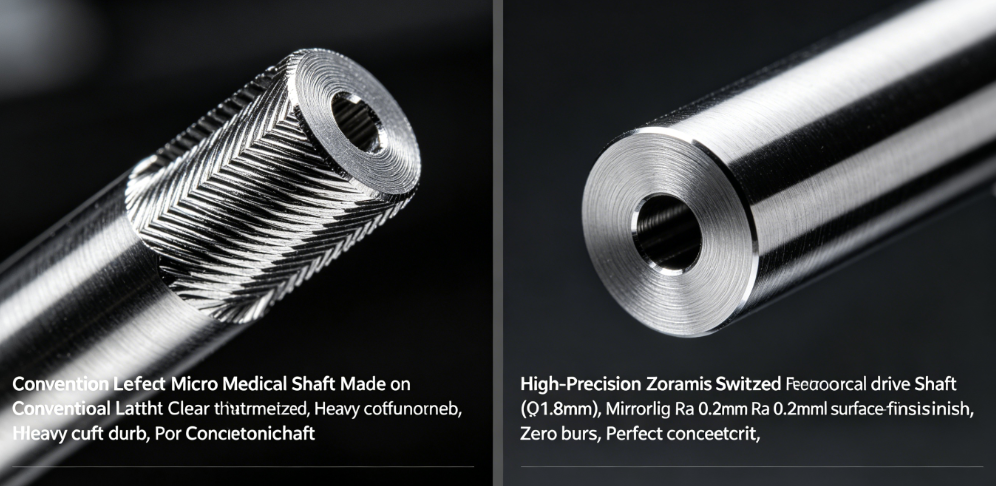
Why Swiss-Type Turning Is The Only Choice For Tiny Medical Shafts
Before diving into cutting parameters, let’s cover the core mechanical advantage that makes Swiss machines irreplaceable for slender micro medical components: the sliding headstock + precision guide bushing system.
How Swiss Lathes Eliminate Micro Shaft Deflection
- Bar stock feeds fully through a carbide guide bushing positioned within 1–5mm of the cutting edge. The bushing supports the thin shaft right where material removal happens—no long unsupported cantilever like standard lathes.
- Headstock slides along Z-axis to advance bar, tools stay stationary; opposite workflow of fixed-head turning.
- Built-in sub-spindle automatically picks off finished shafts for backworking cross-holes, end features and cutoff cleanup without manual re-chucking (single-setup complete machining).
Key Performance Benchmarks For Medical Shafts
| Metric | Swiss-Type CNC Turning | Standard Fixed-Head Lathe | Medical Benefit |
|---|---|---|---|
| Max stable L/D ratio | 15:1–20:1 | Max 4:1 with follow rest | Manufacture ultra-slender catheter & endoscopic shafts |
| Standard dimensional tolerance | ±0.002–±0.005mm | ±0.010–±0.015mm | Hit implant critical fit specs without secondary grinding |
| Typical surface finish | Ra 0.15–0.4μm | Ra 1.2–3.2μm | Smooth surfaces resist bacterial buildup during sterilization |
| Runout repeatability | <0.002mm full length | 0.010mm+ common | Precise rotation for surgical drill & drive shafts |
| Single-setup capability | Turning, cross-milling, drilling, threading, whirling | Limited single-side turning | Eliminate secondary ops that risk scratching micro shafts |
Universal medical rule: Any shaft under Ø12mm with L/D >5:1 must run on Swiss-type equipment to avoid scrap batches.
Medical-Grade Material Breakdown & Swiss Turning Behavior
All medical micro shafts rely on biocompatible alloys; each reacts differently to high-RPM Swiss micro-cutting, so we split tooling and speed rules by grade:
- 316L Stainless Steel (Most Common Implant/Surgical Shaft) Ultra-gummy, prone to heavy BUE, low thermal conductivity. Requires sharp positive-rake micro inserts and constant high-pressure coolant to stop material welding to cutting edges. Sterilizable, fully biocompatible for permanent implants.
- Ti-6Al-4V Titanium Alloy (Lightweight Orthopedic Shafts) High tensile strength, low modulus, chemically reactive at cutting temperatures. Slow SFM mandatory to avoid diffusion wear on tiny micro tools; thin-wall shafts need reduced DOC to eliminate deflection.
- 17-4PH Precipitation Hardening Stainless (High-Wear Surgical Drivers) Hardened up to 44 HRC post-turning; semi-finish Swiss turning at solution-treated 28–32 HRC, then heat treat + micro grind final pass. Abrasive to micro carbide inserts.
- PEEK (Polyetheretherketone Non-Metal Shafts) Low cutting force risk, but melts easily at high RPM; MQL oil mist only, no flood coolant. Requires polished uncoated micro tools to prevent surface smearing.
Minimum wall thickness DFM floor for Swiss micro medical shafts (non-negotiable):
- 316L / 17-4PH stainless: ≥0.8mm
- Ti-6Al-4V titanium: ≥1.0mm
- PEEK polymer micro tubing shafts: ≥0.3mm
Micro Tool Selection Optimized For Small Diameter Swiss Medical Shafts
Generic off-the-shelf turning inserts fail fast on Ø0.5–12mm medical bar stock. Every tool choice targets reduced cutting force, minimal burr formation and extended life on gummy biocompatible alloys.
1. Main OD Turning Inserts (Rough + Finish)
- Substrate: Ultra-fine grain high-cobalt micro carbide (K10/K20 grade)
- Coating for stainless: Thin PVD AlTiN or TiSiN; avoid thick CVD coatings that create friction-induced BUE
- Coating for titanium: ZrN low-friction coating to block alloy chemical adhesion
- Mandatory geometry: Positive rake 15°–20°, small micro-honed edge prep (5–10μm T-land), wide shallow chipbreaker to break long string swarf
- Finish-only upgrade: CBN micro inserts for post-hardened 17-4PH super-finishing, delivers Ra <0.2μm with zero surface tearing
2. Micro Grooving / Cutoff Tools (Critical For Burr-Free Shaft Ends)
- Insert width range: 0.15mm–1.5mm matched to shaft diameter
- Double positive rake top face to shear material instead of pushing it (eliminates feather burrs on cutoff edges)
- Through-coolant tool holders only—direct fluid jet hits the parting line to flush chips instantly
3. Live Tooling (Cross-Drill, Flat Mill, Thread Whirling)
- Micro solid carbide drills (Ø0.2mm minimum) with through-tool high-pressure coolant for deep cross-holes on catheter shafts
- Thread whirling inserts for tiny medical bone screw drive threads; single-pass whirling cuts cycle time in half vs single-point threading
- Shrink-fit hydraulic tool holders to limit total tool runout under 0.002mm—vibration ruins micro thread precision
Hard No-Go Tool Rules For Medical Swiss Turning
- Never use negative-rake inserts: Boosts cutting force, deflects thin micro shafts and creates sharp residual burrs
- Skip uncoated carbide for stainless/titanium production runs: BUE builds within dozens of parts
- Avoid oversized corner radii on finishing inserts: Causes dimensional shift on tight-tolerance micro steps
Production-Proven Swiss Turning SFM & Feed Data For Medical Alloys
All values calibrated for sliding head Swiss lathes with carbide guide bushing, high-pressure 1000 PSI through-tool coolant, bar stock Ø1–10mm micro medical shafts. Imperial SFM + ipr feed for US/EU machinists, split rough vs finish operations.
316L Stainless Steel (Annealed 18–22 HRC)
| Operation | SFM Range | Feed (ipr) | Max DOC (inch) | Key Control Tip |
|---|---|---|---|---|
| OD Rough Turn | 180–240 | 0.003–0.006 | 0.010–0.020 | Increase feed slightly to avoid BUE |
| OD Super Finish | 220–300 | 0.0008–0.002 | 0.003–0.006 | Two light finish passes for burr-free edges |
| Cutoff Parting | 120–160 | 0.002–0.004 | Full bar depth | Coolant jet aimed directly at parting zone |
Ti-6Al-4V Titanium (Solution Treated)
| Operation | SFM Range | Feed (ipr) | Max DOC (inch) | Key Control Tip |
|---|---|---|---|---|
| OD Rough Turn | 60–100 | 0.002–0.004 | 0.006–0.012 | Slow SFM stops thermal diffusion tool wear |
| OD Super Finish | 90–130 | 0.0006–0.0015 | 0.002–0.005 | Minimize unsupported shaft overhang post-bushing |
| Thread Whirling | 300–450 | Variable per pitch | N/A | Constant chip evacuation to prevent galling |
17-4PH Solution Treated (28–32 HRC Pre-Hard)
| Operation | SFM Range | Feed (ipr) | Max DOC (inch) | Key Control Tip |
|---|---|---|---|---|
| OD Rough Turn | 110–160 | 0.0025–0.005 | 0.008–0.015 | Avoid deep single cuts to reduce shaft deflection |
| OD Super Finish | 140–190 | 0.0007–0.0018 | 0.002–0.005 | Switch to CBN inserts for mass finish batches |
Zorapid Quick Tuning Hacks Mid-Production
- Visible stainless BUE on insert rake face: Raise feed rate 10%, boost coolant pressure, drop SFM 15%
- Wavy chatter marks on long micro shafts: Shorten unsupported length past guide bushing, reduce DOC 30%
- Feather burrs on cutoff shaft ends: Switch double positive-rake parting inserts, add sub-spindle facing cleanup pass
Coolant & Guide Bushing Maintenance (Make Or Break Medical Shaft Quality)
Medical Swiss turning lives or dies by coolant cleanliness and precision bushing alignment—critical for biocompatibility and consistent micron tolerances.
1. Medical-Grade Coolant System Rules
- Mandatory high-pressure through-tool coolant minimum 70 bar (1000 PSI); flood coolant alone cannot penetrate micro cutting zones
- Fluid selection: Iron-free semi-synthetic EP medical coolant, filtered to 1μm absolute filtration to eliminate micro metal particle contamination (avoids patient risk on implant parts)
- Daily coolant pH testing to prevent stainless steel surface discoloration and corrosion pre-passivation
- Titanium exception: Add extreme-pressure sulfur-free additives to block chemical workpiece adhesion
- PEEK polymer shafts: MQL oil mist only; liquid flood coolant causes thermal melting and dimensional swelling
2. Guide Bushing Best Practices For Micro Bar Stock
- Match bushing ID to bar diameter tolerance ±0.001mm; excessive clearance creates radial runout, tight fit scrapes bar OD
- Carbide bushings for stainless/titanium production; bronze split bushings for low-volume PEEK prototype runs
- Weekly bore calibration with air micrometer; worn bushings produce inconsistent concentricity across shaft batches
- Critical design note: All OD features must be machined while material remains inside the guide bushing—threads or steps past the bushing lose rigid support and deflect easily
DFM Design Rules For Small-Diameter Swiss Medical Shafts
Most scrap and long lead times stem from poor shaft geometry unsuited to Swiss sliding head machining. Our medical engineering team applies these rules at every DFM review before bar stock loads onto Swiss lathes:
- Control length-to-diameter ratio below 15:1 where possible; above 12:1 add support relief steps inside the guide bushing zone
- Internal radii minimum R0.15mm; sharp 90° corners trap micro burrs and cannot be fully cleaned for sterilization
- Thread relief mandatory on all micro shaft threads; no relief creates ragged thread runout and assembly snags
- Concentric critical features inside the guide bushing supported zone; secondary end features machined via sub-spindle backworking only
- Eliminate blind cross-holes deeper than 3× hole diameter; deep blind holes trap chips and leave internal micro burrs impossible to remove
- Specify tight tolerances (±0.003mm) exclusively on functional mating surfaces; loosen non-critical steps to ±0.010mm to cut cycle time and tool wear
- Avoid asymmetrical heavy cut features on thin micro shafts; uneven cutting force pulls bar off bushing centerline, ruining concentricity
Zorapid End-To-End Burr-Free Swiss Shaft Production Workflow
We follow this standardized single-setup + post-process sequence for every implant and surgical micro shaft to hit zero-burr, biocompatible requirements:
- Load certified traceable medical bar stock into automatic bar feeder
- Swiss main spindle rough turning, cross-drilling, flat milling, thread whirling (all supported inside carbide guide bushing)
- Sub-spindle pick-off transfer, backworking end features, light cleanup facing pass to erase cutoff feather burrs
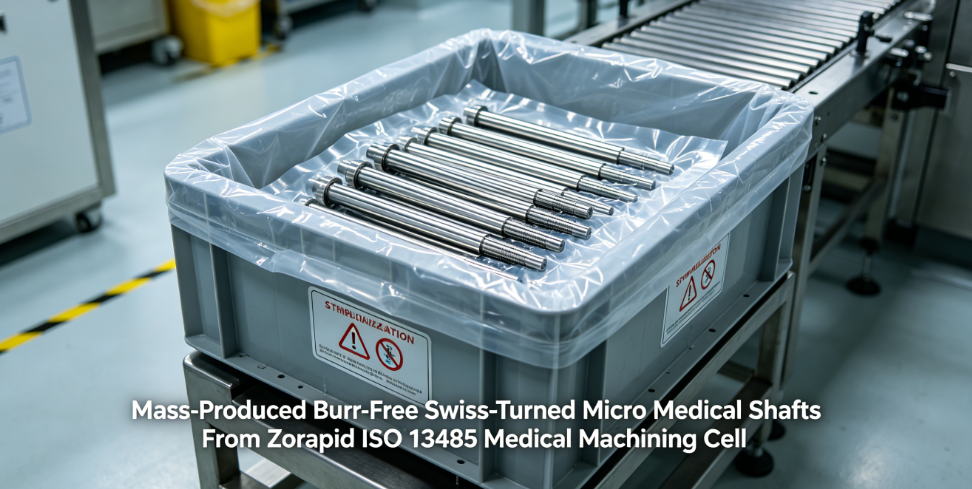
- Automated part ejection into sealed medical-grade collection bin (no manual hand contact pre-cleaning)
- Ultrasonic medical wash cycle to remove micro coolant residue and loose metal swarf
- Controlled passivation / electropolish for stainless/titanium shafts (Ra reduced further, eliminates free iron contamination)
- 100% batch inspection: CMM concentricity check, surface roughness tester, optical burr microscope, hardness verification
- ISO 13485 full production record retention for complete material and process traceability
Common Swiss Medical Shaft Failures + Instant Shop Fix Cheat Sheet
We catalog every recurring micro shaft defect across our medical production cell to minimize downtime and scrap for OEM clients:
- Excessive shaft runout / poor concentricity Root cause: Worn carbide guide bushing, mismatched bar/bushing clearance, long unsupported overhang past bushing Fix: Recalibrate/replace bushing, redesign steps to keep critical OD inside supported zone, limit post-bushing length
- Heavy stainless steel built-up edge (BUE) smearing shaft finish Root cause: Too low feed rate, insufficient coolant pressure, uncoated micro inserts Fix: Raise feed 10–15%, upgrade to 1000 PSI through-tool coolant, swap to thin PVD AlTiN coated positive-rake inserts
- Feather burrs on cutoff shaft ends and cross-hole edges Root cause: Single-sided parting inserts, no sub-spindle cleanup pass, low coolant at parting line Fix: Double positive-rake cutoff tool, add short sub-spindle facing operation, direct dual coolant jets at parting zone
- Chatter ripples on long slender micro shafts Root cause: Excessive DOC, high spindle RPM, thin unsupported wall geometry Fix: Split roughing into multiple shallow passes, drop SFM 20%, add DFM support steps inside guide bushing
- Micro tool chipping & ultra-short service life Root cause: Negative rake inserts, heavy interrupted cuts, contaminated coolant with metal grit Fix: Standardize all micro tools to 15°–20° positive rake, filter coolant to 1μm, reduce radial depth of cut
- Post-passivation surface discoloration / staining Root cause: Residual iron micro-particles trapped in surface micro-grooves, dirty coolant Fix: Extended ultrasonic medical wash, full coolant filtration overhaul, final super-finish Ra <0.4μm
Real Zorapid Medical OEM Case Study – Ø2.2mm Endoscopic Drive Shaft Overhaul
A European medical device manufacturer came to us with a failing batch of 316L endoscopic micro drive shafts made on conventional fixed-head lathes, three costly production failures:
- 32% scrap rate from out-of-spec concentricity (runout >0.012mm) failing assembly rotation tests
- Heavy feather burrs requiring 100% manual deburring (2x labor cost per shaft)
- Cycle time 95 seconds per unit, unable to hit quarterly volume delivery targets
Original flawed workflow: Fixed-head lathe single-pass turning, no secondary cleanup, no high-pressure through-tool coolant
Our Zorapid Swiss turning full process overhaul:
- Migrated production to dedicated medical sliding head Swiss lathe with matched carbide guide bushing for Ø2.2mm bar stock
- Swapped generic negative-rake inserts to positive 18° rake thin PVD AlTiN micro turning & double positive parting tools
- Installed 110 bar through-tool coolant system targeted at OD cutting and cutoff zones
- Programmed full sub-spindle pickoff + end facing cleanup pass to eliminate cutoff burrs entirely
- Applied DFM revision adding short support steps within the guide bushing supported zone to eliminate shaft deflection
- Optimized trochoidal light roughing passes + two sequential super-finish passes for consistent Ra 0.28μm surface finish
Measurable Final Production Results
- Concentricity runout locked under 0.002mm, scrap distortion rate dropped to 0.8%
- Eliminated all manual deburring labor, per-part labor cost cut by 62%
- Single-setup cycle time reduced from 95s to 48s, volume output nearly doubled
- 100% pass rate on sterilization compatibility and surface integrity audit for FDA registration
Why Zorapid Is Your Trusted Swiss Turning Partner For Medical Micro Shafts
We operate a fully segregated ISO 13485 compliant Swiss turning production cell exclusively for biocompatible micro shaft components, serving surgical, orthopedic, endoscopic and implant device OEMs across North America, EU and UK. Our exclusive medical manufacturing advantages:
- 3,000㎡ precision manufacturing facility with 8 multi-axis sliding head Swiss lathes equipped with bar feeders, sub-spindles and 120 bar medical-grade filtered coolant systems
- Full traceability program for all biocompatible raw bar stock (316L, Ti-6Al-4V, 17-4PH, medical PEEK) with mill certification retention per FDA CFR 21 Part 820
- In-house medical engineering team providing free DFM reviews upfront to eliminate deflection, burr and tolerance risks during design phase
- Dedicated micro tool library with medical-grade coated carbide, CBN and thread whirling inserts sized for Ø0.5–12mm small diameter shafts
- Complete post-machining medical finishing line: ultrasonic washing, passivation, electropolishing, optical burr inspection and CMM dimensional verification
- Segregated clean handling & sterile packaging process to avoid cross-contamination of implant-grade micro components
- Flexible lead times: Micro medical shaft prototypes in 3–5 business days; medium/high-volume Swiss turned batch production delivered in 6–11 business days
Final Key Takeaways For Stable, Low-Scrap Swiss Turning Of Small Medical Shafts
- The carbide guide bushing is your most critical asset—keep tight bar/bushing clearance to lock micron-level concentricity on slender micro shafts.
- Stick to high positive-rake micro tools for all medical alloy turning; negative geometry guarantees deflection, burrs and rapid tool wear.
- High-pressure filtered medical coolant is non-negotiable for stainless and titanium micro shafts to eliminate BUE and micro particle contamination risks.
- Leverage the Swiss sub-spindle for automatic backworking and cutoff cleanup to remove feather burrs and skip costly manual deburring steps.
- Follow strict medical DFM rules: control L/D ratios, minimum wall thickness and internal radii to match Swiss machine support geometry limits.
- All functional critical OD features must machine inside the guide bushing supported zone; unsupported overhang creates unavoidable dimensional drift and chatter.
- Full post-process medical washing and passivation delivers sterilization-ready, biocompatible surface finish required for regulatory compliance.
FAQ
What’s the smallest diameter medical shaft Zorapid can Swiss turn?
We reliably produce micro shafts starting at Ø0.5mm in 316L stainless and Ti-6Al-4V, with stable concentricity <0.003mm via precision carbide guide bushings.
Can Swiss turning eliminate all deburring steps on medical micro shafts?
Yes with optimized positive-rake parting inserts + sub-spindle cleanup facing pass; cross-hole micro burrs removed via light low-feed finishing passes and ultrasonic medical wash.
Is Swiss turning required for short medical shafts under L/D 3:1?
Not mandatory for very short thick pins, but Swiss single-setup live tooling still cuts secondary operation time for cross-holes, flats and tiny threads vs standard lathes.
Can we run titanium micro shafts on standard Swiss coolant formulations?
No—use sulfur-free medical EP coolant with high-pressure through-tool delivery to block chemical workpiece adhesion and galling at micro cutting edges.
Does Zorapid maintain full ISO 13485 traceability for implant-grade Swiss turned shafts?
Every bar lot, machining batch and post-process finishing step is fully logged and archived for minimum 10 years, fully aligned with FDA medical device record retention rules.