Published by Zorapid
If you build drive shafts, hydraulic manifolds, gear blanks, mold supports or oilfield tool joints, AISI 4140 chromoly alloy steel is your go-to workhorse. It balances incredible tensile strength, fatigue resistance and through-hardening capability that plain carbon steel like 1045 simply can’t match.
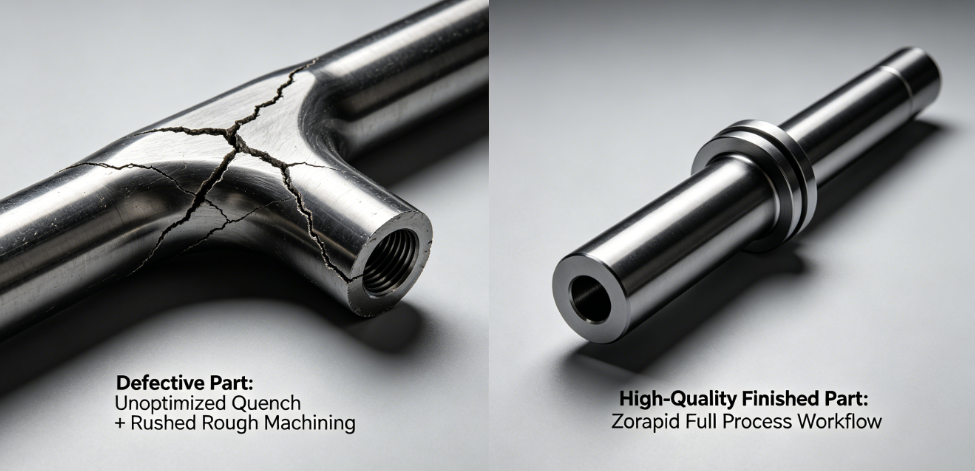
But here’s the costly mistake thousands of machine shops repeat every week: misaligning heat treatment cycles with CNC machining workflows. Do rough cuts too late, skip stress relief, pick wrong quench oil, or run unoptimized finishing feeds—and you’ll get warped shafts, cracked parts, uneven hardness and scraped high-value billets.
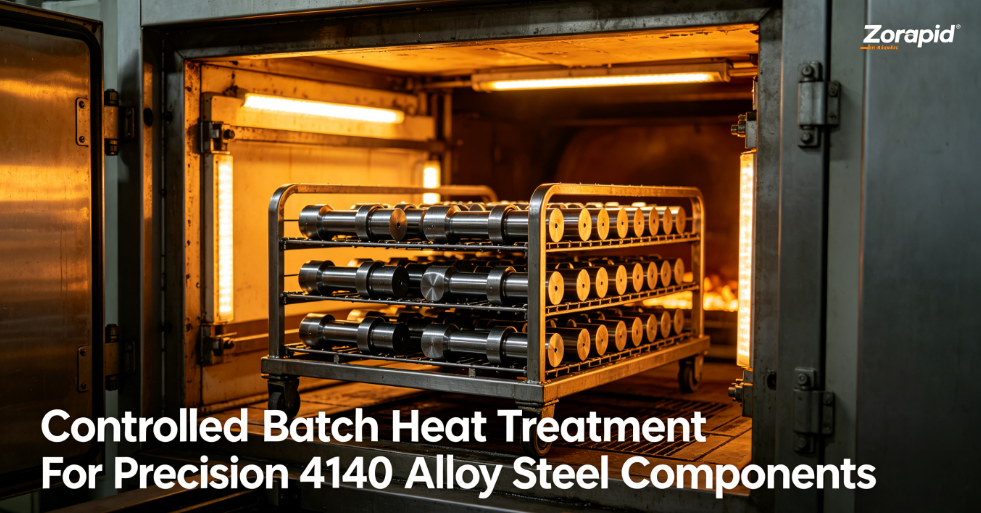
At Zorapid, we process thousands of 4140 components monthly across automotive, energy and heavy machinery clients. We’ve dialed in repeatable heat treatment recipes paired with production-ready CNC roughing & finishing workflows, tested on our 5-axis mills and heavy-duty CNC lathes.
This guide skips dense metallurgy textbooks. We break down every critical heat treatment stage for 4140, compare pre-heat-treat vs post-heat-treat machining paths, share standardized SFM/feed/DOC data for all hardness states, and lay out distortion-fighting finishing hacks proven to hold tight ±0.0005” tolerances. Every process tip is validated on our in-house heat treat furnace and precision CNC lines.
What Makes 4140 Cr-Mo Steel Unique For Heat Treat & Machining
4140 is a low-alloy chromium-molybdenum steel with ~0.40% carbon, 0.95% Cr and 0.20% Mo. This chemistry delivers two game-changing traits:
- Deep through-hardening Uniform hardness through thick cross-sections (up to 4” thick bar) without surface-only hardening—perfect for load-bearing rotating parts.
- Toughness-hardness balance You can tune hardness from soft 20 HRC annealed all the way up to 52–54 HRC fully quenched, while keeping enough impact resistance to avoid brittle failure under shock loads.
Three core material states dictate your entire machining and heat treat roadmap—we’ll reference these through the whole guide:
| Material State | Hardness Range | Core Use Case | Machinability Rating |
|---|---|---|---|
| Fully Annealed 4140 | 18–22 HRC | Heavy roughing, complex deep pockets, high stock removal | ~65% (easiest to cut) |
| Pre-Hardened Q&T 4140 | 28–32 HRC | Low-distortion simple shafts, no secondary heat treat needed | ~50% |
| Fully Hardened Q&T 4140 | 35–52 HRC | High-wear gears, tool shanks, oilfield components | ~40% (slow cutting required) |
Complete Step-by-Step 4140 Heat Treatment Cycles
Every hardness tier relies on a standardized heating, soak, quench and temper schedule. We split each process with clear failure avoidance rules for machined blanks.
1. Annealing (For Soft Raw Stock Prior To Heavy CNC Roughing)
Goal: Remove mill residual stress, soften material for fast high-volume stock removal
- Heat blank slowly to 1525°F (829°C)
- Soak 1 hour per inch of cross-section thickness
- Furnace cool at controlled 50°F/hour rate down to 800°F, then air cool fully Critical Rule: Never skip annealing on hot-rolled 4140 bar—unrelieved mill stress will warp parts during rough milling/turning.
2. Normalizing (Refine Grain For Uniform Hardness After Forging)
Goal: Fix uneven grain structure from hot forging, eliminate localized soft/hard spots
- Heat to 1650°F (900°C), soak 45 mins per inch thickness
- Pull from furnace and air cool freely with no stacking Use case: Forged 4140 gear blanks, heavy machined hydraulic blocks before quenching.
3. Stress Relieving (Non-Negotiable Between Rough Machining & Heat Treat)
This single step cuts heat-treat distortion by 70% on complex geometry parts.
- After full rough CNC machining, remove all sharp internal radii & deep thin walls first
- Heat parts to 1100–1150°F (595–620°C), soak 1 hour minimum
- Slow furnace cool to room temperature before quenching Why it works: Rough cutting locks massive residual cutting stress into the blank; stress relief releases that tension so phase transformation during quench doesn’t bend or twist the workpiece.
4. Quench & Temper (Q&T) – Core Hardness Tuning Process
This is the most error-prone stage for machined 4140 blanks—follow temperature & quench medium strictly.
Standard Quench Stage
- Austenitize at 1540–1575°F (838–857°C), soak 60–90 mins per inch thickness
- Quench medium split by part thickness:
- Sections <1.5”: Warm oil quench (low thermal shock, minimal cracking risk)
- Sections >2”: Moderate-speed polymer quench (balance hardenability & distortion) Water quench only for ultra-thick forgings—massive thermal shock creates edge cracks on machined sharp corners.
Temper Stage (Tune Hardness By Temper Temperature)
Tempering directly controls final hardness and toughness—lower temper temp = harder, more brittle; higher temper = softer, tougher.
| Temper Temperature | Final Target Hardness | Typical Part Application |
|---|---|---|
| 400–500°F | 48–54 HRC | Oilfield wear joints, heavy-duty gear teeth |
| 700–800°F | 38–44 HRC | Tool shanks, press die holders, high-load axles |
| 1000–1100°F | 28–32 HRC (pre-hard spec) | Drive shafts, hydraulic valve bodies |
| 1200–1300°F | 22–26 HRC | Low-stress structural frames, non-wear brackets |
Critical Heat Treat Defect Fixes:
- Quench cracking: Add 0.030” minimum radii to all internal sharp corners pre-heat treat
- Uneven hardness: Ensure full uniform furnace soak, avoid stacking parts blocking airflow
- Post-quench warpage: Mandatory stress relief rough machining pass before Q&T cycle
Two Core Production Workflows – Pre-Heat-Treat vs Post-Heat-Treat CNC Machining
Every 4140 project falls into one of these two paths. We break pros, cons and tolerance limits so you pick the right route at quoting stage.
Route A: Rough Machine → Stress Relieve → Q&T Heat Treat → Finish Grind/CNC
Best for: Complex geometries, thin walls, tight dimensional tolerances (±0.001” and tighter), hardness above 35 HRC
Step Breakdown
- Start with annealed 4140 bar
- Full rough mill/turn, leave uniform 0.015–0.030” finish stock on all surfaces
- Run stress relief cycle to erase cutting stress
- Complete quench & temper to target hardness
- Light finish CNC or surface grind to remove heat-treat minor distortion stock
Pros & Cons
Fast roughing speeds on soft annealed stock; low tool wear during bulk material removal
Uniform full hardness penetration through entire part
Easy correction of minor quench warpage with final grind pass
Extra secondary finishing operation adds lead time and labor cost
Risk of slight dimensional shift during quenching (mitigated by stress relief)
Route B: Machine Fully From Pre-Hardened 28–32 HRC 4140 Bar (No Post Heat Treat)
Best for: Simple shafts, straight pins, low-complexity cylindrical parts, zero distortion tolerance requirements
Step Breakdown
- Source factory pre-Q&T 4140 bar at 28–32 HRC
- Complete all rough + finish CNC turning/milling in single setup
- Ship directly without furnace processing
Pros & Cons
No heat treat outsourcing, eliminates all quench distortion risk
Single CNC operation cuts production lead time by 30–40%
Consistent dimensions without post-heat correction
Slower cutting speeds, higher carbide tool consumption
Max hardness capped at 32 HRC—cannot hit high-wear 40+ HRC specs
Quick Zorapid Decision Hack
If your print requires hardness over 34 HRC or complex thin-wall geometry: always use Route A (rough → stress relief → heat treat → finish).
If hardness spec sits 28–32 HRC and part geometry is solid/symmetric: Route B pre-hardened stock saves time and cost.
Standardized CNC SFM & Feed Data For All 4140 Hardness States (Turning + Milling)
All values use imperial SFM, ipr (turning) and ipt (milling) — baseline shop starting parameters you can adjust ±10% based on machine rigidity and coolant pressure.
1. Turning Parameters (Coated TiAlN Carbide Inserts)
| Material State | Operation | SFM Range | Feed (ipr) | Max DOC (inch) |
|---|---|---|---|---|
| Annealed 18–22 HRC | Rough Turn | 280–350 | 0.010–0.014 | 0.100–0.180 |
| Annealed 18–22 HRC | Finish Turn | 320–400 | 0.002–0.004 | 0.010–0.020 |
| Pre-Hard 28–32 HRC | Rough Turn | 140–190 | 0.006–0.009 | 0.060–0.100 |
| Pre-Hard 28–32 HRC | Finish Turn | 160–220 | 0.0015–0.003 | 0.008–0.015 |
| Hardened 38–48 HRC | Finish Only Turn | 40–70 | 0.0008–0.002 | 0.004–0.010 |
Milling Parameters (3-Flute TiAlN Solid Carbide End Mills)
| Material State | Operation | SFM Range | Feed (ipt) | Max WOC (radial cut) |
|---|---|---|---|---|
| Annealed 4140 | Rough Milling | 220–280 | 0.004–0.007 | 50% tool diameter |
| Annealed 4140 | Finish Milling | 260–320 | 0.0015–0.003 | 10–20% tool diameter |
| Pre-Hard 28–32 HRC | Rough Milling | 100–150 | 0.0025–0.004 | 30% tool diameter max |
| Hardened 38–48 HRC | Finish Milling Only | 30–55 | 0.0008–0.002 | <15% tool diameter |
Universal Machining Rules For All 4140 Hardness
- Coolant: Minimum 70 bar (1,000 PSI) high-pressure semi-synthetic EP coolant directed straight to cutting edge; low-pressure flood leads to rapid flank wear and thermal part expansion
- Tool Geometry: Positive rake inserts/end mills to lower cutting force and reduce work hardening on finished surfaces
- Milling Direction: Strict climb milling for all finishing passes—conventional milling creates built-up edge and poor surface roughness
- Tool Stickout: Limit overhang under 1.2× tool holder diameter to eliminate chatter ripples on finished surfaces
Critical CNC Finishing Best Practices After Heat Treatment
When running Route A (post-quench finishing), distortion and residual surface decarburization are your two biggest enemies. Use these Zorapid proven finishing rules for tight tolerances and clean surface integrity.
- Remove decarburized outer skin first Quenching creates a soft low-carbon surface layer ~0.003–0.006” deep. Run a light skim finishing pass to strip this layer before final dimensioning—otherwise hardness readings will fail material inspection.
- Split finishing into two light passes First pass removes heat-treat warpage stock; second micro-finish pass at reduced feed rate delivers Ra <0.8μm mirror surface without dimensional shift.
- Cool fully before final measurement Heat-treated 4140 retains internal thermal heat for hours. Allow parts to sit at ambient shop temperature for minimum 20 mins before final inspection to avoid thermal expansion tolerance errors.
- Thin-wall part anti-deflection trick For 1.0–2.0mm thin walls on heat-treated blanks: reduce finishing feed by 20% and add temporary support ribs in CAM toolpaths to stop wall bending under cutting pressure.
- Avoid sharp corner finishing overload Internal radii under 0.020” trigger sudden cutting force spikes that chip carbide tools; add minimum 0.030” radii to all finished internal transitions pre-heat treat.
Common 4140 Process Failures + Direct Fix Cheat Sheet
We’ve documented every recurring failure across our automotive and energy production lines—scan this list to troubleshoot mid-run without halting production for hours:
- Post-heat treat part warpage / bending Root cause: No stress relief after rough machining, uneven furnace heating, thin unsupported geometry Fix: Add mandatory stress relief cycle after rough cuts, design multi-point heat treat support fixtures, leave thicker uniform finish stock
- Quench edge cracking on machined corners Root cause: Sharp 90° internal radii, overly fast water quench, inconsistent cross-section thickness Fix: Add minimum 0.030” radii to all sharp edges, switch to warm oil/polymer quench for medium-thick blanks
- Uneven hardness across single component Root cause: Short furnace soak time, stacked parts blocking furnace airflow, mill grain inconsistency Fix: Extend furnace soak by 30 mins, rack parts with full air gap between every blank, normalize forgings prior to quenching
- Fast carbide tool wear machining pre-hardened 4140 Root cause: Excessively high SFM, low coolant pressure, negative rake tool geometry Fix: Drop cutting speed 20–30%, upgrade to high-pressure through-tool coolant, swap to positive rake TiAlN coated inserts
- Wavy chatter marks on finished shafts & flat surfaces Root cause: Long tool stickout, weak hydraulic workholding, heavy radial milling cuts Fix: Shorten tool holder overhang, switch to 6-jaw hydraulic chuck, reduce radial WOC to under 20% tool diameter for finishing
- Failed hardness test on surface finished parts Root cause: Unremoved decarburized outer skin from quenching Fix: Run dedicated light skim pass before final finishing to strip soft surface layer fully
Zorapid Real-World Case Study – Automotive 4140 Drive Shaft Full Process Optimization
A European automotive OEM sent us a failing production run of 4140 transmission drive shafts with three costly process issues:
- 27% scrap rate from post-quench shaft bending distortion
- Tool replacement every 12 roughing parts, sky-high tooling overhead
- Inconsistent surface roughness failing assembly seal inspection
Original client workflow: Annealed rough machine → direct oil quench temper → single-pass finish turning (no stress relief stage)
Our Zorapid engineering full process overhaul:
- Insert dedicated stress relief furnace cycle immediately after all rough turning operations
- Standardize rough machining finish stock to uniform 0.020” across all shaft diameters
- Adjust rough turning SFM from 210 down to 165 for pre-quench annealed stock with TiAlN positive rake inserts
- Redesign heat treat rack fixtures with full-length shaft support to eliminate sagging during quenching
- Split post-heat treat finishing into two sequential light turning passes with high-pressure EP coolant
Measurable Final Results
- Scrap distortion rate dropped from 27% to 1.2%
- Carbide roughing tool life extended 3.8x (45+ parts per cutting edge)
- Consistent surface finish Ra 0.4–0.6μm on all sealing diameters, 100% inspection pass rate
- Total end-to-end production lead time reduced 22% by eliminating rework and secondary straightening operations
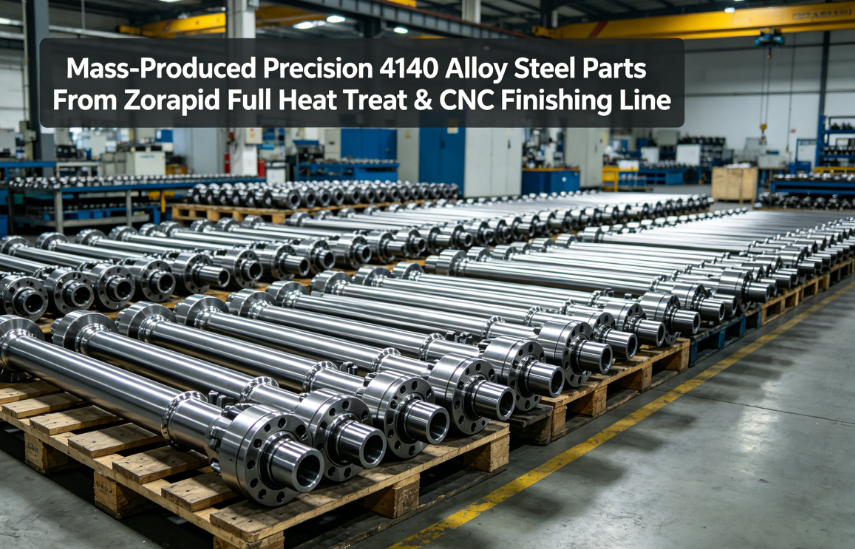
Why Zorapid Delivers Reliable 4140 Heat Treat + CNC Finishing For Global OEMs
We integrate in-house heat treatment furnaces and heavy-duty 5-axis CNC machining centers specifically calibrated for 4140 chromoly alloy steel, serving automotive, oil & gas, heavy machinery and hydraulic equipment clients across North America and Europe. Our core competitive advantages:
- 3,000㎡ dedicated precision manufacturing facility with full in-house controlled atmosphere heat treat furnaces (no outsourced third-party heat treat delay risk)
- Dual production workflows built for both pre-hardened single-setup machining and full rough-stress-relief-quench-temper precision routes
- Full library of TiAlN coated carbide inserts & end mills optimized separately for annealed, 28–32 HRC pre-hard and 38–52 HRC fully hardened 4140
- High-pressure 120 bar through-tool coolant systems on all CNC lathes/mills to extend tool life and lock consistent surface finish
- In-house metallurgy team reviews every 4140 drawing upfront with DFM checks to eliminate heat treat distortion and cracking risks at design stage
- Full post-process quality control: hardness testing, CMM dimensional inspection, surface roughness measurement and ultrasonic crack detection before shipment
- Flexible lead times: 4140 prototype components in 4–6 business days; medium/large batch full-process heat treat + CNC finishing delivered in 7–13 business days
Final Key Takeaways For Stable, Low-Cost 4140 Production
- Stress relief after rough machining is non-negotiable for any 4140 part requiring post-heat treatment—it cuts warpage scrap by nearly 70%.
- Match your production workflow to hardness specs: pre-hardened bar (28–32 HRC) for simple low-distortion parts; annealed rough + full Q&T cycle for high-hardness complex components.
- Always adjust CNC SFM downward as 4140 hardness rises—hardened 38+ HRC stock requires 60–80% slower cutting speeds than soft annealed blanks.
- Leave uniform thin finish stock before quenching; this lets light post-heat finishing skim minor dimensional shift without scrapping entire parts.
- Warm oil/polymer quenching is safer than water for most machined 4140 blanks to eliminate catastrophic corner cracking from thermal shock.
- High-pressure extreme-pressure coolant and positive rake carbide tooling are mandatory to control heat buildup and minimize flank wear across all machining stages.
FAQ
Can I skip stress relief on small simple 4140 pins or shafts?
You can for solid symmetric tiny parts under 1” diameter, but we still recommend stress relief for consistent dimensional stability in mass batches. Thin or asymmetrical geometry must always run stress relief.
What finish stock allowance should I leave before sending 4140 blanks to heat treat?
0.015–0.030” uniform stock on all surfaces is the industry standard at Zorapid; thinner stock risks bare metal after minor quench warpage, thicker stock adds extra finishing time.
Is pre-hardened 4140 (28–32 HRC) strong enough for automotive drive shafts?
Yes for standard passenger vehicle drivetrains. Heavy-duty racing or industrial transmission shafts requiring higher wear resistance need full Q&T to 38–44 HRC via Route A rough + heat treat workflow.
Can I use HSS tools for machining hardened 4140 above 35 HRC?
Not recommended. HSS tools wear out within a handful of parts; TiAlN coated solid carbide inserts/end mills are required for stable finishing on fully quenched 4140.
Why do finished 4140 parts fail hardness testing right after light CNC finishing?
Quenching creates a soft decarburized outer skin. A dedicated skim pass removes this low-carbon layer, delivering accurate core hardness readings matching your print spec.