Published by Zorapid
If your shop runs aerospace turbine disks, oil & gas downhole components, or nuclear heat exchanger parts, Inconel 718 is non-negotiable stock. But let’s be honest—this nickel superalloy is one of the most unforgiving materials you’ll ever turn on a lathe.
It work-hardens instantly, traps extreme heat right at the cutting edge, chews through cheap inserts, and ruins tight tolerance runs with just one wrong tool or bad SFM setting. At Zorapid, we process hundreds of IN718 turned parts monthly across gas engine and energy clients. We’ve burned through dozens of insert grades, scrapped high-cost billets, and dialed in reliable, repeatable turning workflows through thousands of shop floor tests.
This guide cuts out textbook fluff. We break down exactly which tools to pick for roughing, semi-finish and finish turning IN718, share production-proven SFM/feed/DOC data tables, and fix the most common IN718 turning failures like flank wear, built-up edge, chatter and surface cracking. Every tip here is validated on our 5-axis CNC lathes for hardened (36–44 HRC) and solution-treated Inconel 718 stock.
Why Inconel 718 Destroys Generic Lathe Tools (Quick Shop Breakdown)
Before jumping into tool grades and SFM numbers, understand the three core enemies you fight every IN718 turning pass:
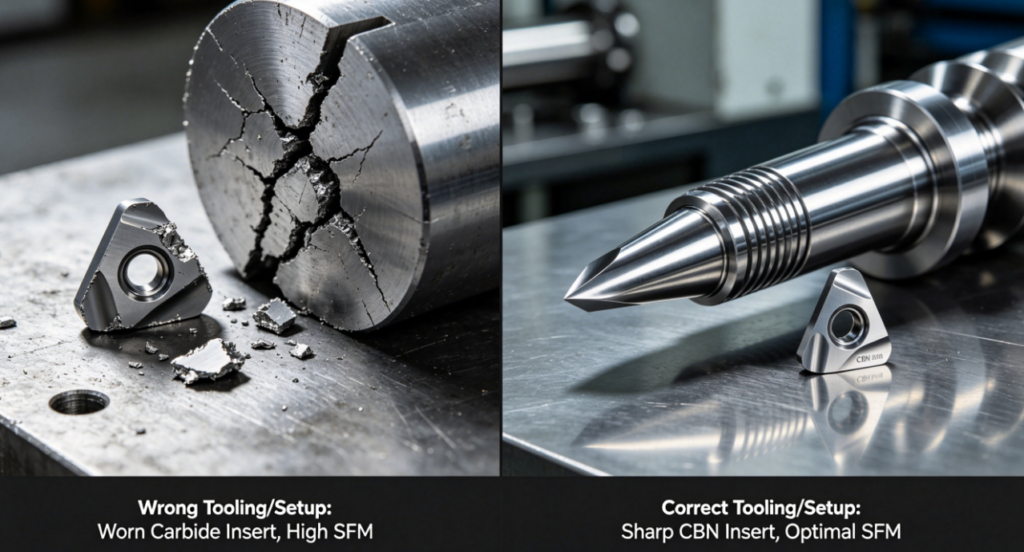
- Extreme work hardening Even light rubbing from dull tools creates a hardened outer skin. Subsequent cuts dig into this layer and trigger catastrophic notch wear on inserts.
- Near-zero heat conductivity 90% of cutting heat stays locked at the tool tip (temperatures hit 1,100°C+). This melts tool coatings and speeds diffusion wear nonstop.
- High chemical reactivity with unoptimized tool substrates Nickel in IN718 welds to steel, uncoated carbide and cheap coatings, forming thick built-up edge (BUE) that rips finished surfaces apart.
Generic stainless steel or titanium inserts cannot stand up to these three stressors. Your tool geometry, substrate and coating all need to be engineered specifically for nickel-based HRSA superalloys.
Complete Inconel 718 Turning Tool Category Breakdown
Three tool families cover every IN718 turning job—we’ll match each to roughing, semi-finish and finish work with exact grade picks from Sandvik, Kennametal and NTK, plus clear SFM baseline ranges.
PVD-Coated Fine-Grain Carbide Inserts
Best use case: All roughing, semi-finish turning, low-volume prototype runs, thin-wall fragile IN718 parts
Recommended Grades & Coatings
- Sandvik GC1105 / GC1115 (AlTiN PVD coating, positive rake SM chipbreaker)
- Kennametal KC5010 (multi-layer AlCrN thermal barrier coating)
- NTK ZC410 (ultra-fine grain substrate for low cutting force)
Mandatory Geometry Rules for IN718
- Insert shape: CNMG / DNMG / WNMG with sharp positive rake (6°–12°)
- Chipbreaker: Aggressive HRSA-specific chipbreaker to curl short, broken chips (stop long string swarf)
- Edge prep: Micro-honed light T-land (0.02–0.04mm) — fully sharp edges chip under heavy roughing loads; heavy hone amplifies work hardening
Critical No-Go Rule
Skip CVD coatings (TiCN/TiN thick layers). They run too hot on IN718 and peel off within minutes of rough turning.
Whisker-Reinforced SiAlON Ceramic Inserts
Best use case: Heavy stock removal, stable rigid lathe setups, full batch aerospace runs, dry cutting only
Top Production Grades
- Greenleaf WG-300
- NTK WA1
- Kennametal KY1540
Hard Limits You Cannot Ignore
- No coolant whatsoever: Liquid thermal shock instantly cracks ceramic cutting edges
- Machine requirement: Minimum 15HP spindle power, zero tool overhang, heavy-duty hydraulic workholding
- Not for thin-wall or low-rigidity parts: Ceramic generates high cutting force and triggers chatter easily
PCBN / CBN Cubic Boron Nitride Inserts
Best use case: Finish turning aged-hardened 38–44 HRC Inconel 718, replace secondary grinding operations, ultra-smooth Ra <0.4μm surface specs
Key Advantages
- 3–5x faster SFM than carbide finishing inserts
- Resists nickel adhesion almost completely, minimal BUE
- Holds sharp edge geometry thousands of parts longer than coated carbide for tight tolerance mass finishing
Restriction
Only use for light finishing passes; never rough turn with CBN inserts — high DOC causes catastrophic edge fracture.
Standardized Inconel 718 Turning SFM & Feed Data Table
All values split by tool type, stock condition (solution-treated vs age-hardened 36–44 HRC), and operation (rough / semi-finish / finish). All units in imperial SFM + ipr feed, inch depth of cut for US/EU lathe operators.
| Tool Type | Material Condition | Operation | SFM Range | Feed (ipr) | Max DOC (inch) | Primary Use Case |
|---|---|---|---|---|---|---|
| PVD Fine-Grain Carbide | Solution-Treated IN718 (28–32 HRC) | Rough Turning | 100–140 | 0.006–0.010 | 0.040–0.080 | Prototypes, small batches, thin walls |
| PVD Fine-Grain Carbide | Age-Hardened IN718 (36–44 HRC) | Rough Turning | 70–110 | 0.005–0.008 | 0.030–0.060 | Hardened turbine blanks, heavy stock removal |
| PVD Fine-Grain Carbide | All IN718 Hardness | Semi-Finish | 120–160 | 0.003–0.005 | 0.010–0.020 | Remove rough work-hardened skin |
| PVD Fine-Grain Carbide | All IN718 Hardness | Finish | 140–180 | 0.001–0.002 | 0.004–0.008 | Standard precision surface finishes |
| SiAlON Ceramic (Dry Only) | Solution-Treated IN718 | Heavy Rough | 600–900 | 0.008–0.012 | 0.060–0.100 | High-volume rigid batch production |
| PCBN CBN | Age-Hardened 36–44 HRC | Super-Finish | 180–260 | 0.0008–0.0015 | 0.002–0.005 | Ra <0.4μm mirror finish, tight ±0.0005” tolerances |
Quick Zorapid Shop Hack For Tuning SFM
- If flank wear appears after <20 parts: Drop SFM by 15–20% immediately
- If thick blue/black BUE coats insert rake face: Raise feed rate 10% (lighter feeds rub and build nickel adhesion)
- If surface chatter ripples show up: Cut SFM 10% and reduce DOC by half
Critical Coolant & Workholding Rules To Extend Insert Life 2–3x
Tool selection only delivers half the performance—coolant pressure and rigid fixturing make or break your IN718 turn runs.
Coolant Strategy (Non-Negotiable For All Carbide/CBN Jobs)
- Minimum pressure: 70 bar (1,000 PSI) through-tool high-pressure coolant Standard low-pressure flood cannot penetrate the steam barrier that forms at the 1,000°C cutting zone. High-pressure fluid blasts chips away and pulls critical heat off the insert edge.
- Coolant fluid type: Heavy-duty semi-synthetic with extreme pressure (EP) additives Straight mineral oil works for light finishing, but semi-synthetic blends balance cooling and lubrication for heavy roughing cycles.
- Ceramic exception: Zero coolant, pure air blast chip evacuation only Liquid coolant creates thermal shock and instant insert cracking on SiAlON ceramic tools.
Rigid Workholding Anti-Chatter Checklist
Chatter on IN718 amplifies work hardening and inserts wear rate by 400%—follow these universal rules:
- Use hydraulic expansion chucks or 6-jaw precision chucks, avoid basic 3-jaw manual chucks for long slender shafts
- Limit tool holder overhang to under 1.2x insert holder diameter
- Support long IN718 workpieces with dead or live centers to eliminate part deflection
- Thin-wall turned IN718 sleeves: Use custom segmented expanding fixtures to evenly distribute clamping force
Inconel 718 Turning Failures + Direct Tool/SFM Fix Cheat Sheet
We’ve documented every common IN718 turning failure across our aerospace production lines—scan this table to troubleshoot mid-run without stopping production for hours:
- Heavy Flank Notch Wear On Carbide Inserts Root cause: Too low feed rate, rubbing against work-hardened outer skin Fix: Raise feed 10–15%, add light semi-finish skim pass before final finishing, switch to AlCrN coated carbide grade
- Thick Nickel Built-Up Edge (BUE) Covering Insert Rake Face Root cause: Excessively low SFM, dull micro-honed edge Fix: Boost SFM by 20%, swap to sharp positive rake HRSA chipbreaker inserts, increase high-pressure coolant flow
- Chatter Vibration + Wavy Turned Surface Finish Root cause: Excessive tool overhang, weak workholding, too high ceramic SFM on thin parts Fix: Shorten tool stickout, upgrade to hydraulic chuck, reduce DOC and cut spindle speed 10%
- Thermal Cracking On Ceramic Inserts Root cause: Coolant contact with ceramic cutting edge Fix: Fully shut down liquid coolant, use only compressed air chip blast, ensure rigid heavy-duty machine spindle
- Poor Surface Integrity (Micro-Cracks, Tensile Surface Stress) Root cause: Insufficient finishing DOC, worn insert edge Fix: Increase finishing pass depth to minimum 0.004”, replace inserts at first sign of flank wear (don’t push to failure)
- Rapid CBN Edge Chipping During Finishing Root cause: Too heavy depth of cut, rough stock surface hard skin Fix: Add carbide semi-finish pass to remove hardened layer, cut DOC to under 0.005” for all CBN operations
Zorapid Real-World Case Study – IN718 Turbine Shaft Turning Overhaul
A North American gas turbine client brought us a failing production run of age-hardened 42 HRC Inconel 718 shafts. Their original process used generic stainless steel carbide inserts with outdated SFM values, creating three costly production issues:
- Insert replacement every 8 parts (massive tooling overhead)
- 22% scrap rate from micro-cracked shaft sealing surfaces
- Cycle time 28 minutes per unit, unable to hit monthly delivery quotas
Our Zorapid engineering team applied targeted tool and SFM adjustments:
- Replaced generic negative-rake inserts with Kennametal KC5010 positive rake AlCrN PVD carbide roughing inserts
- Adjusted rough turning SFM from 150 down to 95 (matched age-hardened IN718 baseline data)
- Installed 120 bar through-tool high-pressure coolant system directed at both rake and flank insert faces
- Added a dedicated semi-finish skim pass to eliminate surface work hardening before CBN super-finishing
- Swapped final finishing operation to NTK PCBN inserts at 220 SFM for mirror surface Ra 0.32μm
Final Measurable Results After Optimization
- Insert service life extended 4.1x (65+ parts per cutting edge)
- Scrap rate dropped to 1.1%, eliminated all surface crack inspection failures
- Total part cycle time reduced 27% to 20.4 minutes per shaft
- Passed aerospace surface integrity audit without secondary grinding steps
DFM Design Tweaks To Reduce IN718 Turning Tool Wear & Cycle Time
Many tool failure problems start at the drawing stage—our DFM team applies these rules before any IN718 blank hits the lathe:
- Avoid sharp 90° internal shoulders Add minimum 0.030” radii to all transitions to prevent sudden cutting force spikes that chip inserts
- Thin wall minimum thickness guideline 1.8mm minimum wall thickness for turned IN718; thinner walls require support fixtures and reduced feed rates
- Remove large stock volumes via rough forging/near-net-shape additive blanks Heavy rough turning of full solid IN718 billets burns through inserts rapidly—near-net preforms cut roughing cycle time in half
- Separate rough and finish operations with a cool-down pause Let the workpiece cool fully after roughing before finishing to eliminate thermal dimensional drift and uneven hardening
Why Zorapid Is Your Trusted Partner For Inconel 718 Hard Alloy Turning
We specialize in precision turning of nickel superalloys including Inconel 718, Inconel 625 and Waspaloy for aerospace, power generation and oil & gas OEMs globally. Our unique advantages for HRSA turning jobs:
- 3,000㎡ dedicated precision manufacturing center with 12 heavy-duty CNC lathes equipped with 1,200 PSI high-pressure through-tool coolant systems
- In-house material engineers pre-run DFM reviews and custom SFM tool parameter sets for every IN718 order before production launch
- Full inventory of HRSA-specific PVD carbide, SiAlON ceramic and PCBN CBN inserts matched to all IN718 hardness grades
- Rigid hydraulic expansion chuck workholding library to eliminate chatter on long shafts, thin sleeves and complex rotational parts
- AI vision coordinate metrology for 100% dimensional and surface finish inspection, guaranteeing aerospace-grade surface integrity
- Flexible lead times: IN718 prototype turning in 4–6 business days, medium/large batch production delivered in 8–14 business days
Final Key Takeaways For Stable, Low-Cost Inconel 718 Turning
- Never use generic steel/titanium inserts for IN718—stick to positive rake PVD fine-grain carbide for 90% of all turning work.
- Match your SFM strictly to IN718 hardness: age-hardened 36–44 HRC stock runs 20–30% slower solution-treated material to control flank wear.
- High-pressure through-tool coolant (70 bar minimum) is mandatory for carbide/CBN; ceramic roughing requires fully dry air blast only.
- Boost feed rate slightly to avoid work hardening and BUE—light, slow cuts rub the material and destroy insert edges fast.
- Reserve PCBN CBN inserts exclusively for super-finishing hardened IN718 to hit ultra-low Ra specs and skip expensive post-turn grinding.
- Early DFM design adjustments and rigid fixturing cut tool replacement costs and scrap rates by up to 40% on every IN718 production run.
FAQ
Can I use ceramic inserts to finish turn Inconel 718?
Not recommended. Ceramic inserts deliver fast roughing stock removal but produce inconsistent surface roughness with micro-notching. Use CBN for all precision finishing on hardened IN718.
What’s the maximum safe SFM I can run carbide inserts on age-hardened Inconel 718?
Stick to a hard ceiling of 110 SFM for roughing and 180 SFM for finishing. Pushing past these values triggers rapid thermal coating breakdown and edge failure.
Does MQL minimum quantity lubrication work for Inconel 718 turning?
Only for tiny light finishing passes on rigid short parts. MQL cannot carry enough heat away for heavy roughing—high-pressure flood through-tool coolant is required for stable long runs.
Why is PCD diamond completely unsuitable for IN718 turning?
Nickel in Inconel chemically reacts with diamond at cutting temperatures above 600°C, instantly dissolving PCD tool edges. Always avoid PCD on all nickel superalloys.
How much longer does CBN last vs coated carbide for IN718 finishing?
PCBN inserts deliver 3–5x more parts per edge compared to premium AlTiN carbide, and consistently hold tighter surface finish tolerances across full production batches.