For Product Designers, Manufacturing Managers & OEMs | Reduce Mold Rework, Save Budget & Shorten Lead Time | Professional Injection Mold DFM Analysis & Cost Optimization
Wasting Thousands on Unnecessary Mold Trials & Rework?
Wasting budget on repeated injection mold trials and unexpected rework? Most manufacturing teams lose thousands of dollars not from poor steel quality or expensive materials, but from unoptimized part designs.
Many product teams rush from CAD design to steel cutting to save upfront time. However, skipped manufacturability checks always result in repeated trial runs, sink marks, weld lines, ejection failures and dimensional errors. Every extra iteration delays mass production and burns your project budget.
The manufacturing industry has reached a clear consensus: fixing design issues in the DFM stage costs 10x less than modifying finished molds. Complex injection mold projects can easily incur $5,000–$25,000 in unplanned rework fees. This does not include hidden revenue losses caused by delayed product launches and missed market windows.
Simply put: DFM (Design for Manufacturability) for injection molding is not an extra step. It is your most cost-effective tool to minimize trials, eliminate rework, and stabilize your mold project budget.
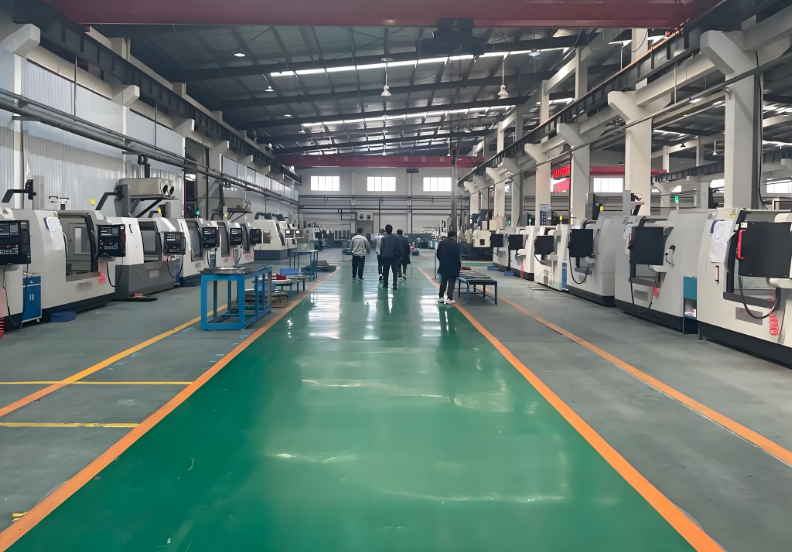
Why Your Mold Projects Keep Wasting Money on Trials & Rework
Nearly all frequent trial iterations and mold revisions result frompoor manufacturability in the original design. Without professional DFM analysis for plastic injection molding before tooling, these avoidable issues will kill your profit margin:
- Bad part geometry: Missing draft angles, unreasonable undercuts and complex parting lines create extra mold structures and require repeated on-site adjustments.
- Uneven wall thickness: Causes sink marks, shrinkage, bubbles and short shots — the top reason for second and third trial runs.
- Poor gating & cooling layout: Improper gate positions lead to visible defects. Unoptimized cooling channels cause long cycle time and part deformation.
- Ignoring material properties: Different plastics have unique shrinkage and flow rates. Generic design settings always result in dimensional failure and mold rework.
All of these manufacturing flaws are completely avoidable with early intervention. Our global project data verifies that professional injection mold DFM optimization cuts mold modification rates by over 80% and reduces costly injection molding trial runs by 30%–50% for most custom mold projects.
How Professional DFM for Injection Molding Cuts Your Mold Cost
Our core DFM strategy is simple: fix risks upfront, instead of repairing later. We run full mold flow simulation and design validation before steel cutting, ensuring your design is fully production-ready.
1. Wall Thickness & Structural Optimization
We uniformize wall thickness and simplify overcomplicated structures to eliminate common molding defects. Removing unnecessary undercuts and redundant slider structures greatly reduces mold complexity. For a German industrial enclosure project, this optimization directly lowered tooling cost by 20% and avoided multiple invalid trials.
2. Draft & Ejection Improvement
Insufficient draft angles cause stuck molds, scratched surfaces and post-trial polishing rework. We customize draft angles based on material and surface requirements to ensure smooth ejection, saving massive trial and rework time.
3. Gate & Runner Layout Refinement
We place gates at optimal positions to avoid weld lines, air traps and filling imbalance. Scientific runner layout stabilizes injection parameters, so you need fewer trial rounds to reach qualified samples.
4. Material Shrinkage & Cooling Tuning
We apply precise shrinkage data for ABS, PC, PP, PA and other materials to pre-correct mold dimensions. Optimized cooling channels ensure uniform cooling, reducing deformation and dimensional deviation — the biggest source of late-stage mold changes.
5. Tolerance Rationalization
Blind high-tolerance requirements greatly increase mold cost and failure risk. Our DFM team keeps critical-area precision and relaxes unnecessary ultra-tight tolerances, balancing performance and manufacturability to avoid useless rework.
Real Results: What You Save with DFM Upfront
Based on our global mold project data, early injection mold design optimization delivers clear, measurable benefits:
- Cost Saving: 15%–40% lower trial & modification cost; avoid $5k–$25k unexpected rework spending.
- Faster Launch: Reduce trial rounds from 3–5 times to 1–2 times; shorten mold lead time by 20%–30%.
- Stable Quality: 60%–80% fewer molding defects; lower mass production scrap rate.
- Lower Risk: Eliminate over 80% of late-stage mold changes and project delays.
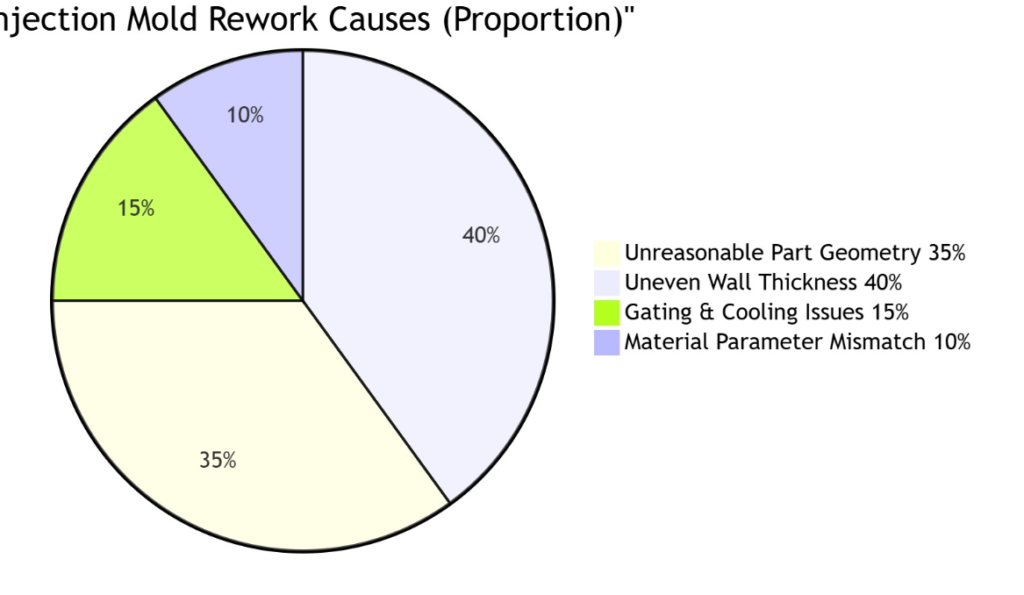
Mold Rework Root Cause Data Distribution
Our Core Principle: Analyze First, Cut Steel Later
For European and American manufacturers, predictable cost, fixed lead time and stable quality matter most.
We treat DFM as the core of mold development, not a sideline service. Before any tooling starts, we deliver a full DFM report covering design risks, optimized solutions, cost-saving analysis and production feasibility feedback.
All optimizations strictly protect your product function and appearance — no performance compromise, only lower risk and lower cost.
Conclusion: DFM Delivers the Best ROI for Your Mold Projects
Repeated trial runs and unplanned mold rework create pure budget waste and lost market opportunities. Injection mold DFM optimization remains the most reliable solution for manufacturers to control production costs, shorten molding cycle times, and stabilize product quality for all injection mold projects.
Stop overspending on expensive late-stage mold modifications. Adopt professional DFM analysis early to make your injection mold projects predictable, cost-efficient, and fully production-ready from the very start.
Key Takeaways
- Cost Reduction: Strategic DFM for injection molding eliminates 15%–40% of unnecessary trial and modification costs, avoiding five-figure unplanned rework expenses.
- Lead Time Optimization: Cuts repeated mold trial cycles and shortens overall mold development lead time by 20%–30%, accelerating product time-to-market.
- Quality Stabilization: Resolves common molding defects like sink marks, weld lines, and deformation, reducing mass production scrap rates significantly.
- Risk Prevention: Fixes structural, gating, and cooling design flaws upfront to eliminate over 80% of late-stage mold rework and project delays.
FAQ
What is DFM in injection molding?
DFM (Design for Manufacturability) is a pre-production design optimization process. It optimizes part geometry, wall thickness, draft angles, gating, cooling systems and material parameters to eliminate manufacturability risks. It is the core solution to reduce mold trials and cut modification costs for custom injection molds.
How much cost can DFM save on injection mold projects?
Based on verified project data, professional DFM optimization reduces 15%–40% of mold trial and modification costs, saving an average of 28% in overall tooling expenses. It avoids $5,000–$25,000 unplanned rework fees for medium and complex molds, while cutting hidden losses from delayed product launches.
Why do most non-DFM mold projects require repeated trials?
67% of non-DFM mold projects suffer unnecessary rework after T1 trials. The main root causes are uneven wall thickness (40%), unreasonable part geometry (35%), unoptimized gating/cooling (15%), and mismatched material parameters (10%). All these design defects lead to repeated trial runs and late mold modifications.
How effective is DFM in reducing mold rework?
Data comparison shows that standardized DFM optimization eliminates over 80% of design-induced molding defects. It reduces unnecessary mold rework rate from 67% to 13% and cuts trial run times by 30%–50%, greatly stabilizing mold project quality and schedule.
Will DFM optimization change my product design or performance?
No. Professional DFM adjustments only optimize manufacturability details for molding production. We fully retain all critical functional dimensions, assembly tolerance and surface appearance requirements. No product performance or design aesthetics will be compromised.
What is the best timing for DFM analysis?
The optimal time is before steel cutting and formal mold machining. Per manufacturing cost rules, fixing flaws in the DFM stage costs only 1/10 of finished mold modification and 1/100 of mass production defect correction cost, achieving the highest project ROI.
Do all custom injection molds need a DFM report?
Yes. It is especially critical for complex structural parts, precision components, multi-cavity molds and mass-production molding projects. A complete DFM report unifies design and manufacturing standards, eliminates communication errors, and makes project cost and lead time fully predictable.
Get Your Free DFM Analysis Now
Have an upcoming injection mold design project or existing CAD files needing manufacturability review? We provide free professional DFM analysis for global OEMs and product manufacturing teams. Simply share your design files and technical specifications, and our engineering team will deliver a customized mold cost-saving and optimization plan within 24 hours.