Published by Zorapid
Let’s cut straight to the pain point every product team fights daily:
You’ve locked your CAD design, but you’ve got zero clarity on two make-or-break variables—how fast you’ll get physical prototypes, and how much each unit will cost. Pick the wrong process, and you’re stuck waiting weeks or blowing your R&D budget before testing even starts.
We’ve seen hundreds of EU/US clients waste thousands by guessing: using CNC for 50 cosmetic plastic units, or ordering rapid injection molding for a single proof-of-concept part. No more guesswork.
Today, Zorapid is walking you through the full side-by-side breakdown of our six core custom prototype manufacturing workflows:
- Multi-Technology 3D Printing (SLA / SLS / FDM / Metal SLM)
- 5-Axis CNC Machining (Plastic & All Metal Alloys)
- Urethane Vacuum Casting
- Custom Sheet Metal Fabrication (Laser Cut + Bend + Rivet)
- Swiss Lathe Turning (Micro Precision Shaft/Pin Prototypes)
- Rapid Aluminum Bridge Injection Molding
We’ll share real-world lead time ranges, transparent cost brackets, tolerance limits, ideal batch sizes, and clear “when to pick this” rules—all data pulled directly from our 3,000㎡ ISO-certified Zorapid manufacturing center.
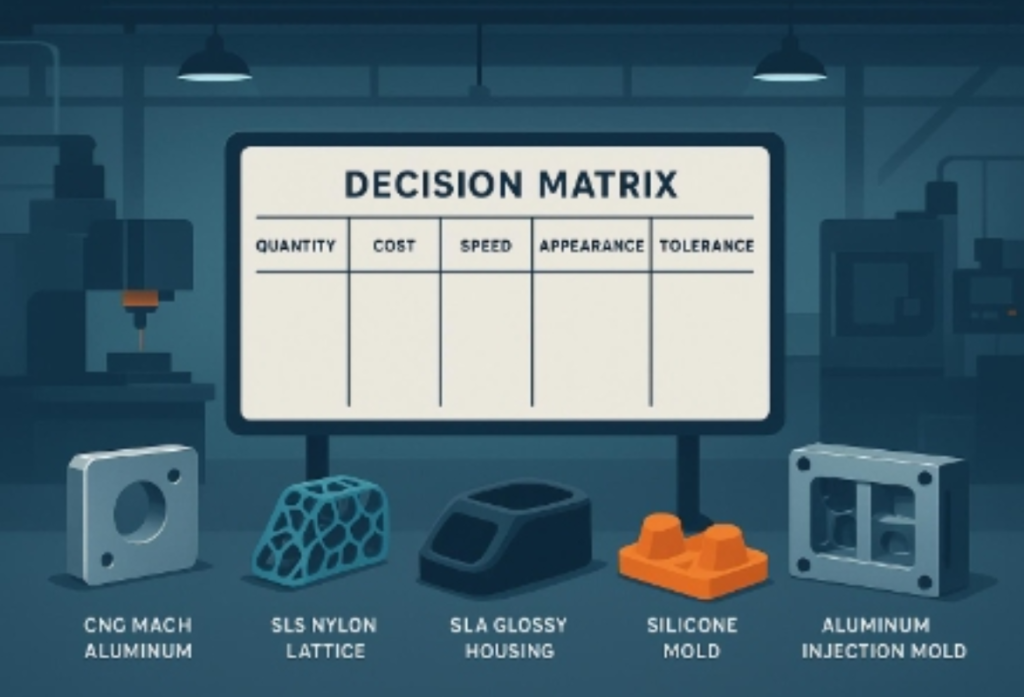
Quick At-A-Glance Comparison Table (Skimmable—highest readability boost)
This single table answers 80% of your comparison questions in 10 seconds. All timelines are standard Zorapid turnaround (expedited rush service available for all processes). All pricing benchmarks are for standard medium-complexity parts, no ultra-tight tolerance surcharges.
| Prototype Process | Standard Lead Time (Business Days) | Entry Cost (1–5 Units) | Per-Unit Cost (10–50 Units) | Best Tolerance | Ideal Batch Count | Core Strength |
|---|---|---|---|---|---|---|
| 3D Printing (SLA/SLM) | 1–4 | $40–$350 / piece | Flat $35–$280 | ±0.05 mm | 1–30 | Fastest iteration, complex organic geometry |
| 5-Axis CNC Machining | 4–10 | $70–$1,200 / piece | $60–$950 | ±0.01 mm | 1–20 | True raw material mechanical performance |
| Urethane Vacuum Casting | 6–12 (mold + cast) | $320–$2,800 master + mold fee, $25–$75 each part | $20–$60 | ±0.10 mm | 10–80 | Production-like plastic cosmetics, low mid-batch cost |
| Sheet Metal Prototyping | 3–7 | $55–$680 / assembly | $45–$520 | ±0.15 mm | 5–100 | Enclosures, brackets, thin formed metal housings |
| Swiss Turning (Micro Parts) | 5–9 | $85–$750 / piece | $70–$620 | ±0.005 mm | 1–100 | Tiny high-precision shafts, pins, medical hardware |
| Rapid Injection Molding (Al Soft Tool) | 14–30 | $4,800–$14,500 tool NRE, $0.7–$5 each part | $0.5–$3.2 | ±0.08 mm | 200–5,000 | Mass-production repeatability, mass volume cost savings |
Key quick takeaway from the chart:
- Need one-off concept parts fast: Go 3D Printing
- Metal functional testing with ultra-tight specs: CNC or Swiss Turning
- Medium plastic batches that look like final injection parts: Vacuum Casting
- Metal chassis & structural panels: Sheet Metal
- Pilot runs of hundreds/thousands identical plastic components: Rapid Injection Molding
Each Process’s Lead Time & Cost Breakdown
We’ll break down each method separately, focusing only on what engineers and product managers care about: timeline breakdown, hidden cost drivers, common client mistakes, and Zorapid’s exclusive efficiency upgrades to cut wait times.
Multi-Type 3D Printing Prototypes (SLA, SLS, Metal SLM)
Lead Time Breakdown
Standard turnaround: 1–4 business days
- Simple resin SLA concept prints: 24–48hr rush available (Zorapid same-day file review)
- Nylon SLS or titanium/aluminum SLM metal prints: 3–4 days No tooling fabrication required—we upload your STEP file straight to our print farm, zero setup delays. Post-processing (polish, paint, support removal) adds just 0.5–1 extra day.
Cost Drivers (Why pricing stays flat across small batches)
3D printing costs scale with material volume and resolution, not quantity. That means printing 1 piece vs 15 pieces has almost identical per-unit pricing—huge win for iterative design tweaks.
- Low-end: Standard SLA resin cosmetic prototypes
- Mid-range: SLS nylon functional prototypes
- High-end: SLM metal (Ti-6Al-4V, Inconel 718) aerospace/medical prints
Who should pick this?
Startup teams iterating weekly, medical device concept validation, complex lattice/undercut geometry impossible for CNC cutting.
Zorapid Advantage
We run 24/7 print lines for rush orders; no minimum order quantity. Free DFM print analysis with every submission to eliminate warpage or support issues before printing starts.
5-Axis CNC Machining Prototypes
Lead Time Breakdown
Standard lead time: 4–10 business days
Timeline split: DFM programing (1 day) → Raw material prep (0.5–2 days, specialty alloys like 7075-T6 / 17-4PH stock in-house) → Multi-axis cutting (2–5 days) → Deburr, anodize, precision inspection (1–2 days)
Rush CNC cuts available for 3-day delivery on simple aluminum parts.
Cost Drivers
CNC pricing spikes with complexity, tight tolerances, and rare metals. Every extra part flip, deep pocket feature, or ±0.01mm tolerance call adds labor and machine runtime.
- Plastic CNC (ABS, PEEK): $70–$380 per unit
- Aluminum 6061-T6: $90–$550 per unit
- Titanium / Inconel high-temp alloys: $600–$1,200 per unit Per-unit cost drops slightly at 10+ units, but never beats vacuum casting for plastic mid-batches.
Who should pick this?
Automotive, aerospace, mechanical teams needing 1:1 raw material functional testing (load, heat, wear testing). CNC is the only process that delivers full bulk material properties identical to mass production machined parts.
Zorapid Advantage
12 sets of 5-axis vertical mills on-site; in-house coordinate measuring machine (CMM) inspection for all tight-tolerance CNC prototypes, third-party inspection reports provided free for EU/US medical & aerospace compliance.
Urethane Vacuum Casting (Silicone Mold Small Batch Plastics)
Lead Time Breakdown
Full cycle: 6–12 business days
- CNC master pattern fabrication (3 days max)
- Silicone mold pouring & curing (2–3 days)
- Urethane resin casting, curing, finishing (1–4 days based on batch size) Molds last 20–80 casts; we reuse tooling for follow-up prototype revisions to cut repeat lead times by 50%.
Cost Drivers
Two core cost buckets: one-time silicone master/mold NRE fee, plus low recurring per-cast resin cost. This is why vacuum casting dominates the 10–80 unit sweet spot.
- One-time mold charge: $320–$2,800 (depends on part size & undercuts)
- Per-part resin cost: $25–$75 (simulates ABS, PP, PC, rubber TPE) If you only need <8 units total, vacuum casting’s mold fee makes it more expensive than SLA 3D printing—this is the #1 mistake we see new clients make.
Who should pick this?
Consumer product teams, medical cosmetic housings, any project needing injection-mold look/feel without expensive hard tooling investment.
Custom Sheet Metal Prototyping
Lead Time Breakdown
3–7 business days total
Laser blanking takes hours, bending & hardware assembly adds 1–3 days, surface finishing (powder coat, brushed finish) adds 1 extra day max.
Perfect for fast enclosure builds with minimal design changes.
Cost Drivers
Cost scales with sheet thickness, bend count, custom cutouts, and assembly hardware. Batch pricing improves steadily above 10 units.
- Thin aluminum steel simple brackets (1–5 pcs): $55–$220 each
- Complex multi-bend electronic enclosures (1–5 pcs): $230–$680 each
- 10+ unit bulk orders: Per-unit cost drops 30–45%
Who should pick this?
Electronics chassis, robotics frames, industrial equipment mounting brackets, cabinet prototypes. No other process matches sheet metal’s low cost for thin formed metal structures.
Swiss Lathe Turning
Lead Time Breakdown
5–9 business days
Swiss machines require custom fixturing for tiny diameters; bar stock cutting, thread milling, and micro tolerance inspection extend timelines vs standard CNC. Rush 4-day turnaround available for simple pin designs.
Cost Drivers
Micro tolerances (down to ±0.005 mm) and tiny complex features drive pricing up. Stainless steel, beryllium copper, and medical-grade titanium bar stock carry material surcharges.
- Small simple brass/aluminum pins: $85–$260 each
- Medical-grade micro shafts with fine threads: $280–$750 each
Who should pick this?
Medical implant hardware, sensor pins, automotive valve micro-components, aerospace tiny fasteners. If your part is under 20mm diameter with precision threads, Swiss turning is non-negotiable.
Rapid Aluminum Bridge Injection Molding
Lead Time Breakdown
Longest timeline of all six processes: 14–30 business days
Full workflow: Mold design CAD → Aluminum mold CNC machining → Polishing, mold test shots → Iterate gate/cooling tweaks → Final qualified parts
Molds hold 200–5,000 shots; ideal pilot run before hard steel mass production molds.
Cost Drivers
Massive upfront NRE mold fee offsets near-zero per-unit plastic cost at scale. This is only economical for batches of 200+.
- Aluminum soft tool one-time charge
- Per-part injection cost (200+ units): $0.7–$5 each If your total order is under 150 units, vacuum casting will always deliver lower total landed cost.
Who should pick this?
Brands launching consumer plastic goods, automotive component pilot runs, medical disposable plastic parts needing identical mass-production material grades.
How To Pick The Right Process In 3 Simple Questions
No more scrolling endless comparison articles—answer these three quick questions to lock your prototype method instantly:
- What’s my total batch size?
- 1–30 units: 3D Print / CNC / Sheet Metal / Swiss Turning
- 10–80 plastic units: Vacuum Casting
- 200+ identical plastic parts: Rapid Injection Molding
- Do I need functional load/heat testing, or just cosmetic fit checks?
- Functional metal/engineering plastic testing: CNC or Swiss Turning
- Cosmetic, look-alike plastic parts: SLA 3D Print or Vacuum Casting
- Thin metal enclosures: Sheet Metal
- How tight are my tolerance specs?
- ±0.005 mm micro precision: Swiss Turning
- ±0.01 mm high-precision structural parts: 5-Axis CNC
- Loose cosmetic tolerances (±0.10 mm+): 3D Print, Vacuum Casting, Sheet Metal
Real Client Case Study (Zorapid EU Medical Device Customer)
A Germany-based medical startup reached out to us last quarter with conflicting goals:
- Requirement A: 3 cosmetic plastic housing prototypes for investor presentations (need in 3 days)
- Requirement B: 40 functional units for lab biocompatibility testing (budget capped at $1,800 total)
- Requirement C: A 1,200-unit pilot run scheduled 3 months later
Our Zorapid engineering team split the workflow to hit all lead time & cost targets:
- Investor demo housings: SLA 3D Printing (2-day delivery, $195 each ×3 = $585 total)
- Lab test batch (40 pcs): Urethane vacuum casting (one-time $1,400 mold + $32 per unit = $2,680 total; beat CNC’s $4,100 quote for same quantity)
- Future mass pilot: Reserved rapid aluminum injection mold production slot to lock lower long-run per-unit pricing
The client avoided the common mistake of using CNC for all batches, saving over $1,400 in prototype costs while hitting every critical deadline.
Zorapid’s Unique Edge For Global Custom Prototype Clients
Most prototype shops only offer 2–3 manufacturing methods, forcing you to split orders across multiple vendors and juggling separate timelines, inspections, and shipping fees. At Zorapid, all six core processes live under one roof in our certified manufacturing facility:
- Unified DFM review for every CAD file—one engineer evaluates cost, lead time, and design optimization across all six processes in a single quote
- No third-party subcontract delays; all cutting, printing, casting, molding, and assembly completed in-house
- Global DHL/FedEx tracked shipping to US, EU, UK, Australia with fixed lead time guarantees
- ISO 9001, ISO 13485 medical, AS9100 aerospace compliant inspection documentation included with every shipment
- Rush expedited service available for all six processes if you’re up against tight product launch deadlines
- Free comparative process breakdown with every quote—we’ll explicitly tell you which method cuts your timeline or budget without upselling unnecessary manufacturing steps
FAQ
Is 3D printing always the cheapest fast prototype option?
Only for batches under 10 units. If you need 15+ plastic cosmetic parts, vacuum casting’s low per-unit cost will beat SLS/SLA printing total pricing. Metal functional testing still requires CNC/Swiss turning regardless of batch size.
Can I mix multiple prototype processes in one order with Zorapid?
Absolutely. Our engineering team regularly combines 3D printed concept models, CNC functional test pieces, and vacuum cast small batches into a single consolidated shipment with one unified timeline.
How accurate are the lead time benchmarks listed in this article?
All timeline data reflects our standard non-rush production schedule. If you submit CAD files with fully finalized designs and clear tolerance specs, we hit these windows 98% of the time. Design revisions mid-production will extend lead times by 1–3 days per update.
Does Zorapid offer volume discounts for repeat prototype orders?
Yes. Return clients get tiered batch pricing across all six processes, plus priority manufacturing slots to shorten standard lead times by 1–2 business days on all follow-up projects.
Final Wrap-Up
Matching your custom prototype project to the right manufacturing process directly controls two of your biggest R&D variables: turnaround timeline and total manufacturing cost. The six-process comparison above eliminates the guesswork that costs product teams weeks of delays and wasted budget every year.
If you’ve got a CAD STEP file ready and want a personalized lead time & cost breakdown across all six prototyping methods—send your design to Zorapid today. Our engineering team will deliver a full side-by-side comparison quote within 12 working hours, no hidden surcharges, no obligation to order.
Get your custom prototype lead time & cost comparison quote now from Zorapid, your one-stop manufacturer for all six rapid manufacturing processes.