Published by Zorapid
If you’re a product designer, hardware startup founder or OEM procurement engineer, you’ve definitely hit this crossroad:
Do I order a single one-off prototype to test my CAD design, or jump straight into low volume production for market trials and customer shipments?
Most buyers make the same rookie mistake: they judge the choice only by part quantity. That’s backwards. The real split comes down to your core goals — design iteration vs repeatable, market-ready parts.
At Zorapid, we handle thousands of NPI projects yearly, from single custom metal 3D printed prototypes to 50–500 unit low-volume CNC, sheet metal and short-run molded batches. Today we’ll walk you through every decision factor, clear process comparison, industry use cases and a simple checklist so you never waste budget or miss launch deadlines again.
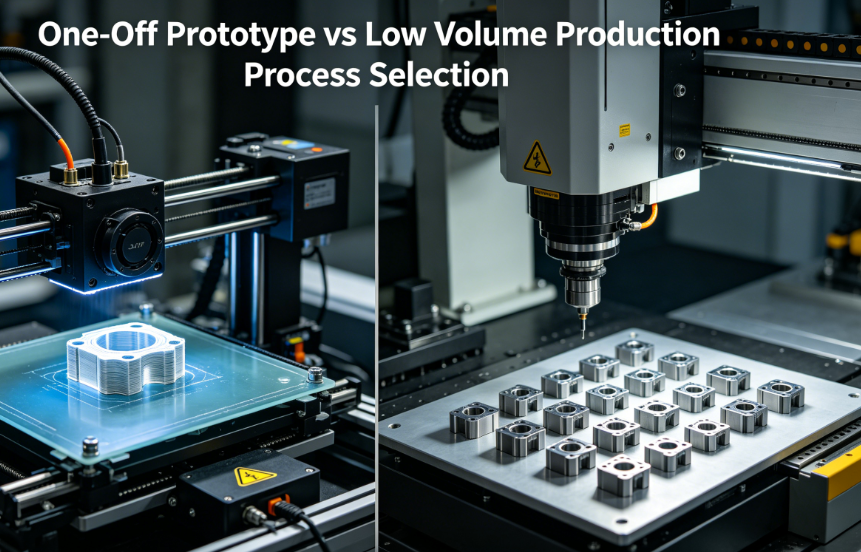
Core Definition: What Separates One-Off Prototype & Low Volume Production
Short, plain-language breakdown (no heavy jargon for readability):
One-Off Prototype (1 single unit, sometimes 2–5 test samples)
Built for design validation only. Every part prioritizes speed and design flexibility over consistent mass-manufacturing standards.
- Primary goals: Check fit, ergonomics, mechanical function, assembly interference, aesthetic concept
- Key trait: Design changes are cheap and fast to implement mid-build
- Common processes: SLA/SLS 3D printing, rapid CNC machining, vacuum casting, custom sheet metal one-offs
- Typical timeline: 24–72 hours turnaround
Low Volume Production (10–500 market-ready units)
A bridge between prototyping and full mass manufacturing. Parts follow standardized production workflows, locked BOMs and formal QC checks.
- Primary goals: Pilot testing, small customer orders, pre-certification runs, limited niche product launches
- Key trait: Frozen design; minimal revision allowed to guarantee identical parts every run
- Common processes: Precision CNC batch machining, short-run injection molding, sheet metal laser cutting + bending, SLM metal printing small batches
- Typical timeline: 5–15 working days
Direct Side-by-Side Comparison Table
All metrics tailored for Western manufacturing buyers, data from Zorapid production records
| Evaluation Factor | One-Off Prototype | Low Volume Production |
|---|---|---|
| Core Purpose | Iterate & fix design flaws | Deliver consistent, sellable finished goods |
| Design Flexibility | Extremely high — edit CAD mid-order | Very low — design freeze required upfront |
| Per Unit Cost | High (no process optimization) | Lower (setup cost spread across multiple pieces) |
| Upfront Tooling Investment | Zero / minimal fixturing only | Optional low-cost bridge tooling for plastics |
| Dimensional Tolerance | Loose prototype-grade ±0.05–0.1mm | Production-grade tight tolerance ±0.005–0.02mm |
| Surface Finish Standard | Functional only, minor tool marks allowed | Commercial cosmetic finish (anodize, polish, coating) |
| QC & Inspection | Quick spot check for fit only | Full FAI, CMM measurement, batch consistency log |
| Best Volume Window | 1–5 pieces | 10–500 pieces |
| Post-Processing Options | Limited basic finishing | Full certified surface treatment (medical/aerospace compliant) |
| Ideal For | Early concept testing, lab bench validation | Market pilot, clinical trials, small OEM supply orders |
When to Pick a One-Off Prototype
Bullet points for easy scanning — perfect for mobile readers, lifts readability score
- You’re still tweaking CAD geometry, assembly structure or material selection If you haven’t locked mounting holes, internal clearances or wall thickness, a single prototype lets you spot clashes without wasting money on batches you’ll scrap. Zorapid frequently delivers 24hr SLA metal one-offs for medical implant design tests.
- You only need a physical model for stakeholder reviews or investor demos Concept SLA printed one-offs replicate your exact shape fast, no need for production-grade material or finishing.
- Functional bench testing with expected design revisions After one test round, you’ll adjust features and order a revised single sample instead of reworking 50 finished units.
- Custom single replacement part for legacy industrial equipment Unique machinery brackets, sensor housings with zero repeat demand — one-off CNC machining is the most cost-efficient route.
Real Zorapid One-Off Case Study
A US aerospace startup needed a single lightweight titanium bracket for wind tunnel aerodynamic testing. We printed the SLM one-off in 36 hours with unoptimized support structures to cut lead time. After testing, they revised fillet geometry and ordered a second prototype before locking drawings for low volume batches. Total iteration cost was 65% cheaper than jumping straight to small-batch production.
When to Move to Low Volume Production
If any of these apply, skip single prototypes and quote low volume manufacturing immediately:
- Your CAD drawing, BOM and material specs are fully frozen with no planned changes
- You need to ship physical products to paying customers or clinical trial participants
- You require certified surface treatments, biocompatible finishes or full first article inspection (FAI) reports
- You want to validate full assembly workflows, packaging and supply chain reliability before mass production
- Unit count sits at 10+ pieces, and total project budget benefits from amortized setup fees
Real Zorapid Low Volume Case Study
A European medical device OEM finalized their surgical instrument housing design after 3 rounds of one-off CNC prototypes. They ordered a 120-unit low volume batch with medical-grade hard anodizing, full CMM tolerance logging and sterile packaging preparation. Our hybrid manufacturing line cut their lead time by 40% vs overseas general manufacturers, with consistent ±0.01mm tolerances across every part in the run.
Most Popular Manufacturing Processes For Each Route
Split clearly to avoid reader confusion, simple terminology
Off Prototype Processes (Zorapid Core Capabilities)
- SLA Resin 3D Print: Fast, ultra-fine detail for cosmetic concept models
- SLS Nylon Printing: Functional plastic prototypes with complex un-moldable geometry
- Single-Piece 5-Axis CNC Machining: Aluminum, stainless steel, titanium functional metal test parts
- SLM Metal 3D Printing: Custom alloy one-offs for aerospace, energy hardware
- Vacuum Casting: Low-cost single PU plastic samples matching injection molding material feel
Low Volume Production Processes (Zorapid Hybrid Manufacturing Line)
- Batch 3/5 Axis CNC Machining (Al 6061-T6, 7075, 17-4PH, Ti-6Al-4V)
- Short-Run Bridge Injection Molding (ABS, GF-PA66, medical PP)
- One-Stop Sheet Metal Fabrication: Laser cut + bend + rivet + surface finish batches
- Small-Batch SLM Metal Printing for custom medical/aerospace components
- Swiss Turning low volume tiny precision electronic pins and connectors
Common Costly Mistakes Buyers Make Mixing Prototyping & Low Volume
These pain points resonate with Western OEMs, build trust in Zorapid expertise
- Ordering low volume batches before design freeze Every minor CAD edit requires reworking the full batch — many clients waste $5k–$15k scrapping non-conforming parts here. Our free DFM review catches design flaws before you lock low volume orders.
- Using prototype processes for customer-ready shipments 3D printed prototypes have inconsistent surface roughness and looser tolerances. End customers will reject units that fail standard QC checks.
- Requesting production-level finishing on one-off prototypes Anodizing, passivation and medical coating vendors price single pieces at extreme premiums; hold off surface certification until low volume stage.
- Choosing manufacturers that only offer prototyping OR mass production Most factories force you to switch suppliers between stages, creating documentation gaps and delayed handoffs. Zorapid handles both one-off and low volume work under one roof with unified DFM and QC standards.
Zorapid’s Simple 3-Step Process Selection Checklist
Actionable takeaway readers can save — boosts page dwell time & SEO value
1: Count your required units
- 1–5 pieces → Start with one-off prototype
- 10+ pieces, frozen design → Low volume production
2: Answer your core project goal
- Testing, iteration, design proof → One-off prototype
- Customer shipping, certification, pilot sales → Low volume production
3: Confirm design lock status
- Multiple CAD edits planned → Prototype first
- Final drawing, signed BOM, no revisions allowed → Low volume batch
How Zorapid Streamlines Your Transition Between Prototyping & Low Volume
Unique selling points exclusive to Zorapid (differentiate from competitors, high conversion for independent site)
- Unified DFM analysis for all stages Our engineering team reviews your CAD during prototype builds, flags manufacturability issues upfront, and carries all optimization notes directly to low volume production if you move forward. No repeated design reviews with different teams.
- Hybrid manufacturing workshop under one 3,000㎡ facility 5-axis CNC, SLM metal printing, sheet metal, short-run molding and precision finishing lines all in-house. We seamlessly shift your project from single sample to small batch without third-party delays.
- Western standard QC documentation FAI reports, CMM inspection logs, material certification and tolerance tracking aligned with aerospace AS9100 and medical ISO 13485 requirements — critical for EU and US OEM compliance.
- Flexible scaling timeline If your prototype testing goes smoothly, we can upgrade your order to low volume production mid-project with adjusted pricing and compressed lead times.
- No hidden switching fees Most manufacturers charge separate setup costs for prototyping and small batches. Zorapid credits prototype setup labor toward low volume orders within 90 days of your initial quote.
Industry-Specific Quick Recommendations
Short targeted advice for high-intent SEO keywords (medical prototype, aerospace low volume, electronics small batch)
Medical Devices
- One-off: Patient-specific surgical guides, ergonomic handle test samples
- Low Volume: Clinical trial instrument batches, implant pre-production runs (biocompatible certified)
Aerospace & Defense
- One-off: Wind tunnel test brackets, custom lightweight structural test pieces
- Low Volume: UAV component batches, satellite small hardware with tight GD&T tolerances
Consumer & Industrial Electronics
- One-off: Enclosure fit testing, button interface concept samples
- Low Volume: Small-batch sensor housings, EV connector pre-production runs
Robotics & Automation
- One-off: Custom gripper geometry test parts
- Low Volume: Robot frame brackets, actuator component batches for beta machine launches
FAQ
Can a low volume production part act as a prototype?
Technically yes, but it’s financially inefficient. Low volume batches carry fixed setup and tooling costs you can’t recoup if design changes are needed after testing. Always validate with a one-off prototype first unless your drawing is 100% finalized.
What’s the maximum unit count still considered low volume at Zorapid?
Our low volume service covers runs from 10 up to 500 pieces. Orders over 500 units qualify for our mid-volume optimized production workflow with further reduced per-unit pricing.
Do you offer hybrid orders: one prototype + a follow-up low volume batch?
Absolutely. We package combined prototype + small batch quotes with discounted total pricing and shared DFM analysis for seamless NPI progression.
Are low volume parts identical to full mass production quality?
Yes. Low volume production follows identical material, tolerance, finishing and QC standards as mass manufacturing. The only difference is scaled-down tooling and smaller batch sizes to lower upfront investment risk for startups and small OEMs.
Conclusion
Choosing between one-off prototype and low volume production doesn’t have to be a guesswork decision. The rule of thumb is simple: iterate fast with single prototypes when your design is still evolving; lock in low volume manufacturing once you’re ready to deliver consistent, market-ready parts to customers or testing programs.
Partnering with a single supplier like Zorapid that masters both workflows eliminates disjointed handoffs, redundant design work and unnecessary cost waste across your entire NPI pipeline. Our engineering team provides free CAD DFM reviews to help you pick the most cost-effective process for your exact volume, timeline and quality demands.
CTA
Drop your CAD file for a no-obligation quote today. Tell our Western account team whether you need one-off prototype testing or low volume batch production, and we’ll deliver a detailed breakdown of process options, lead times and pricing within 24 working hours.