Published by Zorapid
Struggling with drifting Ra, chatter marks, and inconsistent surface finish during lights-out long-run turning? Zorapid shares factory-proven setup, tooling & process tweaks to lock uniform surface quality across thousands of continuous turned parts.
If you run long, unattended turning batches—whether Swiss sliding head bar feed jobs or multi-hour fixed-head lathe production—you’ve almost certainly hit this costly headache:
Your first 100 parts hit perfect Ra specs (Ra 0.4–1.6µm, clean burr-free surfaces), but after 3,000, 8,000 or 12,000 continuous pieces, surface quality slowly falls apart.
You’ll spot rippling chatter marks, hazy matte patches, inconsistent micro-scratches, and drifting roughness readings. Quality teams start rejecting units, operators pause lights-out production to re-adjust tools, and your whole batch timeline blows out.
At Zorapid, our 3,000㎡ precision turning workshop runs non-stop continuous bar feed jobs for EU, US, and Australian OEMs daily—medical pins, EV shafts, aerospace fasteners, industrial hydraulic fittings, all requiring repeatable surface finish across tens of thousands of parts.
Over 20 years refining unattended turning workflows, we’ve built a complete, repeatable system to lock stable surface roughness from part to part 15,000, no mid-run manual intervention required. This post skips generic textbook theory and delivers only shop-verified, actionable fixes you can implement immediately on your long turning orders.
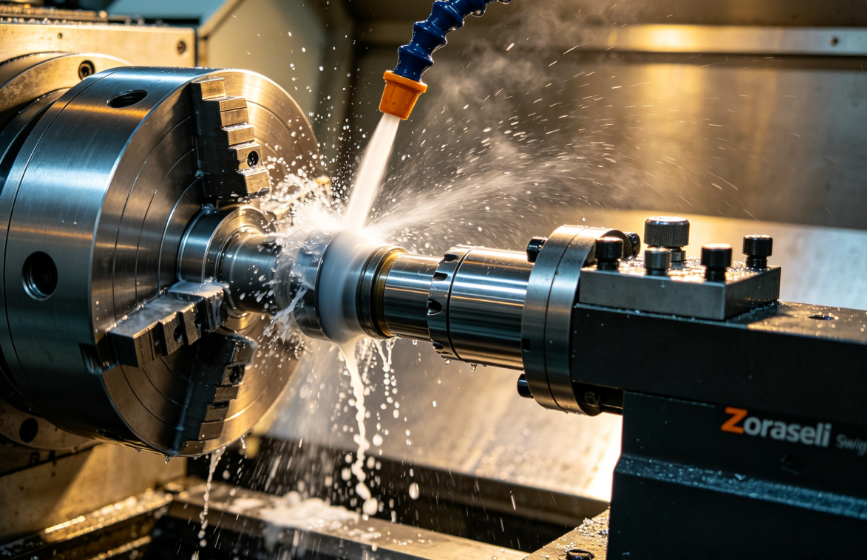
Top 5 Root Causes Of Shifting Ra In Continuous Production
Before jumping into solutions, let’s break down exactly why surface finish degrades during extended, non-stop turning:
- Progressive tool flank wear: Carbide inserts slowly dull over hours of cutting; worn edges create jagged, inconsistent surface scallops and raise Ra values steadily
- Machine thermal drift: Spindle, turret, and workpiece heat up over continuous operation, causing tiny deflection and subtle chatter that ruins uniform finish
- Built-up edge (BUE) buildup: Chips weld onto the cutting edge mid-run, dragging metal across finished surfaces and leaving streaky haze, common in stainless steel, aluminum, and titanium
- Uncontrolled vibration/chatter: Fatigued toolholders, excessive tool overhang, or unstable tailstock pressure amplify resonant vibrations as cutting forces shift with wear
- Poor chip evacuation: Stringy chips recut finished surfaces when coolant pressure or nozzle targeting fails mid-batch
Small prototype runs mask these issues, but every minor compounding flaw multiplies over thousands of continuous parts—wasting raw material, labor, and shipment windows.
Rigid Workholding & Machine Thermal Stabilization (Foundation Of Consistency)
You can tweak cutting parameters all day, but unstable setup guarantees drifting surface finish on long runs. Rigidity and thermal control are your first critical layer of defense.
Machine Thermal Pre-Cycle (Mandatory For All Zorapid Long Runs)
We run a 45-minute warm-up cycle before starting any continuous batch: full spindle RPM sweep, turret axis reciprocation, and dummy material cutting to stabilize machine base temperature to a constant 22°C workshop ambient.
Without pre-heating, spindle bearing expansion shifts cutting geometry; we’ve seen Ra swing from 0.6µm to 2.2µm in the first 2,000 parts due to uncalibrated thermal growth alone.
Workholding & Support Rules For Long Continuous Turning
- Swiss lathe jobs: Use precision ground guide bushings matched to bar stock diameter; eliminate radial runout below 0.002mm to stop thin shaft vibration
- Fixed-head long shafts: Calibrate tailstock pressure with dial indicator before batch start; over/under pressure creates taper and uneven surface bands
- Toolholding upgrade: Replace standard ER collets with hydraulic or shrink-fit holders to cut tool runout from 0.008mm down to <0.002mm, drastically reducing chatter over multi-hour cuts
- Minimize tool overhang: Shorten stick-out length as much as possible—10% less overhang boosts tool rigidity by ~25% and suppresses vibration that degrades finish
For slender long turned components (length:diameter >5:1), we add vibration-damping boring bars and steady rest supports to lock consistent surface quality across full bar feed cycles.
Grade-Matched Tooling + Wiper Inserts To Slow Wear Drift
Tool degradation is the 1 driver of worsening surface finish mid-batch. Our standardized tooling stack for long continuous turning eliminates gradual Ra creep:
- Material-specific coated carbide grades
- Aluminum: High-polish uncoated carbide or diamond inserts to resist BUE
- 304/316 stainless: TiAlN coated micro-grain carbide, low friction coating slows flank wear
- Titanium / 17-4PH: Multi-layer heat-resistant coatings to delay edge breakdown during long cutting cycles
- Wiper finishing inserts as standard for all long-run finish passes Standard round nose inserts create scalloped surface patterns that grow larger as edges wear. Wiper geometry adds a flat secondary finishing land that smooths scallops, holding stable Ra even with mild insert wear over thousands of parts. Our production data: Wiper inserts maintain Ra ±0.2µm variance across 10,000 parts, vs ±1.0µm drift with standard inserts on identical stainless steel shafts.
- Predictable tool life scheduling We log maximum usable cut time per insert edge based on material, cutting speed, and target Ra. Once flank wear hits 0.1mm VB threshold, the machine auto-triggers tool offset correction before surface quality drops—no operator guesswork required.
Optimized Finishing Parameters Tuned For Multi-Hour Unattended Runs
Most shops program short-run prototype feeds/speeds and reuse them for continuous production—this accelerates wear and finish instability. We use a two-stage finishing parameter setup built for endurance:
Core Finishing Rules For Long Continuous Turning
- Use moderate constant cutting speed (avoid extreme high/low RPM): Excessively high speed burns tool coatings fast; too low speed triggers heavy built-up edge. We lock speeds into the material’s stable “sweet spot” from stability lobe testing to avoid resonant chatter frequencies.
- Reduce finishing feed rate slightly vs short-batch jobs: The theoretical Ra formula shows roughness rises with feed squared; lowering feed 15–20% creates a larger buffer against minor tool wear drift mid-run. Standard long-run finish feed: 0.06–0.10 mm/rev (vs 0.12–0.15 mm/rev for short prototypes)
- Thin consistent finishing depth of cut (0.1–0.2mm): Heavy finish passes spike cutting force, amplify vibration, and accelerate edge wear. Light uniform stock removal delivers steady surface quality for thousands of pieces.
- Adaptive variable feed programming for inconsistent stock: Bar stock minor diameter variance creates fluctuating cut load. Our CAM adaptive paths adjust feed in real time to maintain constant chip load, preventing sudden surface roughness spikes mid-batch.
Sample stable long-run parameter set (304 stainless steel shaft, target Ra 0.8µm):
- Cutting speed Vc: 160 m/min
- Finish feed: 0.08 mm/rev
- Depth of cut ap: 0.15 mm
- Wiper insert 0.8mm nose radius
High-Pressure Directed Coolant To Kill Built-Up Edge & Heat Buildup
Heat and welded chip material (BUE) are silent finish destroyers during non-stop turning. Our high-pressure coolant system is non-negotiable for stable long batches:
- Through-tool internal coolant + dual external top/bottom jets at 70–100 bar pressure
- Coolant concentration maintained at 7–9% mixed solution, filtered daily to remove fine metal swarf that scratches finished surfaces
- Precision nozzles targeted directly at the cutting edge—no scattered flood cooling that fails to flush chips away
Key Coolant Benefits For Continuous Runs
- Suppresses extreme cutting heat that softens tool coatings and accelerates wear
- Blows stringy stainless/titanium chips clear of finished OD surfaces to eliminate recut scratch marks
- Prevents built-up edge from forming on insert cutting edges, which causes hazy, inconsistent surface haze
- Stabilizes workpiece temperature across multi-hour cutting to avoid dimensional and surface drift
We’ve cut Ra variance by 65% on 10,000-piece stainless bar runs solely by upgrading to through-spindle high-pressure coolant delivery.
Automated In-Process Monitoring & Tool Offset Compensation
Manual operator spot checks every 30 minutes can’t catch slow, gradual surface finish drift during overnight lights-out turning. Our fully automated closed-loop process eliminates human error:
- Turret-mounted contact probing: Machine auto-measures finished part diameter every 20–50 units
- Auto tool wear offset correction: When measured diameter drifts beyond ±0.003mm threshold, the CNC controller automatically adjusts X-axis tool offsets to compensate for insert flank wear
- Scheduled surface roughness sampling: For critical medical/aerospace parts, we pause every 500 pieces for automatic profilometer Ra logging to track trend lines
- Tool life alert logic: Machine flags insert replacement once pre-programmed part count or wear threshold is hit, before surface quality falls out of spec
This system keeps surface finish consistent across 10,000+ piece unattended runs without any manual operator adjustments.
Zorapid Real Client Case Study: 12,000-Piece Continuous Stainless Shaft Run
Client Background
German industrial pump OEM, 12,000-unit continuous bar feed turning job, 316 stainless steel pump shafts, strict as-turned Ra ≤0.8µm requirement, 24-hour unattended production window.
Original Pre-Optimization Pain Points
- After 3,200 parts: Ra drifted up to 1.8–2.4µm, visible chatter streaks and surface haze
- Operators forced hourly stops to tweak tool offsets, breaking lights-out workflow
- Scrap rate hit 11% from inconsistent surface finish mid-batch
- Standard uncoated inserts required full replacement every 2,800 pieces
Zorapid Full Stability Optimization Rollout
- 45-minute machine thermal warm-up cycle before batch launch
- Hydraulic toolholders + shortened tool overhang for maximum rigidity
- Swapped standard inserts for TiAlN coated wiper finishing geometry
- Installed 80 bar through-spindle high-pressure targeted coolant jets
- Reprogrammed adaptive low-feed finishing parameters for long-run endurance
- Activated automatic turret probing + tool wear offset compensation
Final Measurable Results
- Stable Ra locked at 0.5–0.75µm from part 1 all the way through part 12,000
- No mid-batch manual adjustments required; full 24-hour lights-out production completed
- Insert service life extended to 7,600 pieces per edge (2.7x longer than original tooling)
- Surface finish scrap rate dropped from 11% to under 0.4%
- Client eliminated costly secondary polishing operations to fix rough surfaces
DFM Design Tweaks That Simplify Stable Long-Run Turning
Minor design changes on your CAD drawing drastically reduce surface finish instability risk during continuous mass turning—we flag all these issues in our free pre-production DFM review for OEM clients:
- Avoid abrupt sharp diameter shoulders; add smooth 0.4mm+ radii to eliminate cutting force spikes that trigger chatter
- Standardize groove widths and relief radii to match wiper insert nose radii, preventing uneven finish at feature transitions
- Limit deep narrow bores (L:D ratio ≤10:1); deep internal turning creates tool deflection and fluctuating ID surface roughness
- Avoid ultra-fine finishing Ra specs (<0.2µm) for high-volume unattended runs unless secondary polishing is budgeted—long-run wear makes ultra-mirror as-turned finish hard to sustain
- Consolidate small intermittent features to reduce constant cutting load variation across the part length
All DFM adjustments preserve your functional tolerances and performance specs while creating a far more stable turning process for thousands of continuous units.
Zorapid’s Standard Continuous Turning SOP For Consistent Surface Finish
Every long unattended turning order at our facility follows this fixed 6-step workflow to guarantee uniform surface finish:
- CAD DFM analysis: Flag geometry that creates chatter, variable chip load or unstable cutting zones
- Machine thermal stabilization pre-cycle + spindle/tailstock alignment calibration
- Material-matched wiper tooling setup with vibration-damping holders
- Long-run optimized finishing parameters + adaptive feed CAM programming
- High-pressure targeted coolant system calibration & concentration testing
- Activate auto probing, tool offset compensation and tool life monitoring logic
Once the first article inspection passes Ra specs, the full batch runs uninterrupted with consistent surface quality, backed by our ISO 9001 quality documentation for all exported OEM orders.
Quick Troubleshooting Cheat Sheet For Surface Finish Drift In Long Runs
| Symptom Visible On Turned Parts | Root Cause | Fast Long-Run Fix |
|---|---|---|
| Wavy rippling chatter marks | Vibration / tool overhang / unstable tailstock | Shorten tool stick-out, switch to hydraulic holders, re-calibrate tailstock pressure |
| Hazy matte streaks across OD | Built-up edge (BUE) | Upgrade wiper coated inserts, boost through-tool coolant pressure |
| Ra slowly rises over thousands of parts | Progressive insert flank wear | Enable auto tool offset correction, set scheduled insert change thresholds |
| Scratch lines on finished surfaces | Unflushed chips recutting part | Reposition coolant nozzles to blast cutting zone directly |
| Tapered uneven surface bands | Machine thermal drift | Add mandatory pre-batch thermal warm-up cycle |
FAQ
Can wiper inserts hold stable Ra for 10,000+ continuous parts?
Yes, when paired with material-matched wear-resistant coatings and high-pressure coolant. Our stainless steel production runs regularly maintain consistent Ra across 7,000–12,000 pieces per wiper edge before minor offset correction is needed.
Do I need climate-controlled workshops to stabilize surface finish on long turning jobs?
Consistent ambient temperature (20–24°C) helps, but our thermal pre-cycle warm-up process eliminates most drift risk even without full climate control. Critical ultra-fine Ra (<0.4µm) medical batches do run in our temperature-locked precision turning cell.
Is lights-out continuous turning possible with consistent surface finish?
Absolutely—our full automation stack (auto probing, tool life management, adaptive feeds, high-pressure coolant) removes all manual intervention. The German pump shaft case study above completed a full 24-hour unattended batch with zero surface quality rejects.
Will lowering feed rates hurt my long-run production speed?
The small feed reduction for stable finishing only adds 5–10% cycle time per part, but eliminates hours of mid-batch downtime for tool tweaks and rework. Net total throughput improves drastically over full large batches.
Does this stabilization process apply to Swiss sliding head turning AND standard fixed-head lathes?
All strategies translate directly to both machine types; Swiss jobs add guide bushing calibration as an extra rigidity step for ultra-slender long bar stock parts.
Final Wrap-Up
Unstable surface finish during long continuous turning isn’t an unavoidable mass production flaw—it’s a failure to build a fully balanced process covering machine rigidity, thermal control, wear-resistant tooling, targeted cooling, and automated monitoring.
Most fabricators only optimize for short prototype runs and ignore the compounding wear and heat effects of thousands of uninterrupted pieces. At Zorapid, our entire turning workflow is engineered specifically for lights-out, high-volume continuous bar feed production, locking repeatable Ra from the first to last component of your order.
If you’re planning a large continuous turning batch and want a free DFM + process stability assessment to eliminate surface finish drift and scrap, send your CAD files to our precision turning engineering team for a no-obligation optimized quote today.