Published by Zorapid
If you’ve burned through carbide cutters mid-batch, dealt with blurry surface finishes, or watched your stainless parts work-harden into un-machinable junk, this guide is built for you.
Most machinists grab a generic 4-flute AlTiN mill and call it a day—then lose hours reworking parts, tossing chipped tools, and missing client deadlines. Stainless steel and hardened tool steel don’t play by the same machining rules. One wrong geometry or coating choice slashes tool life by 60% or more.
At Zorapid, our 3,000㎡ 5-axis CNC workshop runs thousands of stainless (304, 316, 17-4 PH) and hardened steel (H13, D2, 4140 HRC45–62) parts monthly for aerospace, medical, mold, and automotive OEMs. We’ve tested dozens of end mill lines side-by-side to lock in reliable, cost-saving selection rules.
This no-fluff guide skips textbook theory and gives you shop-ready picks, exact speed/feed numbers, and quick fixes for every common failure. By the end, you’ll stop guessing and match your end mill perfectly to your workpiece every time.
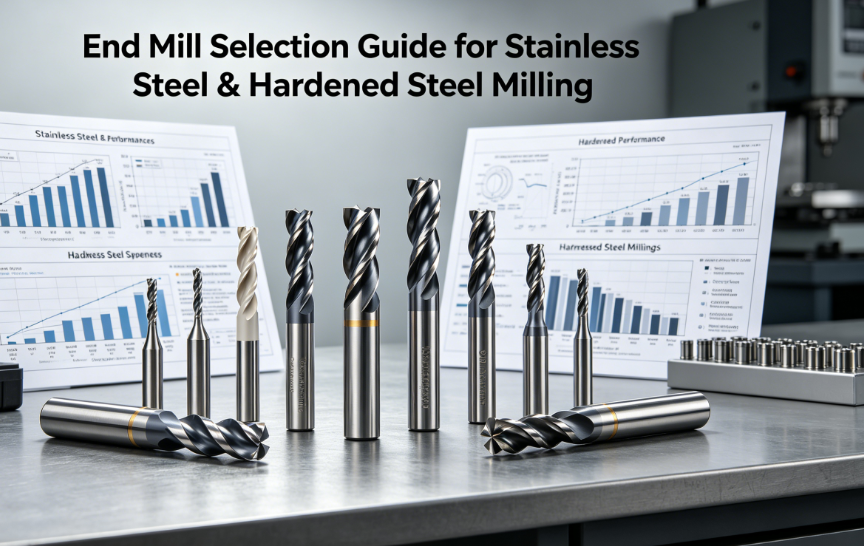
Core Milling Headaches: Stainless vs Hardened Steel
Before choosing a cutter, understand what you’re fighting against for each material—their unique flaws dictate every end mill design choice.
Stainless Steel (304, 316, Duplex, 17-4 PH) Main Pain Points
- Severe work hardening: Any rubbing, slow feed, or tool dwell instantly hardens the cutting zone, creating a rock-hard skin that chews edges to dust
- Low thermal conductivity: Heat gets trapped at the flute tip instead of escaping via chips
- Built-Up Edge (BUE): Sticky alloy smears onto tool flutes, ruining surface finish and dimensional tolerance
- Heavy cutting forces that trigger chatter on thin walls or deep slots
Hardened Steel (HRC 45–68: H13, P20, D2, 4140 QT) Main Pain Points
- Extreme abrasive wear: Hard martensitic grains grind carbide edges flat in minutes
- High compressive stress: Weak substrate mills chip instantly under heavy radial cuts
- Thermal cracking: High cutting heat creates micro-cracks along flute edges
- Minimal room for error—even tiny tool deflection ruins precision mold surfaces
Key takeaway: Your stainless steel end mill needs great chip evacuation and anti-stick properties. Your hardened steel end mill needs ultra-rigid substrate, reinforced edge prep, and high-heat coatings. Never cross-use them long-term.
Pick The Right Carbide Substrate First
High-speed steel (HSS) end mills are dead weight for these two materials. HSS can’t hold hardness above 500°F cutting temp—your edges dull within 10 parts. Stick 100% to solid tungsten carbide.
Best Carbide Grades For Stainless Steel
- Submicron grain WC-Co carbide, 8–10% cobalt content
- Higher cobalt boosts toughness to resist chipping during interrupted cuts
- Avoid ultra-low Co carbide (6% or less): Too brittle for sticky stainless shear forces
Best Carbide Grades For Hardened Steel (HRC ≥50)
- Fine/nano grain carbide, 5–7% cobalt content
- Lower cobalt = higher substrate hardness, fights abrasive grain wear
- Mandatory edge honing (0.001–0.002” micro radius) to stop edge micro-chipping on hard steel
Zorapid Shop Tip
We stock two dedicated end mill lines: SS-series high-Co carbide for stainless, HM-series low-Co reinforced carbide for hardened tool steel. Generic all-purpose carbide cuts 30–40% shorter life on both materials.
Flute Count, Helix & Rake Geometry Breakdown (Stainless VS Hardened Steel)
Geometry makes or breaks chip flow, heat management, and surface quality. Below is our field-tested split for each workpiece material.
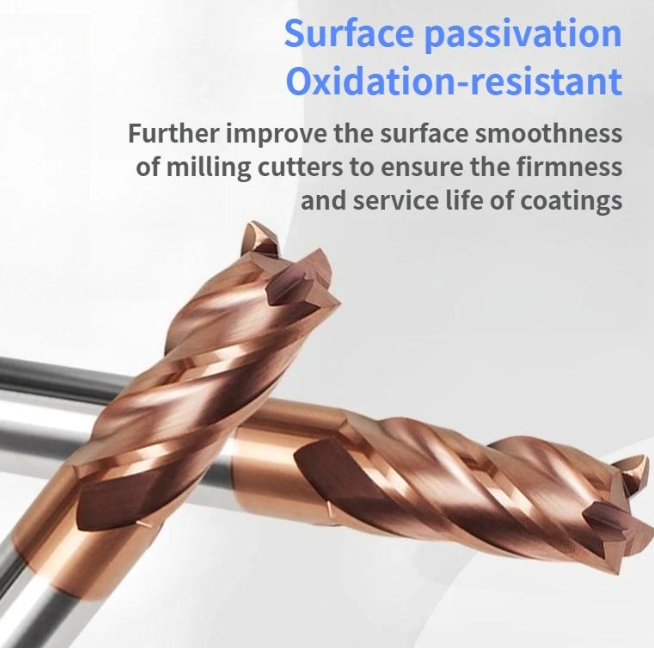
Stainless Steel End Mill Geometry Rules
- Flute Count:
- Slotting / Deep roughing: 2-flute (massive gullets for fast chip evacuation, eliminates BUE)
- Contour finishing / Thin walls: 3–4 high-helix flutes
- Helix Angle: 40°–50° high helix Sharp shear angle slices stainless instead of plowing, drastically cuts work hardening risk
- Rake Angle: Positive ground rake (6°–10°) Reduces cutting load, prevents material smearing on flutes
- Optional: Polished flute surfaces to cut BUE adhesion by half
Hardened Steel End Mill Geometry Rules
- Flute Count: Always 4-flute minimum (rarely 6-flute for ultra-finishing) More flutes spread cutting load evenly, less deflection on hard material Skip 2-flute mills entirely for HRC 50+ steel—too much stress per flute
- Helix Angle: 30°–35° medium helix Balances rigidity and chip flow; high helix weakens thin cutting edges on hard steel
- Rake Angle: Slightly neutral / low positive (2°–4°) Reinforces edge strength to stop chipping under high abrasive loads
- Mandatory: Micro edge hone on all cutting corners
End Mill Coatings Cheat Sheet – Which One Wins Each Material
Coatings control heat resistance, friction, and wear life. We cut through marketing hype to list only coatings that deliver measurable shop gains.
| Coating Type | Max Heat Tolerance | Best For | Skip For |
|---|---|---|---|
| AlTiN Multilayer | 850°C / 1560°F | Hardened steel HRC45–68, high-speed stainless roughing | Low-speed dry light cuts |
| AlCrN Nano | 1100°C / 2010°F | 316 / 17-4 PH stainless, long-run production | Soft mild steel |
| TiSiN Nano Composite | 1200°C / 2190°F | Hardened steel finishing, mirror surface mold work | Deep rough slotting (high impact risk) |
| TiCN | 400°C / 750°F | General mild steel only | All stainless & hardened steel (too low heat resistance) |
| TiN Gold | 300°C / 570°F | Hobby low-volume cuts only | Production runs on target materials |
Zorapid Pro Pick
- Stainless steel production rough/finish: AlCrN nano coated end mills (35–50% longer tool life vs standard AlTiN)
- Hardened mold steel rough + finish: AlTiN for roughing, TiSiN for final mirror finishing passes
Quick Reference Chart: Recommended End Mills + SFM/IPT Speeds & Feeds
All values are wet cutting with flood high-pressure coolant (MQL dry cuts reduce SFM by 30%). Units: SFM (Surface Feet Per Minute), IPT (Inches Per Tooth Chip Load)
Stainless Steel (304 / 316 / 17-4 PH)
| Operation | End Mill Spec | SFM Range | IPT Feed Rate |
|---|---|---|---|
| Deep Slot Roughing | 2-flute 45° helix AlCrN carbide | 100–160 | 0.0025–0.004 |
| Contour Roughing | 4-flute high helix AlCrN | 120–180 | 0.002–0.0035 |
| Precision Finishing | 4-flute polished flute AlCrN | 140–200 | 0.001–0.002 |
Hardened Steel HRC 45–58 (4140 QT, P20, H13)
| Operation | End Mill Spec | SFM Range | IPT Feed Rate |
|---|---|---|---|
| Roughing Passes | 4-flute reinforced AlTiN carbide | 80–120 | 0.0018–0.003 |
| Semi-Finish Mold Cuts | 4-flute micro-honed AlTiN | 90–140 | 0.0012–0.0022 |
| Mirror Finishing (HRC 58–62 D2) | TiSiN nano coated 4-flute | 70–100 | 0.0008–0.0015 |
Critical Rule: Never drop feed rate below minimum IPT. Slow feeds create rubbing—#1 cause of stainless work hardening and premature tool failure.
Common Machining Defects & Tool Fixes (BUE, Chatter, Chipping, Work Hardening)
We troubleshoot these four issues daily at Zorapid’s CNC workshop—every problem traces back to wrong end mill selection or geometry mismatch.
Defect 1: Built-Up Edge (BUE) on Stainless Parts
Symptoms: Ragged surface finish, dimensional drift, blue/grey smears on workpiece edges
Root Cause: Low helix mill, unpolished flutes, wrong TiN/TiCN coating
Fix: Swap to high-helix polished AlCrN 2/4-flute stainless dedicated end mill, increase IPT feed rate
Defect 2: Edge Chipping on Hardened Steel Cutters
Symptoms: Flute corners chip after 10–20 parts, uneven finish lines
Root Cause: Low-Co cheap carbide, no edge hone, overly positive rake geometry
Fix: Upgrade to HM-series low-Co micro-honed carbide hardened steel mill, reduce helix angle to 30–35°
Defect 3: Severe Chatter Vibration
Symptoms: Loud machine hum, wavy chatter marks on side walls
Root Cause: Wrong flute count, overly long tool overhang, thin rigid substrate
Fix: Stainless: switch from 2-flute to 4-flute for thin walls; Hardened steel: shorter shank projection, 4-flute rigid carbide only
Defect 4: Work-Hardened Stainless Skin
Symptoms: Subsequent cuts grind instantly, impossible to hold tolerances
Root Cause: Slow spindle speed, minimal chip load, tool dwell in corners
Fix: Raise SFM to minimum 100, lock IPT above 0.002, use climb milling toolpaths only
Zorapid Real-World Shop Case: 17-4 PH Stainless + HRC 58 H13 Mold Steel Batch Run
Last quarter, a mold OEM client sent us a dual-material job: 200 stainless 17-4 PH fixture plates + 50 HRC58 H13 injection mold cores. Their in-house team burned through 18 generic AlTiN end mills in 2 days with terrible surface quality.
Our Zorapid Tool Selection Swap
- 17-4 PH Fixtures: 4-flute polished high-helix AlCrN stainless dedicated end mills
- H13 Mold Cores: Micro-honed TiSiN coated low-Co hardened steel carbide mills
Measurable Results
- Total end mill consumption dropped from 18 to just 4 cutters for full batch
- Stainless surface finish Ra improved from 1.6μm down to 0.4μm without secondary polishing
- Hardened mold core dimensional tolerance hit ±0.003mm consistent across all 50 parts
- Total machining cycle time cut 22% by running optimized SFM/IPT parameters
This is the difference between generic one-size-fits-all cutters and material-matched end mill selection our engineering team standardizes for every tough metal project.
Pro Machinist Quick Hacks To Double Your End Mill Lifespan
- Climb mill 100% of stainless steel operations—conventional milling cranks up work hardening risk
- Flood coolant directed straight at flute cutting zone; dry cutting slashes tool life by 70% on both materials
- Limit tool overhang to ≤3x cutter diameter for hardened steel to eliminate deflection
- Avoid full-width slotting on hardened steel—max radial engagement 50% of tool diameter
- Store dedicated stainless/hardened steel end mills in separate tool holders; cross-contamination from hard steel grit scratches stainless cutter flutes
When To Let Zorapid Handle Your Tough Stainless/Hardened Steel Milling Jobs
Even with perfect end mill selection, complex high-tolerance parts need hybrid manufacturing expertise most small shops can’t match. Zorapid’s 5-axis CNC + metal 3D print hybrid workflow solves hard-to-machine challenges:
- Complex internal cooling channels in H13 mold steel (print near-net shape then CNC finish)
- Thin-wall medical stainless components requiring ±0.005mm precision
- High-volume stainless batch runs with consistent mirror surface finishes
- Hardened steel fixture blanks with deep narrow slots that cause severe tool deflection
We run pre-job DFM analysis to lock end mill selection, speeds/feeds, and toolpaths before cutting any stock—eliminating costly trial-and-error for your team. Send your CAD drawings for a free machining feasibility review today.
FAQ
Can I use a hardened steel end mill to cut stainless steel?
Short light finishing passes work, but long runs waste money. Hardened steel mills have low helix & neutral rake that causes BUE and work hardening on stainless—tool life drops 40% minimum. Always use dedicated stainless geometry for stainless work.
Is a bull nose end mill better than square end for these materials?
Bull nose reduces corner stress on both stainless and hardened steel, perfect for mold contours. Square ends stay best for sharp shoulder features and slotting operations. Match the tool profile to your part geometry first.
Do nano coatings justify the higher end mill cost?
Absolutely for production batches. AlCrN / TiSiN nano coatings deliver 30–60% longer life than standard AlTiN, cutting your total tool spend long-term. Hobby low-volume jobs can stick to standard multilayer AlTiN.
What end mill works for duplex stainless steel?
4-flute 45° helix AlCrN polished carbide mills, SFM set 90–140, higher coolant pressure than standard 304 stainless—duplex alloys harden faster than austenitic grades.
Zorapid Closing CTA
Struggling with short end mill life or inconsistent surface finishes on stainless/hardened steel parts? Our in-house CNC engineering team can review your CAD files, lock optimized cutter selection, and deliver precision machined prototypes or low-to-high volume production batches fast. Reach out via our contact page to schedule your free DFM and machining parameter consultation.