A machining center is a multi-tool CNC machine widely used across manufacturing for component and custom part fabrication. This guide covers all key aspects of machining centers.
What Is a Machining Center?
Machining centers use assorted cutting tools to remove workpiece material for desired shapes, supporting drilling, milling and more.
Origin and History of Machining Centers
The first NC machine debuted in Germany in 1952, originally for saws, files and chisels. Automation and full machining center capabilities came in the late 1980s.
Advantages of Manufacturing Parts with Machining Centers
The benefits of using machining centers are as follows:
- Fast machining enabled by ATC (Automatic Tool Change).
- Higher productivity for part production.
- Superior precision and efficiency with tighter tolerances.
Key Components of the Machining Center
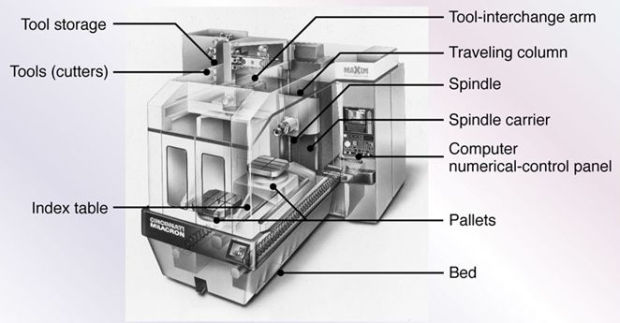
The given diagram illustrates multiple components of a machining center. Its key parts include:
Tool Storage, which holds various cutting tools;
Spindle, which controls the rotational speed of the tools;
Pallet, which facilitates workpiece replacement;
and Bed, on which parts are machined.
What Operations Does a Machining Center Perform?
Drilling blind holes or through holes on components with various drill bits. This process is known as drilling.
Tapping internal threads inside pre-drilled holes using different taps, which is called tapping.
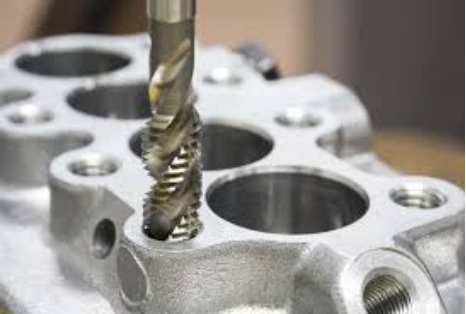
The boring process enlarges the diameter of pre-drilled holes on a machining center.
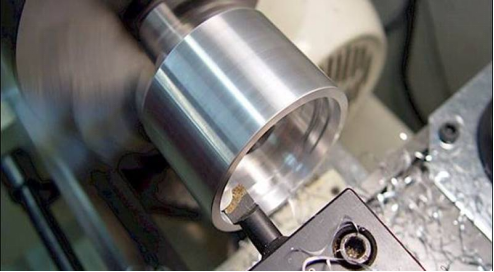
Grinding process can create complex shapes by cutting on a machining center.
Types of Machining Centers
An overview of different types of machining centers.
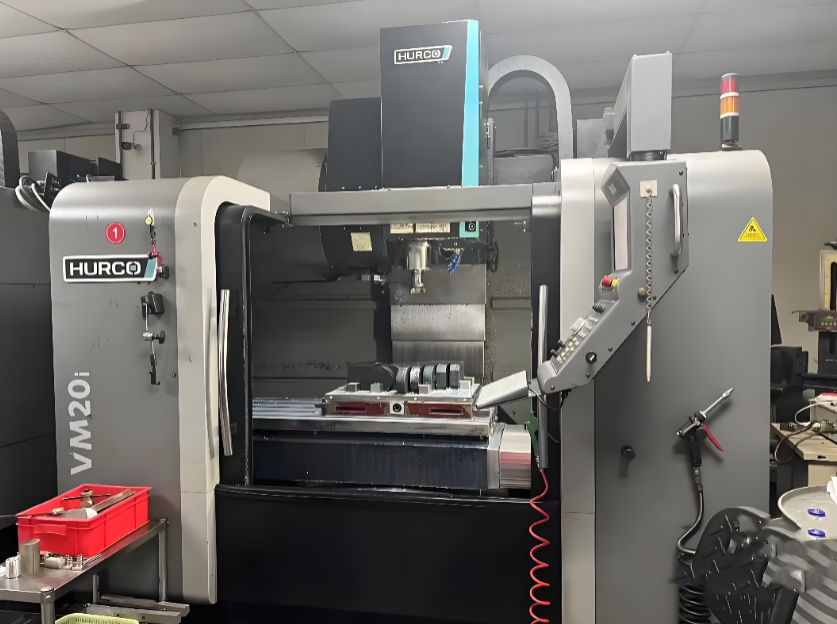
Vertical Machining Center (VMC)
This machining center excels at tight tolerances, with a vertical spindle aligned perpendicular to the workpiece. Equipped with ATC and APC, it ideal for small part machining. Its vertical design leaves chips on the surface, requiring manual cleanup.
Horizontal Machining Center (HMC)
Compared with vertical machining centers, the spindle of an HMC is arranged horizontally. It has a notable advantage over VMCs: chips do not accumulate on the workpiece surface and manual chip removal is largely unnecessary. Another benefit is its ability to machine 3 to 4 sides of a workpiece in a single setup. It offers excellent value for high-precision machining performance.
In summary, the core technical difference between the two machine types lies in the orientation of the spindle.
5-Axis Machining Center
A 5-axis machining center can operate on a workpiece in 5 different directions simultaneously. Its tool storage module holds a wide range of cutting tools for performing various operations such as drilling, milling, and more. Each CNC machine runs on CNC software, which controls the machine’s tools.
This machine offers more applications than any other type. Undercutting various parts is a challenging task, yet it becomes quite easy with this machine. While other machines cannot deliver customized machining solutions, 5-axis machines excel at this task as well. With its outstanding capabilities, it achieves higher efficiency, precision, quality, and output for parts than any other machine.
Which Industries Use Machining Centers?
The following section discusses some of the industries that utilize machining centers.
Aerospace Industry
This industry puts safety above all others. High-precision parts must meet strict safety standards, with machining centers and advanced tech producing complex components like turbine blades and fuselage parts.
Automotive Industry
Second only to aerospace, this industry uses machining centers to make complex automotive parts including brakes, chassis and engine components.
Oil and Gas Industry
Parts machined by machining centers include pump components, riser systems, valve bodies, and more. These parts are used in the exploration and production of oil and natural gas resources.
Part Manufacturability Machinability
Certain criteria must be met prior to machining and manufacturing. Key considerations include the workpiece geometry, process planning and optimization, cutting tools and their availability, and most importantly, the workpiece material. Selecting improper tools may result in waste of cost, time and labor.
FAQ
What is the difference between a machining center and a CNC milling machine?
The key difference is the built-in tool magazine and automatic tool change on machining centers for continuous multi-process production. Standard milling machines require manual tool change, leading to lower efficiency and higher positioning error.
What are the main types of machining centers?
Main types include vertical, horizontal, gantry and 5-axis simultaneous machining centers, covering small parts, large workpieces and complex curved components.
Why choose machining centers for precision manufacturing?
High rigidity, accurate positioning, fast automatic tool change and integrated processes ensure excellent dimensional consistency. It supports prototyping, small batches and mid-volume production for custom precision parts.