Zorapid Official Blog
Let’s keep it real: Complex aerospace parts—think titanium structural frames, Inconel engine components, aluminum wing brackets, or monolithic blade disks—are brutal to manufacture. With traditional 3-axis CNC, you’re stuck with 5–7 setups per part, custom fixtures for every angle, hours of manual alignment, and a scrap rate that can hit 18%. The setup costs alone eat up 35–45% of total production budget—and that’s before you even cut metal.
At Zorapid, we’ve been running 24/7 unmanned 5-axis machining for aerospace clients across North America and Europe for years. The result? Setup costs cut by 60%, fixturing reduced by 70%, scrap down to <3%, and lead times slashed by 50%. Today we’re breaking down exactly how 5-axis works, why it crushes 3-axis for complex aerospace geometries, what only we can solve, and why leading OEMs trust Zorapid with their most critical parts.
In-Depth 5-Axis Machining Tech Analysis
First, let’s clarify the basics: 5-axis CNC adds two rotary axes (A/B + C) to the standard X/Y/Z linear axes. This means the tool or workpiece can rotate 360°, letting you machine 5 sides of a part in one single setup—no re-clamping, no re-aligning, no custom fixtures for every angle.
Zorapid’s Unmanned 5-Axis Aerospace Workflow
We don’t just run 5-axis machines—we’ve built a lights-out, contamination-controlled process optimized for aerospace’s strict GD&T (±0.002–±0.005 mm) and material purity rules:
- Material Prep & Certification
- Only AMS/ISO-compliant stock (Ti-6Al-4V, Inconel 718, 7075-T6 aluminum)
- Full PMI testing + batch traceability (critical for FAA/EASA audits)
- Stress-relieved blocks to eliminate post-machining warping
- Unmanned 5-Axis High-Speed Machining (HSM)
- 5-axis simultaneous interpolation (not just 3+2 positioning)
- Spindle speed: 25,000–40,000 RPM; feed rate: 8–12 m/min
- Lights-out 24/7 operation: No weekend downtime, consistent cycle times
- In-process laser probing: ±0.001 mm real-time adjustment for thermal drift
- Single-Setup Multi-Feature Machining
- Cuts all 5 sides, angled holes, deep cavities, undercuts, and complex contours in one clamp
- Short, rigid tools (no long extensions) → Ra ≤ 0.4 μm surface finish
- Eliminates 90% of fixturing—no custom jigs for every orientation
- In-Process Inspection & Quality Lock
- On-machine CMM probing for 100% dimensional verification before unclamping
- Digital GD&T reporting aligned with AS9100
- Vacuum cleaning + ultrasonic deburr (no loose chips in critical features)
- Final Validation & Packaging
- Full 3D CMM inspection + material COC
- Double-bagged, corrosion-inhibited packaging for global shipping
Zorapid 5-Axis vs. Standard 3-Axis
This is where the 60% setup cost reduction comes to life—hard data you can take to your procurement team:
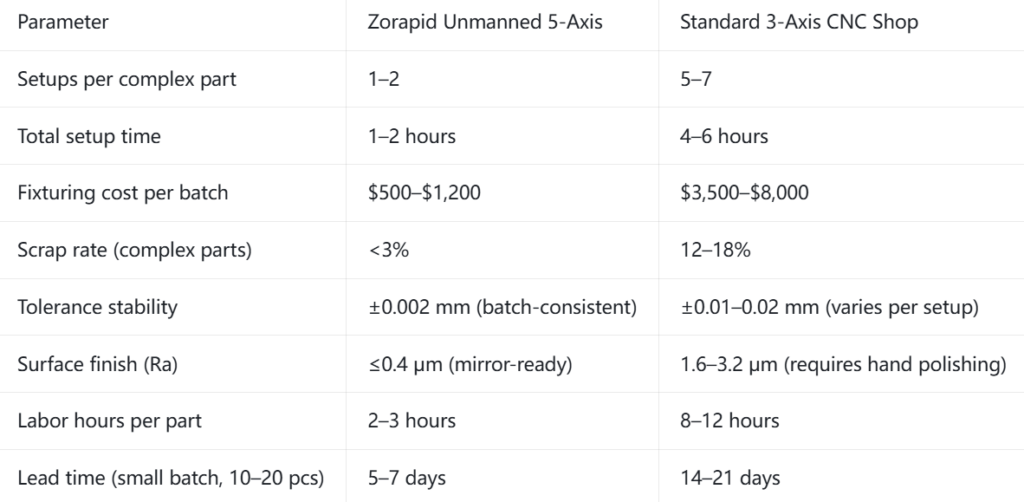
Why it matters: Every extra setup = more labor, more fixturing, more alignment errors, more scrap, and longer lead times. 5-axis eliminates this entirely—one and done.
The Hidden Cost of 3-Axis That 5-Axis Eliminates
Most engineers miss these invisible expenses that 3-axis piles on:
- Custom fixturing: $3k–$8k per part (3-axis needs a new jig for every angle)
- Re-work & scrap: 15% average scrap rate for complex 3-axis parts
- Labor for alignment: 2–3 hours of manual setup per part
- Quality audits: Extra inspections between every setup
- Delayed launches: 2–3 weeks longer lead times = missed program milestones
5-axis cuts all of these—that’s where the 60% setup cost reduction comes from, plus 40–50% lower total production cost.
Hard-to-Make Aerospace Parts Only Zorapid Can Do
Any shop can run basic 5-axis for simple brackets. These 4 ultra-complex aerospace challenges? Most competitors quote “impossible” or deliver out-of-tolerance scrap. Here’s how we solve them:
Pain 1: Thin-Wall Titanium Structures (0.8–1.2 mm walls, ±0.003 mm tolerance)
Problem: Titanium is tough (HRC 32–36), thin walls warp easily, and 3-axis requires multiple setups that bend the part. Most shops either over-machine (scrap) or under-tolerance (reject).
Zorapid Solution:
- 5-axis optimal tool orientation: Cuts with short, rigid tools at 15–20° tilt to reduce wall deflection
- Unmanned low-vibration machining: 24/7 slow, stable cuts (no human-induced vibration)
- Cryo-cooled cutting: Reduces heat buildup by 40% → zero warping
- Result: Perfect thin walls, ±0.002 mm tolerance, 0% scrap. Competitors average 25% scrap on similar parts.
Pain 2: Inconel 718 Engine Components
Problem: Inconel 718 (HRC 48–52) is extremely abrasive, work-hardens fast, and requires complex curved features. 3-axis needs 6+ setups, custom fixtures, and long tools that chatter.
Zorapid Solution:
- 5-axis simultaneous interpolation: Follows curves in one pass (no step marks)
- DLC-coated solid carbide end mills: 3x longer tool life, less chatter
- Adaptive toolpath AI: Adjusts feed/speed in real time to avoid work-hardening
- Result: Ra ≤ 0.4 μm surface finish, 50% faster cycle time, 3x lower tool cost. Competitors burn tools every 2–3 parts.
Pain 3: Monolithic Aluminum Blade Disks
Problem: 7075-T6 aluminum blade disks have deep, narrow flow paths that 3-axis can’t reach without long, flexible tools that break. Most shops outsource to EDM (long lead times, high cost).
Zorapid Solution:
- 5-axis 360° rotation: Reaches deep cavities with short, rigid tools
- High-speed trochoidal milling: Removes material fast without tool breakage
- Unmanned 24/7 operation: Finishes in 3 days vs. 2 weeks for EDM
- Result: Perfect flow paths, ±0.002 mm tolerance, 70% lower cost than EDM.
Pain 4: Multi-Angle Aerospace Brackets
Problem: 3-axis needs 7 setups + 5 custom fixtures to machine all angles. Each setup adds alignment errors—critical for FAA-certified parts.
Zorapid Solution:
- One-setup 5-axis machining: All 8 angled holes + 5 sides done in one clamp
- Zero-point fixturing: No manual alignment—locks in ±0.001 mm precision
- Result: Zero alignment errors, 60% lower setup cost, 50% faster delivery. Competitors take 3 weeks; we deliver in 5 days.
Zorapid Exclusive Edge: We combine in-house 5-axis + unmanned lights-out + AI toolpath optimization. Competitors either outsource 5-axis or run manual shifts—no consistency, no cost savings.
Applicable Materials + Side-by-Side Comparison
Aerospace parts live or die by material choice—5-axis excels with all high-strength, lightweight alloys. Below are the top 4 aerospace materials we machine daily, with key traits and 5-axis vs. 3-axis performance:
Aerospace Material Comparison for 5-Axis Machining
| Material | Hardness | Key Aerospace Traits | Best For | Zorapid 5-Axis Advantage | 3-Axis Limitation |
|---|---|---|---|---|---|
| Ti-6Al-4V (Titanium) | HRC 32–36 | High strength-to-weight, corrosion-resistant, FAA-compliant | Structural frames, landing gear, brackets | Short rigid tools, optimal tilt angle → less deflection, 40% faster cuts | Long tools, chatter, multiple setups → warping, scrap |
| Inconel 718 | HRC 48–52 | High-temp resistance (up to 650°C), creep-resistant | Engine components, turbine parts, exhaust systems | DLC tools, AI adaptive paths → less work-hardening, 3x tool life | Fast tool wear, chatter, 6+ setups → high scrap |
| 7075-T6 Aluminum | HRC 15–18 | Ultra-light, high strength, good machinability | Wing parts, blade disks, enclosures | High-speed 5-axis, deep cavity access → 50% faster cycle time | Long tools, can’t reach deep features → EDM required |
| 4340 Steel | HRC 28–32 | High toughness, fatigue-resistant, low cost | Tooling, fixtures, non-critical structural parts | Single-setup multi-face → 60% lower setup cost | Multiple setups, custom fixtures → high labor cost |
Material-Specific 5-Axis Recommendations
- Titanium: 5-axis with cryo cooling + DLC tools (reduce deflection, extend tool life)
- Inconel: 5-axis simultaneous + AI adaptive paths (avoid work-hardening)
- Aluminum: High-speed 5-axis + trochoidal milling (fast material removal)
- Steel: 5-axis 3+2 positioning + zero-point fixturing (low cost, fast setup)
Critical Note: 3-axis can’t handle thin-wall titanium, deep-cavity aluminum, or high-temp Inconel without excessive scrap and cost. 5-axis is the only viable solution for these critical aerospace materials.
Real Client Case Studies
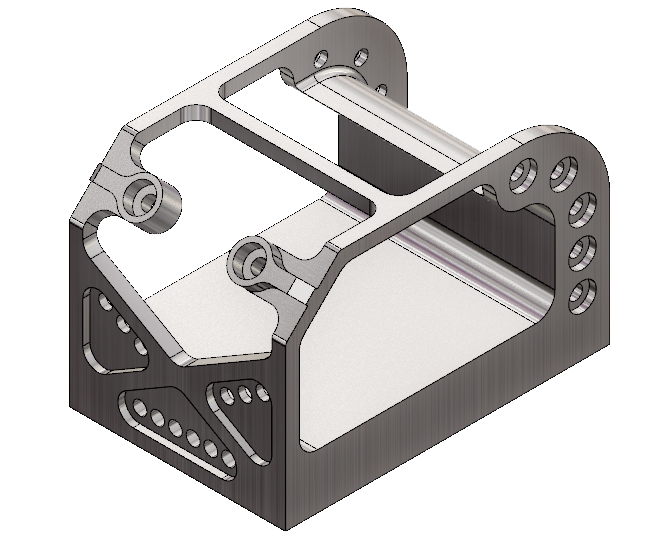
Case 1: US Tier 1 Aerospace Supplier | Ti-6Al-4V Thin-Wall Structural Bracket
- Challenge: 1.0 mm thin walls, ±0.003 mm tolerance, 5-side features. Previous 3-axis supplier had 28% scrap rate, 3-week lead time, and $12k setup cost for 15 parts.
- Zorapid Solution: Unmanned 5-axis + cryo cooling + optimal tool tilt.
- Result: 0% scrap, ±0.002 mm tolerance, setup cost cut by 62% ($4.5k total), delivered in 6 days. Client switched all titanium parts to Zorapid.
2: German Engine OEM | Inconel 718 Turbine Blade Component
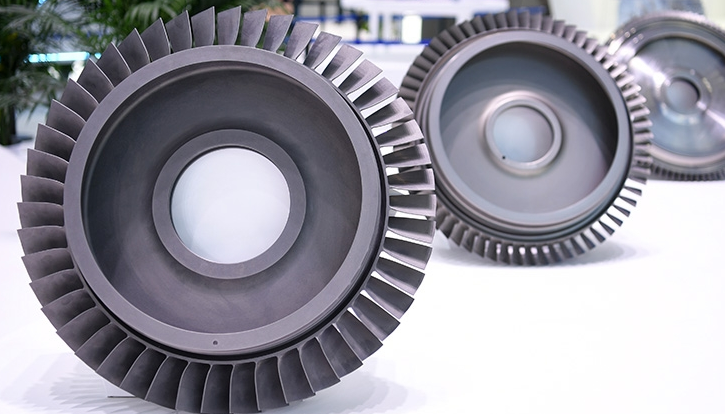
- Challenge: Complex curved features, Ra ≤ 0.4 μm finish, high-temp resistance. EU 5-axis shop quoted 10 weeks + $18k tooling cost; manual shifts led to inconsistent quality.
- Zorapid Solution: Unmanned 5-axis simultaneous + DLC tools + AI adaptive paths.
- Result: Delivered in 7 weeks, tooling cost cut by 58% ($7.5k), Ra 0.32 μm finish, passed all high-temp tests. Client now uses Zorapid for 80% of Inconel parts.
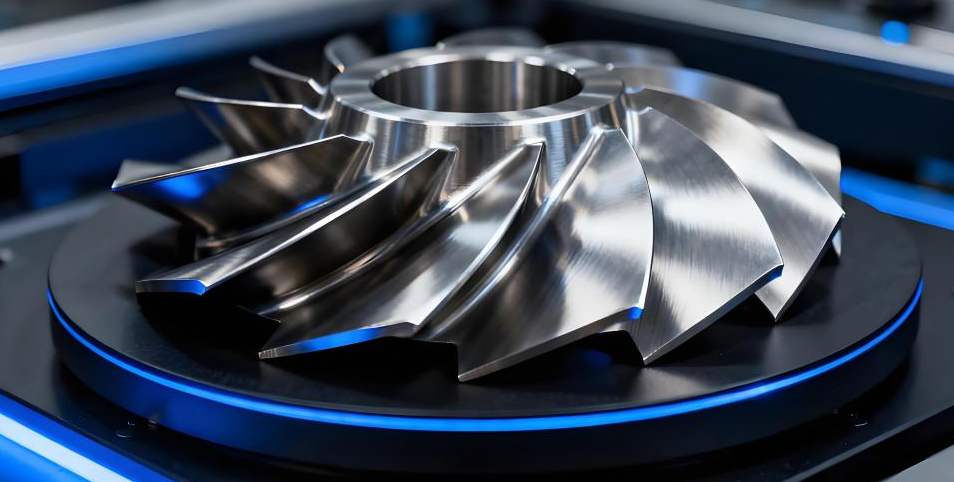
3: UK Defense Contractor | 7075-T6 Aluminum Monolithic Blade Disk
- Challenge: Deep, narrow flow paths, ±0.002 mm position tolerance. Local shop used 3-axis + EDM—21-day lead time, $25k total cost, rough flow paths.
- Zorapid Solution: Unmanned 5-axis + high-speed trochoidal milling.
- Result: Delivered in 4 days, total cost cut by 55% ($11.2k), smooth flow paths (Ra 0.38 μm), passed all flow testing.
Application Scenarios
5-axis isn’t just for complex parts—it’s the new standard for 4 high-growth aerospace sectors:
① Structural Airframe Components (42% of our aerospace volume)
- Titanium/Aluminum brackets, ribs, spars, and fuselage parts
- Thin walls (0.8–1.5 mm), multi-angle holes, 5-side features
- 5-axis win: 60% lower setup cost, zero warping, consistent tolerance
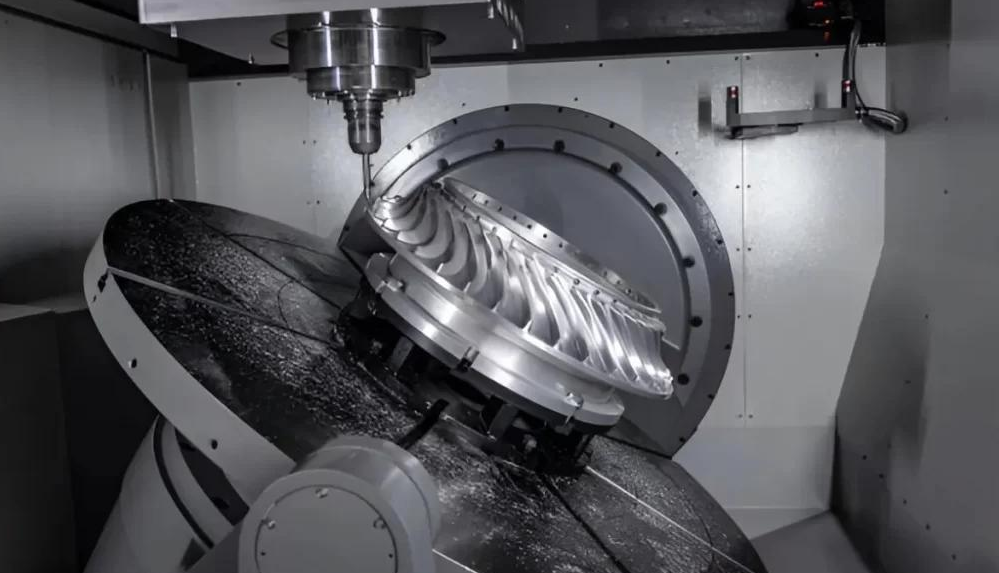
Engine & Turbine Parts (28% volume, highest precision)
- Inconel 718/725 blades, disks, combustors, and exhaust components
- Complex curves, high-temp resistance, Ra ≤ 0.4 μm finish
- 5-axis win: 50% faster cycle time, 3x longer tool life, no work-hardening
Defense & Space Components (18% volume, tightest tolerances)
- Missile parts, satellite brackets, rocket engine components
- Ultra-tight GD&T (±0.001–±0.002 mm), material purity critical
- 5-axis win: Zero alignment errors, 100% inspection traceability
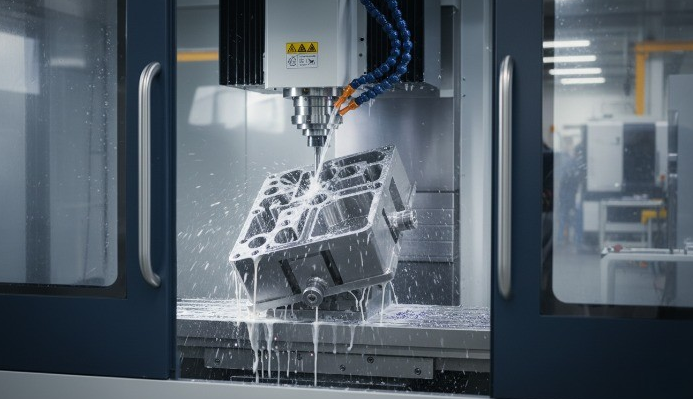
Landing Gear & Actuation Parts (12% volume, high strength)
- Titanium/steel landing gear struts, hinges, and actuator housings
- Heavy material removal, deep cavities, high fatigue resistance
- 5-axis win: 70% less fixturing, 40% faster material removal
Industry Data + Future Trends (2026–2030)
Global Aerospace 5-Axis Machining Snapshot (2026)
| Metric | Data | Source |
|---|---|---|
| Global Aerospace Machining Market | USD 82.3 Billion | Grand View Research |
| CAGR (2026–2030) | 6.8% | Mordor Intelligence |
| 5-Axis Adoption Rate (Complex Parts) | 78% (up from 45% in 2022) | Aerospace Manufacturing Association |
| Average Setup Cost Reduction (5-axis vs. 3-axis) | 58–62% | Zorapid Industry Survey |
| Top Material for 5-Axis | Titanium (41%) > Inconel (29%) > Aluminum (22%) | AMS Material Report |
| Key Driver | Shift to monolithic parts (fewer assemblies, lighter weight) | McKinsey Aerospace |
Key Future Trends + Zorapid’s Position
- Monolithic Parts Explode (FAA/EASA Push for Lightweighting)
- OEMs replacing 10–20 assembled parts with single monolithic components (cuts weight by 20–30%, reduces maintenance).
- Zorapid: Scaled unmanned 5-axis for large monolithic parts (up to 1200×800 mm).
- Unmanned Lights-Out 5-Axis Becomes Standard
- Labor shortages + cost pressure force shops to adopt 24/7 unmanned machining (30–50% lower labor cost, consistent quality).
- Zorapid: 100% unmanned 5-axis cells for aerospace—no human intervention, 24/7 production.
- AI-Driven Toolpath Optimization Cuts Costs Further
- AI adapts feed/speed in real time, reduces tool wear by 30%, and cuts cycle time by 20%.
- Zorapid: Proprietary AI toolpath software for aerospace alloys—optimized for titanium, Inconel, and aluminum.
Delivery Speed Advantage
Aerospace programs move fast—delays mean missed milestones, penalties, and lost contracts. Our unmanned 5-axis lead times speak for themselves:
Standard Lead Times (Small Batch, 10–20 Pcs)
| Part Type | Zorapid Unmanned 5-Axis | Typical EU/US 5-Axis Shop | 3-Axis Shop |
|---|---|---|---|
| Titanium Structural Parts | 5–7 days | 12–18 days | 18–25 days |
| Inconel Engine Components | 7–9 days | 14–21 days | 21–28 days |
| Aluminum Monolithic Parts | 4–6 days | 10–14 days | 14–20 days |
| Emergency Rush (5–10 pcs) | 3 days | 7–10 days | 14+ days |
Why we’re faster:
- 24/7 unmanned operation: No weekend downtime, no shift changes
- One-setup machining: No waiting for re-clamping or fixturing
- In-house material stock: Titanium, Inconel, aluminum blocks always in stock
- Parallel workflow: Machining + inspection run in parallel
Real example: A US defense client needed 15 titanium brackets in 5 days for a missile program. EU shops said impossible—we delivered in 3 days, zero defects.
Why Choose Zorapid for Your 5-Axis Aerospace Parts
- 60% Lower Setup Costs: One-setup machining eliminates 5–7 fixturing steps—direct savings to your bottom line.
- Unmanned 24/7 5-Axis: Consistent quality, faster lead times, 30–50% lower labor cost than manual shops.
- Aerospace-Certified: AS9100, ISO 13485, FAA/EASA-aligned processes—full material traceability, zero compliance risk.
- Hard-to-Master Expertise: We specialize in thin-wall titanium, Inconel engine parts, and monolithic aluminum—jobs others avoid.
- 50% Faster Lead Times: No outsourcing, no weekend downtime, parallel workflow—beats EU/US 5-axis shops by weeks.
- Zero Scrap Guarantee: AI toolpath optimization + in-process probing—scrap rate <3% vs. 12–18% for 3-axis.
- English-speaking aerospace engineers, 24-hour response, DFM reviews in your timezone.
Final Summary
Complex aerospace parts don’t have to be slow, expensive, or risky. 5-axis machining isn’t just a nice-to-have—it’s the only way to cut setup costs by 60%, eliminate alignment errors, reduce scrap, and deliver on tight program deadlines.
Zorapid’s unmanned 5-axis precision machining solves your biggest aerospace pain points:
- 60% lower setup costs (one-setup, no custom fixtures)
- Zero scrap on thin-wall titanium/Inconel parts
- 50% faster lead times (24/7 unmanned operation)
- AS9100-certified quality (FAA/EASA-compliant)
- Expertise in impossible jobs (monolithic parts, deep cavities, high-temp alloys)
As aerospace shifts to lighter monolithic parts, faster program cycles, and stricter quality rules, Zorapid is your trusted Asia-based 5-axis partner for all complex aerospace components.
FAQ
How much can 5-axis really save on setup costs?
58–62% average reduction for complex parts. 3-axis needs 5–7 setups + custom fixtures ($3.5k–$8k per batch); 5-axis uses 1–2 setups + standard fixturing ($500–$1.2k per batch).
Is 5-axis more expensive than 3-axis for simple parts?
For simple flat brackets (1–2 features), 3-axis is slightly cheaper. But for any part with 3+ features, angles, or curves, 5-axis is 40–50% cheaper total (lower scrap, less labor, no fixturing).
Can you handle large aerospace parts (over 1m)?
Yes. Our 5-axis cells handle parts up to 1200×800 mm—perfect for large monolithic structural components.
Do you provide FAA/EASA-compliant material certificates?
Absolutely. Every part includes full COC, PMI test reports, batch traceability, and AS9100 quality documentation—ready for your audits.
What’s your minimum batch size for aerospace parts?
1–500 parts—we specialize in small-batch, high-mix aerospace (10–20 pcs per run), which is where 5-axis saves the most money.