Published:Zorapid.Ltd
If you’re an EV mechanical design engineer or procurement lead, you know one hard truth: your battery tray’s weight directly hits driving range, payload, suspension wear, and production cost.
Heavy steel trays are out of the picture for modern passenger EVs, commercial vans, and light electric trucks. Today’s two mainstream manufacturing paths—sheet metal fabrication and solid/extrusion CNC machining—both deliver massive weight cuts, but they follow totally different lightweight design rules.
Get the rules wrong, and you’ll end up with a tray that’s too flimsy for crash protection, prone to thermal warpage, or more expensive than necessary. Get them right, and you can slash 20–40% of baseline weight while hitting all NVH, impact, and liquid cooling specs.
This guide breaks down clear, actionable lightweight design rules split for sheet metal and CNC machined EV battery trays. We’ll cover material picks, structural tricks, avoidable design errors, and answer every frequent question your team will ask before releasing CAD for production.
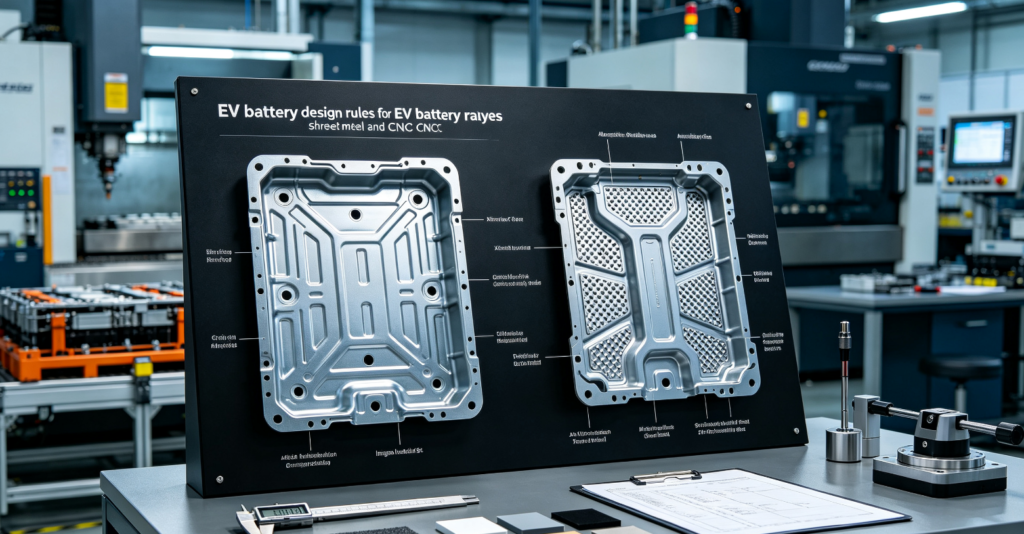
Universal Core Lightweight Design Rules (Applies To Sheet Metal & CNC Trays)
These ground rules work no matter which manufacturing method you pick. Follow them first before adding process-specific lightweight features.
- Remove material where stress load is zero or extremely low
- Add stiffness via geometric features instead of thicker base material
- Match material grade to local load zones (don’t overengineer every section)
- Integrate cooling channels, mounting bosses, cable routing into the tray body to eliminate separate brackets
- Keep wall thickness consistent where possible; uneven thickness creates thermal stress and extra weight
- Optimize load paths: route crash impact force along reinforced ribs, not flat thin panels
- Limit redundant mounting holes and unused boss structures—every extra feature adds mass
- Balance weight reduction with bottom guard impact resistance for road debris
Sheet Metal EV Battery Tray Lightweight Design Rules
Sheet metal trays are built from stamped, bent, welded aluminum alloy sheets (3003, 5052, 6061). Lightweighting here relies on forming geometry, not removing bulk material. Stick to these rules:
1: Use strategic bead ribbing instead of thicker sheet stock
Deep, narrow stamped beads add 2–3x panel stiffness without boosting base material gauge. Never jump from 2mm to 3mm sheet to fix flex—add cross ribs first.
2: Employ tapered side wall flanges for side impact zones
Full-height uniform flanges add unnecessary weight. Taper flanges thin toward low-load upper sections, only keep thick flanges along bottom crash rails.
3: Large cutouts with perimeter reinforcing frames
For cable access, thermal vent cutouts, or weight relief holes: add a small bent lip around every cutout edge. The lip prevents panel buckling so you don’t need heavier sheet.
4: Split tray into modular thin sub-panels, not one single thick shell
A multi-piece welded assembly with 1.5–2mm sheets weighs far less than a single deep-drawn 3mm tray. Weld joints add minimal mass vs extra sheet thickness.
5: Avoid full solid bottom plates; use grid cross rib frames
A full flat bottom sheet is heavy. Replace with intersecting stamped ribs spaced 80–120mm apart, with partial thin cover panels only where battery modules sit.
6: Minimize continuous weld seams; use spot welds + structural adhesive
Long weld beads add extra material weight. Mix structural adhesive with spaced spot welds to maintain rigidity while cutting weld material mass.
7: Design folded edge hems instead of added reinforcement brackets
Rolled folded hems on all open panel edges boost edge stiffness without attaching separate support blocks.
CNC Machined EV Battery Tray Lightweight Design Rules
CNC trays come from solid aluminum blocks or large extruded profiles milled down. Lightweighting centers on controlled pocketing, rib layout, and material removal. Follow these strict design rules:
1: Variable-depth pocketing for low-stress zones
Machine deep pocket cavities in areas under battery modules with minimal vertical load. Leave thicker base stock only under mounting points, crash rails, and cooling manifolds.
2: Uniform rib thickness control (3–5mm standard)
Design all internal support ribs at equal thin thickness. Thick random ribs stack weight fast. Space ribs 60–100mm apart for optimal stiffness-to-mass ratio.
3: Round all pocket and rib fillets
Sharp internal corners require extra thick material to avoid stress cracks. Large R fillets let you thin surrounding walls safely for weight savings.
4: Integrate liquid cooling channels directly into CNC pockets
Don’t bolt separate cooling plates onto the tray. Mill channel grooves into the tray base in one CNC operation—cuts two-part assembly weight and fastener mass.
5: Hollow out mounting bosses, don’t use full solid posts
Drill blind core holes inside all module mounting bosses. Hollow bosses cut 30–50% weight per boss without losing thread pull strength.
6: Step wall thickness for tiered load zones
Bottom impact rail zones: 6–8mm thick base. Middle module support zones: 3–4mm. Upper non-load side walls: 2–2.5mm. No uniform thick walls across the full tray.
7: Eliminate secondary hardware via integrated locating tabs
Machine alignment tabs, cable clips, and sealing lip structures directly into the tray. Remove dozens of small metal brackets and fasteners that add cumulative weight.
8: Limit deep overhangs that require heavy support stock
Long unsupported cantilever sections force thicker base material. Split long overhangs with vertical connecting ribs to thin wall sections.
Sheet Metal vs CNC EV Battery Tray Lightweight Tradeoff Chart
| Metric | Lightweight Sheet Metal Tray | Lightweight CNC Machined Tray |
|---|---|---|
| Typical Weight Reduction | 25–32% vs steel baseline | 30–42% vs steel baseline |
| Minimum Wall Thickness | 1.2mm (form limit) | 2mm (machining stability limit) |
| Best For | Mass production passenger EVs, standard pack sizes | Premium EVs, custom low-volume packs, integrated cooling |
| Lightweight Core Method | Stamped ribs, cutouts, folded flanges | Deep pocketing, hollow ribs, integrated channels |
| NVH Performance | Moderate; thin panels risk resonance | Excellent; solid ribbed structure dampens vibration |
| Crash Stiffness Tuning | Limited by stamping geometry | Highly customizable via rib layout & wall stepping |
| Unit Cost (10k+ batches) | Lower | Higher |
| Unit Cost (100–500 prototypes) | Higher (tooling charges) | Lower (no stamping dies) |
Material Matching Lightweight Rules
Don’t pick a high-strength heavy alloy everywhere—match grade to load zones to hit weight targets:
Sheet Metal Material Rules
- Main tray body: 5052-H32 aluminum (balanced light weight, formability, corrosion resistance)
- Crash bottom rails: 6061-T6 thicker localized blanks (welded on only impact areas)
- Avoid steel entirely unless ultra-low cost microcars; steel adds 2.5x aluminum weight
CNC Machined Material Rules
- Standard lightweight trays: 6061-T6 extrusion/block
- High-impact heavy-duty commercial EV trays: 7075-T6 (use sparingly only on rails, not full tray)
- Thermal optimized packs: 6063 extrusion base for CNC (superior heat transfer, lighter than 7075)
Top Lightweight Design Mistakes That Add Unnecessary Tray Weight
- Uniform thick walls across full CNC tray (no tiered thickness zoning)
- Overusing solid steel reinforcement brackets on sheet metal trays
- Ignoring pocket fillets, forcing thicker walls to counter stress cracks
- Full solid bottom sheets on sheet metal trays instead of ribbed frames
- Separate bolt-on cooling plates instead of CNC integrated channels
- Over-dimensioned solid mounting bosses without hollow core drilling
- Adding redundant cross ribs that don’t align with actual crash load paths
- Choosing high-strength 7075 aluminum for non-load-bearing upper tray walls
Real-World Lightweight Tray Design Examples
- Compact Passenger EV Sheet Metal Tray Base steel weight: 42kg | Optimized aluminum sheet metal design weight: 29kg Weight cut: 31% via stamped cross ribs, partial bottom cutouts, tapered flanges.
- Premium SUV CNC Integrated Cooling Tray Baseline thick solid CNC tray: 38kg | Optimized pocketed ribbed design: 22kg Weight cut: 42% through variable-depth pocketing, hollow bosses, built-in cooling channels.
- Light Commercial EV Hybrid Tray (Sheet Metal Base + CNC Crash Rails) Combines low-cost lightweight sheet metal main body with CNC machined high-strength bottom rails—balances weight, cost, and crash safety for fleet vehicles.
FAQ
Which process delivers better maximum weight reduction: sheet metal or CNC?
CNC machined trays hit higher overall weight savings (up to 42%) because deep pocketing removes far more unused material from the tray core. Sheet metal maxes out around 32% weight cut due to minimum formable wall thickness limits. For mass-market high-volume EVs, sheet metal is still the better balance of weight and production cost.
Can lightweight design compromise battery crash safety?
Not if you follow load-path lightweight rules. All weight removal happens in low-stress zones. Reinforced ribs, stepped thick crash rails, and perimeter frames keep impact resistance unchanged. We run FEA simulation to validate every lightweight revision before manufacturing.
What’s the minimum safe wall thickness for CNC lightweight EV trays?
2mm for non-load upper side walls. Load-bearing rib structures stay 3–5mm, bottom crash rails step up to 6–8mm. Going thinner than 2mm creates chatter during CNC milling and weakens vibration resistance over vehicle lifespan.
For sheet metal trays, how large can weight-relief cutouts be without losing stiffness?
Keep cutout width under 150mm, and add a minimum 8mm folded reinforcing lip around every cut edge. Spacing between cutout frames must stay above 70mm to maintain panel rigidity against road vibration.
Does lightweight CNC pocketing hurt thermal performance of the battery tray?
No—we design shallow thin base lands directly under battery module contact points to preserve heat transfer. Deep pockets only sit in empty gap areas between modules. You can also machine micro-fin cooling channels into contact lands for better thermal control without extra weight.
Are lightweight CNC trays noisier than solid thick trays from road NVH?
Opposite. Strategically spaced internal ribs break up vibration resonance far better than flat thick solid aluminum slabs. Proper filleted rib layout eliminates the hum noise common in thin lightweight sheet metal trays.
When should I choose a hybrid sheet metal + CNC lightweight tray design?
Ideal for commercial EVs, delivery vans, and heavy pickup trucks. Use low-cost lightweight sheet metal for the large main tray housing, then bolt/weld CNC machined high-strength rails on the bottom for debris impact protection. This cuts total weight and balances production cost.
How much weight can integrated CNC cooling channels save vs bolt-on cooling plates?
Typically 6–10kg per full pack tray. You remove the cooling plate body, dozens of sealing bolts, and gasket hardware—all while simplifying assembly lines.
Can lightweight design rules apply to solid-state EV battery trays?
Yes, but adjust wall thickness up by 0.5–1mm for both sheet metal and CNC builds. Solid-state cells carry tighter thermal expansion loads, so rib spacing should shrink to 60–80mm for extra dimensional stability.
Do you provide FEA weight optimization checks for EV tray CAD files?
Our engineering team runs free lightweight FEA reviews for OEM customers. We mark all low-stress zones where extra material can be removed, adjust rib layouts, and propose tiered wall thickness changes to hit your target weight without sacrificing safety or thermal performance.
Quick Lightweight Design Checklist (Copy-Paste For Your CAD Team)
Sheet Metal Tray Checklist
Cross bead ribs added to all large flat panels
All cutouts have folded reinforcing perimeter lips
Side flanges tapered thin on upper non-impact sections
Grid rib bottom frame instead of full solid base sheet
Structural adhesive + spot weld mix (minimize long heavy weld beads)
Localized thick 6061 crash rails only on bottom impact zones
CNC Machined Tray Checklist
Variable depth pocketing across all low-load interior areas
All mounting bosses hollow cored to reduce mass
Tiered wall thickness matching local load levels
Integrated cooling channels milled directly into tray base
All internal pocket corners have large radius fillets
Rib thickness locked to 3–5mm with consistent spacing
Integrated locating tabs/clips eliminate bolt-on brackets
Closing Wrap-Up
Lightweight EV battery tray design isn’t just “make walls thinner.” It’s a set of process-specific rules tailored to sheet metal stamping or CNC milling that cut weight while locking in crash safety, thermal stability, and NVH performance.
Sheet metal lightweighting relies on smart forming and ribbing for affordable mass production. CNC machining leverages deep pocketing and integrated features to hit extreme weight targets for premium and low-volume EV platforms. Mix the two into a hybrid tray design if you need to balance cost and maximum weight reduction.
If you’re finalizing tray CAD drawings and want a free lightweight optimization review, send over your STEP files. Our manufacturing engineers will flag every excess material section and deliver a revised lightweight design proposal with clear weight savings estimates.