Published:Zorapid.Ltd
Machining removes excess material from metal/plastic blanks to form functional mechanical parts. Two mainstream manufacturing approaches dominate the market: manual machining operated by skilled machinists on conventional lathes, mills, drill presses, and CNC machining controlled by pre-programmed digital code.
Many manufacturers struggle to pick the right process based on order quantity: one-off prototypes, small custom batches, medium runs, or mass bulk production. Neither option is universally superior. Manual machining shines for certain low-quantity urgent jobs, while CNC delivers unmatched stability for large-scale orders. This article compares the two methods across 12 critical dimensions and gives clear selection rules for low-volume (1–50 units) and mass-volume (500+ units) manufacturing.
Fundamental Working Principles
Manual Machining
All cutting motion relies on human operation. Skilled machinists physically turn handwheels, adjust feed rates, align workpieces, control cutting depth, and repeat every step by eye and experience. Every hole, slot, contour requires manual positioning. Common equipment includes knee mills, engine lathes, manual surface grinders, bench drills. Programs do not exist; adjustments happen in real time.
CNC Machining
Machines run via G-code CAM programs generated from 3D CAD files. Spindle speed, feed rate, tool path, axis movement, dwell time are fully pre-programmed. The CNC controller automatically executes all cutting paths repeatedly with zero human manipulation during operation. Operators only load/unload blanks, change tools, and monitor machine status. Equipment includes CNC milling centers, CNC lathes, 5-axis CNC machines, CNC grinders.
Core Machining Performance Differences
| Evaluation Item | Manual Machining | CNC Machining | Production Impact |
|---|---|---|---|
| Dimensional Accuracy & Tolerance | Typical tolerance: ±0.02~±0.1 mm. Accuracy highly tied to operator skill. Consistency poor across multiple parts. Hard to hold GD&T, concentricity, position tolerance | Stable tolerance ±0.005~±0.03 mm. Consistent accuracy for all parts. Reliable for tight GD&T, complex positional tolerances, Ra surface repeatability | Low volume: manual can hit loose tolerances; mass production requires CNC for uniform precision |
| Repeatability | Extremely low. Every machinist produces slight deviations; one machinist makes variations between separate parts. Batch dimension scatter is unavoidable | Perfect repeatability. Identical toolpaths produce identical dimensions across thousands of units. No human-caused dimensional drift | Repeatability is CNC’s decisive advantage for mass batches |
| Complex Geometry Capability | Limited to simple features: straight holes, flat planes, basic turning profiles. Impossible for 3D curves, angled holes, multi-sided pockets, twisted contours, 5-axis undercuts | Supports 2D, full 3D curved surfaces, inclined features, deep complex cavities, impeller blades, multi-angle drilled holes via 3/4/5-axis equipment | Complex custom low-volume parts need CNC; only simple basic shapes fit manual machining |
| Surface Finish Consistency | Surface roughness varies based on operator hand stability. Tool marks differ part to part. Fine finishing heavily relies on operator technique | Uniform Ra value for all components. Programmed feed/speed delivers consistent surface texture. Easy stable finishing down to Ra 0.2 μm | Sanitary hardware and precision wear parts demand CNC surface consistency |
| Material Compatibility | Works best on soft-to-medium metals (aluminum, brass, mild steel). Hard alloys (carbide, hardened D2 steel) cause severe tool wear and operator fatigue | Compatible with all machinable materials: aluminum, stainless, hardened tool steel, tungsten carbide, PEEK, PTFE, superalloys. Supports high-hardness cutting with PCD/CBN tools | Hard wear-resistant materials almost exclusively machined via CNC |
Cost, Labor, Lead Time & Operational Differences
| Evaluation Item | Manual Machining | CNC Machining | Production Impact |
|---|---|---|---|
| Labor Requirement & Skill Level | Depends entirely on senior skilled machinists. Long training cycle (2–5 years). High reliance on manpower availability | Low operator skill threshold. Workers only need basic loading, programming backup, quality inspection. Programming work is separate; machine runs autonomously | Manual faces skilled labor shortages; CNC eases staffing pressure for mass factories |
| Labor Cost Structure | High per-unit labor cost. Labor time = total machining time. Labor expense rises linearly with part count | High upfront programming cost, low incremental labor cost. After programming, adding more parts barely increases labor spending | Manual cheaper for 1–5 pieces; CNC unit cost falls with higher quantity |
| Setup Lead Time | Fast setup for simple single parts. No CAD/CAM programming needed. Machinist can start cutting within minutes after drawing review | Long initial setup: CAD modeling, CAM programming, simulation, tool setting, fixture alignment. Setup takes hours or days for complex parts | Manual wins urgent one-off jobs; CNC setup cost amortizes over large batches |
| Modification Flexibility | Ultra-flexible. If dimensions need adjustment, the machinist tweaks handwheel settings instantly on the machine floor | Program edits require CAM revision, re-simulation, re-tool setup. Design changes add noticeable turnaround time | Frequent design revisions suit manual; fixed finalized drawings fit CNC |
| Batch Changeover Speed | Quick switch between totally different simple parts. No stored programs to reset | Longer changeover between unrelated complex parts; new fixtures, new G-code required | Mixed small orders benefit from manual flexibility |
| Production Uptime | Limited to human working hours. Cannot run overnight unattended | Supports lights-out unmanned operation. CNC runs 24/7 with bar feeders, automatic pallet changers. Maximizes equipment utilization | Mass production achieves far higher throughput with round-the-clock CNC |
Detailed Application Breakdown: Low-Volume Production (1–50 Units, Prototypes, Custom Spares)
Low-volume runs include R&D prototypes, custom replacement spare parts, one-time custom fixtures, repair components, short-run customized machinery parts.
Advantages of Manual Machining for Low Volume
- Zero programming overhead. For simple parts, machinists start cutting within 10–30 minutes. Urgent emergency breakdown spare parts are delivered far faster than CNC.
- Lower total cost for tiny batches. Programming CAM fees and CNC setup time cost more than full manual labor for 1–10 simple pieces.
- Agile design tweaks. If engineers adjust dimensions mid-machining, manual operators adjust cutting instantly without redoing CAM files. Ideal for iterative prototype testing with constant revisions.
- Small job shops with limited capital avoid expensive CNC hardware/software licensing costs.
Limitations of Manual Machining in Low Volume
- Complex curved or multi-angle parts cannot be completed manually. Even for small batches of 3D aerospace/medical components, CNC is mandatory.
- Tight tolerances (below ±0.02 mm) are unreliable manually. Precision low-volume sensor parts, mold inserts require CNC regardless of quantity.
- Hardened steel, carbide, superalloy manual cutting is exhausting, slow, and prone to tool failure.
Best Low-Volume Split Rule
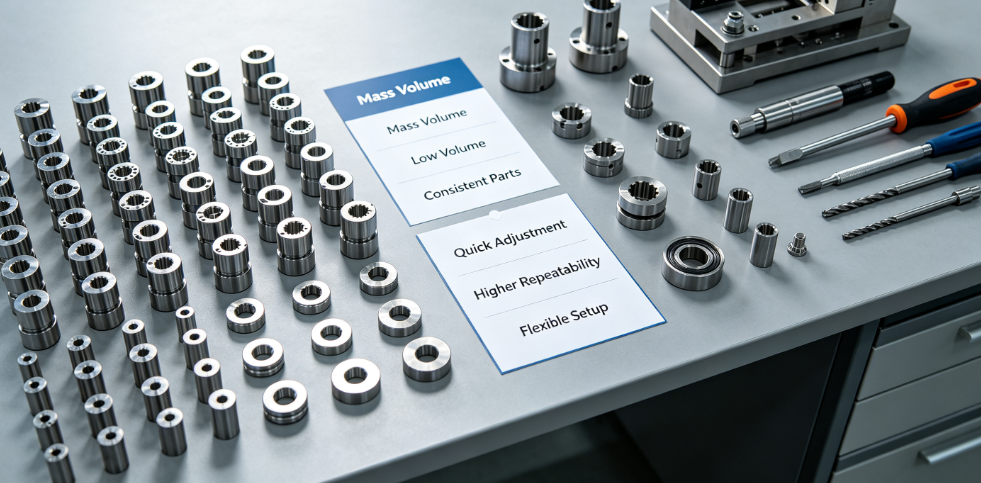
- Choose manual: Simple flat/turned features, loose tolerances (≥±0.03 mm), urgent delivery, frequent design edits, quantity ≤10 units
- Choose CNC: Complex geometry, tight tolerance, hard alloys, surface finish critical, quantity 10–50
Detailed Application Breakdown: Mass-Volume Production (500+ Units, High-Volume OEM Parts)
Mass production covers automotive bulk components, standard automation hardware, food machinery repeat parts, consumer equipment machined parts with stable finalized drawings.
Advantages of CNC Machining for Mass Production
- Dramatically reduced per-unit cost. One-time programming cost spreads across thousands of pieces. Labor cost per part plummets; mass orders achieve clear cost savings vs manual.
- Consistent batch quality. No operator variation; all parts pass inspection with uniform dimensions. Eliminates costly mass rework or recalls caused by manual inconsistency.
- Unattended 24-hour operation boosts daily output far beyond human working limits. Lights-out CNC multiplies factory throughput without adding night-shift labor.
- Simplified quality control. QC teams only spot-check random samples, instead of full 100% measurement needed for variable manual batches.
- Scalable capacity. Adding more CNC machines linearly expands output; manual production expansion requires hiring dozens of veteran machinists, a major labor bottleneck.
Why Manual Machining Fails Mass Production
- Cumulative labor expense becomes prohibitive. Hiring enough skilled operators to run thousands of parts drives total cost far higher than CNC.
- Batch inconsistency leads to high scrap rates, assembly failures at customer factories. Different batches do not interchange smoothly.
- Human fatigue causes rising defects across long shifts; output speed plateaus at human physical limits.
- Mass production of hard alloys and precision surfaces is practically unfeasible manually.
Mass Production Non-Negotiable Rule
Nearly all mass-produced machined components use CNC. Manual machining is only acceptable for extremely low-complexity, low-tolerance cheap hardware where labor is abnormally inexpensive.
Hybrid Workflow Strategy (Most Common for Modern Job Shops)
Most precision machine shops combine both processes to maximize profit across mixed orders:
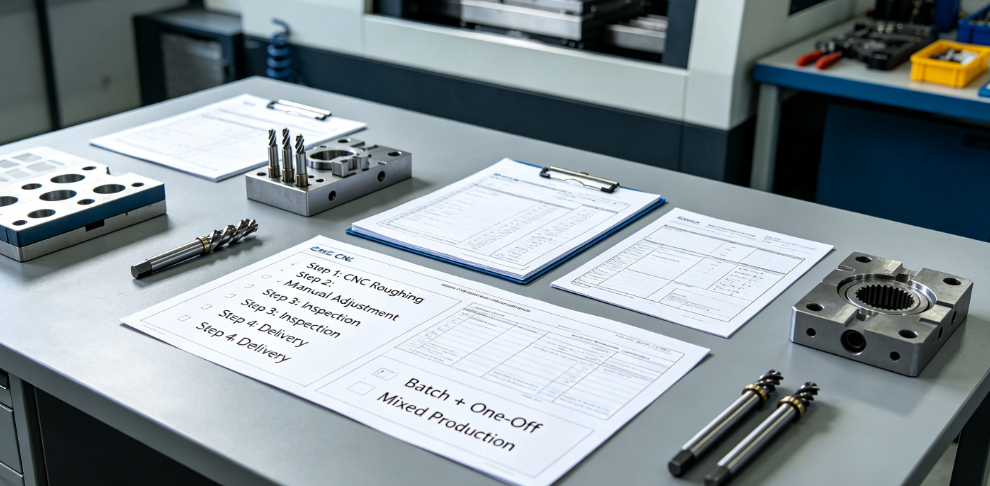
- Manual machining handles urgent simple prototypes, emergency repair spares, one-off low-tolerance brackets, basic fastener blanks.
- CNC completes all complex prototypes, tight-tolerance small batches, and all mass orders.
- Manual machines perform secondary operations: deburring, light hand finishing, tapping simple holes after CNC roughing.
- CNC roughs large hard-alloy blanks; manual grinders do minor precision touch-ups for ultra-fine requirements.
This hybrid model balances flexibility for small jobs and cost efficiency for bulk orders.
Key Cost Breakdown Model
Manual Machining Cost Drivers
Total Cost = Machinist Hourly Rate × Total Processing Time + Raw Material + Consumable Tools No fixed setup cost; cost rises proportionally with every extra part.
CNC Machining Cost Drivers
Total Cost = One-Time CAM Programming + CNC Setup Fee + (Machine Hour Rate × Machining Time + Minimal Labor) × Part Count + Material + Tools After ~15–30 identical parts, the fixed setup cost is fully amortized, and CNC becomes cheaper per unit than manual.
Break-even quantity reference: For standard aluminum simple parts, CNC matches manual total cost at roughly 20–30 units. Quantities above this threshold favor CNC economics.
Industry-by-Industry Process Recommendations
| Industry | Low-Volume Pick | Mass-Volume Pick | Reasoning |
|---|---|---|---|
| Aerospace & Medical | CNC | CNC | Tight tolerance, complex contours, biocompatible alloys cannot rely on manual precision |
| Automotive OEM | CNC | CNC | Mass interchangeability critical; high scrap risk with manual batches |
| General machinery maintenance | Manual | CNC | Emergency repair parts use manual; standardized production runs use CNC |
| Mold & Die | CNC | CNC | Complex curved cavities demand CNC 3-axis/5-axis milling at all batch sizes |
| Construction hardware fittings | Manual (small orders) | CNC (bulk) | Simple geometry flexible for manual small runs; bulk needs low per-unit CNC cost |
| Custom laboratory equipment | CNC | CNC | Precision and repeatability required even for small custom batches |
Common Misconceptions Corrected
- Misconception: Manual machining is always cheaper for small batches Fact: If parts have complex curves or tight tolerances, CNC costs less even for 5 units, because manual trial-and-error takes excessive skilled labor time.
- Misconception: CNC eliminates all operator errors Fact: Errors happen from wrong CAM programming, improper fixture clamping, worn cutting tools. But mistakes are batch-wide and easy to trace, unlike random scattered human errors in manual work.
- Misconception: Manual machinists can replicate CNC-level precision Fact: Veteran machinists hit tight tolerances occasionally, but consistent replication across multiple parts cannot match CNC repeatability.
FAQ
What quantity marks the typical cost break-even between CNC and manual machining?
For simple aluminum/steel components with regular tolerances, break-even falls at 20–30 identical parts. Below this number, manual usually costs less; above this count, CNC gains economic advantage. Complex parts lower break-even to 5–10 units due to slow manual processing.
Should emergency repair spare parts use manual or CNC?
Manual machining is preferred for urgent breakdown spares with basic geometry. If the spare has complex angled holes or strict tolerance, use rapid CNC programming even for rush delivery.
Can manual machining process hardened steel and tungsten carbide?
It is technically possible but extremely slow, tool-intensive, and labor-heavy. Hard alloy jobs are universally assigned to CNC shops equipped with PCD/PCBN cutting tools.
Which process has better lead time for one completely redesigned prototype?
Manual has faster lead time for simple prototypes (same-day turnaround). Complex 3D prototypes require CAD/CAM work for CNC, extending lead time by several hours or a full day.
If a customer needs 20 fully interchangeable assembly parts, manual or CNC?
CNC is mandatory. Even 20 manually machined parts have enough dimensional variation to cause assembly fit issues. Repeatability is non-negotiable for mating components.
Final Conclusion
- Manual machining core strengths: Fast setup, high flexibility, low upfront expense, cost-effective for simple, low-quantity (≤10), frequently revised one-off parts with loose tolerances. Major weaknesses: poor repeatability, limited geometry, labor-heavy, inconsistent quality across batches.
- CNC machining core strengths: Precise repeatability, complex geometry capability, low per-unit mass cost, 24/7 unattended production, compatibility with all hard/engineering materials. Drawbacks include long initial programming setup and higher upfront capital investment.
- Selection decision formula:
- Low volume + simple + loose tolerance + urgent changes → Manual
- Low volume + complex/tight tolerance/hard material → CNC
- Medium batch (30–500) and all mass volume (500+) → CNC without exception
- Most profitable operational strategy is hybrid production: leverage manual for flexible small emergency jobs and CNC for all repeat, precision, complex, and bulk manufacturing work. Matching process to order quantity and part complexity controls total cost while stabilizing quality across all order types.