Published:Zorapid.Ltd
Industrial equipment working under heavy friction, impact, high abrasion, slurry erosion and repeated fatigue demands components with extreme wear resistance. Ordinary carbon steel, 45# steel and common stainless steel wear rapidly under sand grinding, mineral impact, high-speed sliding and chemical abrasion, leading to frequent part replacement, equipment downtime and high maintenance costs.
Hard alloys (mainly cemented tungsten carbide, high-speed steel, tool steel, wear-resistant superalloy) feature ultrahigh hardness, excellent abrasion resistance and impact toughness. CNC milling fabricates complex hard alloy geometry, including curved surfaces, precision grooves, threaded holes and multi-angle profiles for wear-critical machinery. This guide classifies widely machinable hard alloy grades, sorts CNC milling workflows, cutting tool matching, parameter settings, fixture schemes, wear-oriented DFM design, mass production control and typical industrial application scenarios.
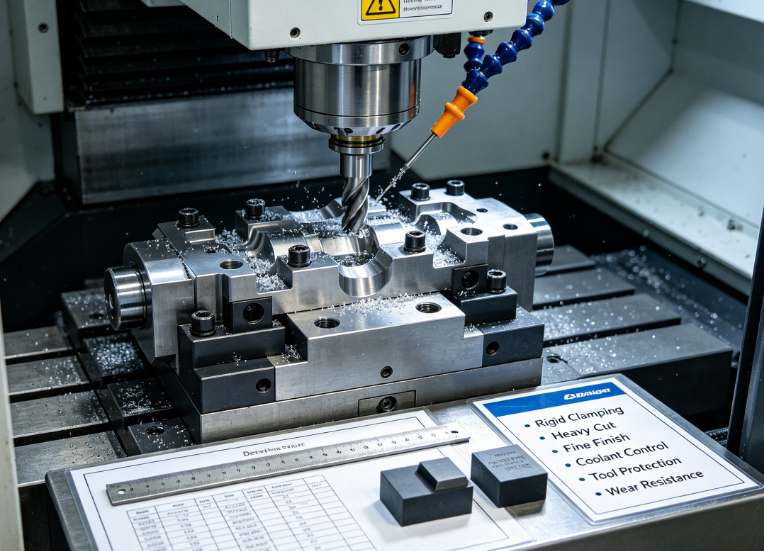
Common Hard Alloy Grades for CNC Milling & Wear Characteristics
All grades below support CNC milling/boring/tapping; categorized by wear mechanism (abrasion wear, impact wear, corrosion wear) and industrial applicability.
Cemented Tungsten Carbide (WC-Co Cemented Carbide, Most Popular Wear Alloy)
The top choice for severe abrasive wear conditions. Hardness range HRA 85~92 (HRC 68~78). Cobalt (Co) binder percentage determines toughness and machinability.
| Grade | Cobalt Content | Hardness | Wear & Performance | CNC Machining Property | Typical Wear Scenarios |
|---|---|---|---|---|---|
| YG6 (WC-6%Co) | 6% | HRA 89.5 | Balanced abrasion resistance + moderate impact resistance | Standard machinability; most versatile millable carbide | Sand slurry valves, crusher liners, conveyor wear tiles, extrusion dies |
| YG8 (WC-8%Co) | 8% | HRA 88 | Higher toughness, slightly lower wear resistance than YG6 | Easier milling, less prone to edge chipping during interrupted cuts | Mining impact hammer heads, forging wear inserts, gravel processing parts |
| YG3 (WC-3%Co) | 3% | HRA 91 | Maximum abrasion resistance, poor impact toughness | Hardest to machine; easy tool wear and carbide breakout | Fine powder grinding rollers, precision wear sleeves, textile spinning wear guides |
| YT15 / YT5 (Titanium Carbide Alloy) | TiC added | HRA 90~91 | Anti-adhesive wear, resist metal sticking | High cutting heat accelerates tool aging | Hot metal forming wear dies, steel contact sliding parts |
Key feature: Higher cobalt = tougher, easier CNC milling, lower pure abrasion resistance; lower cobalt = harder, more wear-resistant, harder to machine.
Hardened Tool Steel (HRC 50–62, Secondary Wear Alloy)
More cost-effective than carbide, easier CNC machining, used for medium wear with strong impact loads.
- D2 Cold Work Steel (HRC 58–62 after full heat treatment) Compliance: High abrasive wear resistance, good dimensional stability post-hardening. CNC rule: Rough mill soft annealed blank first, finish grind after quenching/tempering; finish milling allowed with CBN tools. Application: Punching dies, wear gauge blocks, agricultural tillage cutters, sludge scraper blades.
- SKD11 / Cr12MoV Balanced wear + impact resistance; widely used for stamping wear molds, plastic extruder wear bushings.
- M2 High-Speed Steel (HRC 62–65) Resists high-temperature wear; suitable for high-speed rotating wear parts, hot cutting blades.
Martensitic Wear-Resistant Stainless Steel (440C, HRC 55–59)
Dual advantages: wear resistance + rust/corrosion resistance. Machining note: Annealed state for rough milling; hardened finish milling requires coated carbide/CBN cutters. Application: Food processing wear rotors, chemical slurry pump shafts, seawater valve trim, medical wear machinery components.
Nickel-Based Hard Superalloys (Stellite 6, Stellite 12)
Cobalt-chromium hardfacing alloy; anti-abrasion, anti-corrosion, high-temperature wear resistance. Machining difficulty: High work hardening tendency during CNC cutting. Application: High-temperature steam valve seats, thermal power ash handling wear parts, hot exhaust machinery liners.
Hard Alloys Not Recommended for Standard CNC Milling: Fully sintered low-Co carbide, boron carbide, silicon carbide; ultrahard ceramics require grinding instead of milling.
Core Difficulties of Hard Alloy CNC Milling
Hard alloys bring four major machining challenges that cause poor part quality and fast tool damage:
- Extreme cutting hardness: High hardness creates huge cutting resistance; ordinary HSS tools blunt in minutes.
- Severe work hardening: WC alloy, Stellite, D2 harden locally under cutting pressure, further raising cutting load.
- High thermal conductivity deficit: Hard alloys conduct heat poorly; cutting heat accumulates at tool edges, triggering tool thermal wear and cratering.
- Brittleness risk: Low-cobalt carbide is brittle; interrupted milling (pockets, holes, uneven surfaces) easily causes workpiece edge chipping and crack propagation.
Cutting Tool Selection for Hard Alloy Milling
Tool material selection decides machining efficiency and cost. Matched by workpiece hardness:
Solid Coated Carbide End Mills (HRC ≤65 Workpieces: D2, 440C, YG8/YG6 carbide roughing)
- Coatings preferred: TiAlN, AlTiN, nano blue coating; high heat oxidation resistance.
- Geometry: 2–4 flutes, medium helix angle (35°~40°), reinforced thick core for rigidity; avoid thin-core fragile cutters.
- Use case: Rough milling hardened tool steel, medium-cobalt cemented carbide.
CBN / PCBN Inserts (Hardness HRC 60+, Finish Milling)
Cubic Boron Nitride is the optimal choice for finishing HRC 60–78 carbide and hardened steel.
- Advantages: Hardness second only to diamond, stable at high cutting temperatures; no chemical reaction with ferrous alloys.
- Restriction: Not applicable for non-ferrous WC carbide long-term machining (chemical affinity causes rapid wear).
- Usage: Finish profiling, precision slotting, surface finishing of hardened D2, 440C, Stellite.
PCD Polycrystalline Diamond Tools (Cemented Tungsten Carbide Only)
The only economical long-life tool for milling pure tungsten carbide (YG3/YG6/YG8).
- Benefits: Ultrahigh hardness, minimal abrasion; 10~30 times longer service life than coated carbide.
- Limit: Cannot machine ferrous steel (iron reacts with diamond at high heat, causing graphitization).
Tool Selection Quick Reference Table
| Workpiece Material Hardness | Rough Milling Tool | Finish Milling Tool |
|---|---|---|
| HRC ≤55 (annealed tool steel) | AlTiN coated solid carbide | Coated carbide fine pitch end mill |
| HRC 55~65 (hardened D2, 440C) | Heavy-duty coated carbide | PCBN solid/insert cutter |
| Cemented WC Carbide (YG6/YG8) | PCD roughing cutter | PCD finishing end mill |
| Stellite Cobalt Alloy | High-hardness coated carbide | PCBN |
CNC Feeds & Speeds, Depth of Cut Parameters
General rules: Low cutting depth per pass, moderate spindle speed, stable feed rate; avoid heavy cuts that induce workpiece cracking and tool breakage. Coolant must be abundant for heat removal.
Cemented Tungsten Carbide (PCD Tools)
- Spindle speed: 6,000–12,000 RPM
- Feed rate: 800–1,600 mm/min
- Axial depth Ap: 0.2–0.5 mm per pass
- Radial width Ae: ≤30% tool diameter
- Cooling: High-pressure flood coolant (water-soluble grinding fluid)
Hardened Tool Steel HRC 58–62 (PCBN)
- RPM: 2,500–6,000
- Feed: 400–1,000 mm/min
- Ap: 0.15–0.4 mm
- Ae: 25%–35% tool diameter
- Cooling: Mist coolant or dry air (PCBN performs well dry)
Stellite Hard Cobalt Alloy (Coated Carbide)
- RPM: 1,500–3,500 (lower speed to control work hardening)
- Feed: 300–700 mm/min
- Ap: 0.1–0.3 mm
- Critical: Reduce cutting engagement time to suppress surface hardening
Universal process order for all hard alloys:
- Rough machine soft annealed blanks to near-net shape
- Conduct heat treatment (quenching/tempering/hardening)
- CNC finish milling with high-hardness cutting tools This sequence eliminates heavy cutting on fully hardened material, saves tool cost and prevents part cracking.
Fixturing & Anti-Vibration CNC Setup
Hard alloy milling generates strong cutting vibration; vibration worsens tool wear and workpiece chipping.
- High-rigidity clamping Use thick-body precision vises, custom hardened steel fixtures, zero-point positioning chucks. Thin fixtures flex and amplify vibration. Clamping force is firm but not excessive: carbide under extreme compressive load may crack during cutting.
- Support thin protruding features For thin carbide wear ribs, long cantilever wear bars: add removable hard alloy backup supports during milling to eliminate flex vibration. Remove supports after machining.
- Avoid cantilever tool extension Hold cutting tools as short as possible; long tool overhang causes chatter, poor surface finish and frequent tool fracture. Use shrink-fit tool holders for maximum concentricity and rigidity. ER collets are acceptable only for short tools.
- Batch production: Vacuum fixtures forbidden for solid hard alloys; mechanical rigid clamping is mandatory.
Wear-Oriented DFM Design Rules for CNC Hard Alloy Parts
Design adjustments extend component service life and lower CNC manufacturing difficulty simultaneously.
Geometry to Reduce Local Stress & Machining Brittleness
- All internal milled corners add minimum R0.8~R2 mm radii. Sharp 90° internal corners concentrate stress; carbide cracks under abrasion impact and cutting force.
- Eliminate ultra-thin walls: WC carbide minimum wall thickness ≥1.2 mm; hardened steel minimum wall ≥0.8 mm. Thin walls chip easily during milling and fracture in field service.
- Through-hole inlets/outlets add small chamfers (0.2×45°); prevents carbide breakout at hole edges.
Wear Optimization Geometry
- Design streamlined curved contact surfaces instead of sharp angular profiles. Curved surfaces disperse abrasive particle impact, slowing material loss.
- For sliding wear surfaces: Machine consistent fine surface finish Ra 0.4~1.6 μm. Excessively rough surfaces accelerate abrasive grain embedding; overly smooth surfaces risk adhesion wear.
- Design assembly dovetails, stepped mounting shoulders instead of full through-thread holes on carbide parts. Tapping hard carbide is extremely difficult; install steel threaded inserts for bolt connection to replace direct carbide threading.
Material Grade Matching per Wear Load
- Heavy abrasive + light impact: Choose low-Co YG3 carbide
- Balanced abrasion + frequent impact: YG6 / YG8 carbide
- Medium wear + corrosion: 440C hardened stainless steel
- High-temperature wear + chemical erosion: Stellite alloy
Post-CNC Surface Treatments to Further Boost Wear Resistance
After CNC milling, targeted surface coatings double or triple service life of hard alloy components:
- TiN / TiCN Coating (hardened steel) Adds a hard ceramic outer layer; reduces friction and abrasive loss for agricultural, construction wear parts.
- DLC Diamond-Like Carbon Coating Low friction, high hardness; ideal for high-speed sliding wear surfaces on carbide and tool steel.
- Cryogenic Treatment (for D2, Cr12MoV steel) Stabilizes post-hardening microstructure, relieves CNC residual stress, improves toughness and uniform wear.
- Mechanical honing & superfinishing: Remove CNC tool lines, smooth surface peaks to minimize abrasive particle adhesion.
Typical Industrial Wear-Resistant Hard Alloy CNC Components
- Mining & Mineral Processing YG6 carbide milled crusher tooth inserts, chute wear liners, sand pump impeller wear rings; resist long-term rock and sand abrasion.
- Construction Machinery Hardened D2 steel road milling picks, concrete mixer wear scrapers, drill bit carbide bases; tolerate gravel impact and concrete friction.
- Plastic & Rubber Extrusion YG8 carbide extrusion screw bushing, die wear land, granulator rotor blades; withstand high-speed polymer filler abrasion (glass fiber, calcium powder).
- Oil & Fluid Equipment 440C CNC wear valve trim, Stellite pump sealing seats, slurry pipeline carbide throttling sleeves; anti-slurry erosion and chemical corrosion wear.
- Agricultural Equipment Hardened SKD11 tillage blades, fertilizer spreader carbide wear plates; continuous soil, fertilizer particle abrasion resistance.
- General Automation High-speed bearing carbide wear sleeves, packaging machine cutter rollers, textile yarn guide nozzles; anti-friction wear for cyclic high-speed motion.
Common CNC Milling Defects & Troubleshooting
| Defect | Root Cause | Corrective Action |
|---|---|---|
| Carbide workpiece edge chipping | Interrupted cut + brittle low-Co grade; long tool overhang | Switch to higher-Co carbide grade; shorten tool length; reduce cutting depth |
| Fast tool wear, poor surface finish | Wrong tool material; insufficient cooling | Use PCD for WC, PCBN for hardened steel; increase high-pressure coolant flow |
| Part dimensional shift after milling | Cutting thermal stress + residual hardening stress | Rough mill before heat treatment; slow feed to lower heat; add stress relief tempering |
| Vibration chatter waves on surface | Low fixture rigidity, thin tool core | Upgrade rigid fixtures/shrink holders; use thick-core end mills; lower spindle speed slightly |
| Hard alloy tapping thread tearing | Direct tapping ultrahard material | Machine thread inserts; use thread milling with PCD cutters instead of tap drilling |
FAQ
Can tungsten carbide be fully CNC milled, or is grinding mandatory?
Complex 3D contours, angled surfaces, irregular pockets can be efficiently CNC milled with PCD tools. Precision finishing (Ra <0.2 μm) still requires surface grinding; standard dimensional tolerance parts rely entirely on CNC milling.
Why not choose YG3 carbide for all wear parts?
YG3 delivers top abrasion resistance but very low impact toughness. Any periodic impact load will crack YG3 during machining or equipment operation. YG6/YG8 are safer for most general industrial wear equipment.
Is dry milling acceptable for hard alloys?
Dry cutting is only allowed for PCBN finishing of hardened steel. Tungsten carbide and Stellite require full flood coolant; dry cutting accumulates extreme heat, burning tools and inducing workpiece thermal cracks.
How to machine threads on cemented carbide?
Direct tapping is not recommended. Preferred options: 1) Thread milling with PCD end mills; 2) Machine smooth counterbores and press-fit steel threaded inserts; 3) Design non-thread mechanical locking structures.
Which hard alloy has the best combination of wear resistance and CNC machinability?
YG6 tungsten carbide balances abrasion resistance and milling feasibility for over 70% of industrial wear equipment. For steel wear parts, pre-hardened D2 with rough machining in annealed state is the most cost-effective workflow.
Final Summary
Hard alloy CNC milling for wear-resistant equipment follows three core rules:
- Material selection matches wear mode: WC carbide for abrasive wear, hardened tool steel for impact-abrasion mixed load, Stellite/440C for corrosive wear environments. Cobalt content directly trades off machinability and wear resistance for cemented carbide.
- Tooling and parameters must adapt to high hardness and work hardening: PCD for WC carbide, PCBN for hardened ferrous alloys; shallow cuts, stable feeds and sufficient cooling control heat and vibration. All complex hard parts follow “rough mill soft blank → heat hardening → finish CNC” process.
- Wear-focused DFM eliminates sharp corners, thin fragile walls and difficult threads; post-machining coatings further extend service life. Rigid fixturing prevents chipping and chatter during high-load milling.
Proper material matching, process sequencing and geometric design reduce machining costs while maximizing component abrasion service life for mining, construction, extrusion, fluid and automation machinery.