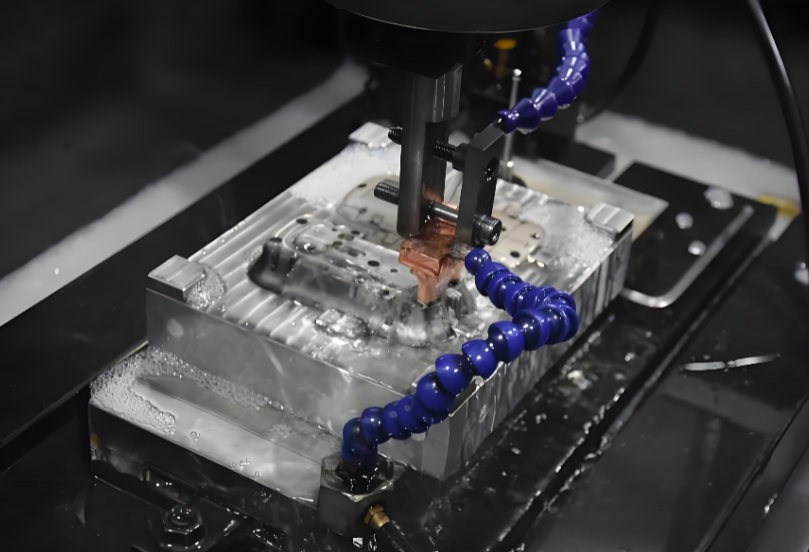
Climb milling and conventional milling are both common machining and cutting methods.Conventional milling is a traditional machining method, while climb milling is an advanced alternative.
It is essential to understand the differences, development history, and practical applications between these two methods.
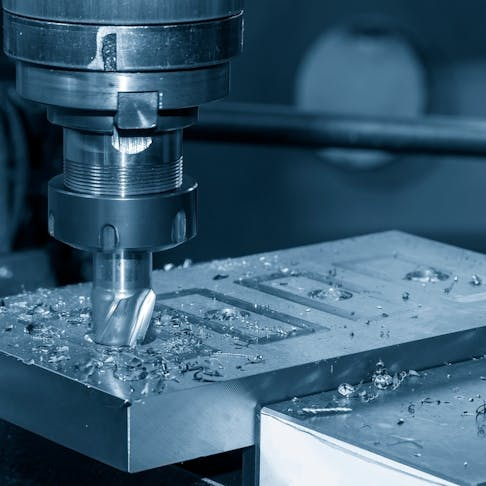
What Is Climb Milling?
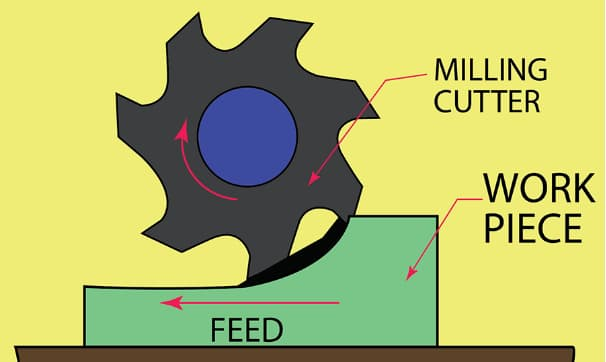
It is a machining method applied by CNC machine tools. The cutting tool teeth climb along the material surface to cut the workpiece and shape it into the required form. Supported by CNC equipment, the process is straightforward. The cutting tool moves in the same direction as the feed direction of the workpiece.
Climb Milling Direction
As shown in the figure in the introduction section, the milling cutter machines along the feed direction, namely the moving direction of the workpiece. The milling cutter remains in constant contact with the workpiece.
Climb Milling in CNC Machine Tools
Anyone working with CNCs knows modern machines have advanced features. Automatic tool changers make climb milling easy to perform.
Thanks to CNC machining, climb milling delivers high precision and dimensional accuracy. The processed parts are widely applied in critical industries including aerospace, automotive, and medical devices.
What Is Conventional Milling?
Climb milling is simply an advanced version of this milling method. As the oldest milling technique, conventional milling was originally used with manual tools to fabricate complex designs. Also known as up-milling, it operates with the cutting tool moving against the direction of workpiece feed.
How Conventional Milling Works
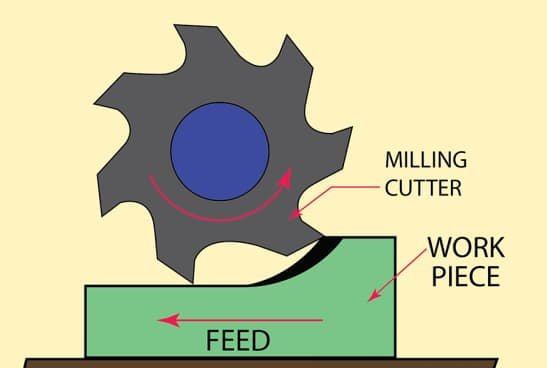
You can refer to the figure below to understand its working principle.
To achieve the desired shape, the cutting tool moves in the opposite direction of the workpiece feed motion.
Conventional Milling Machines and Their Applications
The main applications of conventional milling are listed below:
- Fabricate complex and curved components
- Achieve superior surface finish
- Applied for prototyping
- Suitable for manufacturing various types of gears
- Prepare casting molds
Up-Milling vs Climb Milling: Historical Background
In the late 1890s, conventional up-milling was the most prevalent machining method. During World War II, driven by the growing demand for high precision, climb milling gradually came into widespread use. Nowadays, climb milling has become more commonly adopted than conventional milling.
Advantages of Climb Milling
This section outlines the benefits of climb milling:
Superior Surface Finish
Advanced cutting tools and CNC machine tools deliver an excellent surface finish when machining steel, aluminum and other materials.
Extended Tool Life and Reduced Wear
Lower surface roughness reduces friction, minimizes tool wear, and prolongs tool service life.
Reduced Cutting Force and Heat Generation
Climb milling is ideal for softer materials such as aluminum and low-carbon steel. It requires less cutting force and generates less cutting heat during processing.
Simplified Workpiece Clamping
As the cutting tool travels in the same direction as the workpiece feed, complex clamping fixtures are unnecessary.
Climb Milling vs Conventional Milling: Efficiency Advantages
Climb milling works effectively for soft materials, while conventional milling is more suitable for harder materials.
With automatic operation on CNC machines, climb milling enables higher production efficiency.
Advantages of Conventional Milling
Some key advantages of conventional milling are as follows:
Stability and Control
The cutting tool moves against the feed direction of the workpiece, delivering higher stability and better control while reducing vibration. With minimal backlash and lower cutting force, tool movement can be controlled more precisely.
Ideal for Finishing and Light Cuts
Finishing removes excess material for target surface roughness. Conventional milling works best for finishing and shallow cuts.
Zero Clearance for More Precise Cutting
In conventional milling, achieving zero clearance and precise cutting is relatively easy. Zero clearance means there are no unnecessary gaps left on the workpiece after milling. This allows other machines to move accurately and repeatedly without unexpected displacement.
When to Choose Conventional Milling for Specific Materials
Milling methods fit different materials, so workpiece material dictates the choice. Machining accuracy also matters when selecting cutting strategies.
- Choose climb milling for softer materials
- Choose conventional milling for harder materials
Disadvantages of Climb Milling
Every machining technique has its own advantages and disadvantages. The following outlines the drawbacks of climb milling.
Risk of Chatter and Stability Issues
Cutting forces tend to pull the workpiece and machine table toward the cutter, resulting in unintended movement and positioning errors.
Not Suitable for Harder Materials
Hard materials such as high-carbon steel are difficult to machine due to high brittleness. Applying climb milling may compromise the structural integrity of the material.
Risk of Tool Deflection and Inaccuracy at High Speed
CNC machines often operate at high cutting speeds. High-speed machining brings challenges such as tool deflection and dimensional inaccuracy. These problems occur more frequently when the workpiece has defects such as edge gouging.
Climb Milling Direction and Its Challenges
These are the key challenges encountered in climb milling:
- Tool deflection
- Workpiece positioning errors
- Backlash
- Inadaptability to hard materials
Disadvantages of Conventional Milling
Now it is time to get familiar with the drawbacks of conventional milling.
Surface Finish Limitations of Conventional Milling
Reliance on manual operation may lead to human error, bringing multiple challenges to finished parts, among which poor surface finish is the main issue. It is difficult to achieve an ultra-smooth surface quality.
Higher Heat Generation and Impact on Tool Life
The cutting tool moves opposite to the workpiece rotation direction, causing intense friction and excessive heat generation, which shortens the service life of cutting tools.
Increased Cutting Force and Impact on Stability
To illustrate with an analogy: climbing a mountain requires greater physical effort, and the same applies to conventional milling. This method demands higher cutting force to remove material, which in turn affects overall machining stability.
Differences Between Climb Milling and Conventional Milling
Let’s look at some key differences between climb milling and conventional milling:
Climb Milling vs Conventional Milling: Cutting Direction and Tool Movement
Climb Milling: As shown in the earlier introduction, the cutting path of climb milling runs in the same direction as workpiece feed.
The tool rotates clockwise.
Conventional Milling: The tool rotates counterclockwise.
The cutting path moves against the direction of workpiece feed.
Surface Finish Comparison: Climb Milling vs Conventional Milling
Climb Milling: The process is automated with no manual intervention required, achieving a high-quality surface finish compared to conventional milling.
Climb Milling vs Conventional Milling: Which Is Best for Different Materials?
Below is the recommended milling technique for various materials.
Climb Milling vs Conventional Milling for Aluminum Alloys
Aluminum is a relatively hard material and should be machined using conventional milling.
Climb Milling vs Conventional Milling for Plastics
For soft materials like plastics, climb milling is the most suitable technique due to its cutting characteristics.
Choosing Between Climb Milling and Conventional Milling: When to Use Each
Climb Milling: Suitable for soft materials and tight tolerances
Conventional Milling: Suitable for hard materials
Choose Climb Milling for Heavy Cutting and Soft Material Machining
Machine-mounted cutting tools can easily deliver high cutting force up to approximately 1000N, making climb milling the optimal choice for heavy material removal and soft workpiece materials.
When to Use Conventional Milling for Finishing and Precision Machining
Conventional milling is better suited for light, fine cuts.
It offers excellent control over cutting forces, delivering a smooth surface finish and higher dimensional accuracy.
Key Factors to Consider: Part Geometry, Material Type and Cutting Speed
These factors should be evaluated before selecting a milling strategy. Proper assessment helps reduce costs and avoid machining risks.
If climb milling is applied to extremely hard materials, it may easily cause tool breakage and other failures.
Milling Terms: Up-Milling and Down-Milling
You will learn how up-milling and down-milling relate to conventional milling and climb milling. Up-milling and down-milling are alternative names for these cutting methods widely used in industry.
What is Up-Milling and How Does It Relate to Conventional Milling?
Up-milling is comparable to climbing a mountain, where the force is applied against the direction of workpiece feed. This is why it is synonymous with conventional milling.
What is Down-Milling and How Does It Relate to Climb Milling?
The cutting tool moves downward. In down-milling, the cutting path runs in the same direction as workpiece feed, which is why it is also called climb milling.
Up-Milling vs. Down-Milling: Effects on Chip Thickness and Cutting Forces
Down-Milling (Climb Milling)
Chip thickness starts thick and gradually decreases toward the end of the cut. This results in:
- Lower cutting forces
- Reduced tool wear
Up-Milling (Conventional Milling)
Chip thickness starts thin and gradually increases, leading to:
- Higher cutting forces
- Increased tool wear
Up-Milling vs. Down-Milling in CNC Machines: Differences and Applications
Up-Milling (Conventional Milling)
- Cutting direction: Opposite to workpiece feed
- Applications:
- Roughing operations
- Machining hard materials
Down-Milling (Climb Milling)
- Cutting direction: Identical to workpiece feed
- Applications:
- Precision machining
- Finishing operations
- Machining soft materials
Practical Tips for Climb Milling and Conventional Milling
Follow the tips below to avoid common machining issues:
Minimize Backlash in Climb Milling
These guidelines help effectively reduce backlash during climb milling:
- Adopt spring systems and double nuts as anti-backlash devices
- Keep the machine well-maintained
- Use preloaded lead screws
Adjust Milling Parameters for Optimal Results
To achieve the best performance and machining accuracy, carefully configure the following parameters:
- Cutting speed
- Feed rate
- Depth of cut
Tool Selection and Its Impact on Milling Strategy
Selecting the right cutting tool is critical for milling operations. It saves processing time, reduces material waste, and preserves tool integrity. The tool geometry should match the geometry of the workpiece.
Efficient Use of CNC Machines for Climb and Conventional Milling
CNC machines can produce parts with tight tolerances and high precision if the following requirements are met:
- Program toolpaths carefully
- Optimize tool changes and machine setup
- Apply backlash compensation
Climb Milling vs Conventional Milling: Which Is Best for Your Project?
If your project involves soft materials such as aluminum, you should adopt the climb milling process, and vice versa.
Start Your Next CNC Milling Parts Project with Zorapid
Zorapid is equipped with state-of-the-art CNC machines. We provide high-precision machining for complex parts with tight dimensional tolerances. Thanks to our advanced equipment, we are capable of mass production within a shorter lead time. We deliver custom machined parts in the shortest possible time at a reasonable cost.
FAQ
Can climb milling be used for all materials?
No, it is not universally applicable. It is only limited to softer materials such as aluminum, copper, and more.
How does climb milling direction affect performance?
In climb milling, the cutter moves in the same direction as the workpiece feed. Therefore, less mechanical force is required for machining. This feature improves overall performance, delivering a smoother surface finish and tighter tolerances.
Which milling method feeds the workpiece against the rotation of the cutting tool?
Conventional milling