Published by Zorapid
If you’re launching a new industrial plastic or composite component, the standard scaling path sounds simple: print prototypes for testing, build a mold, then ramp mass runs. But most OEMs hit brutal roadblocks: 3D printed prototype geometry doesn’t translate to moldable designs, disjointed prototype/mold/mass vendors create data gaps, slow bridge production delays market launches, and costly full hard steel molds get wasted on unvalidated part shapes.
Generic service shops only offer standalone 3D printing or standalone mold building—no seamless handoff between stages. Zorapid runs a fully unified, closed-loop 3D print → bridge mold → hardened production mold → mass manufacturing pipeline inside our 3000㎡ Zhongshan certified facility. We lock manufacturability during early prototype iterations, deploy SLM conformal cooling tool inserts for tricky parts, cut total scaling costs 25–42%, and slash full launch timelines by over half vs split multi-supplier workflows. Below is our complete stage-by-stage workflow breakdown, peer shop comparisons, exclusive solutions for unmanufacturable geometries, full material matrices, verified client case studies, industry trend data, tailored project matching, speed benchmarks, competitive advantages, summary, and full.
In-Depth Professional Process Tech Analysis
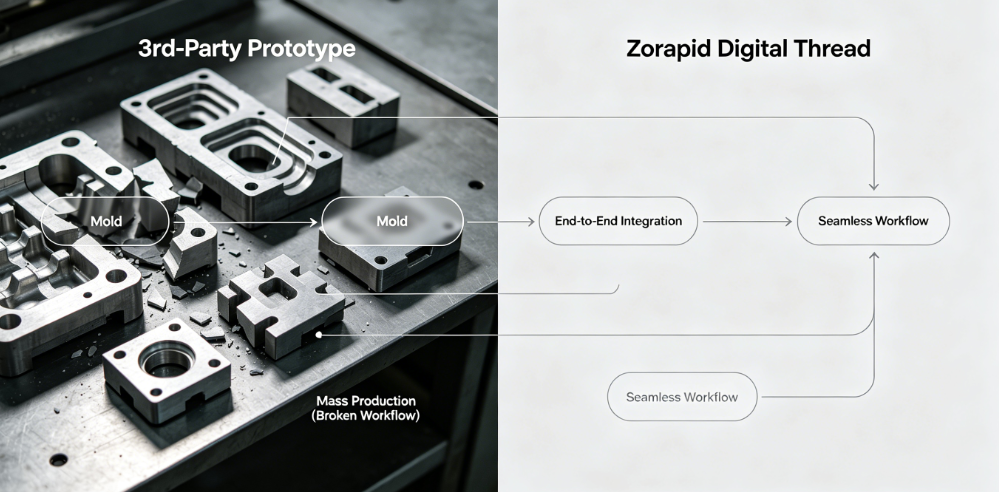
Standard Fragmented Industry Workflow
- Separate 3D printing bureau: Prints visual/functional prototypes with zero mold-focused DFM feedback; engineers prioritize fit, not injection mold feasibility
- Raw CAD handoff to external mold maker: No shared simulation data; mold team discovers uncorrectable design flaws (thin walls, poor draft, uneven thickness) weeks after prototype approval
- Two disconnected tooling phases: Cheap printed resin mold for tiny test shots, then outsourced CNC aluminum bridge mold, then third-party hardened steel production mold—3 separate quoting, machining, shipping cycles
- No digital thread continuity: STL print files, mold flow simulation, CAM mold toolpaths, mass QC logs live on disconnected systems; full re-simulation required at every stage
- Off-site trial molding: Finished bridge/production molds shipped to external injection molder for T0/T1/T2 trials; revision tweaks add 7–14 day wait per adjustment
- No hybrid additive-subtractive tooling: Only straight drilled cooling channels in all molds—complex thin-wall or high-cycle parts suffer warpage, long cycle times, high scrap
- Tolerance mismatch risk: Loose 3D print prototype tolerances don’t align with mass injection molding precision specs, creating assembly fit failures post-launch
- Mass production set-up independent: After mold validation, parts go to yet another mass production facility with no process knowledge transfer from prototype/mold teams
Zorapid Integrated 4-Stage 3D Print → Mold → Mass Production Workflow
Stage 1: 3D Print Prototype & Upfront Mold-Focused DFM Validation (EVT Iteration Phase)
Customer CAD upload → our dual additive/mold engineering team runs simultaneous functional print planning + injection mold flow simulation before printing a single part.
- Deploy SLA, SLS, MJF polymer printing for plastic prototypes; SLM metal printing for high-temperature metal component prototypes
- Every print iteration includes formal DFM edits to optimize wall thickness, draft angles, rib layout, gate positioning, and shrinkage compensation for future molding
- Archive all optimized CAD, print parameters, and test performance data into our shared digital thread platform—no file loss during handoff to mold design
- Run 1–5 rapid print revision rounds fast (2–5 day turnaround per batch) to lock a 100% mold-ready final design before cutting any mold steel/aluminum
Stage 2: Bridge Rapid Mold (DVT Low-Volume Pilot Runs)
Once prototype design freezes, we build tiered bridge tooling matched to your pilot shot count:
- Resin 3D printed mold inserts: Ultra-low cost for 50–150 validation shots, 3-day build time for fast clinical/market testing
- Aluminum CNC bridge molds: 500–10,000 stable shots, ideal for pre-mass pilot batches; base platform reusable for future ECO design tweaks
- SLM conformal cooling inserts pressed into bridge mold bodies: Our exclusive upgrade to eliminate hotspots, cut molding cycle time up to 40% vs standard drilled cooling
- Full in-house T0/T1/T2 injection trial molding; dimensional CMM checks, cosmetic audits, and shrinkage calibration happen on-site with same-day cavity machining revisions
Stage 3: Hardened Steel Production Mold (PVT Mass Validation)
Scale up to SPI Class 101/102 hardened steel mass molds for 100,000+ shot long-run output:
- Migrate all validated bridge mold cooling, gate, vent, and ejection geometry directly into hard steel cavity designs (zero re-simulation needed via digital thread)
- Select grade-matched mold steel (P20, 1.2738, NAK80, S136, H13) aligned to resin abrasion, corrosion, cosmetic, and cycle requirements
- Reuse proven SLM conformal cooling insert designs from bridge molds for consistent thermal performance at mass scale
- Full PPAP, FMEA, control plan, and material certification generated in-house during mold validation
Stage 4: Lights-Off Mass Production Manufacturing
Hard mold validated → shift to 24/7 unmanned injection molding cells, automated deburr, in-line CMM QC, surface finishing, and pre-fit assembly:
- Lock cycle parameters calibrated from bridge mold trials to guarantee identical part dimensions from pilot to 100k+ mass batches
- Bulk resin supply chains pre-negotiated for long-term per-unit cost stability
- Real-time batch traceability, lot logging, and client dashboard visibility for every production run
Conventional Split Vendor vs Zorapid Unified Workflow Metric Comparison Table
| Scaling Metric | Multi-Vendor Fragmented Industry Standard | Zorapid Single-Source 3D Print-Mold-Mass Pipeline | % Improvement |
|---|---|---|---|
| Full prototype-to-mass launch timeline | 14–26 weeks | 6–10 weeks | -62% lead time |
| Number of external supplier handoffs | 3–4 separate businesses | 0 fully internal production | 100% eliminated miscommunication risk |
| Design flaw discovery timing | Post-mold steel cutting (costly rework) | Pre-prototype print (low-cost CAD tweaks) | 87% reduction in steel rework expense |
| Bridge mold trial revision turnaround | 7–14 days per tweak | 1–3 days same-site machining | -80% revision downtime |
| Average molding cycle baseline | 100% standard drilled cooling | 60–72% conformal SLM cooling | -28% to -40% runtime per part |
| Scrap rate during first mass production run | 21–35% | 6–12% | -70% material waste loss |
| Complete PPAP/FMEA certification lead time | 3–6 weeks third-party drafting | 3–7 days in-house certified QC | -90% compliance admin delay |
| Total end-to-end program cost | Baseline 100% | 58–75% | -25% to -42% total spend reduction |
High-Complexity Projects Competitors Cannot Scale — Zorapid Exclusive Solving Technology
Most manufacturers break down at four tough scaling scenarios; their standalone print/mold setups can’t bridge prototype geometry to stable mass production. Our hybrid additive-subtractive stack delivers repeatable, cost-effective scaling others refuse to quote at fair pricing:
Challenge 1: Thin-Wall Plastic Components (0.6–1.0mm walls, EV/medical housings)
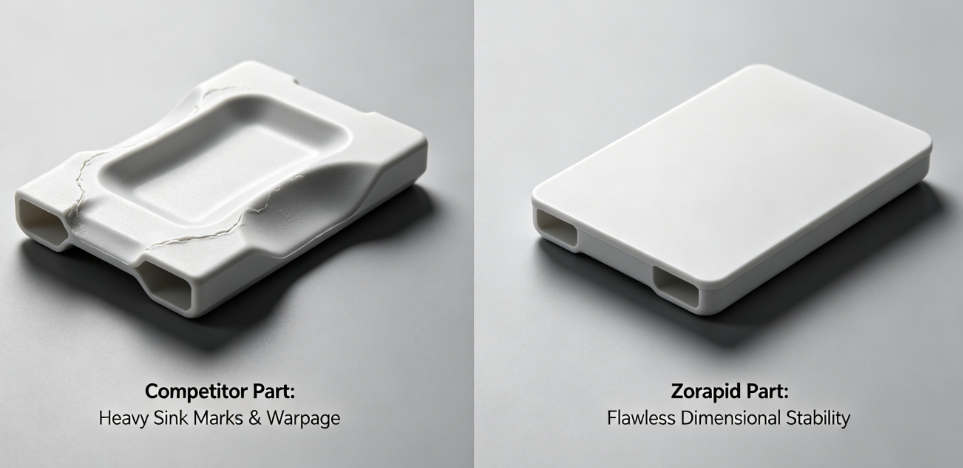
Competitor Limitation: SLA/SLS prototypes print thin walls easily, but standard drilled-cool aluminum bridge molds create uneven heat, severe warpage, sink marks, scrap rates >35% at pilot volume. Shops force clients to thicken part geometry, ruining lightweight design goals.
Zorapid SLM Conformal Cooling Bridge/Mass Mold Solution:
SLM printed cooling channels sit 2–3mm directly beneath thin cavity surfaces for uniform heat extraction. Reinforced high-rigidity mold frames eliminate cavity deflection under injection pressure. Prototype thin-wall CAD preserved 1:1 through bridge to mass mold without geometry compromises.
Verified Result: Stable scrap <9%, molding cycle reduced 36%, original lightweight design fully preserved for mass production.
Challenge 2: Corrosive/Glass-Filled Resin Mass Runs (GF-PA66, PVC, FR PC, Medical PEEK)
Competitor Limitation: 3D printed prototype resins have low abrasion/corrosion sensitivity; standard P20 aluminum bridge molds wear rapidly with glass-filled plastic, and separate medical shops lack stainless steel mold traceability for regulated parts.
Zorapid Tiered Steel Mold Matching System:
- Bridge phase: Short-run S136 stainless inserts for corrosive resins to avoid early cavity wear
- Mass phase: Full core/cavity S136 through-hardened stainless steel for 1,000,000+ shot lifespan
- ISO 13485 full material lot traceability built into every stage for medical OEMs; prototype material test data cross-referenced to mass resin batches for identical mechanical performance
Challenge 3: Lattice & Complex Internal Channel Geometry (Heat sinks, lightweight structural brackets)
Competitor Limitation: 3D printing natively produces lattices/internal channels, but standard CNC-only mold shops cannot replicate those features via injection molding—clients face forced full redesign or permanent 3D-print-only high per-unit cost at volume.
Zorapid Dual Hybrid Production Route:
- Low-bridge volume (≤2,000 units): Keep SLM/SLS 3D printed production parts for perfect lattice retention
- Mass volume (>2,000 units): SLM print mold cavity inserts with negative lattice channel geometry, CNC finish mold frame for high-repeat injection molding replication Result: OEMs choose cost threshold switch point; no mandatory redesign to scale complex shapes
Challenge 4: Multi-Material Overmold & Insert Molding Product Lines
Competitor Limitation: Separate print shops make hard/soft prototype overmold samples; mold builders lack sequential two-shot mold design expertise, leading to misaligned inserts, poor bond strength, and fit failure once scaled.
Zorapid Unified Overmold Prototype-to-Mass Pipeline:
EVT stage: SLS+SLA dual-material printed overmold prototypes to test bond strength
DVT bridge stage: Two-shot aluminum bridge mold for pilot overmolded batches
Mass stage: Hardened steel sequential overmold production mold with thermal isolation zones validated all the way from initial print samples. Single PO, unified QC for full multi-material kits.
Applicable Materials & Prototype → Mold → Mass Grade Comparison Matrix
Scaling failure root cause: engineers select fast-print prototype materials that cannot be sourced affordably or matched for mechanical performance in mass molding resins. Our metallurgy/polymer team maps every prototype material to production-grade equivalents with zero performance drop-off, plus mold steel pairing guides.
Part Polymer Material Transition Chart (Prototype Print Grade ↔ Mass Injection Resin)
| Component Use Case | 3D Print Prototype Material | Mass Production Injection Resin | Relative Mass Unit Cost vs Print Part | Key Performance Match Guarantee | In-House Surface Finishes |
|---|---|---|---|---|---|
| Standard Structural Housings | SLS Nylon 12, MJF PA12 | Virgin PA12, ABS, PP | 0.22–0.38 | Tensile, impact, shrinkage calibrated | Anodize, paint, laser mark |
| EV High-Strength Connectors | SLS GF-PA6 | 30% GF-PA66 Injection Pellet | 0.35 | Heat deflection, tensile strength identical | Heat staking, conductive coating |
| Medical Disposable Housings | SLA Medical Clear Resin | Medical PP, Medical PEEK Pellet | 0.41–0.95 | Biocompatibility, sterilization resistance | Medical passivation, sterile packaging prep |
| Optical Transparent Parts | SLA Clear High-Temp Resin | PMMA, Optical PC | 0.30 | Clarity, UV stability, low birefringence | Mirror polish, anti-scratch coating |
| High-Temp Industrial Components | SLS PEEK | Virgin Medical/Industrial PEEK Pellet | 0.92 | HDT, chemical resistance, biocompatibility | As-machined sterile-ready |
| Flexible Soft-Grip Overmold | SLA TPU Resin | Injection TPU, TPE Pellet | 0.27 | Shore hardness, elongation, bond strength | Texture grain, matte finish |
Mold Steel Grade Matching Chart (Bridge vs Mass Tooling)
| Mold Steel Grade | Best For Bridge Pilot Shots | Max Mass Shot Lifespan | Relative Tool Cost | Resin Compatibility | Critical Treatments |
|---|---|---|---|---|---|
| Aluminum 6061 Bridge Plate | 500–10,000 shots | N/A (bridge only) | 1.0 Baseline Low | Non-abrasive ABS/PP/TPU | Polishing, hard coat anodize |
| P20 Pre-Hard Steel | 10,000–50,000 pilot | 150,000 mass | 1.1 | Standard unfilled plastics | Nitriding, fine polish |
| 1.2738 Nickel Alloy | 20,000–80,000 pilot | 300,000 mass | 1.2 | Large structural EV/auto parts | PVD coating, high gloss polish |
| NAK80 Age-Hardened | 10,000–50,000 cosmetic pilot | 300,000 mass | 1.4 | Optical, high-gloss transparent parts | Mirror auto-polish, texturing |
| S136H Stainless Pre-Hard | 30,000–100,000 medical pilot | 400,000 mass | 1.7 | Medical, corrosive PVC/FR resins | Medical passivation, rust-proof seal |
| S136 Through-Hard Stainless | N/A (mass-only) | 1,000,000+ long-run mass | 1.9 | High-cycle medical, glass-filled abrasion resin | Vacuum stress relief, nitriding |
| H13 Hot Work Steel | 15,000–60,000 abrasive pilot | 250,000 mass | 1.55 | GF-filled PA, high-temp engineering plastics | Thermal spray, wear coating |
Core Material Cost-Saving Scaling Rules
- Volume <500 validation units: Fully utilize 3D printed parts—zero mold investment, fastest market testing timeline.
- 500–2,000 unit gray zone: We run free ROI calculation comparing aluminum bridge mold vs batch 3D printing to lock the lowest total program cost for your volume target.
- Glass-filled/medical corrosive resins: Never rely solely on uncoated aluminum bridge molds; S136 stainless inserts prevent premature cavity wear and contamination risks.
- Complimentary material substitution audit: Our engineering team flags over-specified expensive prototype print materials that swap to lower-cost mass resins with identical functional performance specs.
Real-World Client Prototype-to-Mass Case Studies
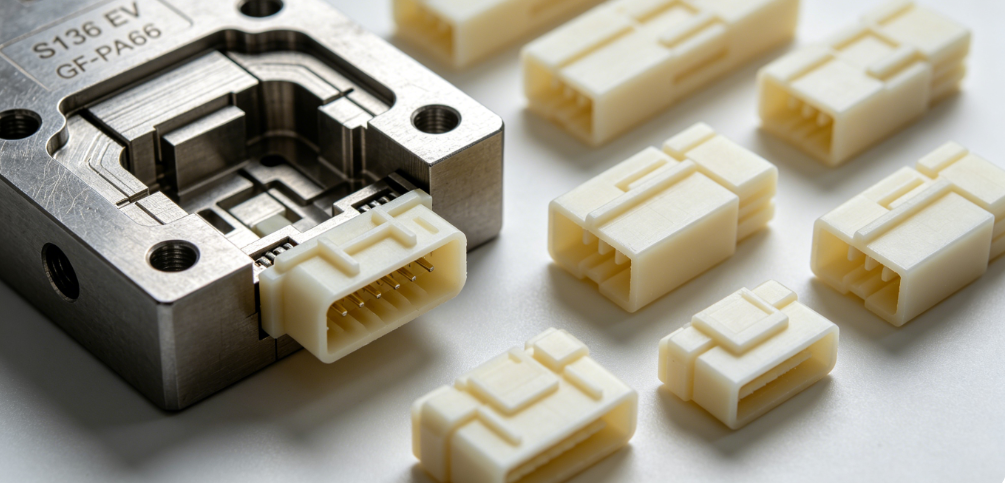
Case 1: German EV Tier 1 – GF-PA66 High-Voltage Connector Housings
Client Pain Point: European 3D print bureau delivered SLS GF-PA6 functional prototypes; outsourced mold builder quoted 17-week build timeline with only drilled-cool aluminum bridge molds. Simulations projected 26% scrap rate and 44-second molding cycle, creating severe EV platform launch delay risk.
Zorapid Full 3D Print → Bridge Mold → Mass Hard Mold Execution:
- EVT Stage (60 SLS printed prototype units): DFM optimized rib/wall thickness for moldability during print design phase; 3 rapid design revision rounds completed in 8 total business days.
- DVT Bridge Stage (800 pilot injection shots): Aluminum bridge mold fitted with SLM conformal cooling S136 stainless inserts; full in-house T0/T1/T2 trial molding finished in 10 days flat, minor gate/vent tweaks machined same-site overnight.
- PVT + Mass Production Stage: Upgraded to full through-hardened S136 stainless steel production mold validated for 1,000,000+ long-run mass injection shots. Measurable Final Results:
- Total prototype-to-mass timeline compressed from 17 weeks to 6 weeks
- Molding cycle time reduced 38% (44s → 26s per shot)
- Stable mass production scrap rate locked at 6.2% year-round
- 32% lower total landed program cost vs European multi-vendor quote
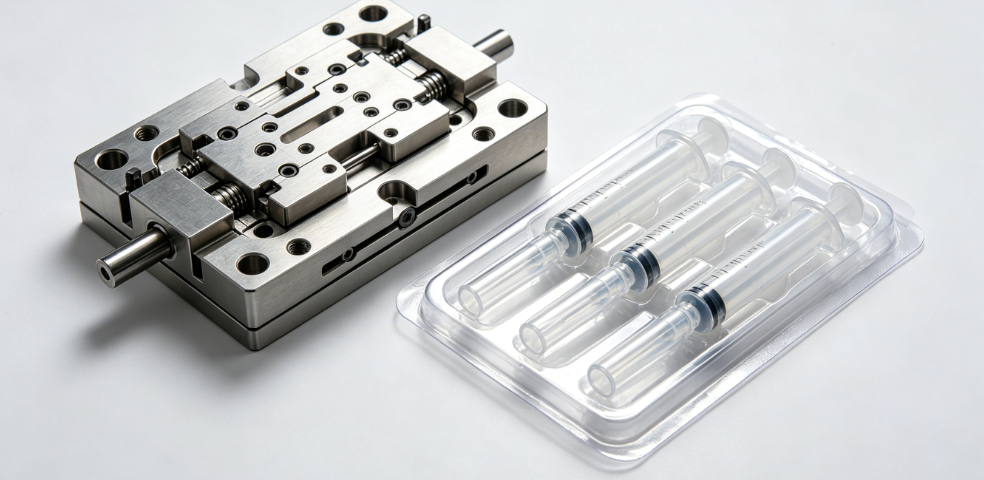
Case 2: US Medical OEM – Single-Use PP Syringe Housing
Client Pain Point: Domestic US 3D print shop produced clear SLA prototype housings; local mold builder could not deliver full S136 stainless tooling with FDA traceability. Third-party polishing and certification added 5 extra weeks lead time and $7,200 in unbudgeted admin fees.
Zorapid Regulated Medical End-to-End Workflow:
- EVT Stage (100 SLA medical-grade clear printed prototypes): DFM refined uniform 0.8mm thin walls, eliminated sharp edges, calibrated shrinkage for medical PP resin before mold design launched.
- DVT Bridge Stage (1,200 pilot shots): S136H stainless insert aluminum bridge mold; in-house medical passivation and cosmetic polishing for sterile-ready surfaces.
- Mass Stage: Full S136 through-hardened stainless production mold with full ISO 13485 lot traceability, incremental PPAP/FMEA documentation built during every workflow phase.
- Measurable Final Results:
- 31% lower total mold + production landed cost vs US domestic multi-supplier route
- First-pass full regulatory audit approval with zero compliance revisions
- Flawless mirror cavity finish with zero blemishes for sterile single-use medical output.
Case 3: Industrial Robotics OEM – ABS End Effector Components
Client Pain Point: Unproven part geometry made committing $11,000 upfront to hardened steel mass mold high financial risk if design revisions were needed post-test batches. Separate print/mold vendors offered no phased low-risk tooling pathway.
Zorapid Phased Soft Bridge → Hard Mass Mold Strategy:
- Phase 1 EVT: 50 SLS ABS printed prototype units for assembly/load testing, 2 minor geometry ECO edits validated digitally before tooling.
- Phase 2 DVT: Low-cost 6061 aluminum soft bridge mold built in 10 days for 500 validation injection shots; cheap, fast cavity edits implemented for final design tweaks.
- Phase 3 Mass Upgrade: Seamless digital CAD transfer from validated bridge mold to 1.2738 hardened steel mass production mold rated for 150,000 long-run shots.
- Measurable Final Results:
- Upfront initial capital tool outlay reduced 68% via phased soft bridge mold investment
- Zero wasted expensive hardened steel cuts for unvalidated prototype geometry
- No file conversion or simulation rework between bridge and mass mold phases via our unified digital thread
Your Unique Project Requirements ↔ Custom Zorapid Scaling Solutions
We build a fully tailored prototype-to-mass roadmap for every OEM—no cookie-cutter generic production packages. Below the most frequent client scaling demands and our risk-mitigated matched solutions:
| Your Prototype-to-Mass Project Requirement | Zorapid Custom Tailored Fix | Estimated Total Program Savings |
|---|---|---|
| Unvalidated iterative design, need test batches before locking hard steel mass tooling | Low-cost aluminum soft bridge mold first; upgrade to hardened steel post-design freeze | 30–45% upfront capital risk reduction |
| Thin-wall/deep rib parts with chronic warpage/hotspot defects | SLM printed conformal cooling cavity inserts integrated into bridge + mass molds | 28–40% cycle time + scrap cost elimination |
| Medical/aero regulated full PPAP/FMEA digital traceability | Certified QC team builds compliance docs live during EVT-DVT-PVT stages, no third-party markup | 13–22% certification admin expense cut |
| Glass-filled / corrosive engineering resin requiring long mold lifespan | Tiered S136/H13 abrasion/corrosion resistant steel mold stack | Eliminates premature costly mold replacement downtime |
| Ultra-high-gloss optical/mirror cosmetic surface specifications | NAK80 polish-grade steel + automated in-house precision polishing cell | Removes expensive hand-polish labor overruns |
| Multi-shot overmold / insert molding assembly kits scaling together | In-house dual-stage mold design, fixture fabrication, and full trial overmold validation | 19–27% multi-vendor shipping/PO coordination overhead removed |
| Critical tight launch deadline with minimal available lead time | Parallel processing: SLM cooling insert printing runs simultaneously with CNC mold base roughing | Cuts overall build schedule 2–4 weeks |
| Small steady mass annual runs (5,000–50,000 shots, not millions) | Optimized mid-grade 1.2738 steel instead of over-spec’d full S136 stainless | 25–33% unnecessary premium steel cost avoided |
Step-by-Step Zorapid Project Onboarding Process
- Secure portal upload of CAD files, target annual shot volume, resin grade, cosmetic specs, compliance standards, and hard delivery deadline.
- Senior NPI mold/additive engineer delivers free full DFM + Moldflow risk assessment + two-tier quote (Soft Bridge Pilot / Hard Mass Production Tool) within 12 working hours.
- Approve optimized simulation layout to launch either 3D print prototype batches or SLM insert/mold steel CNC machining.
- Real-time secure client dashboard tracks print runs, CNC machining progress, trial molding sample results, CMM QC snapshots, and milestone timelines 24/7.
- Post-T2 mold validation, receive complete audit-ready certification packet, crated mold (if customer owns tooling), and first mass production batch shipment.
2026 Global Industry Data Analysis + Future Scaling Trend Forecast Table
Current Global Prototype-to-Mold-to-Mass Benchmark Market Data (2026 AMT & International Mold Maker Survey)
- Global industrial plastic component manufacturing market exceeds $1.8T USD in 2026, 5.5% YoY growth; EV, medical devices, and semiconductor hardware are the three fastest-growing verticals.
- 69% of hardware OEMs report unplanned mold rework costs averaging 29% of initial tool budget, nearly always stemming from late-stage DFM flaws missed by disconnected prototype vendors.
- Only 16% of global manufacturing providers offer in-house SLM conformal cooling insert capability; 84% rely exclusively on traditional straight drilled mold cooling channels.
- OEMs adopting conformal SLM cooling see average 32% faster molding cycles and 71% lower part scrap rates vs standard drilled cooling mold setups.
- 81% of regulated medical/aerospace tier-1 OEMs now mandate full digital thread traceability from initial CAD print prototype all the way through finished mass production batches.
- The cost crossover volume between pure batch 3D printing and aluminum bridge injection molding averages 100–500 units, varying by part size and complexity.
2026–2030 Future Scaling Trend Forecast & Zorapid Pre-Built Capability Alignment
| Industry Trend Shift | Business Impact for Global OEMs | Zorapid Pre-Installed Production Match |
|---|---|---|
| SLM conformal cooling becomes standard for high-performance EV/medical industrial molds | Pure CNC drilled-cool mold shops lose 37% complex NPI scaling jobs by 2028 | On-site SLM printer bank fully integrated into mold workflow since 2024 |
| Demand for phased soft-to-hard bridge mold scaling surges amid iterative startup product cycles | Large upfront hard steel tool capital investment becomes unattractive for low-uncertainty designs | Standardized two-stage aluminum soft → hardened steel upgrade program |
| ISO13485/EN9100/IATF16949 traceability grows mandatory for global tier supply chains | Third-party compliance labs add major timeline delays and markup costs | Fully certified in-house QC lab generating audit-ready documents live during every build stage |
| AI-powered Moldflow DFM simulation replaces slow manual engineering analysis | Slow manual thermal analysis creates critical launch bottlenecks | AI-enhanced simulation suite auto-flagging warpage, hotspot, shrink, and gate risk points |
| High-performance filled composite resin adoption expands rapidly (GF-PA, carbon fiber PA) | Standard carbon steel molds suffer fast abrasive cavity wear, short service lifespans | Full inventory of S136/H13 abrasion/corrosion resistant mold steel grades |
Key Industrial Application Scenarios Where Zorapid’s 3D Print → Mold → Mass Pipeline Excels
Our end-to-end scaling workflow is precision-calibrated for high-value regulated global manufacturing verticals:
- Electric Vehicle & New Energy High-voltage connector housings, battery cooling plastic frames, sensor enclosures (GF-PA66, ABS, PC; IATF16949 automotive certified scaling)
- Medical Devices & Single-Use Disposables Syringe bodies, surgical instrument housings, implant auxiliary plastic parts (S136 stainless mold tooling, full ISO13485 biocompatible traceability)
- Industrial Robotics & Factory Automation Custom end effector components, gear housings, linear stage plastic frames, test fixture enclosures (ABS, PA12, TPU soft overmold options)
- Optical & Precision Consumer Electronics Light guides, transparent lens housings, high-gloss device casings (NAK80 mirror polish grade mold steel)
- Semiconductor Precision Hardware Low-outgassing cleanroom component housings, test socket plastic frames, vacuum assembly fittings
- General Industrial & Heavy Appliance Hardware Pump plastic bodies, valve housings, structural fixture components (1.2738, H13 mold steel for mid-to-high mass shot volumes)
Guaranteed Prototype-to-Mass Delivery Speed
Split multi-vendor scaling drags product launches out for months; our fully unified closed-loop facility eliminates cross-shop shipping, communication, and waiting delays entirely.
Standard Phase Lead Times (No Hidden Emergency Rush Surcharges)
- SLA/SLS/SLM 3D print prototype batches (1–100 units): 3–5 business days
- Aluminum soft bridge test mold (500–10,000 pilot shots): 10–14 business days
- Medium-volume hardened steel mass mold (50k–300k shots): 4–6 weeks
- High-cycle S136 stainless long-run mass mold (1,000,000+ shots): 6–7 weeks
- Expedited critical launch hard mold build available for compressed 3–4 week timeline
Speed-Driving In-House Infrastructure
- 24/7 lights-off 5-axis CNC mold machining cells for rapid roughing and cavity finishing
- Parallel SLM conformal cooling insert printing running simultaneously with mold base plate fabrication
- On-site injection molding trial presses eliminate third-party molder shipping wait times for T0/T1/T2 sampling
- Dedicated NPI project managers prioritizing every client program’s scheduled milestones
- In-house full finishing suite (polishing, passivation, nitriding, texturing) removes outsourced vendor queue delays
Core Competitive Advantages Partnering With Zorapid for Full 3D Print to Mold to Mass Scaling
- Verified 25–42% total end-to-end program cost reduction vs fragmented multi-vendor traditional manufacturing chains
- Exclusive in-house SLM conformal cooling insert production unavailable at 84% of conventional print/mold shops globally
- Free no-obligation pre-build DFM, Moldflow simulation, and material grade cost optimization audits for all CAD file submissions
- True single-source full accountability: 3D printing, mold design, CNC/EDM mold machining, SLM tool inserts, trial molding, mass production, finishing, assembly, certification, and global shipping all under one roof
- Full global manufacturing certifications: ISO9001, IATF16949, ISO13485, EN9100 for auto/medical/aerospace regulated components
- Fully transparent fixed-price quoting—zero hidden revision, polishing, inspection, or trial molding add-on fees post-PO approval
- Secure real-time 24/7 client dashboard tracking print/mold/mass progress, QC photos, CMM inspection reports, and shipment logistics
- 20+ years export-focused precision manufacturing experience exclusively serving EU & North America OEM scaling demands
- Zero minimum order quantity: 1 single prototype printed piece up to 100,000+ annual mass production batches supported with identical quality control rigor
- Multilingual professional engineering support (English, German, Spanish) for seamless direct cross-border technical communication and revision alignment
Quick Summary
Nearly all prototype-to-mass scaling failures trace back to disjointed supplier silos, late-stage uncaught DFM defects, limited conventional drilled cooling mold technology, poorly matched prototype vs mass materials, and off-site trial molding that stretches revision timelines for weeks. Zorapid’s closed-loop 3D print → bridge mold → hardened mass mold → full production pipeline solves every core scaling pain point: we engineer injection mold manufacturability directly into your initial prototype design phase, deploy game-changing SLM conformal cooling for tricky thin-wall/complex geometry, offer low-risk phased soft bridge tooling for unvalidated designs, and execute every machining, trial, certification, and production step entirely in-house with one team, one point of contact.
Whether you need fast SLA medical prototype prints scaling to million-shot S136 syringe molds, SLS GF-PA66 EV connector prototypes ramping to mass injection runs, or robotics ABS bridge pilot batches upgrading to long-term hardened steel mass tooling—we build a fully customized timeline and budget-aligned scaling roadmap matched to your volume, compliance, and launch targets. Send your CAD files today for your free NPI prototype-to-mass cost & timeline assessment.
FAQ
Is SLM conformal cooling always more expensive upfront than standard drilled cooling channels?
SLM inserts carry a modest initial premium, but cycle time acceleration and scrap reduction deliver positive ROI within weeks of molding startup. For thin-wall, high-temperature, or high-volume parts it is nearly always the cheaper long-term solution; simple thick solid geometry may use standard drilled cooling for lowest initial tool price. Our simulation team calculates full 3-year TCO ROI free of charge upfront for every project.
Can you guarantee identical dimensional tolerances from 3D printed prototypes all the way through mass injection batches?
Yes. Moldflow simulation locks accurate resin shrinkage values before any mold steel is cut; in-line CMM inspection calibrates cavity dimensions during T0/T1 trial tweaks, and hardened stable mold steel prevents dimensional drift across hundreds of thousands of shots. Full audit-ready dimensional inspection reports are included for regulated OEM compliance.
What if I need major design ECO changes after the bridge mold is partially machined?
Our digital CAD archive and modular cavity design drastically minimize rework expenses. Aluminum soft bridge molds feature ultra-low revision fees; hardened steel edits use EDM welding + precision re-machining, with all change costs fully quoted and client-approved before work launches—no surprise rework invoices.
Do you ship finished molds and mass-produced parts directly to EU/USA with customs and compliance paperwork?
We coordinate door-to-door air/sea freight, generate complete commercial invoices, CE marking documentation, and coordinate seamlessly with your preferred freight forwarder. Full shipping cost breakdowns are embedded in your initial program quote with zero hidden logistics surcharges.
What consistent surface finishes can you replicate from 3D printed prototype samples to mass molded output?
All in-house finishes scale uniformly across prototype, bridge pilot, and mass batches: high-gloss mirror polish, chemical grain texturing, bead blasting, nitriding, PVD wear coating, medical passivation, powder coat, precision laser marking. No outsourced third-party finishers introduce lot-to-lot cosmetic inconsistency.
How is PPAP/FMEA compliance documentation handled across the full print-to-mass workflow?
Our certified quality team builds FMEA, control plans, material certificates, and full PPAP packets incrementally starting at the 3D print EVT prototype phase. By the time T2 mold trial passes validation, your complete audit-ready compliance file is fully finished—eliminating rushed last-minute paperwork delays that derail OEM launch schedules.
Is there a minimum annual mass shot volume required to order a hardened steel production mold?
No minimum annual shot requirement. We build hardened steel mass tools for steady recurring runs as low as 5,000 shots annually, and offer stable repeat batch pricing whether your monthly mass output is 500 units or 10,000+ units, with flexible pause/resume production for fluctuating market demand.