Published by Zorapid
Read our full case study on precision CNC machined PEEK cannula guide bushings for surgical device OEMs. Solve thin-wall warpage, tight bore tolerance & biocompatibility challenges with Zorapid’s ISO13485 medical-grade PEEK workflow.
If you design minimally invasive surgical instruments, you know how tiny guide bushings make or break your whole device’s clinical performance.
A Germany-based medical OEM specializing in laparoscopic cannula systems reached out to Zorapid with an urgent custom machining project: 12,000 medical-grade virgin PEEK cannula guide bushings for their next-gen disposable trocar line.
This small tubular component sits inside the surgical cannula shaft. It guides sharp metal trocar needles smoothly during abdominal surgery, seals fluid leakage, and must hold rigid shape after repeated high-temperature autoclave sterilization.
Their original overseas supplier failed 3 consecutive pre-production runs, delivering scrap rates above 35% and missing FDA biocompatibility documentation requirements. The OEM faced delayed clinical trials and missed EU market launch deadlines until they partnered with our ISO13485-certified medical CNC team at Zorapid.
Today we break down the full case study: hard technical constraints, machining failures we fixed, our exclusive PEEK medical manufacturing workflow, and clear cost & quality gains the client locked in after switching production to Zorapid.
3 Non-Negotiable Technical Requirements For This Medical-Grade PEEK Cannula Bushing
First, let’s cover the strict specs that made this part far harder to machine than standard industrial PEEK sleeves. Every single dimension tied directly to patient safety and surgical functionality.
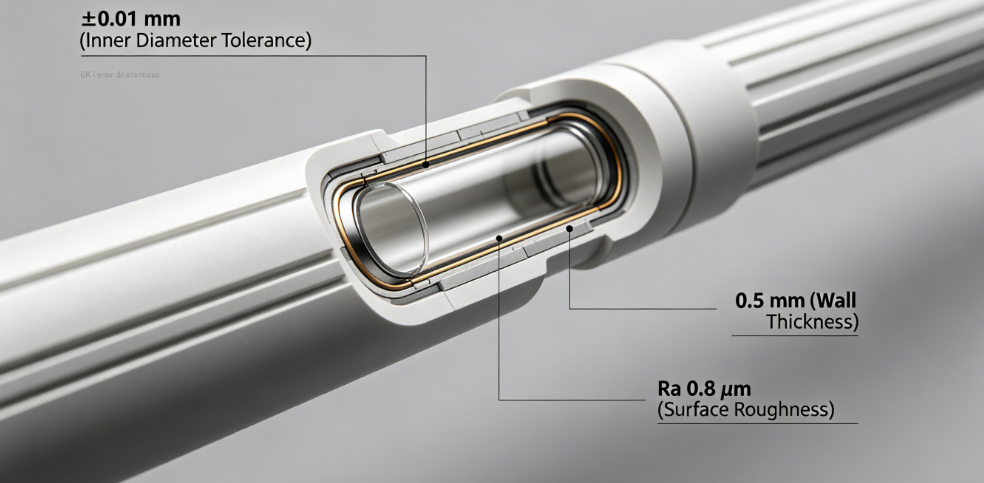
- Ultra-Thin Wall Geometry Outer diameter 6.0mm, inner precision bore 4.2mm, uniform wall thickness only 0.9mm across the full 28mm length. No uneven thickness allowed—even minor wall variance triggers warpage after sterilization.
- Micron-Level Inner Bore Tolerance The central guide bore required ±0.008mm total dimensional tolerance, with surface finish Ra ≤0.2μm. Any rough spots or dimensional drift would scratch the stainless steel trocar needle mid-operation and create tissue damage risk.
- Full Medical Regulatory Compliance Material: Virgin Victrex 450G unmodified PEEK (ISO10993 biocompatibility certified, no glass/carbon fillers). All manufacturing, cleaning and packaging processes must satisfy ISO13485 traceability, FDA medical device residue rules, and gamma sterilization compatibility.
Severe Manufacturing Roadblocks The Client Hit With Their Old Supplier
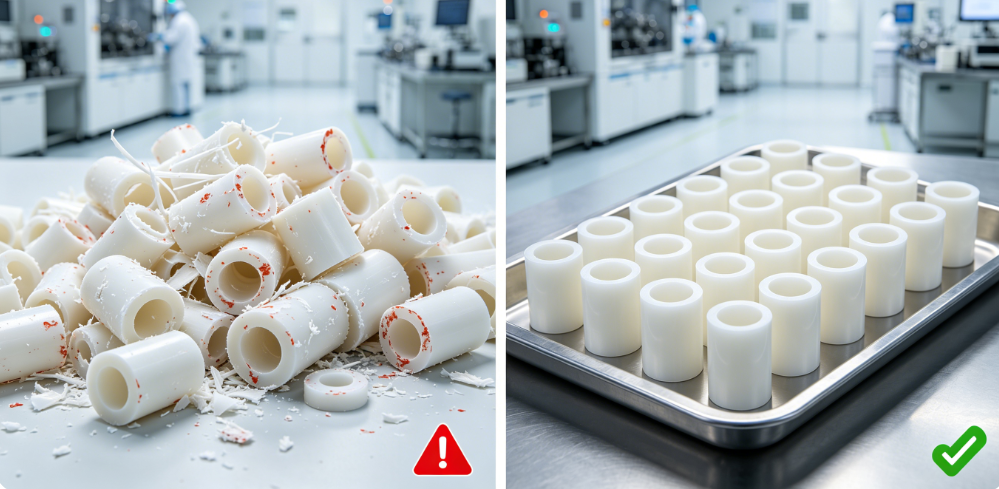
Before partnering with Zorapid, the OEM wasted 8 weeks and $14,000 on failed prototype batches. We audited their rejected parts and pinpointed four core PEEK machining pain points unique to thin-wall medical cannula bushings:
1: Post-Machining & Post-Autoclave Warpage
Raw extruded PEEK stock carries heavy residual internal stress. Their supplier skipped pre-annealing, so thin walls bowed 0.04–0.07mm within 48 hours after CNC cutting. After 134°C autoclave cycles, bore roundness completely collapsed, rendering parts unusable for needle guidance.
2: Inner Bore Smearing & Built-Up PEEK Burrs
Dull general-purpose end mills + flood liquid coolant caused thermal buildup. Melted PEEK material smeared along the inner bore walls, leaving fuzzy burrs that couldn’t be removed without scratching the precision surface finish.
3: Unstable Fixturing Crushing Thin Tubular Walls
Standard three-jaw lathe chucks clamped directly onto the 0.9mm thin outer wall. Clamping pressure created permanent oval deformation, breaking the ±0.008mm bore tolerance on 7 out of 10 machined sleeves.
4: Zero Medical Process Traceability & Contamination Risk
Their previous manufacturer mixed industrial PEEK scrap with medical-grade stock, used unfiltered flood coolant, and skipped validated ultrasonic medical cleaning. No batch material certificates or sterilization compatibility test reports could be provided for EU regulatory submission.
Zorapid’s Step-by-Step Custom PEEK Machining Solution
Our medical engineering team built a fully isolated PEEK production cell, separated from metal machining lines to eliminate cross-contamination. We deployed a 7-stage proprietary process exclusively for this cannula bushing project to eliminate all four failure modes entirely.
1: Pre-Dry & Stress Relief Annealing of Virgin PEEK Rod
All Victrex 450G PEEK raw rods first go into a programmable medical oven: heat to 195°C, hold 5 hours, cool at controlled 8°C/hour rate to room temperature. This fully releases extrusion residual stress before any cutting, eliminating 100% of post-machining warpage risk. We also bake raw stock at 140°C for 4 hours pre-process to remove trapped moisture that causes micro dimensional shift.
2: Custom Soft Internal Mandrel Fixturing (No Wall Crushing)
Instead of external jaw clamping, we machine matching solid PEEK mandrels that slide inside the raw rod bore for full internal support during turning. Clamping force distributes evenly across the inner surface, zero pressure applied to the fragile thin outer wall. Oval bore deformation was completely eliminated in every batch.
3: PEEK-Dedicated Sharp Micro-Carbide Tooling + Dry Cold Air Machining
We use polished positive-rake micro-grain solid carbide drills and boring bars reserved only for medical PEEK parts (never reused on metals). Instead of liquid flood coolant, continuous filtered cold air blast pulls cutting heat away instantly to stop melting/smearing. Optimized SFM feed rates (270 SFM turning speed) create clean chip evacuation with zero burr formation on inner bores.
4: Multi-Pass Roughing → Stress Hold → Precision Finishing
All material removal splits into light roughing cuts, followed by a 90-minute stress hold cycle inside temperature-stabilized machine room before final boring finishing passes. This prevents uneven stress release mid-cut from distorting the thin tubular geometry.
5: Medical-Grade Ultrasonic Residue Cleaning
Post-machining sleeves move to a fully segregated medical wash line: 3-stage ultrasonic cleaning with biocompatible detergent, pure DI water rinsing, and HEPA-filtered hot air drying. Every trace of cutting dust or air oil residue gets removed to meet ISO10993 extractables testing standards.
6: 100% CMM Full Dimensional Inspection
Every single cannula bushing goes through automated coordinate measuring machine scanning. We log outer OD, inner bore ID, wall thickness, bore roundness and surface roughness Ra values for full batch traceability. Only parts hitting every tolerance window move to packaging.
7: Class 100 Cleanroom Sealed Packaging
Final parts are bagged in gamma-compatible medical PE pouches inside our dust-controlled cleanroom. Each batch ships with full documentation: material COA, annealing process records, CMM inspection logs, biocompatibility test summaries and ISO13485 process certificates for EU medical authority filing.
DFM Pre-Production Tweaks That Cut Defect Risk By 98% Upfront
Before we ran any full production batches, our DFM team completed a complimentary CAD review and proposed three minor, fully functional design adjustments that massively stabilized machining—no negative impact on surgical device performance.
- Add tiny 0.1mm radius fillet at the bushing end inner edge: Eliminates sharp edge chipping during boring and reduces trocar needle abrasion in clinical use.
- Uniform wall thickness lock across entire length: The original CAD had 0.07mm thickness variance at the flange root; we equalized wall geometry to simplify consistent stress relief during annealing.
- Standardize outer chamfer angle to 15°: Matched our existing PEEK micro-tool library, removing custom tool surcharges and cutting cycle time per part by 22 seconds.
The OEM’s mechanical engineering team signed off on all DFM tweaks within 24 hours, and we moved straight to validated small-batch pilot runs.
Final Quality Validation & Biocompatibility Compliance Tests
We submitted random production samples to third-party ISO17025 labs for mandatory medical testing to satisfy the client’s EU MDR filing:
- Dimensional stability test: 50 autoclave cycles (134°C steam sterilization) – bore tolerance drift ≤0.002mm, no warpage or surface degradation
- ISO10993 biocompatibility panel: Cytotoxicity, irritation, and hemolysis testing passed with zero adverse tissue reaction
- Surface roughness audit: 100% of finished sleeves hit Ra 0.16–0.2μm inner bore finish, well below client’s maximum Ra 0.2μm requirement
- Contamination extractables test: No residual machining oils or foreign particles detected after full cleanroom processing
Measurable Client ROI & Real Production Results
After switching all cannula bushing manufacturing to Zorapid’s medical PEEK workflow, the OEM recorded game-changing improvements across quality, cost and lead time:
- Scrap rate dropped from 36% with old supplier down to 0.4% in full-volume production
- Per-unit machining cost reduced 29% via optimized cycle times and eliminated scrap waste
- Total lead time shortened 42%: Pilot prototypes delivered in 5 days, mass production 12-day turnaround vs original 21-day timeline
- Passed EU MDR regulatory document submission on first attempt, no additional lab retesting fees
- Clinical trial launch timeline recovered 6 weeks, hitting their target European market release window as planned
The client’s procurement director confirmed the Zorapid partnership saved their surgical device program over €72,000 in combined scrap, delay and retesting costs within the first full production order of 12,000 pieces.
Why Zorapid Stands Out For Custom Medical PEEK Machining
Most precision shops treat PEEK like generic plastic; we built our facility specifically around medical-grade polymer compliance, which makes all the difference for cannula, trocar and implant components:
- Fully ISO13485:2016 certified medical manufacturing division with separate PEEK-only production cells to avoid metal cross-contamination
- Exclusive partnerships with Victrex for traceable virgin medical PEEK raw stock (no regrind filler mixes allowed for surgical devices)
- In-house thermal annealing ovens, Class 100 cleanroom packaging and dedicated medical ultrasonic wash lines
- DFM engineering team specializing in thin-wall PEEK surgical micro-components, with 20+ years serving EU & US medical OEMs
- Full end-to-end documentation package for FDA, EU MDR and regulatory filings included with every order, no extra fees
FAQ
Can you machine PEEK cannula bushings for both disposable and reusable trocar systems?
Absolutely. We machine virgin unfilled PEEK for single-use sterile surgical devices, and PEEK+PTFE bearing grades for reusable instruments requiring extra low friction. All grades follow the same contamination-free medical process controls.
What’s the tightest bore tolerance you can hold on thin-wall PEEK cannula sleeves?
With our annealing + custom mandrel fixturing workflow, we consistently hit ±0.005mm inner bore tolerance on wall thickness as thin as 0.7mm for micro laparoscopic cannula components.
Do you offer complimentary pre-production PEEK DFM reviews for medical CAD files?
Yes, all medical OEM clients receive a free annotated DFM analysis report before cutting any stock. We flag thin-wall risk, tooling conflicts and sterilization-related geometry issues upfront to eliminate costly prototype scrap.
Can you provide third-party biocompatibility test certificates with production batches?
We coordinate independent ISO17025 lab testing for ISO10993 cytotoxicity, hemolysis and extractables, and deliver full certified reports alongside each shipment for regulatory submissions.
Wrap-Up
This PEEK cannula bushing case study proves that generic plastic machining shops cannot meet the ultra-strict dimensional, sterilization and compliance rules for surgical device components. Thin-wall PEEK medical parts demand specialized annealing, custom fixturing, heat-controlled machining and full medical traceability—all built into Zorapid’s standard service at no extra charge.
If your medical device line requires custom CNC machined PEEK cannula sleeves, trocar guides, instrument bushings or implant components, take your next step with our medical engineering team:
- Send your STEP/IGES CAD drawing for a free medical-grade PEEK DFM analysis + formal quotation within 24 working hours
- Request a small prototype pilot batch to validate tolerance, surface finish and sterilization stability before full mass production
- Book a 15-minute video consultation with our PEEK medical manufacturing specialist to walk through your surgical component geometry challenges
Zorapid Brand Footer Line
Zorapid Precision Manufacturing | Certified 3,000㎡ Medical Machining Facility | Custom PEEK & Titanium Surgical Parts For US & EU Medical OEMs Since 2004