Published by: Zorapid Precision 5-Axis CNC Machining
Most buyers only compare hourly machine rates, and that’s where they get burned.
You pick cheap 3-axis VMCs, stack 4–6 manual setups to machine all faces of your part.
Then you pay extra labor, build multiple custom fixtures, fight tolerance drift from repeated re-clamping, and watch lead times stretch out for weeks.
At Zorapid, we run side-by-side quoting every day: multi-setup 3-axis vs one-clamp 5-axis.
The hard truth: For parts with 3+ machined faces, 5-axis often lowers your total piece price, even with a higher hourly machine cost.
Today we break down real shop-floor numbers: full cost breakdown, lead time gap, scrap risk, and tolerance differences — no marketing fluff, just production data.
The Core Operational Gap
Let’s keep this simple without textbook jargon.
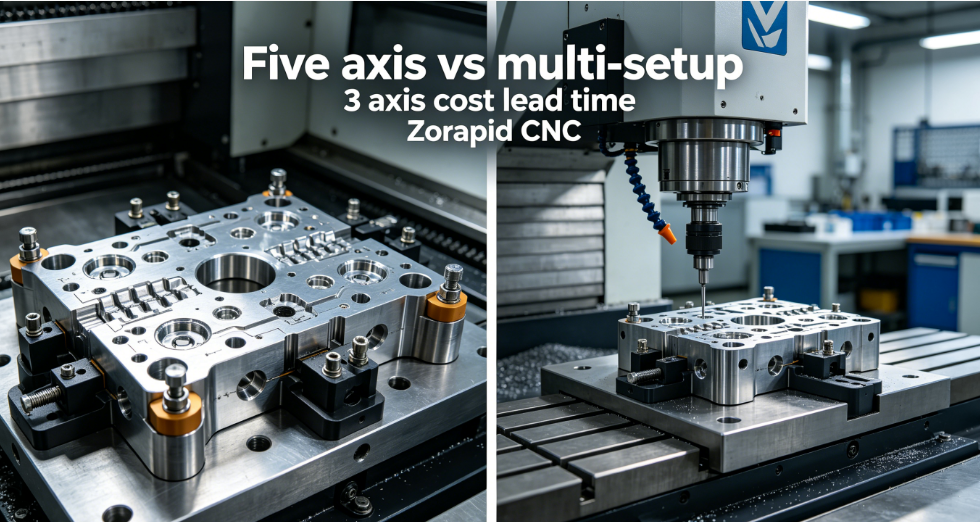
Multi-Setup 3-Axis Machining
Tool only moves X/Y/Z straight lines.
Every new face, angled hole or undercut means stopping the machine, unbolting the workpiece, re-fixturing, re-zero the datum, and restart cutting.
Each flip creates downtime, human alignment error, and extra fixture work.
5-Axis Machining (3+2 & Simultaneous)
Two rotary axes tilt the part freely.
We clamp the blank once, and the spindle reaches nearly all surfaces without opening the machine door.
One setup completes 95% of all features — no re-clamping, no repeated zeroing.
The biggest hidden cost you miss: every extra setup adds labor, downtime and tolerance stack-up.
This is the main reason multi-fixture 3-axis jobs always run over budget.
Side-by-Side Full Comparison (Real Production Data From Zorapid Workshop)
We use a 4-face aluminum aerospace bracket as the test part, 6061-T6 with angled bores and tight GD&T position tolerance ±0.008mm.
| Comparison Item | Multi-Setup 3-Axis (4 Clamps) | Single-Setup 5-Axis |
|---|---|---|
| Standard Hourly Machine Rate | $65–85 / hr | $130–160 / hr |
| Number of Fixture Setups | 4 separate clamping cycles | 1 single vise setup |
| Manual Setup Labor Time | 110–140 minutes total | 12–18 minutes total |
| Custom Fixture Cost | 3 sets of soft jaws + dedicated stops | Only standard vise, zero custom tooling |
| Net Machine Cutting Time | 7.5 hours (long extended tools + slow feeds) | 4.2 hours (short rigid cutters, higher SFM) |
| Tolerance Stack-Up Error | ±0.02~0.04mm after repeated re-zeroing | ±0.006mm, no datum shift |
| Scrap & Rework Rate | 14~18% from misalignment | Below 2.5% |
| Total Project Lead Time | 7–9 working days | 3–4 working days |
| Final Total Cost Per Part | $218 | $176 |
Key takeaway:
Even though 5-axis hourly cost is nearly double, setup labor, fixture expense, scrap loss and longer cycle time make multi-setup 3-axis 24% more expensive on this multi-face component.
Full Cost Breakdown (Where Multi-Setup 3-Axis Bleeds Money)
Most RFQ only counts cutting machine time. Let’s unpack the hidden line items:
Repeated Fixturing Labor (Biggest Cost Leak)
Each re-clamp requires:
- Unloading & repositioning
- Edge finding and datum zeroing
- Re-running program prove-out block by block
Four setups eat nearly 2 hours of skilled machinist labor that never gets quoted upfront.
On low-volume prototype batches, this labor cost can exceed the actual cutting time cost.
Custom Fixture Tooling Expense
Multi-face 3-axis jobs need multiple custom soft jaws, angle plates and stops.
These one-time fixture costs get spread across small batch runs, pushing up unit price sharply.
5-axis rarely needs custom workholding; a standard machine vise handles most multi-angle positioning via rotary axes.
Extended Cutting Cycle Time
3-axis needs long overhang tools to reach deep pockets and side features.
Long tools vibrate, force lower feedrates and slow down material removal.
5-axis tilts the workpiece, uses short, rigid cutters, runs faster spindle speeds and shortens total cycle time by 35~50%.
Rework & Scrap From Tolerance Stack-Up
Every time you re-clamp, you add positional error.
Datum shift accumulates across multiple setups.
When features on different faces share tight GD&T positional tolerance, multi-clamp 3-axis frequently fails CMM inspection, forcing costly rework or outright scrapped billets.
At Zorapid, we regularly see 1 out of 6 multi-setup 3-axis parts get rejected due to cumulative alignment error.
Lead Time Gap: Why Multi-Fixture 3-Axis Slows Your NPI Schedule
Lead time does not only include cutting time. It includes all downtime between setups.
Multi-Setup 3-Axis Timeline
- Program 4 separate NC files for each clamping position
- Machine build 3 sets of custom fixtures (1–2 days)
- Run setup 1 → unload → re-clamp → setup 2 → repeat 4 times
- Inspect after every clamping operation to catch drift early Total wall-clock time: 7~9 business days for a 20-piece batch.
5-Axis Single-Setup Timeline
- One program with 3+2 positioning
- Clamp once in standard vise
- Run full part continuously without interruption
- One final CMM inspection Total wall-clock time: 3~4 business days.
Net lead time saving: 40~55% for multi-face components.
This is critical for medical, aerospace and EV prototype NPI phases with tight testing deadlines.
When Stick With Multi-Setup 3-Axis (No Sense Paying 5-Axis Premium)
5-axis is not always the winner. Stick with repeated 3-axis clamping if all these apply:
- Part only has 1–2 machined faces, no angled holes or compound pockets
- Batch volume runs 200+ pieces, you can amortize custom fixture cost over hundreds of units
- Tolerance is loose (±0.05mm or higher), no strict inter-feature GD&T
- Simple prismatic blocks, brackets without cross-face positional requirements
For simple flat plates and single-side milled parts, multi-setup 3-axis stays cheaper.
Zorapid Exclusive Middle Solution: 3+2 Positional 5-Axis
We offer a balanced middle ground for cost-sensitive customers:
Not full simultaneous 5-axis milling, just 3+2 positional 5-axis.
- Still one single setup (no re-clamping)
- Rotary axes lock the angle, cutting runs in standard 3-axis mode
- Hourly rate sits 25% lower than full 5-axis
- Keep all tolerance stability and eliminate repeated fixturing
This hybrid option cuts unit cost 12~18% vs full 5-axis while retaining all setup-free advantages. It’s our most popular option for export industrial OEM orders.
Real Zorapid Customer Case Study
Project Info
Ti-6Al-4V titanium fixture block, features on 5 faces + 6 angled threaded holes, batch of 18 pieces.
Option A: Multi-Setup 3-Axis
- 5 separate clamping cycles
- Built 4 custom fixture plates
- 17% scrap from re-clamp drift
- Total lead time: 8 days
- Final unit cost: $262
Option B: 3+2 5-Axis Single Setup
- One standard vise, zero custom fixtures
- Zero alignment shift, scrap rate <1%
- Total lead time: 3.5 days
- Final unit cost: $194
Result: The customer switched to 5-axis processing, cut cost 26% and hit their prototype testing milestone 5 days early with zero rejected parts.
Quick Decision Checklist for Your Next RFQ
Choose Multi-Setup 3-Axis
- 1~2 machined faces only
- High volume production with dedicated fixtures
- Loose linear tolerances, no cross-face GD&T
- Simple prismatic geometry
Choose 5-Axis (3+2 or Simultaneous)
- 3+ machined faces, angled holes or pockets
- Tight positional GD&T between different surfaces
- Low-to-medium NPI prototype batches
- You need shorter lead time and lower scrap loss
- Want to eliminate custom fixture investment
Why Choose Zorapid for Balanced 3-Axis & 5-Axis Quoting
- We run both processes in-house, so we quote objectively — no push for unnecessary 5-axis work
- Our engineers calculate total landed cost including labor, fixturing and scrap risk, not just machine hourly time
- VERICUT offline simulation eliminates collision risk on all 5-axis programs
- We offer 3+2 positional 5-axis as a cost-saving middle tier between 3-axis and full 5-axis
- First-pass inspection yield stays above 97% on single-setup 5-axis components
- We compress lead times by cutting all repeated clamping downtime
Conclusion
The old myth “5-axis is always more expensive” only holds true if you ignore setup labor, fixture cost, scrap loss and lead time delays.
Multi-setup 3-axis looks cheap on hourly rate alone, but repeated clamping piles up hidden expenses and tolerance drift.
For multi-face parts with cross-feature GD&T, single-setup 5-axis consistently delivers lower total cost and 40–50% faster turnaround.
When you send your STEP file to Zorapid, we will generate two parallel quotes: multi-fixture 3-axis and one-clamp 5-axis, with full breakdowns of fixture labor, cycle time and risk. You pick the most cost-effective path without guesswork.
Send your multi-face component drawing for a side-by-side cost & lead time comparison today.
FAQ
Does every extra 3-axis setup add tolerance error?
Yes. Each re-zero and re-clamp creates datum stack-up. 4 clamping cycles typically add ±0.02~0.04mm cumulative deviation, impossible to eliminate even with careful operator work.
Can multi-setup 3-axis match 5-axis lead time on multi-face parts?
Almost never. You cannot skip the manual unloading, repositioning and re-proving for each new fixture. These non-cutting downtime hours cannot be compressed.
What is 3+2 5-axis, and does it save money?
3+2 uses rotary axes to tilt the part then locks rotation for standard 3-axis cutting. It keeps one-setup accuracy while cutting hourly machine cost, perfect for cost-sensitive multi-face parts without free-form curved surfaces.
Why do small-batch 3-axis jobs always run over budget?
Custom fixture cost and skilled setup labor can’t be spread across thousands of parts. Low-volume prototypes bear 100% of fixturing expense, blowing up the original quote.
Will 5-axis eliminate all scrap caused by clamping errors?
Yes. With only one single clamping operation, there is no repeated datum shift, so alignment-related scrap drops from 15% down to under 3%.