Published:Zorapid.Ltd
Every product development team faces the same critical decision: which manufacturing process to use for each part?
- Standard 3-axis CNC
- 5-Axis Precision CNC
- Injection Mold Molding
- 3D Printing (SLM, SLS, FDM, resin, etc.)
Each process has wildly different tolerance limits, material options, lead times, cost curves, and ideal batch sizes. Using the wrong method leads to sky-high costs, missed deadlines, poor performance, and failed compliance (medical, aerospace, semiconductor).
Core Process Overview
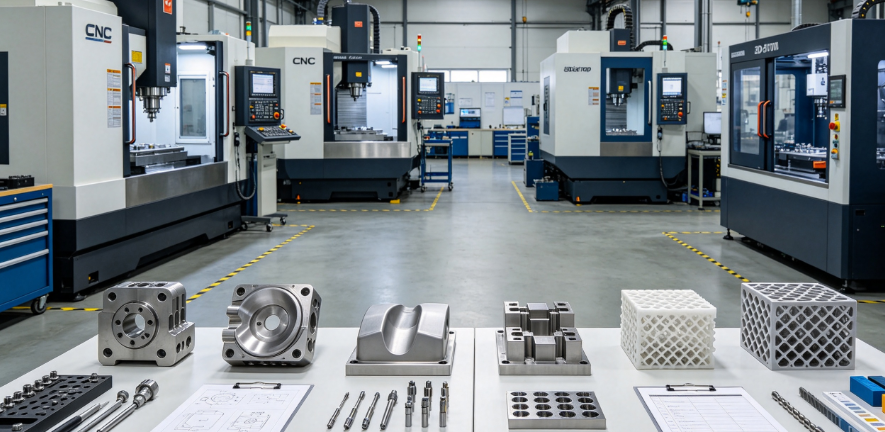
Standard 3-Axis CNC Machining
Subtractive manufacturing: Remove material from a solid billet/plate with 3 linear-axis cutting tools (X/Y/Z only). Requires re-fixturing for multi-angle features. Common for aluminum, steel, PEEK, and general structural components.
5-Axis CNC Machining
Full 5-axis simultaneous / indexed subtractive machining (X/Y/Z + 2 rotary axes). Single-setup machining of complex 3D contours, angled holes, and freeform geometry. Ultra-precision variants run in cleanrooms for aerospace, medical, semiconductor hardware.
Injection Molding (Mold)
Formative manufacturing: Molten plastic (or metal MIM) is forced under pressure into a hardened steel mold cavity, then cooled and ejected. High upfront tooling cost, ultra-low per-unit cost at high volume.
3D Printing (Additive Manufacturing)
Layer-by-layer material deposition / sintering (SLM metal, SLS polymer, FDM, resin, etc.). No dedicated molds or fixturing; builds complex lattices, internal channels, and patient-specific geometries directly from CAD. Split into polymer and metal SLM variants for different specs.
Key Strengths & Limitations of Each Process
Standard 3-Axis CNC
- Strengths: Fast for simple prismatic parts, broad material compatibility, easy DFM, moderate cost for mid-batches, full material density
- Limitations: Poor for freeform/angled geometry, cumulative tolerance drift from repeated re-fixturing, slow complex contours
- Ideal for: Brackets, frames, base plates, simple housings, non-critical structural components
5-Axis CNC
- Strengths: Ultra-precision single-setup complex geometry, tight GD&T tolerances, superior fatigue performance, aerospace/medical validation capability, low distortion for mating surfaces
- Limitations: High machine hourly cost, slower for simple flat parts, requires skilled CAM programming, not cost-effective for high-volume simple geometry
- Ideal for: Vacuum flanges, orthopedic implant mating surfaces, motorsport uprights, turbine brackets, semiconductor precision hardware
Injection Molding
- Strengths: Ultra-low per-unit cost for mass runs, repeatable cosmetic finish, automated high-speed cycle, large volume scalability
- Limitations: Very high upfront mold cost, slow design revisions, DFM constraints on undercuts/wall thickness, long validation cycles
- Ideal for: Consumer housings, electronic enclosures, disposable medical devices, mass EV plastic components, >10k annual volumes
3D Printing (Additive)
- Strengths: Zero tooling cost, rapid design iteration, biomimetic lattices/conformal cooling channels, full patient-specific geometry, fast NPI prototyping
- Limitations: Poor baseline surface finish, high per-unit cost for mass runs, anisotropic material properties, requires extensive post-processing (HIP, CNC finish, cleaning), slower for simple solid geometry
- Ideal for: Medical lattice implants, conformal cooling manifolds, motorsport custom parts, R&D prototypes, spare part obsolescence replacement
Material & Tolerance Guidelines
Standard 3-Axis CNC
- Common: 6061 aluminum, 304 stainless, PEEK, Delrin
- Tolerance rule: Reserve tight tolerances only for critical mating holes; relax general features to ±0.05mm
5-Axis CNC
- Common: Ti6Al4V ELI, 316L VIM-VAR, Inconel, medical PEEK, 7075 aluminum
- Tolerance rule: Use cleanroom 5-axis for ±0.003mm or tighter sealing/thread features; apply DFM fillets to reduce stress risers
Injection Molding
- Common: ABS, PC, PP, PEEK, PPSU, glass-filled engineered plastics
- Tolerance rule: Account for material shrinkage; maintain uniform wall thickness, add proper draft angles, minimize deep undercuts to avoid expensive slides/lifters
3D Printing
- Polymer (SLS/FDM): Nylon, PEEK, TPU, ±0.15mm typical tolerance, best for non-primary load prototypes
- Metal (SLM): Ti6Al4V, 316L, Inconel, as-built ±0.1mm, always HIP + post-CNC finish for load-bearing ortho/aero parts
Cost-Volume Curve Basics
- 3-Axis CNC: Cost decreases gradually with volume; good for 20–500 pcs, poor for >10k
- 5-Axis CNC: Cost stays high per unit, only justified by precision/performance needs (not raw volume savings)
- Injection Molding: High initial cost, dramatic per-unit cost drop after break-even volume (typically 500–2,000 pcs)
- 3D Printing: Low fixed cost, flat high per-unit cost, economical only below ~100 pcs (custom/prototype)
Hybrid Manufacturing Best Combinations
- SLM 3D Print + 5-Axis CNC: Lattice/complex core via SLM; precision mating surfaces/threads via 5-axis (orthopedic implants, conformal cooling manifolds)
- 3D Print + 3-Axis CNC: Low-cost polymer prototype bodies + machined mounting datums
- 3D Print Master + Mold Fabrication: 3D print master patterns for rapid prototype molds to speed up early validation before production steel molds
- Sheet Metal + 5-Axis CNC: Large low-cost structural frame + precision machined critical interface flanges (semiconductor equipment)
Common DFM Mistakes Across All Processes
- 3-Axis CNC: Over-spec global tight tolerances, excessive re-fixture geometry, deep narrow pockets without proper radii
- 5-Axis CNC: Long tool overhangs (chatter risk), unoptimized rotary axis travel, machining before thermal stress relief
- Injection Molding: Uneven wall thickness, missing draft angles, excessive undercuts, unvalidated shrinkage geometry
- 3D Printing: Ultra-thin struts, hidden trapped support structures, expecting as-built parts to meet ultra-tight tolerance specs
FAQ
What process is best for NPI medical device prototypes (1–20 units)?
5-Axis CNC for critical mating titanium/PEEK parts, SLS/SLM 3D printing for custom lattices, avoid hard steel injection molds in NPI.
What process is best for mass consumer plastic housings (50,000+ units)?
Injection molding, once DFM validation and mold trials are complete; ensure proper conversion coating/finishing specs upfront.
Can 3D printing replace 5-axis CNC for aerospace flight-critical structural parts?
Not fully. SLM can produce core geometry but always requires HIP, NDT, and 5-axis finishing for GD&T precision and fatigue compliance, plus full AS9100 traceability.
When should I choose 5-axis CNC over standard 3-axis CNC?
When parts have compound angles, complex freeform contours, ultra-tight GD&T mating features, or require single-setup production to eliminate tolerance stack-up (aerospace, semiconductor, orthopedic hardware).
What is the biggest hidden cost of injection molding?
Mold rework, DFM revision changes, and long validation cycles. Always complete DFM reviews before cutting steel mold cavities.
How do I handle compliance traceability for each process?
- CNC / 5-Axis: MTR material lot traceability + CMM batch reports, AS9100 / ISO13485 travelers
- Injection Molding: Resin batch logs, mold run records, material CoA, FAIR documentation
- 3D Print: Powder heat lot records, HIP/heat treatment logs, UDI/serial traceability + NDT validation
What process has the fastest iteration speed for motorsport R&D?
SLM/SLS 3D printing for lattice/complex geometry + quick 5-axis finishing for critical mounting interfaces.
What process works best for low-volume obsolescence spare parts?
3D printing or 3-axis CNC (based on material specs), avoid legacy injection molds which are costly to maintain.
How do I balance speed, cost, and tolerance for semiconductor vacuum components?
5-Axis ultra-precision CNC for CF flanges and sealing surfaces, avoid pure 3D printing for primary UHV vacuum mating flanges.
What is the typical break-even volume for switching to injection molding from CNC/3D print?
Typically 500–2,000 identical parts, depending on part size, material, and complexity. Run a formal landed cost analysis for your specific BOM.
Quick Selection Checklist
Prototype / NPI (1–50 pcs)
Complex lattices/conformal channels: SLM / SLS 3D printing
Tight mating precision features: 5-Axis CNC
Simple structural brackets: Standard 3-Axis CNC
Avoid permanent steel injection molds
Mid-Volume (50–500 pcs)
Standard structural parts: 3-Axis CNC / optimized sheet metal
Precision complex parts: 5-Axis CNC with fixed DFM rules
Repeat plastic geometry: Soft prototype molds (not production steel)
Mass Production (5,000+ pcs)
Commodity plastic geometry: Hardened steel injection mold (DFM validated first)
Precision metal critical interfaces: 5-Axis CNC as secondary finishing
Standard metal frames: 3-Axis CNC / sheet metal fabrication
Closing Wrap-Up
There is no universal best manufacturing process—only the right fit based on batch size, tolerance requirements, geometry complexity, material rules, regulatory compliance, and timeline constraints.
- Use 3-Axis CNC for mid-volume simple solid metal/plastic structural parts
- Use 5-Axis CNC for ultra-precision complex mating parts requiring tight GD&T and regulated quality
- Use Injection Molding for high-volume repeatable plastic components after DFM validation
- Use 3D Printing for prototypes, custom lattices, patient-specific hardware, and low-volume unique parts
Hybrid workflows (3D print + 5-axis CNC) deliver the best of both worlds for advanced medical, aerospace, motorsport, and semiconductor applications, balancing geometric freedom and precision compliance.
If you send your BOM part list and volume forecast, I can create a custom process allocation + landed cost breakdown for each component.