Bearings are one of the most essential components in mechanical systems.
From the smallest wristwatches to massive forging presses, bearings can be found everywhere.
For mechanical engineers and designers, selecting the right type of bearing is critically important.
Here we introduce the different types of bearings and their applications.
What Are Bearings and Why Are They So Important?
A bearing is an indispensable component in mechanical systems. It reduces friction, supports loads, and restricts motion in one or multiple directions. Bearings are required for nearly all mechanical equipment. Rotating parts in almost every machine — such as bicycle sprockets and automotive shafts — all rely on bearings.
What Are the Main Uses of Bearings?
Bearings are primarily used to reduce friction between moving parts. They also support applied loads and limit the direction of motion. Reduced friction saves energy and improves mechanical efficiency. It enables more precise, regulated movement and maintains consistent rotational speed.
How Do Bearings Reduce Friction in Machines?
Bearings convert sliding motion into rolling motion. Rolling elements, such as the balls in ball bearings, feature ultra-smooth surfaces, and the raceways are also highly polished. Lubricants like oil or grease further lower friction. The coefficient of friction between bearing contact surfaces is far lower than that of ordinary surfaces, and rolling motion makes mechanical operation even smoother.
Benefits of Using Bearings in Mechanical Systems
Bearings offer numerous advantages, key benefits include:
- Energy Saving: Low friction minimizes the energy required for component movement.
- Uniform Speed: Consistent surface properties during operation maintain steady rotational speed.
- Extended Machine Lifespan: High-quality bearings greatly reduce wear and tear on mechanical parts.
Ball Bearings: Types and Common Applications
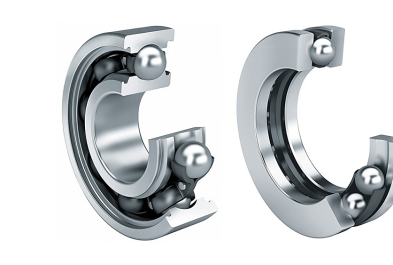
Ball bearings are one of the most widely used bearing types. The rolling elements are spherical, featuring hard, smooth and incompressible properties. Ball bearings can be classified into sub-types such as deep groove ball bearings, angular contact ball bearings, self-aligning ball bearings, and thrust ball bearings.
Material Types
Titanium Ball Bearings
It serves as a ball bearing material for specialized use. Titanium ball bearings outperform steel variants with superior strength-to-weight ratio, corrosion and fatigue resistance.
Ideal for aerospace, medical devices and high-demand scenarios needing longevity and light weight.
Deep Groove Ball Bearings
Bearing Housings
- Bearing Housing: Commonly used for easy installation and alignment on the shafts of conveyors and fans.
- Flange Housing:
Advantages & Typical Applications
These bearings can well withstand both radial and axial loads.
Featuring rugged durability and a compact, streamlined design, they are suitable for general applications requiring high speed, high load capacity and low friction.
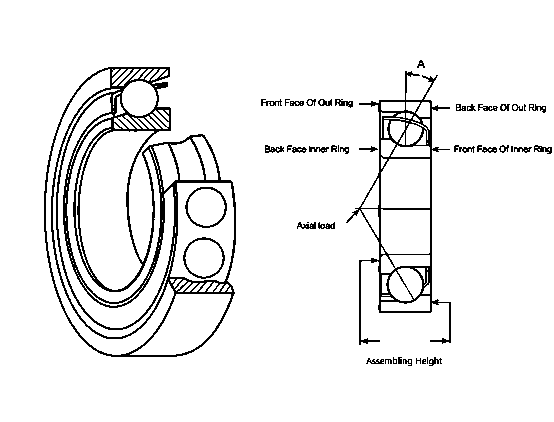
Angular Contact Ball Bearing
Bearing Housings
Flange housing
Cartridge housing
When to Use Angular Contact Bearings?
In angular contact ball bearings, the raceways of the inner and outer rings have a contact angle ranging from 15° to 40°. This allows them to support both axial and radial loads for applications such as machine tool spindles, centrifugal pumps, and precision gearboxes.
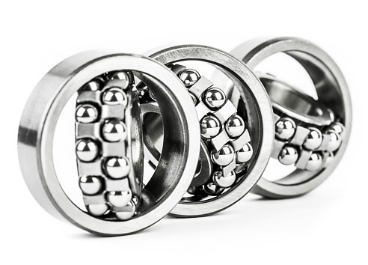
Self-Aligning Ball Bearings
Bearing Housings
Bearing Housing
Self-Aligning Bearing Housing & Ideal Applications of Self-Aligning Bearings
Self-aligning bearings can automatically compensate for misalignment between the shaft and raceways.
They are especially suitable for applications such as agricultural machinery, textile machinery, and conveyor belts.
Thrust Ball Bearings
Bearing Housings
Thrust bearing housing
Washer-type housing
Main Advantages of Thrust Bearings Under Vertical Loads
Thrust ball bearings are engineered to handle unidirectional and bidirectional axial loads.
Thanks to the special structure of rolling elements, they can bear loads along the shaft direction.
Thrust bearings fit crane hooks, vertical shafts, machine tool tables and elevator motors perfectly.
Roller Bearings: Types and Applications
Roller bearings are another common type of bearing, typically used to withstand large radial loads.
They feature a larger contact area. Unlike point-contact ball bearings, roller bearings feature line contact defined by their rolling element geometry.
There are several special subtypes of roller bearings.
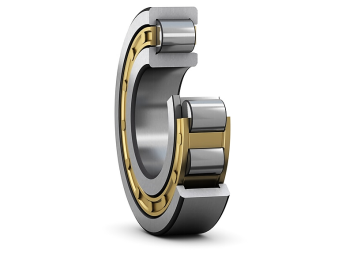
Cylindrical Roller Bearings
Bearing Housings
Pillow block bearing housing
Cartridge housing
End cover housing
Advantages for High‑Speed and Heavy‑Load Applications
Thanks to their unique design, cylindrical roller bearings can support heavier loads.
They feature a larger contact area between rolling elements and raceways, which improves bearing rigidity.
The geometric uniformity of the rolling elements reduces friction.
Capable of operating at high speeds, these roller bearings are ideal for electric motors, machine tool spindles, compressors and gearboxes.
Spherical Roller Bearings
Bearing Housings
Split bearing housing
Self‑aligning housing
Adapter sleeve housing
Best Applications for Misalignment and Heavy Loads
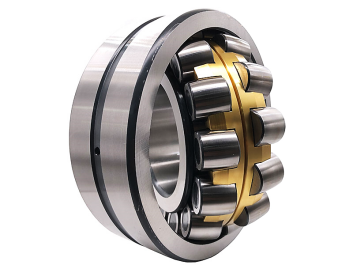
Spherical roller bearings automatically compensate for shaft misalignment and deflection with built‑in self‑aligning performance.
The optimized design of rolling elements and raceways enables spherical roller bearings to withstand high radial and axial loads.
This makes them ideal for mining equipment, vibrating screens, paper machinery and similar applications.
Tapered Roller Bearings
Bearing Housings
- Flange housing
- Double cup housing
- Combined tapered roller bearing housing
Why Tapered Bearings Lead in Automotive & Heavy Machinery
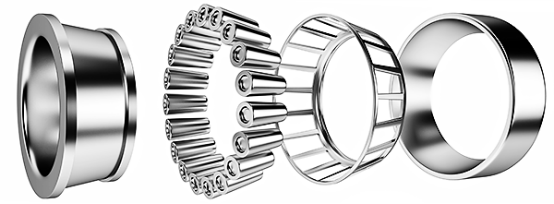
Tapered roller bearings feature a tapered geometry consisting of cup and cone structures.
They are capable of supporting both radial and axial loads required by automotive equipment and heavy machinery.
Needle Roller Bearings
Bearing Housings
- Stamped cup bearing housing
- Caged needle housing
- Insert housing
Applications Requiring Compact and Lightweight Bearings
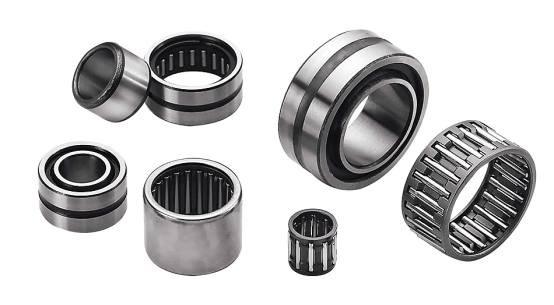
Needle-shaped rolling elements have a tiny diameter-to-length ratio, with smooth profiles, compact build and light weight.
Plain Bearings (Friction Bearings)
Plain bearings are the simplest type of bearing. They contain no rolling elements or raceways, and feature a sleeve where the shaft rotates freely through sliding motion. Lubricants such as oil and grease reduce surface friction and enable smooth shaft rotation.
Types of Plain Bearings
Journal Bearing
Supports rotating shafts and carries radial loads, commonly used in engines and heavy machinery.
Sleeve Bearing
Simple tubular bearings designed for low-speed, light-duty equipment such as small electric motors and fans.
Flange Bearing
Built with a flange design for secure mounting, typically used in applications where alignment and positioning are critical.
| Characteristic | Journal Bearing | Sleeve Bearing | Flanged Bearing |
| Shape | Cylindrical | Tubular | Flanged tube |
| Load Type | Radial | Light radial | Radial + limited axial |
| Housing Fitment | Split solid bearing housing | Bored, one-piece housing | Flanged or bolt-on housing mount |
| Axial Support | Requires additional components | None | Built-in flange |
| Common Applications | Engines, turbines | Fans, small electric motors | Conveyors, stationary assemblies |
Key Advantages and Limitations of Plain Bearings
Advantages
- Low cost
- Compact design
- Misalignment tolerance
Limitations
- Excessive wear
- Low precision
- High friction
- Low speed
Common Industrial Applications
Plain bearings are widely used in industrial machinery, automotive applications, and light consumer products.
Linear Bearings: Everything You Need to Know
Linear bearings are used to guide shafts in linear motion rather than rotational motion. They reduce friction along the travel path and precisely align mating components. Read on to learn more about their types.
How Do Linear Bearings Work?
Linear bearings use lubricants and smooth rolling elements to minimize friction along the linear travel path.
Types of Linear Bearings and Their Features
Ball Bushing Bearings
Adopt circulating balls to achieve smooth linear motion with high precision and low friction.
Linear Roller Bearings
Linear roller bearings use rollers for higher load capacity and rigidity. They are ideal for heavy-duty equipment.
Plain Linear Bearings
Plain linear bearings use sliding contact and are typically self-lubricating.
| Type | Housing Fitment | Load Capacity | Platform Precision | Friction | Applications |
| Ball Bushing | Round flange, bearing housing | Medium | High | Very low | CNC machines, 3D printers |
| Roller Bearing | Square block | Heavy | Medium | Low | Industrial machinery, robots |
| Plain / Sliding Bearing | Compact block | Light | Low | Medium | Furniture, light applications |
Best Applications of Linear Bearings
Linear bearings are ideal for applications requiring low-friction linear travel paths.
Ball bushing bearings deliver smooth, precise, and repeatable motion for 3D printer robotic arms.
Linear roller bearings support heavy loads and are suitable for industrial machinery.
Plain linear bearings feature a compact structure and fit light-duty applications such as drawers.
Pillow Block Bearings: Types and Selection Tips
Pillow block bearings are pre-assembled and can be easily installed without additional brackets. Equipped with integrated bearing housings, they allow simple mounting, precise alignment and convenient replacement.
Pre-Assembled Bearings and Their Housing Types
Pillow Block Bearings
Pillow block bearings mount on rigid bases to support rotating shafts, fitting flat-surface installation and versatile equipment use.
Flange Bearings
Flange bearings come with a mounting flange featuring bolt holes for surface fixing. They are commonly used where the shaft needs to pass through a wall or partition.
Take-Up Bearings
Take-up bearings are designed to slide within a frame. The adjustable movement allows tension regulation for belts or chains, and they are widely used in conveyor systems.
Common Industrial Applications of Pillow Block Bearings
Pillow block bearings are widely used in scenarios requiring simple support and positioning.
They are commonly applied in material handling systems, gearboxes, packaging lines, agricultural equipment and various other industrial machinery.
Key Factors When Selecting Pillow Block Bearings
- Load capacity
- Load direction
- Space constraints
- Maintenance convenience
- Housing type
Specialized Bearings: Fluid Bearings and Magnetic Bearings
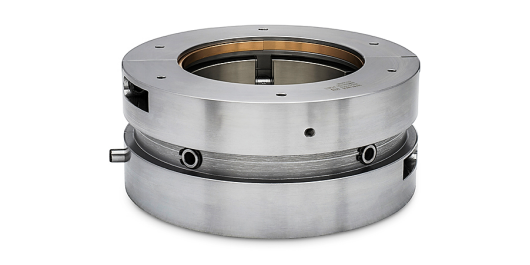
Specialized bearings rely on fluid force or magnetic force to support radial loads. Instead of direct contact between solid surfaces, these bearings use pressurized fluid or magnetic force to bear loads. They deliver nearly friction-free operation with almost negligible wear.
Introduction to Fluid Bearings
Hydrostatic Bearings
These bearings require an external pressure source such as a pump to fill the clearance with fluid.
They operate perfectly even when the shaft speed is zero.
Hydrodynamic Bearings
These bearings rely on shaft rotational speed to draw fluid into the clearance.
A certain speed threshold is required to achieve smooth operation.
Magnetic Bearings and Their Unique Features
Active Magnetic Bearings
In active magnetic bearings, magnetic levitation is generated by electromagnets.
An external power supply provides electric current for magnetization.
A feedback control system keeps the bearing shaft centered by adjusting the current.
Passive Magnetic Bearings
Passive magnetic bearings use permanent magnets to achieve magnetic levitation with a stable magnetic field.
However, performance may not always be ideal under varying load conditions.
Specialized Bearing Housings
Specialized bearings require custom housings, usually CNC machined to ensure precise fit
and meet specific requirements in load capacity, misalignment compensation, or fluid containment.
Bearings in Automotive Applications
A wide variety of bearings are used in vehicles. All rotating components require bearings to reduce friction, achieve precise positioning, and support loads for efficient operation. Bearings are essential in engines, transmission systems, wheels, steering systems, and suspension systems.
Types of Bearings Used in Automobiles
Wheel Bearings
Tapered roller bearings are the most common type. They can withstand both radial and axial loads generated by wheel movement.
Transmission Bearings
Gearboxes require needle roller bearings to fit within compact spaces. Axles need tapered roller bearings to support radial and axial loads.
Engine Bearings
Engines require alloy plain bearings and journal bearings that are resistant to high temperatures and creep.
| System | Bearing Type | Function | Benefits |
| Engine | Journal / Plain bearings | Support crankshaft / camshaft | Reduce friction and manage heat |
| Transmission | Needle, ball, and tapered roller bearings | Support gears | Smooth gear shifts |
| Wheels | Deep-groove ball and tapered roller bearings | Enable rotation, support loads | Stability and safety |
| Steering | Ball and thrust bearings | Assist steering motion | Responsive control |
| Suspension | Spherical roller bearings and bushings | Absorb shocks, allow articulation | Maintain alignment |
How Automotive Bearings Affect Vehicle Performance
High-quality bearings ensure smooth operation of components. By reducing friction and maintaining precise alignment, component wear is minimized. This saves a significant amount of energy, improves vehicle fuel efficiency, and lowers maintenance requirements.
Signs of Bearing Wear in Automotive Systems
Vehicles with worn bearings produce abnormal noise and suffer degraded performance.
CNC Machining for Precision Bearings
CNC machining plays a critical role in ensuring product consistency, precision, and automation, especially for high-value bearings.
How Does CNC Machining Produce Precision Bearings?
A well-designed CAD (Computer-Aided Design) model is imported into CAM (Computer-Aided Manufacturing) software. CAM converts the model into a set of instructions known as G-code. The CNC machine then performs various operations based on the G-code, such as turning, milling, and drilling, to manufacture the bearing.
Process List for Titanium Alloy Ball Bearing Machining
- Material preparation
- Heat treatment
- Raceway milling
- Drilling
- Grinding
- Quality inspection
- Assembly
- Final testing
Advantages of Custom CNC Machining for Precision Bearings
CNC machining offers numerous benefits for high-value precision bearings. Bearings can be customized based on detailed CAD drawings. Special alloys can be used to meet specific application requirements. Additional features can be integrated, and the unit cost for mass production is relatively low.
Conclusion
There is a wide variety of bearings with different sizes and materials. It is essential to select the proper bearing specifications for specific applications. A well-chosen bearing can minimize friction, save energy, improve efficiency, and reduce maintenance requirements.
FAQ
What is the difference between ZZ and Z bearings?
ZZ bearings have metal seals on both sides, while Z bearings have a metal seal on only one side.
How to tell if a bearing needs replacement?
Abnormal noise, movement obstruction, and increased lubrication demand are typical signs of faulty bearings.
Which bearing type is the most durable?
It entirely depends on the actual application scenario.
Can one type of bearing be replaced with another?
It is very difficult, as extensive design adjustments are required. Though it is technically possible, it takes substantial effort and modification.