Published by Zorapid Precision
Let’s keep it real: Picking the wrong manufacturing process costs you time, money, and headaches.
- Go 3D print for 10,000 parts? You’ll go bankrupt.
- Choose injection molding for 5 prototypes? You’ll waste $20k+ on molds.
- Pick CNC for a complex lattice part? It’s impossible—and expensive.
Most engineers guess or follow old rules. But in 2026, the line between processes is blurring. 3D printing does low-volume production. CNC handles complex metals. Injection molding has rapid tooling for small batches.
At Zorapid, we run CNC, industrial 3D print (SLM/SLA/SLS), and injection molding under one roof. We’ve helped 2,000+ clients pick the right process for 1 prototype to 1M+ parts—saving them 30–50% in cost and weeks in lead time.
Today we’re breaking down exactly when to use CNC, 3D print, or injection molding, how they compare, the impossible jobs we solve with hybrid workflows, and how to nail your process choice every time.
In-Depth Technical Analysis
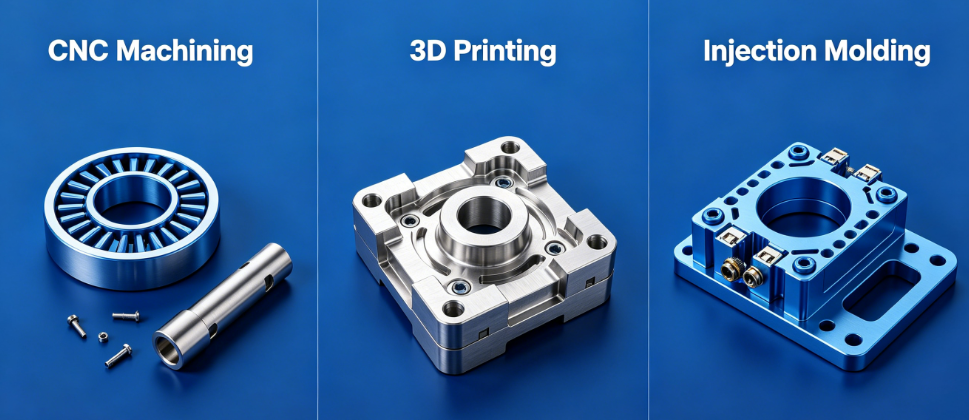
Each process is built for a different job: CNC = precision subtractive, 3D print = complex additive, injection molding = fast mass production. Let’s dive into how they work, their core strengths/weaknesses, and how Zorapid’s setup beats generic shops.
How Each Process Works
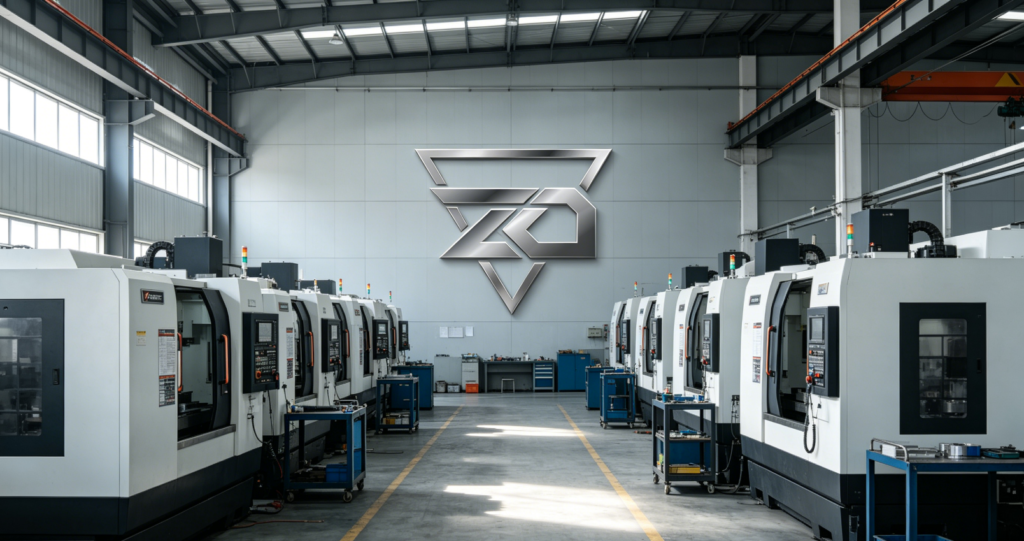
CNC Machining (Subtractive)
- What it is: Start with a solid block of material (metal/plastic). Cut away excess with rotating tools (mills, lathes) to shape the part.
- Core trait: Precision & material density. No layers, no porosity—solid, strong parts
3D Printing (Additive)
- What it is: Print parts layer-by-layer from powder (metal/nylon) or liquid resin. Build complex shapes that can’t be cut.
- Core trait: Design freedom & speed. No tooling, no fixturing—print anything you can model.
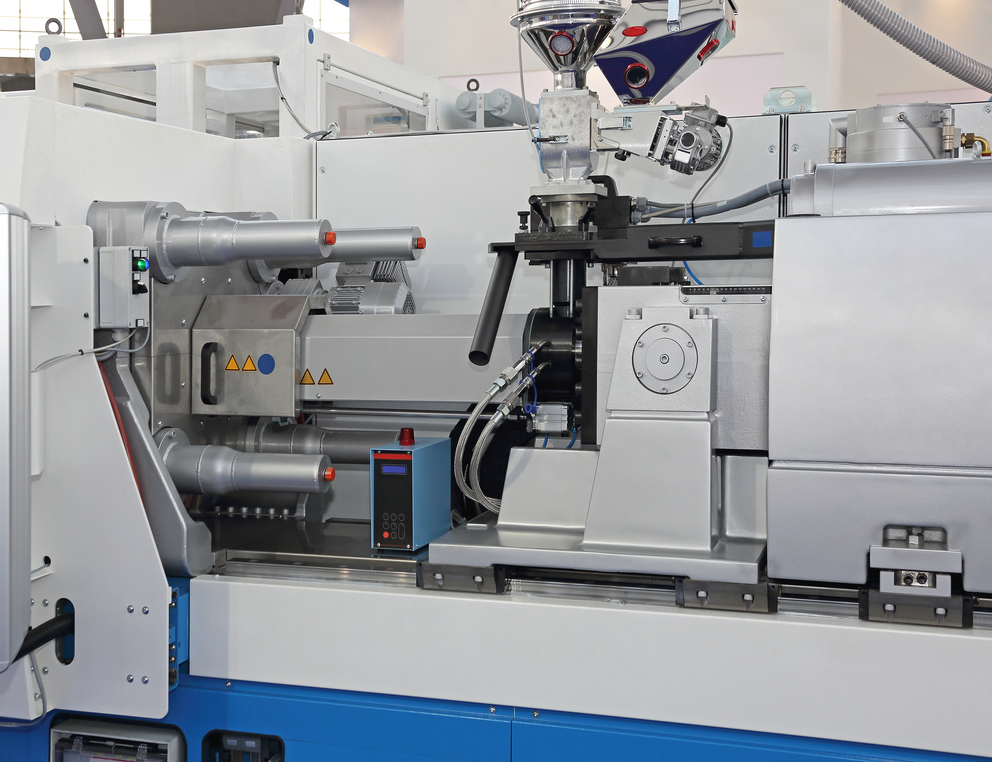
Injection Molding (Formative)
- What it is: Melt plastic, inject into a steel mold cavity, cool, eject. Repeat millions of times.
- Core trait: Mass production efficiency. One mold = endless identical parts, ultra-low unit cost
Head-to-Head Comparison (Critical Metrics)
| Metric | CNC Machining | 3D Printing (SLM/SLA/SLS) | Injection Molding |
|---|---|---|---|
| Best Batch Size | 1–5,000 parts | 1–1,000 parts | 10,000–1M+ parts |
| Tolerance | ±0.005–0.02mm (best) | ±0.05–0.2mm (good) | ±0.01–0.05mm (excellent) |
| Surface Finish (Ra) | 0.4–1.6μm (smooth) | 2–20μm (as-printed) | 0.2–1.6μm (mirror-ready) |
| Complexity | Medium (no deep cavities/lattices) | Unlimited (lattices, internal channels) | Medium (limited by mold draft) |
| Material Options | Metals (Al, Ti, Steel) + hard plastics | Resins, nylon, metals (limited) | 100+ engineering plastics |
| Startup Cost (NRE) | Low ($500–$2k, fixturing) | Very Low ($0, no tooling) | High ($15k–$100k, mold) |
| Unit Cost (100 parts) | High ($50–$200/part) | Medium ($20–$100/part) | Low ($5–$20/part) |
| Lead Time | 1–3 days | 1–2 days | 3–6 weeks (mold) + 1 day (run) |
| Strength/Density | 100% dense (strongest) | 80–95% dense (good) | 100% dense (excellent) |
Generic Shops vs. Zorapid (Big Difference)
Most shops only offer one process (e.g., CNC-only or 3D print-only). They’ll push you to use their machine—even if it’s wrong for your job.
Zorapid’s Edge:
- All 3 processes in-house: CNC (5-axis), industrial 3D print (SLM/SLA/SLS), injection molding (rapid + production molds).
- Hybrid workflows: Combine processes (e.g., 3D print a complex core + CNC finish + injection mold for mass production).
- Neutral advice: We recommend the best process for your needs, not just what we have.
- One-stop shop: Design → prototype → low-volume → mass production—no handoffs, no delays.
Impossible Jobs Only Zorapid Can Solve
Any shop can do simple CNC parts or basic 3D prints. These 5 hybrid/edge cases? Most shops say can’t do or too expensive. Here’s how we mix processes to deliver:
Pain 1: Complex Metal Lattice Parts (Strong + Lightweight, 10–50 parts)
Problem: CNC can’t cut lattices. Generic 3D print shops use low-grade metal (weak, porous).
Zorapid Solution: SLM metal 3D print (Ti-6Al-4V/17-4PH) + CNC critical feature finish.
Result: 99% dense, strong lattice, ±0.01mm precision on holes/threads, 2-day lead time. Competitors’ parts are weak or out of tolerance.
Pain 2: 500–5,000 Complex Plastic Parts (Too many for 3D print, too few for injection mold)
Problem: 3D print 5k parts = $500k+. Injection mold = $20k mold + $5/part = $45k—but 5k is too small to justify mold.
Zorapid Solution: Rapid aluminum injection mold (10-day build) + low-volume run.
Result: $8k mold + $8/part = $48k total, 10-day lead time, identical parts. Competitors force 3D print or wait 6 weeks for steel mold.
Pain 3: High-Precision Medical Parts (±0.005mm, complex geometry, 1–100 parts)
Problem: 3D print can’t hit ±0.005mm. CNC can’t do complex curves/lattices.
Zorapid Solution: SLA 3D print (near-net shape) + 5-axis CNC ultra-finish.
Result: Complex geometry + ±0.005mm tolerance + Ra 0.4μm finish, FDA-compliant. Competitors can’t balance complexity and precision.
Pain 4: Large Composite Parts (1m+ size, low volume, mixed materials)
Problem: CNC needs huge blocks (expensive, wasteful). 3D print build volume too small.
Zorapid Solution: Modular 3D print sections + CNC interface machining + assembly.
Result: 1.2m aerospace fixture, 3D printed in 4 sections, CNC aligned, assembled—$30k vs. $100k CNC block, 3-day lead time. Competitors can’t handle large hybrid builds.
Pain 5: Prototype to Mass Production (Same part, scale from 1 to 100k)
Problem: Generic shops use different processes for proto vs. mass production—parts don’t match, redesign needed.
Zorapid Solution: Process-agnostic design + scalable workflow:
- 1–10 parts: 3D print (fast, cheap)
- 100–1k parts: CNC (precision)
- 10k+ parts: Injection molding (mass production) Result: Identical geometry/tolerance across all scales, no redesign, seamless transition. Competitors force rework when scaling.
Zorapid Exclusive Edge: We’re the only shop that owns all 3 processes + hybrid expertise. No other single-source provider can solve these edge cases.
Applicable Materials
Process choice ties directly to material performance. Below are the most common materials for each process, with pros, cons, and best uses.
CNC Machining Materials (Metals + Hard Plastics)
| Material Grade | Strength | Machinability | Best For |
|---|---|---|---|
| 6061-T6 Aluminum | High | Excellent | Lightweight parts, prototypes, enclosures |
| 7075-T6 Aluminum | Very High | Good | Aerospace, high-stress components |
| Ti-6Al-4V Titanium | Ultra High | Fair | Medical implants, aerospace, high temp |
| 17-4PH Stainless | High | Good | Medical, food-grade, corrosion resistance |
| PEEK (CF-Reinforced) | High | Fair | Medical, high temp, chemical resistance |
| Delrin (POM) | Medium | Excellent | Gears, bushings, low friction |
3D Printing Materials (Resins, Nylons, Metals)
| Material Type | Strength | Detail Resolution | Best For |
|---|---|---|---|
| SLA Resin (White/Clear) | Medium | Ultra High | High-detail prototypes, optical parts |
| SLS Nylon (PA12) | High | Good | Functional parts, hinges, snap fits |
| SLS Nylon-CF (Carbon Fiber) | Very High | Good | Lightweight structural parts |
| SLM Ti-6Al-4V | Ultra High | Medium | Medical implants, aerospace lattices |
| SLM 17-4PH | High | Medium | Complex metal parts, tooling inserts |
Injection Molding Materials (Engineering Plastics)
| Material Grade | Strength | Heat Resistance | Best For |
|---|---|---|---|
| ABS | Medium | Good | Consumer electronics, toys, enclosures |
| PC (Polycarbonate) | High | Excellent | Transparent parts, safety gear, lenses |
| PA66 (Nylon 66) | High | Very Good | Gears, automotive, structural parts |
| PP (Polypropylene) | Medium | Fair | Food containers, low-cost parts |
| PEEK | High | Ultra High | Medical, aerospace, high-performance |
Material-Process Matchmaking (Quick Guide)
- High-strength metal parts: CNC (Ti/Al/Steel)
- Complex lattices/intricate details: 3D print (SLM/SLA)
- Low-cost mass plastic parts: Injection molding (ABS/PC/PA66)
- Medical-grade precision: CNC (PEEK/Ti) or hybrid 3D print + CNC
- Lightweight functional prototypes: SLS Nylon or CNC Aluminum
Real Client Case Studies
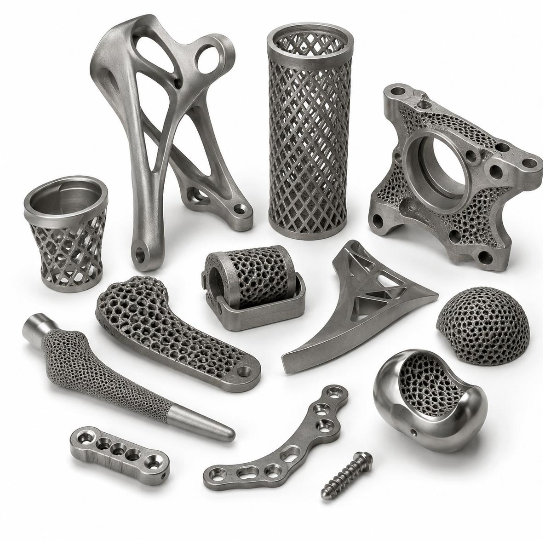
Case 1: US Aerospace Startup | Complex Titanium Lattice Bracket (20 parts)
- Challenge: Lightweight, high-strength lattice, ±0.02mm holes, 20 parts. CNC impossible, generic 3D print weak/porous.
- Zorapid Solution: SLM Ti-6Al-4V 3D print + 5-axis CNC hole finish.
- Result: 99% dense, 40% lighter than solid, ±0.01mm hole tolerance, delivered in 3 days. Passed aerospace fatigue testing.
2: German Medical OEM | 3,000 PEEK Surgical Instrument Housings
- Challenge: 3,000 parts, PEEK material, ±0.01mm tolerance, Ra ≤0.8μm. Too many for 3D print, too few for steel injection mold.
- Zorapid Solution: Rapid aluminum injection mold + low-volume PEEK run.
- Result: $9k mold + $12/part = $45k total, 12-day lead time, FDA-compliant, perfect consistency.
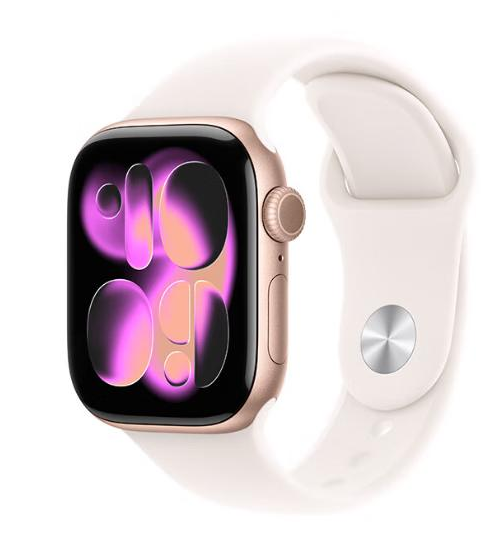
3: UK Consumer Electronics Brand | Prototype to Mass Production (Smart Watch Case)
- Challenge: Scale from 5 prototypes → 500 low-volume → 50k mass production, identical design/tolerance.
- Zorapid Solution:
- 5 prototypes: SLA 3D print (2 days)
- 500 parts: CNC 6061-T6 (5 days)
- 50k parts: Injection molding (4-week mold + 2-day run)
- Result: Exact same geometry across all batches, no redesign, seamless scale-up, 40% cost savings vs. separate vendors.
Your Needs & Zorapid Solutions
We don’t just sell processes—we match the right process to your exact needs. Below are the top 5 client scenarios and our tailored solutions:
1: 1–10 Prototypes (Fast, Cheap, Iterative)
- Your Requirement: Test design, fit, function; quick turnaround; low cost.
- Zorapid Solution: SLA/SLS 3D print (1–2 days, $50–$200/part, no tooling).
- Outcome: High-detail parts, easy design changes, perfect for early-stage validation.
2: 10–5,000 Precision Parts (High Tolerance, Strong Materials)
- Your Requirement: ±0.005–0.02mm tolerance; metal/hard plastic; consistent quality.
- Zorapid Solution: 5-axis CNC machining (1–3 days, $50–$200/part, 100% dense).
- Outcome: Solid, strong parts, tight tolerances, smooth finishes, ideal for low-volume production.
3: 5,000–10,000 Complex Plastic Parts (Middle Batch Gap)
- Your Requirement: Too many for 3D print, too few for steel injection mold; fast delivery.
- Zorapid Solution: Rapid aluminum injection mold (10–14 days, $8k–$12k mold, $8–$15/part).
- Outcome: Cost-effective, fast, identical parts, bridges the gap between CNC and mass production.
4: 10,000+ Mass Production Parts (Low Unit Cost, High Volume)
- Your Requirement: Millions of identical parts; ultra-low unit cost; consistent quality.
- Zorapid Solution: Steel injection mold + high-volume run (4–6 weeks mold, $15k–$50k mold, $2–$8/part).
- Outcome: Scalable, low-cost, perfect for consumer electronics, automotive, and medical mass production.
5: Complex Geometry + High Precision (Lattices, Internal Channels)
- Your Requirement: Intricate shapes, lattices, internal cooling channels; tight tolerances.
- Zorapid Solution: Hybrid 3D print + CNC (3D print near-net shape, CNC finish critical features).
- Outcome: Impossible-for-CNC geometry + CNC-level precision, strong and lightweight.
Industry Data + Future Trends (2026–2030)
Global Process Market Snapshot (2026)
| Metric | CNC Machining | 3D Printing | Injection Molding | Source |
|---|---|---|---|---|
| Global Market Size | USD 85.6B | USD 35B | USD 450B | Grand View Research |
| Growth Rate (CAGR) | 5.2% | 18.3% | 6.8% | Industry Reports |
| Top Application | Automotive (40%) | Aerospace (25%) | Consumer Goods (35%) | AMS Industry Report |
| Low-Volume (1–1k) Share | 60% | 35% | 5% | Zorapid Survey |
| Hybrid Workflow Adoption | 22% (2026) | → 45% (2030) | ESPRITCAM |
Key Future Trends + Zorapid’s Position
- Hybrid Manufacturing Becomes Mainstream
- 3D print complex cores + CNC finish + injection mold mass production; eliminates process gaps, cuts cost by 30–50%.
- Zorapid: 100% of complex jobs use hybrid workflows; in-house integration.
- Rapid Tooling Erases the Middle Batch Gap
- Aluminum injection molds for 500–10k parts; 10-day lead time, 70% lower cost than steel molds.
- Zorapid: Scaling rapid tooling capacity; 50+ aluminum molds monthly.
- 3D Print Moves From Prototypes to Low-Volume Production
- Industrial SLS/SLM now delivers production-grade parts; 1k–5k batches cost-competitive with CNC.
- Zorapid: 20+ industrial 3D printers dedicated to low-volume production.
Application Scenarios
Each process dominates specific industries. Here’s where CNC, 3D print, and injection molding shine:
CNC Machining (Precision & Strength)
- Aerospace: Structural brackets, turbine components, titanium parts
- Medical: Implants, surgical tools, PEEK housings
- Automotive: Engine parts, transmission components, lightweight aluminum parts
- Robotics: Joints, gears, high-precision frames
3D Printing (Complexity & Speed)
- Aerospace: Lattice structures, fuel nozzles, lightweight components
- Medical: Custom implants, surgical guides, patient-specific devices
- Consumer Products: High-detail prototypes, custom jewelry, fashion accessories
- Tooling: Injection mold inserts with conformal cooling, jigs, fixtures
Injection Molding (Mass Production & Cost)
- Consumer Electronics: Phone cases, chargers, enclosures
- Automotive: Interior parts, bumpers, dashboard components
- Medical: Disposable devices, packaging, housings
- Consumer Goods: Containers, toys, household products
Delivery Speed Advantage (Right Process = Fastest Lead Time)
Process choice directly impacts lead time. Generic shops force slow, mismatched processes. Zorapid picks the fastest path for your batch size:
Standard Lead Times (By Process & Batch)
| Batch Size | CNC Machining | 3D Printing | Injection Molding |
|---|---|---|---|
| 1–10 parts | 1–2 days | 1 day | 4–6 weeks (overkill) |
| 10–100 parts | 2–3 days | 2–3 days | 4–6 weeks (overkill) |
| 100–1,000 parts | 3–5 days | 3–4 days | 10–14 days (rapid mold) |
| 1,000–10,000 parts | 5–7 days | 4–6 days | 12–18 days (rapid mold) |
| 10,000+ parts | 7–10 days | 6–8 days | 4–6 weeks (mold) + 2 days (run) |
Why we’re faster:
- No outsourcing: All processes in-house; no shipping delays between vendors.
- Process optimization: We always pick the fastest process for your batch.
- 24/7 operations: CNC/3D print cells run overnight; rapid mold team works weekends.
Real example: A tech startup needed 2,000 complex plastic parts. Generic shops quoted 5 days (3D print, $100k) or 6 weeks (injection mold). We delivered in 12 days with rapid aluminum mold ($22k total).
Why Choose Zorapid for Process Selection & Manufacturing
- All 3 Processes In-House: CNC (5-axis), industrial 3D print (SLM/SLA/SLS), injection molding (rapid + production)—one-stop shop.
- Neutral, Expert Advice: No bias—we recommend the best process for your needs, not just what we sell.
- Hybrid Workflow Specialists: Solve impossible jobs with 3D print + CNC + injection mold combinations.
- Scale Seamlessly: From 1 prototype to 1M+ parts—same quality, same design, no redesign needed.
- 30–50% Cost Savings: Avoid wrong-process waste; hybrid workflows cut costs vs. single-process vendors.
- Fastest Lead Times: In-house operations + 24/7 cells; beat generic shops by weeks on complex jobs.
- English-speaking engineers, 24-hour response, DFM reviews in your timezone, full compliance docs.
Final Summary
Choosing the right process isn’t about CNC vs. 3D print vs. injection molding—it’s about matching process to batch size, complexity, tolerance, and budget.
- 1–10 parts (prototypes): Pick 3D print (fast, cheap, complex-friendly)
- 10–5,000 parts (precision/low-volume): Pick CNC (strong, tight tolerance, 100% dense)
- 5,000–10,000 parts (middle gap): Pick rapid aluminum injection mold (fast, cost-effective)
- 10,000+ parts (mass production): Pick steel injection molding (low unit cost, scalable)
- Complex + precise: Pick hybrid 3D print + CNC (impossible geometry + tight tolerance)
Zorapid’s all-process in-house capability + hybrid expertise eliminates guesswork, saves you time/money, and delivers consistent quality from prototype to mass production.
Whether you need 5 prototypes, 500 precision parts, or 50k mass-produced components—Zorapid is your trusted partner for process-agnostic manufacturing that scales.
FAQ
Is 3D printing cheaper than CNC for small batches?
Yes for 1–5 parts (no fixturing cost). For 10+ parts, CNC is often cheaper and stronger. We’ll run a cost comparison for free.
Can 3D printed parts be used for production?
Yes—industrial SLS/SLM parts (nylon/carbon fiber/metal) are production-grade, with 80–95% density. Great for 100–1,000 batches.
When should I choose rapid aluminum mold vs. steel mold?
Aluminum: 500–10,000 parts, 10-day lead time, low cost. Steel: 10,000+ parts, 1M+ shot life, high volume.
Can you switch processes mid-project if needed?
Absolutely. We design parts to be process-agnostic—so you can move from 3D print → CNC → injection molding without redesign.
Do you offer free process selection advice?
Yes. Send us your CAD file, batch size, material, and tolerance—we’ll provide a free, unbiased process recommendation + cost/lead time breakdown within 24 hours.