Published:Zorapid.Ltd
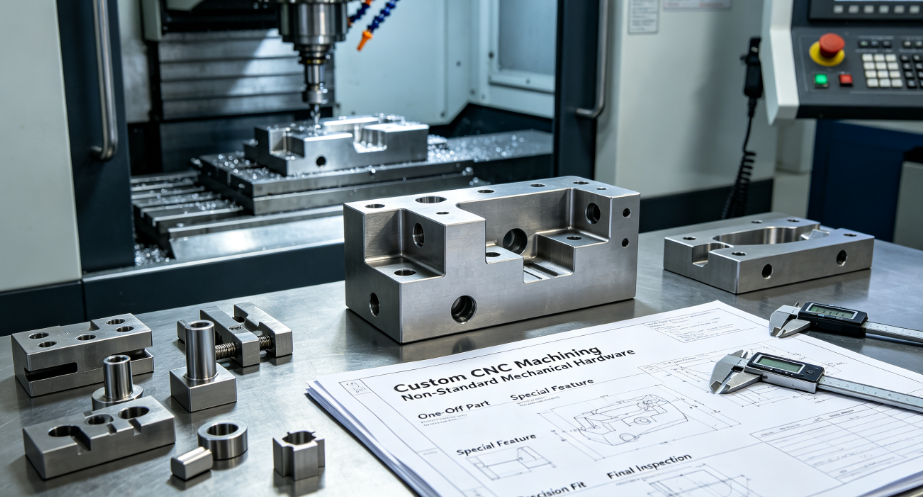
If you’re new to custom industrial part sourcing or mechanical design, CNC machining is everywhere. Semiconductor vacuum chambers, aerospace titanium brackets, medical titanium implants, injection molds, automation fixtures—nearly all high-precision metal and hard plastic hardware relies on CNC.
CNC stands for Computer Numerical Control. Simply put: computers guide cutting tools to carve solid blocks of material into finished shapes. No manual hand-cranked milling, no heavy reliance on a machinist’s steady hands. Repeatability and precision become predictable.
Lots of beginners get confused by machine types, process steps, material options, tolerances and pricing rules. This beginner-friendly guide breaks CNC down step by step. We skip overly complex jargon, focus on real industrial production rules, cover workflow, machine categories, materials, design tips, common pitfalls and frequently asked questions. By the end, you can confidently talk with CNC manufacturers and draw manufacturable industrial drawings.
What Exactly Is CNC Machining? Basic Working Principle
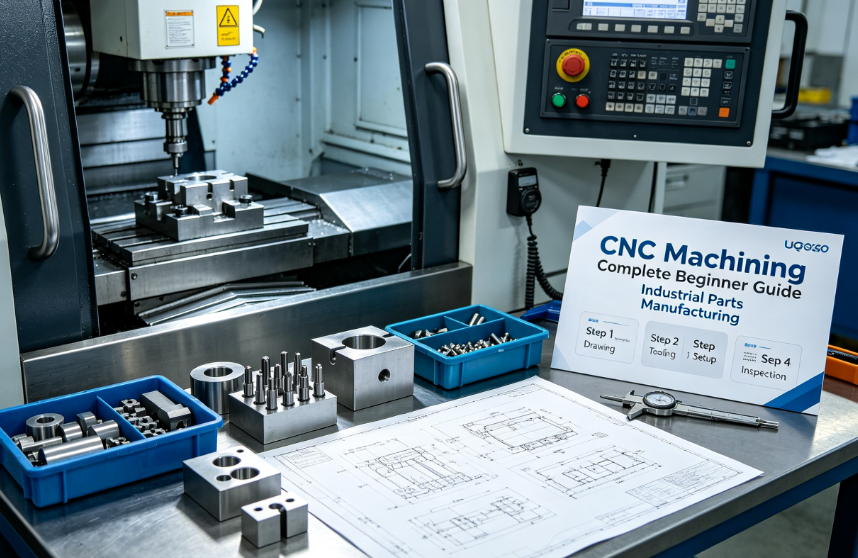
Traditional manual mills or lathes require operators to turn wheels to move tools. CNC replaces human wheel control with coded G-code instructions. A CAM software converts your 3D CAD model into thousands of coordinate commands. The CNC machine follows these coordinates to cut metal/plastic accurately.
Core logic: Solid raw material block → cut away unwanted material layer by layer → final net shape (subtractive manufacturing). Opposite of 3D printing (additive, building up material). CNC wins for tight tolerances, smooth surface finish (such as Ra 0.2 μm), high material strength and mass repeatability.
Two core advantages for industrial manufacturing
- Ultra repeatable: One CAD file produces hundreds of identical parts with consistent dimensions, no human error drift. Critical for aerospace safety and semiconductor yield control.
- Wide material compatibility: Works for aluminum, stainless steel, titanium, Inconel, PEEK, PVDF and dozens more engineering-grade metals and plastics.
Main Types of CNC Machines for Industrial Parts (Beginner Classification)
You do not need to memorize all models. Focus on the 5 most common machines used for industrial custom components.
CNC Milling (Most widely used for complex parts)
Mills use rotating cutting tools. Workpiece sits fixed on the table; tools move along X/Y/Z axes to cut pockets, holes, contours, slots and faces.
- 3-axis CNC Mill: X/Y/Z linear movement only. Great for simple prismatic parts: flat plates, simple brackets, standard mounting blocks. Cannot easily reach deep undercuts or angled surfaces. Multiple re-clamping needed for complex geometry.
- 5-axis CNC Mill: Adds two rotary axes. The spindle or workpiece tilts and rotates. Tools reach all sides of a part in one single setup. The go-to choice for semiconductor chambers, turbine parts, curved medical components. Eliminates alignment errors and delivers uniform surface roughness on complex curved walls.
CNC Turning (Lathe)
The workpiece spins fast; stationary cutting tools cut outer diameters, inner bores, threads and chamfers. Best for round symmetrical parts: shafts, pins, vacuum flanges, threaded connectors, motor sleeves. Many modern lathes come with milling function (turn-mill combo) for holes and flats on round parts.
CNC Drilling
Focused on mass hole making: deep holes, tapped threads, counterbores. Often integrated into mills/turning centers rather than standalone machines for most industrial jobs.
Wire EDM
Uses thin electrically charged brass wire to erode conductive metal. Perfect for tiny sharp internal corners, narrow slots, hardened mold steel. Cannot cut plastics. Ideal when regular end mills cannot fit into tiny features.
CNC Grinding
Uses abrasive grinding wheels. Hits ultra-tight tolerances (±0.001 mm level) and mirror-smooth surfaces. Used for precision bearing surfaces, mold shutoffs, sealing faces requiring Ra 0.2 μm finish.
Quick selection cheat sheet:
- Flat, square, boxy parts → 3-axis milling
- Curved, multi-angle, deep cavities, semiconductor chambers → 5-axis milling
- Round cylindrical parts → CNC turning
- Hard steel tiny slots/sharp corners → Wire EDM
- Ultra-precision smooth sealing surfaces → CNC grinding
Full End-to-End CNC Production Workflow
Every CNC industrial order follows this fixed sequence, from your CAD file to finished delivered parts.
- CAD Design (Your job as designer) Build 3D model in SolidWorks, Fusion 360, UG or Creo. Add dimensions, tolerances, GD&T notes, surface finish requirements (Ra value). Export STEP or IGES universal files for manufacturers.
- CAM Programming (Manufacturer’s work) Engineers import CAD into CAM software, set cutting paths, choose cutting tools, calculate spindle speed, feed rate, coolant mode. The software outputs G-code, the language CNC machines understand. Programmers avoid tool collision and optimize cycle time.
- Material Preparation Cut bulk raw stock into blank blocks slightly bigger than final part size. Factories leave small machining allowance on all sides for finishing. For expensive alloys like titanium, blanks are sized tightly to reduce waste and cost.
- Workholding & Fixturing Clamp material blank onto machine tables with vises, custom fixtures, vacuum chucks. Fixtures lock parts rigid to stop shifting during high-speed cutting. 5-axis often uses zero-point fixtures for fast changeover.
- Rough Machining Big, fast cuts remove most excess material. Leaves 0.1 mm~0.5 mm leftover stock on all surfaces. Goal: remove bulk material quickly, ignore fine surface quality.
- Semi-Finish & Finish Machining Small, slow precise passes cut remaining stock. Finish passes define final dimensions, tolerances and surface roughness. Critical semiconductor sealing surfaces use dedicated finishing tools to hit Ra 0.2 μm. High-pressure coolant is commonly applied here to extend tool life.
- Deburring & Secondary Operations Remove sharp edge burrs via hand brushing, ultrasonic washing, tumbling or CNC edge breaking. Add tapping, reaming, engraving if needed. Mold and semiconductor parts strictly control burrs to avoid particle shedding.
- Surface Post-Treatments (Critical for industrial performance) Most functional industrial parts need extra treatment after CNC cutting:
Most Common CNC Materials for Industrial Parts
We group materials by application, list pros and typical use cases so you pick correctly on the first try.
Metallic Materials
| Material Grade | Key Benefits | Typical Industrial CNC Use |
|---|---|---|
| 6061 Aluminum | Low cost, easy machining, lightweight, good anodizing | Semiconductor chambers, manifolds, automation frames, fixture blocks |
| 7075 Aluminum | Higher strength than 6061 | Aerospace brackets, high-load structural parts |
| 316L Stainless Steel | Corrosion resistant, low magnetism, UHV compatible | Vacuum flanges, liquid chemical fittings, corrosion-resistant process parts |
| Ti6Al4V Titanium | Extremely high strength-to-weight, heat resistant, biocompatible | Aerospace structural components, medical implants, high-temperature chamber hardware |
| Inconel 718 | Outstanding high-temperature resistance | Furnace components, plasma exposed parts, turbine hardware |
| H13/P20 Mold Steel | Hard after heat treatment, wear resistant | Injection molds, die casting molds, long-run wear fixtures |
Engineering Plastics (CNC machined for cleanroom/semiconductor)
- PEEK: High heat, chemical resistant, medical safe, easy to machine smooth
- PVDF / PFA: Low outgassing, plasma resistant for semiconductor wet process
- LCP: Low particle generation, ideal wafer handling plastic parts
Beginner rule of thumb: Start with 6061 aluminum for most custom non-high-temperature metal projects. Choose stainless if corrosion/vacuum is needed. Titanium/Inconel only when high strength or extreme heat is required (they cost more and machine slower).
Critical Basic CNC Terms Every Beginner Must Know
No heavy jargon, only essential words you will see on quotes and drawings:
- Tolerance: Allowed dimension variation. Tighter tolerance = higher cost. ISO 2768 default ±0.1 mm works for non-critical areas; sealing surfaces often ±0.01 mm or tighter.
- Ra (Surface Roughness): Number measuring smoothness. Ra 0.2 μm = ultra-smooth for vacuum sealing; Ra 1.6 μm common general machined finish. Lower Ra means more machining time.
- Burr: Tiny sharp metal flaps left after cutting. Cleanroom/semiconductor parts require zero burrs.
- GD&T: Geometric dimensioning and tolerancing. Controls flatness, position, concentricity instead of basic linear tolerances, ensures fit at lower cost.
- Stock Allowance: Extra material left for finishing between roughing and final cut.
- Through-Tool Coolant: Coolant flows out of drill/end mill tips, critical for deep holes and hard alloys to extend tool life.
- Fixturing: Jigs and clamps holding parts stable during cutting. Complex geometry needs custom fixtures, adding small cost.
Top Beginner Design Mistakes That Raise CNC Cost & Lead Time
New designers regularly create hard-to-machine features, increasing price and scrap rate. Avoid these seven errors:
- Internal sharp 90° corners: Standard round end mills leave radii inside pockets. If you draw perfect sharp inner corners, manufacturers need expensive Wire EDM. Always add minimum 0.8 mm internal radius.
- Over-tight tolerances on all dimensions: Blanket ±0.01 mm across the whole drawing doubles/triples cost. Only tighten tolerances on mating/sealing surfaces.
- Extra-deep narrow cavities: Long thin cutting tools vibrate, cause chatter and poor surface finish. Widen deep slots or add larger radii.
- Extremely thin walls: Walls thinner than 0.8 mm for aluminum bend during cutting. Thicken walls or add support ribs.
- Ignoring draft angles for post-machined molded inserts: If parts will be used as mold cores, draft angles help ejection.
- Too many tiny unreachable undercuts for 3-axis: Undercuts need multiple re-clamping or 5-axis; redesign if you only plan 3-axis production.
- No callout for Ra surface requirements: Manufacturers apply standard rough finish by default. Always write required Ra on critical surfaces for vacuum/seal parts.
How CNC Pricing Works for Beginners
CNC cost is never based purely on part size. Six major factors control quotes:
- Material cost: Titanium, Inconel cost far more per kilogram than aluminum. High-cost stock makes material waste a big expense.
- Total machining time: Longer CNC runtime = higher machine hourly fees. Complex curved 5-axis geometry takes longer.
- Tolerance & surface finish: Tight tolerances and ultra-low Ra need extra finishing time and frequent inspection.
- Number of setups: More fixture re-clamping = more labor cost. 5-axis reduces setup count and lowers overall cost for complex shapes.
- Secondary processes: Anodizing, electropolishing, CMM inspection, cleanroom cleaning all add separate fees.
- Order quantity: Prototypes (1–10 pcs) cost highest per unit. Larger batches spread programming/fixture fixed cost across all units, lowering piece price.
Simple cost tip: For small-batch complex industrial parts, 5-axis CNC often saves total money vs multiple 3-axis setups.
FAQ
What is the difference between 3-axis and 5-axis CNC? Which should I pick?
3-axis moves X/Y/Z only, cheap for simple flat parts. Any part with angled holes, curved surfaces, deep undercuts or multiple-sided critical features should use 5-axis. 5-axis finishes all features in one setup, improves precision and surface consistency, cuts rework risk. For semiconductor chamber components, 5-axis is almost mandatory.
Can CNC make fully complex hollow internal channels like conformal cooling paths?
Traditional CNC struggles with enclosed long internal channels. For intricate internal manifolds, hybrid additive + CNC works best: 3D print internal structures, then CNC machine outer critical surfaces. Simple straight drilled internal holes are fully CNC achievable.
How smooth can CNC get surfaces? What Ra levels are normal?
Regular finish milling hits Ra 1.6 μm ~ Ra 3.2 μm. Precision finishing with high-pressure coolant reaches Ra 0.4 μm~Ra 0.2 μm. For Ra below 0.2 μm, add grinding, electropolishing or hand buffing. Semiconductor vacuum sealing commonly specifies Ra ≤0.2 μm.
Is CNC suitable for mass production, or only prototypes?
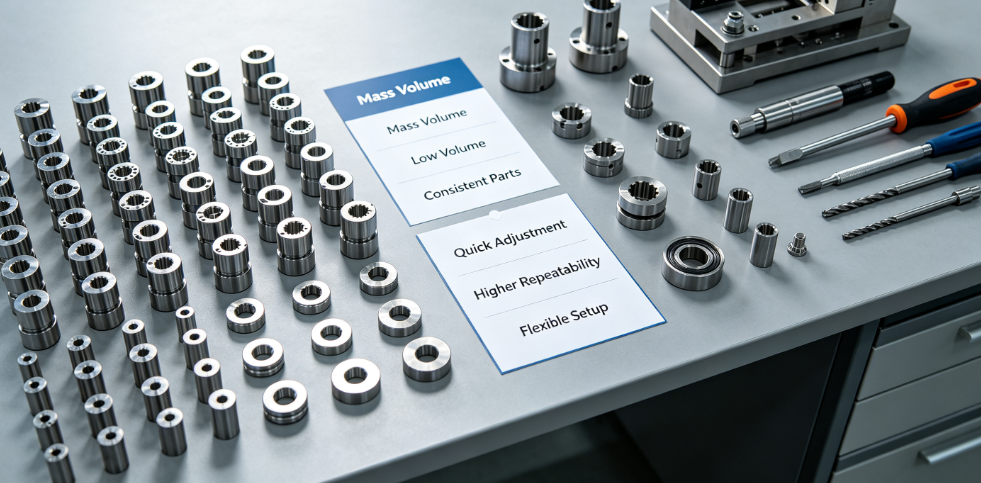
CNC works well for low-to-medium batches (1–5,000 units). For volumes above 10,000 identical plastic parts, injection molding becomes cheaper long-term. Metal mass production above 10k pieces usually switches to forging + CNC secondary machining.
Do I need to provide G-code to CNC manufacturers?
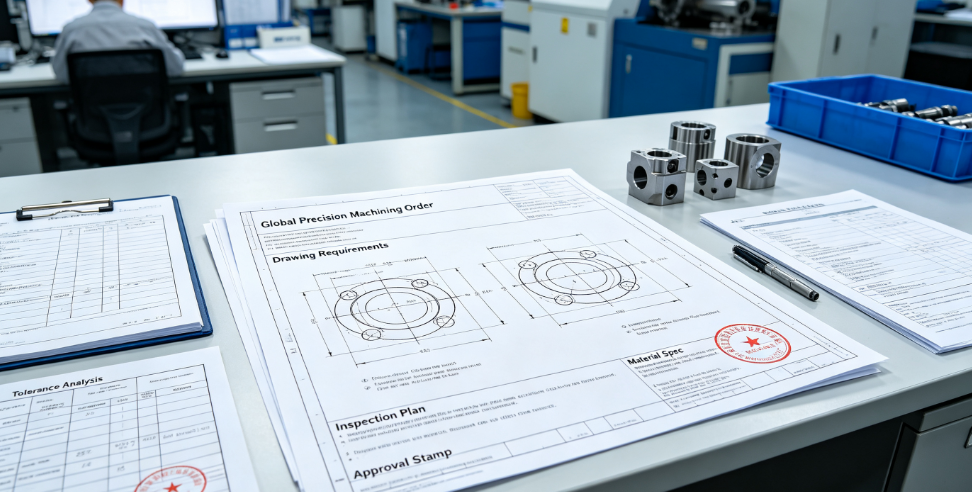
No. You only need finished CAD files (STEP preferred). Vendors handle CAM programming and G-code generation. You only supply design drawings with dimensions, tolerances, material and surface specs.
Are burrs unavoidable on CNC parts? How to request burr-free parts?
Minor burrs are normal after cutting. Specify deburr requirements on drawings. Semiconductor and medical components require precision edge breaking, no loose burrs. Manufacturers use ultrasonic cleaning, vibratory finishing or manual micro-deburr to meet zero-burr standards.
Which material is cheapest for CNC metal prototypes?
6061 aluminum is the most cost-effective choice. Fast machining speed cuts hourly machine cost, raw material price is low, and multiple anodizing color options are available.
What causes CNC dimensional inconsistency between batches?
Common reasons: unstable workshop temperature, repeated re-fixturing on 3-axis, worn cutting tools, inconsistent cutting parameters. Qualified industrial CNC shops control shop temperature, replace tools regularly and use fixed CAM programs to guarantee batch consistency. 5-axis single-setup largely eliminates batch variation.
Final Conclusion
CNC machining is the backbone of modern industrial precision manufacturing. As a beginner, you do not need to master every machine parameter, but you must grasp four core basics: machine selection rules, material matching, tolerance/surface finish planning, and simple design for manufacturability.
The biggest beginner wins come from designing parts friendly to CNC (large internal radii, reasonable wall thickness, zoning tight tolerances only on functional surfaces) and picking the correct machine (3-axis for simple geometry, 5-axis for complex industrial hardware).
Whether you build semiconductor equipment, aerospace assemblies, medical devices or molds, clear CAD specs paired with basic CNC knowledge will help you get accurate parts at lower cost, shorter lead times and fewer quality disputes with manufacturers.