Published by Zorapid
Hardened alloy steel turning is always a balancing act.
Once your material hits 52–62 HRC, cutting heat spikes instantly.
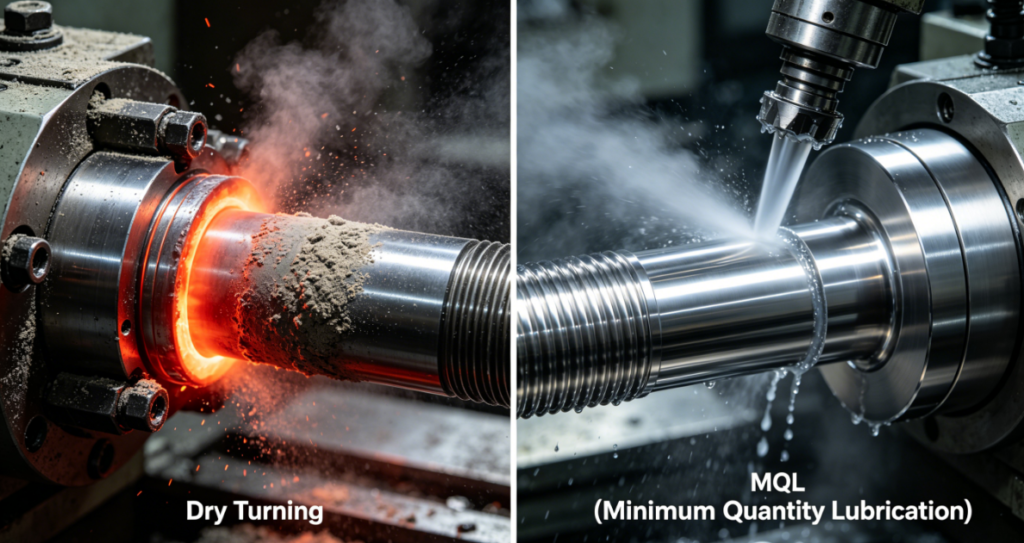
Most workshops pick one of two sustainable options: full dry turning, or MQL (Minimum Quantity Lubrication).
Dry turning looks perfect at first glance: no coolant tanks, no fluid waste, zero messy cleanup.
But here’s the catch: extreme heat burns out your inserts, ruins surface quality, and triggers thermal dimensional shift.
MQL sprays just tiny oil droplets straight into the tool-chip zone, with less than 0.2L of oil consumed per hour. No flood coolant mess, but far better lubrication than dry cutting.
The big question our clients keep asking:
Should we stick with dry turning to cut overhead, or add MQL to extend tool life and hold tighter tolerances on hardened alloy steel?
At Zorapid, we run hard turning daily on AISI 4340, 4140, D2 and 52100 hardened shafts, bearing sleeves and hydraulic components. We have run hundreds of head-to-head dry VS MQL tests.
This practical buyer’s guide breaks down temperature data, tool wear, surface finish, total production cost, and clear rules to pick the right process every time.
The Core Challenge of Hardened Alloy Steel Turning
Hardened low-alloy and tool steel generates brutal friction during turning.
Cutting zone temperatures easily jump above 750°C without lubrication.
Two major failures show up with zero cooling:
- Rapid flank wear & crater wear on coated carbide or cBN inserts. Tools degrade halfway through a small batch.
- Built-up Edge (BUE). Workpiece material welds onto the cutting edge, tearing up surface texture and throwing dimensions out of spec.
Dry turning eliminates flood coolant, which makes it eco-friendly. But it trades fluid cost for sky-high tool replacement and scrap cost.
MQL sits right in the middle: near-zero oil consumption, plus a thin lubricating film that stops BUE and slows thermal wear.
Basic Process Definition
- Dry Turning: No oil, no air-oil mist. Pure metal-to-metal cutting. Only compressed air for chip removal.
- MQL Turning: High-pressure air carries micron-sized biodegradable oil droplets directly into the tool-chip contact area. Oil consumption: 5–200 mL/h, 99% less than traditional flood cooling.
Head-to-Head Test Data — Dry VS MQL on 55 HRC AISI 4340
We ran controlled hard turning tests with identical parameters at Zorapid’s turning cell:
Material: AISI 4340 alloy steel quenched & tempered to 54–58 HRC
Cutting data: Vc = 165 m/min, feed = 0.12 mm/rev, depth of cut = 0.25 mm
Test endpoint: VB flank wear = 0.3 mm (standard tool life rejection rule)
| Measured Result | Dry Turning | MQL Vegetable Oil Turning | Improvement with MQL |
|---|---|---|---|
| Tool service life | 26 minutes | 39 minutes | +50% longer insert life |
| Cutting zone peak temperature | 765 °C | 530 °C | 31% heat reduction |
| Average Surface Roughness Ra | 1.6–2.2 μm | 0.35–0.6 μm | 70% smoother finish |
| Built-up Edge (BUE) | Heavy, consistent weld | Almost zero BUE | Eliminated edge welding |
| Chip condition | Dark blue, overoxidized, jagged | Silver, uniform, low thermal stress | No burnt chips |
| Part thermal expansion drift | ±0.022 mm | ±0.007 mm | 68% less dimensional shift |
The raw numbers make it obvious.
Dry cutting works, but heat destroys your tools and surface quality. MQL drastically cuts thermal damage while keeping the workshop clean and coolant-free.
Tool Wear & Insert Cost
Tooling is the biggest ongoing expense in hard turning.
Dry Turning Weakness
Without boundary lubrication, the insert rubs directly against hot hardened steel.
- Abrasive flank wear progresses fast
- High heat softens the PVD coating
- Nose chipping becomes common on interrupted cuts You end up replacing inserts 30–55% more frequently than you would with MQL.
MQL Performance
The oil mist forms a solid anti-friction film between tool and chip.
This stops adhesive wear and slows down crater wear on the rake face.
Our production data shows MQL consistently extends carbide insert life by 20% to 55% on 52–62 HRC alloy steel.
Even cBN premium inserts last noticeably longer under optimized dual-jet MQL.
Zorapid Practical Tip:
Point one MQL nozzle at the rake face, the second nozzle at the flank line. Dual jet penetration cuts wear far better than a single air-oil stream.
Surface Finish & Dimensional Stability
This is where dry hard turning hits its strict limit.
- Chatter and uneven texture Hot cutting edges vibrate easily without lubrication. You get regular chatter feed marks on OD surfaces, which require extra grinding or polishing as secondary work.
- Thermal expansion error Dry turning heats the workpiece unevenly. The shaft expands mid-cut. When it cools down after machining, the diameter shrinks, creating out-of-tolerance parts.
- Surface oxidation Burnt high-temperature chips scratch the freshly machined surface, leaving dark discoloration that ruins corrosion resistance.
With properly targeted MQL mist:
- Friction drops sharply, vibration fades away
- Workpiece temperature stays stable, thermal shrinkage is minimal
- Ra easily holds below 0.6 μm without post-finishing operations
For precision shafts requiring Ra ≤0.4 μm, dry turning rarely hits spec reliably. MQL hits that finish consistently in one pass.
Chip Control & Scrap Rate
Dry cutting produces overheated, discontinuous chips.
These hot blue chips stick to the workpiece, scratch finished surfaces, and jam inside the tool post. Operators must stop the lathe often to clear chip nests.
In small NPI batches, this downtime adds up fast.
MQL cools the chip from the inside. Chips stay short, uniform, and silver-gray.
Compressed high-pressure air blows chips away continuously.
Result: fewer stoppages, fewer scratch defects, lower scrap rate.
Zorapid batch statistics:
Dry turning scrap rate on hardened 4340 shafts: 11–16%
MQL turning scrap rate under identical parameters: below 2.5%
Operating Cost & Environmental Impact
Let’s compare total running costs (USD per production hour):
Dry Turning
Zero oil purchase cost
No fluid filtration, no wastewater disposal
High insert consumption: extra tooling cost (
$7–12/hour)
High scrap + rework labor cost ($9–15/hour)
Longer cycle time due to frequent tool changes and chip clearing
MQL Turning
Oil consumption: only 8–30 mL/hour. Biodegradable vegetable oil costs less than $0.40 per hour of runtime
Insert cost drops by roughly one-third
Scrap and secondary polishing labor almost disappear
Small upfront cost for MQL nozzle, air regulator and oil metering unit (one-time low investment)
Total landed cost calculation from our job shop data:
On batches over 50 hardened steel parts, MQL cuts total production cost by 18–27% compared to dry turning.
For low-volume prototype runs under 15 pieces, dry turning can still save you the small MQL setup time.
Eco note:
Both dry and MQL qualify as green machining, far cleaner than flood coolant. MQL just balances sustainability with productivity. No oily sludge, no bacterial coolant tanks, no waste oil paperwork.
When Dry Turning Is Still The Better Choice
MQL is not always mandatory. Stick fully dry if all these conditions apply:
- Hardened steel material ≤53 HRC, low alloy 4140, continuous turning with no interrupted cuts
- Tolerances are loose (±0.025 mm or wider), no ultra-fine surface requirements (Ra >1.2 μm is acceptable)
- Very small prototype batches (1–12 pcs), you cannot spare time setting up MQL nozzles
- Roughing passes only, no finishing OD work
- Short single-cut cycles with minimal heat build-up
For rough stock removal with generous stock allowance, dry cutting works perfectly well without extra investment.
When You Must Use MQL for Hardened Alloy Steel Turning
Switch to MQL immediately if you tick any box below:
Material hardness ≥55 HRC (AISI 4340, D2, 52100 bearing steel)
Finishing pass required, target Ra ≤0.8 μm
Tight GD&T diameter tolerance (±0.01 mm or tighter)
Interrupted cuts, keyways, notches that cause edge chipping on dry inserts
Batch size over 25 pieces, tool replacement cost eats into profit
You want to eliminate post-turning grinding or manual polishing
Thermal stability is critical for long slender shafts prone to heat distortion
At Zorapid, we apply dual-nozzle MQL on all hardened steel finishing runs, and only use dry cutting for roughing stock removal on short prototype jobs.
Zorapid Real-World Case Study
A European hydraulic OEM sent us an order of 220 hardened 4340 alloy steel piston shafts (56 HRC).
Their original process: full dry hard turning with coated carbide inserts.
Initial problems:
- Insert replacement every 25 parts
- 14% scrap from thermal dimensional drift and surface chatter
- Extra OD polishing added 3 days of lead time Total cost for the batch: $3,470
We switched the finishing pass to targeted dual-jet vegetable oil MQL, kept roughing in dry mode.
Optimized outcome:
- Insert life extended from 25 pieces up to 37 pieces per edge
- Scrap rate fell to 1.8%
- One-pass finish hit Ra 0.45 μm; no secondary polishing needed
- Total batch cost dropped to $2,580 (25% cost reduction) Lead time shortened by 3 full working days.
The client now uses this dry rough + MQL finish hybrid process for all hardened shaft production.
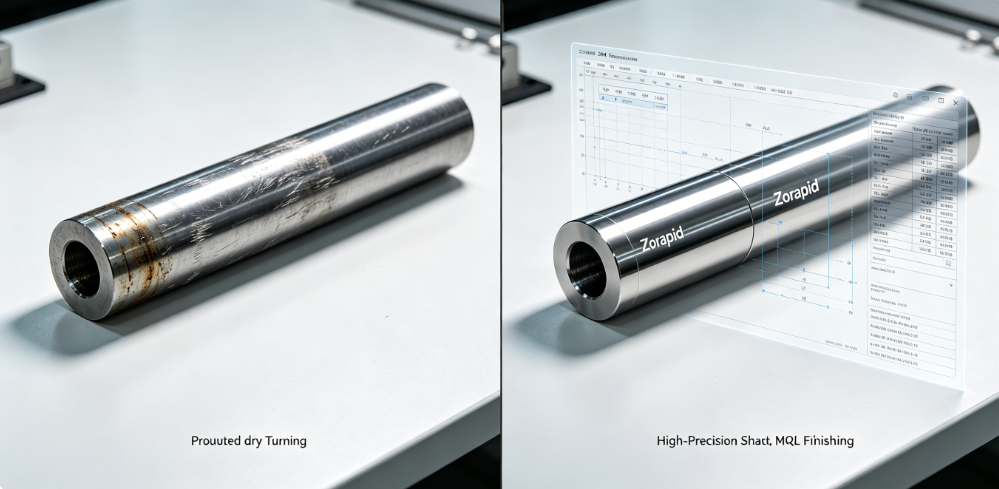
5 Pro Tips to Optimize MQL Hard Turning
- Use biodegradable vegetable-based MQL oil Mineral oil breaks down too slowly. Vegetable ester oil sticks to the tool edge better and creates a stronger anti-BUE film on hardened steel.
- Angle two nozzles independently One jet hits the rake face (anti-BUE lubrication). The second jet targets the flank line to reduce flank wear. Air pressure set to 5–6 bar for best penetration.
- Lower cutting speed slightly if you switch from dry to MQL Better lubrication lets you hold surface quality without pushing RPM so high, cutting thermal load further.
- Keep dry roughing + MQL finishing split process You save oil cost on rough stock removal while protecting finishing inserts with lubrication.
- Seal the machine enclosure lightly MQL produces fine oil mist. A simple enclosure stops airborne oil residue without flood coolant mess.
Final Verdict
Dry turning and MQL are both flood-free sustainable options for hardened alloy steel.
- Dry turning: Best only for low-hardness roughing and tiny prototype batches with loose tolerances. It has zero fluid cost, but suffers from short tool life, heat distortion and poor surface finish.
- MQL lubricated turning: The clear winner for 55+ HRC hardened steel finishing, tight tolerances, and batch production. You spend pennies on oil, cut tooling expense, eliminate scrap and secondary polishing, and hold stable precision.
The sweet spot for most hard turning jobs:
Dry roughing + targeted dual-nozzle MQL finishing.
You keep production clean and eco-friendly while balancing cost, tool life and surface quality.
At Zorapid, we run optimized hard turning processes for quenched alloy steel, tool steel and bearing steel components. We can run side-by-side dry / MQL process simulation and recommend the most cost-effective turning method for your shafts and sleeves.
Send your print and material spec, and we will deliver a optimized turning plan + budget quote within 12 working hours.
FAQ
Can MQL match dry turning’s environmental advantages?
Yes. MQL only uses milliliters of oil per hour, no wastewater, no waste coolant disposal. It remains fully green machining without flood fluid pollution.
Does MQL reduce thermal expansion on long hardened steel shafts?
Definitely. The oil-air mist lowers cutting zone temperature sharply, so workpiece heating stays consistent. Dimensional drift from thermal shrinkage drops by two-thirds compared to fully dry turning.
Will MQL eliminate built-up edge (BUE) on hard alloy steel?
The boundary oil film stops workpiece material from welding onto the cutting edge. BUE is almost eliminated in finishing passes, which directly improves surface quality.
Is the upfront MQL equipment cost worth it for small machine shops?
Basic metering valves and dual nozzles cost less than $300 total. On batches above 30 hardened steel parts, the savings on inserts and scrap quickly pay back the small investment.
Can we run cBN inserts under MQL hard turning?
Absolutely. MQL reduces thermal shock on expensive cBN tools and slows crater wear, extending the life of premium superhard inserts.