Published:Zorapid.Ltd
What Is Sheet Metal Springback & Why It Happens
Definition
Springback: After bending force is removed, the sheet metal partially rebounds toward its original flat shape, causing final bend angle to deviate from target, dimensional variation, assembly fit issues, NVH problems, and assembly line rework.
- Measured as springback angle (Δθ): difference between programmed bend angle and final measured angle after unloading
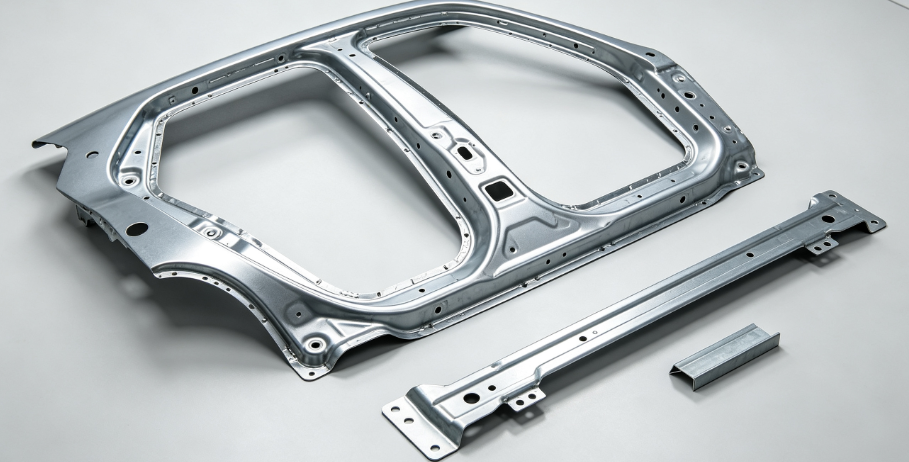
- Critical for automotive: structural chassis parts, frame rails, suspension brackets, door pillars, battery tray frames, body panels, AHSS (Advanced High-Strength Steel) components
Root Causes
- Elastic Recovery: Outer fibers stretched (tension), inner fibers compressed (compression); elastic strain recovers when load is released (residual stress gradient across sheet thickness)
- Higher yield strength = much larger springback (AHSS, DP steel, boron steel > mild steel)
- Thinner sheet, larger bend radius = higher elastic recovery
- Material Anisotropy: Grain direction, rolling texture, work hardening, residual mill stresses from coil manufacturing
- Bending Geometry: Large R/t ratio (bend radius / sheet thickness), shallow bend angles, uneven clamping
- Process Variation: inconsistent sheet thickness, material batch variation, press brake tonnage drift, variable lubrication, temperature change
- Residual Bulk Stress: coil memory, blanking/shear residual stress, previous stamping operations
Key Automotive Material & Process Variables
Common Automotive Sheet Grades
- Mild Steel (CRDQ, DC04, DC06): Low yield strength, minimal springback, easy compensation
- HSLA / DP (Dual Phase) / TRIP / Boron Steel (AHSS): High yield strength (700MPa+), severe springback, main automotive challenge
- Aluminum Alloys (6061, 5052, 6022 auto body sheet): High elastic modulus ratio, significant springback, sensitive to bend radius & temperature
- Galvanized / Galvanneal / Al-Si coated steels: coating friction changes strain distribution, adds variability
Key Formula Rule
- Higher R/t (bend radius / sheet thickness) → higher springback
- Lower bend angle (shallow bends) → higher relative springback percentage
- AHSS: springback can exceed 5–15°, vs <1° for mild steel
Core Springback Reduction Methods
A. Overbending (Compensation Bending)
- Overbend Strategy: Program the press brake/die to bend past the target angle (overbend angle = pre-calculated springback value), so elastic rebound lands exactly on the nominal angle
- Example: 90° target bend with 3° springback → program 87° die angle (overbend 3° inward)
- Two variants:
- Fixed offset overbend (baseline measured springback value)
- Adaptive closed-loop overbend (auto-correct per in-process angle measurement)
- Limitation: not universal across batches, must re-calibrate for AHSS/aluminum coil changes
B. Bottoming / Coining (Compressive Plastic Deformation)
- Bottoming: Force the sheet fully flat against the die bottom (full die contact), apply controlled localized coining pressure at the bend apex
- Creates through-thickness plastic deformation, reduces elastic residual stress gradient, drastically cuts springback
- Requires sufficient tonnage (especially AHSS) + rigid tooling; avoid excessive coining (risk of material cracking, coating damage, fatigue risk)
- Not ideal for ultra-thin/aluminum panels (risk of denting, surface damage)
- Auto structural parts: validated coining zones only at bend apex (not full panel surface)
C. Stretch Bending / Tension Bending
- Apply axial tension during bending to reduce the neutral axis shift, flatten the residual stress gradient across the sheet
- Used for long automotive frame rails, bumper beams, curved structural profiles
- Tensile load minimizes elastic recovery; reduces AHSS springback dramatically
- Requires dedicated stretch-bend machines, controlled tension, FEA validation to avoid necking/rupture
D. Variable Radius / Variable Depth Bending
- Use smaller controlled bend radii (reduce R/t ratio where DFM allows), within minimum bend radius specs to prevent cracking
- Avoid overly large free bend radii on AHSS
- Use stepped die geometry to apply localized controlled compression at bend line
E. Hot Bending / Warm Forming (High-Strength / Aluminum Auto Parts)
- Warm forming aluminum / AHSS at moderate elevated temperatures (controlled cycle) to reduce yield strength, lower elastic recovery
- Common for EV aluminum chassis components, validated thermal cycles to avoid coating degradation and material property changes
- Must comply with OEM crash performance specs (material hardness validation post forming)
F. Post-Bend Stress Relief (Selective)
- Low-temperature stress relief cycles (per material spec) to reduce residual bulk stress, after primary bending
- Not for mass stamping lines; used for low-volume high-precision chassis/EV components
- Must validate dimensional stability + crash/ fatigue performance after thermal cycles
Tooling & Die Design Modifications
- Rigid Precision Tooling & Press Frames
- Eliminate die deflection, frame flex, uneven tonnage distribution (big hidden cause of inconsistent springback across long bends)
- Hardened, ground, CNC-machined press brake dies; avoid worn soft tooling (causes variable bend geometry)
- Add backgage repeatability control, hydraulic/pneumatic clamping for consistent blank positioning
- Anti-deflection crowning systems (press brake bed crowning, die crowning) to compensate for machine frame deflection under heavy AHSS tonnage
- Die Geometry Tuning
- Add pre-compensated springback geometry directly into 3D die CAD (FEA simulated overbend profile)
- Apex coining ribs (narrow localized ribs at bend line only, not full surface)
- Consistent V-die opening width (match material thickness, avoid variable die gaps)
- Use segmented dies for long auto panels, to prevent bowing along bend length
- Lubrication Control
- Apply validated auto-grade stamping lubricant uniformly to reduce friction variation; avoid excessive/uneven lube (changes strain distribution, causes inconsistent springback)
- Galvanized/coated steel: use OEM-approved lubricants to prevent coating damage + consistent friction
- Gauging & Backgage Tooling
- Laser/vision angle measurement, servo backgage with closed-loop feedback, repeatable datum referencing (unified primary edge datum) to eliminate positional variation
Bending Process Parameter Tuning
- Tonnage Validation
- Calculate required bending tonnage per material grade/thickness (AHSS requires significantly higher tonnage than mild steel)
- Avoid insufficient tonnage (partial elastic bend = massive springback variation)
- Maintain consistent tonnage across production batches; monitor hydraulic pressure for drift
- Bend Speed & Cycle Time
- Consistent bend speed; avoid fast impulse bending (creates dynamic residual stress, variable rebound)
- Hold dwell time at bottom dead center (BDC): short dwell to stabilize plastic deformation (do not over-dwell for coated/aluminum panels)
- Controlled slow unloading cycle for AHSS/aluminum to reduce dynamic springback
- Blank Preparation
- Remove shear burrs, trim uneven edges, flatten pre-bent residual coil curvature (blank leveling/straightening process)
- Orient bends relative to material rolling direction (grain direction): bend across rolling direction (90° to grain) when possible to reduce anisotropic springback variation
- Pre-level blanks to eliminate coil memory stress (critical for long auto rails)
- Batch Changeover Rules
- Run validation bend coupons for new coil batches, new tooling, seasonal ambient temperature shifts
- Store baseline springback offset values in press brake CNC programs, use recipe management for material variants
DFM Design Rules for Automotive Parts
- Follow Minimum Bend Radius Specs (OEM/AHSS specs)
- Do not force ultra-large bend radii on AHSS; specify R/t ratios validated via FEA (avoid shallow, wide-radius bends on structural AHSS)
- Add gradual blended transition radii to reduce local stress and inconsistent bending
- Avoid multiple sequential shallow bends (cumulative springback error)
- Add Datum & Jig Features
- Include fixed primary datums away from bend zones for repeatable fixturing, inspection, and robotic assembly
- Add small validation gauge holes/features for in-line angle checking
- Avoid critical assembly mating features directly on high-springback bend lines
- Material Grade DFM Tradeoffs
- Where possible: split large panels, use lower-springback material for non-critical geometry, reserve AHSS only for crash zones
- Avoid sharp ultra-thin flanges on aluminum/AHSS; add local stiffeners to reduce global shape distortion
- Comply with automotive crash simulation DFM rules—coining/overbend zones must pass crash validation
- Assembly DFM Allowance
- Use 3D tolerancing (GD&T) that accounts for residual controlled springback variation (Cpk ≥1.33 per IATF16949)
- Robotic assembly jigs with compliant fixturing for residual minor variation, while fixing root causes in bending process
Simulation & Digital Validation Workflow
FEA Simulation
- Input exact material card data (auto OEM validated AHSS/aluminum material models, yield curve, anisotropy, hardening curves, thickness variation)
- Generic material models produce poor springback predictions
- Simulate full process: blanking → pre-leveling → bending → unloading springback → trimming
- Generate compensated tool mesh (springback inverse compensation): warp die geometry to offset predicted rebound
- Validate simulation with physical coupon bend tests (correlate measured springback vs simulation)
- Digital Twin & CAM Template
- Embed validated springback offset parameters in press brake CNC programs
- Create material-specific press brake recipes (IATF16949 change control, formal ECO process)
- Full 3D scan validation of first article bends (laser scanner / CMM), update FEA models iteratively
- First Article Validation
- Full 3D GD&T inspection, SPC Cpk validation, full vehicle assembly fit check, NVH testing, crash simulation validation
In-Process Monitoring & Closed-Loop Control
- Real-Time Angle Measurement
- Laser/vision 2D/3D in-line angle sensors, linear displacement sensors to measure actual bend angle after unloading
- Closed-loop servo press brakes: auto-adjust bend depth/overbend offset per measured springback (adaptive bending)
- MES production logging: record bend angle, tonnage, batch ID, material coil ID for IATF16949 traceability
- SPC Statistical Process Control
- Track critical bend angles daily (Cpk, PPM variation), set alert limits (e.g., Cpk <1.33)
- Auto-generate corrective action alerts for springback drift (coil change, tool wear, temperature drift)
- IATF16949 layered audits, PFMEA risk mapping for springback variation
- Thermal & Environmental Control
- Maintain consistent shop temperature (±2–3°C), avoid direct sun/air conditioning drafts (thermal expansion variation)
- Allow blanks to reach ambient temperature before bending (cold aluminum/AHSS = variable springback)
Common Defects & Troubleshooting
1. Consistent Fixed Springback Offset
- Root: baseline elastic recovery, uncompensated overbend setting, generic material model
- Fix: measure average springback, apply fixed overbend offset in CNC, validate with FEA inverse compensation, bottom apex coining (if allowed by specs)
2. Variable / Uneven Springback Along Bend Length (Twist / Bow)
- Root: press frame deflection, lack of crowning, uneven clamping/tonnage, residual coil stress, anisotropic grain variation, worn segmented dies
- Fix: add press/die crowning, re-grind dies, pre-level blanks, use unified datum fixturing, closed-loop lengthwise scanning, validate AHSS grain direction
3. AHSS / Aluminum Excessive Springback (Large Angular Deviation)
- Root: high yield strength, large R/t ratio, insufficient tonnage, shallow bends, residual bulk stress
- Fix: stretch bending / controlled coining / validated overbend + FEA inverse die compensation, reduce R/t ratio, validate dwell cycle, pre-level blanks
4. Cracking / Edge Fracture (While Reducing Springback)
- Root: excessive coining, too-small bend radius, wrong grain direction, AHSS over-forming, galvanic coating damage
- Fix: validate minimum bend radius, reduce apex coining force, bend across grain direction, FEA formability simulation, formability coupon testing
5. Seasonal / Batch-to-Batch Springback Drift
- Root: coil material variation, ambient temperature change, lubrication variation, tool wear
- Fix: adaptive closed-loop bending, batch validation coupons, formal material change control, regular tool maintenance, MES batch traceability
Quick Checklist
Automotive Sheet Metal Bending Springback Checklist
IATF16949 validated material specs, AHSS/aluminum FEA material cards, pre-leveled blanks
FEA inverse springback die compensation validated with physical 3D scan correlation
Press brake crowning + rigid ground tooling, baseline springback offset programmed
Validated bend tonnage, BDC dwell cycles, consistent lubrication, grain direction rules
Laser/vision bend angle validation, SPC Cpk monitoring of critical bend GD&T
First article 3D CMM/laser scan validation, vehicle assembly fit & crash validation
Closed-loop adaptive bending (AHSS/aluminum high-precision structural lines)
MES batch traceability, formal ECO change control, periodic PFMEA reviews
Ambient temperature control, validated automotive coating/lube compatibility
OEM validation (crash, NVH, corrosion, fatigue) for coining/overbend modified processes
FAQ
What is the fastest method to fix consistent mild steel springback?
Fixed validated overbend offset + apex bottom coining, verify with laser angle measurement, add to press brake CNC recipe
How to handle AHSS boron steel automotive structural bends?
FEA inverse die compensation + stretch bending / controlled localized coining + closed-loop adaptive bending, validate crash performance, avoid aggressive full-surface coining
Can springback be fully eliminated, or only controlled?
Fully zero springback is impossible (elastic strain always exists); the goal is to control it to IATF16949 Cpk ≥1.33 within drawing GD&T tolerances for mass automotive production
What is the difference between overbending and inverse die compensation?
Overbending = adjust press brake depth/program angle per measured rebound; inverse die compensation = warp the 3D die geometry in CAD/FEA to pre-offset global shape distortion (best for long 3D curved auto frames)
Does IATF16949 require springback process validation?
Yes, as part of PFMEA, control plans, SPC, PPAP/FAI validation for structural automotive safety components
How to manage long EV aluminum battery tray frame bends?
Stretch bending + FEA inverse compensation + pre-leveled aluminum blanks + closed-loop adaptive bending, add 24hr soak dimensional validation, SPC long-term monitoring
Closing Notes
Springback control for automotive sheet metal is a system process, not just a single press brake setting. Mild steel relies on overbend + coining; high-strength AHSS/EV aluminum structural parts require FEA inverse die compensation, stretch bending, closed-loop adaptive bending, and full IATF16949 validation. Always validate final geometry with 3D scanning, SPC, and OEM crash/assembly validation—never rely purely on fixed offsets for AHSS production.