Published:Zorapid.Ltd
If you regularly source custom CNC machined parts—whether aluminum EV trays, stainless semiconductor vacuum chambers, medical PEEK components, or general automation hardware—you’ve likely run into inconsistent quotes.
One manufacturer gives you a cheap number, another doubles it, and you have no clear way to tell which estimate is realistic. The root issue: most buyers only look at raw material price, ignoring dozens of time-based, setup, finishing, and tolerance-related charges that dominate total CNC cost.
This guide walks you through a repeatable, accurate calculation method to forecast CNC part costs before sending CAD for quoting. We break down every cost component, share simple math formulas, real case examples, hidden fees, and design tweaks that immediately lower your machining budget. This framework works for 3-axis, 5-axis, prototype low-volume and mass production CNC runs alike.
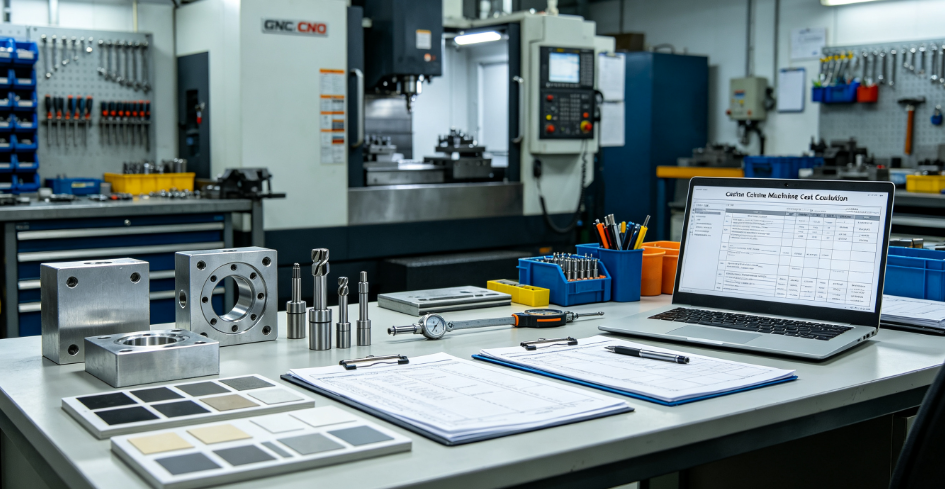
Seven Core Cost Drivers for All Custom CNC Parts
Every CNC quote is built from these seven stacked cost layers. To calculate accurately, you must account for all seven:
1. Raw Material Cost (Base Block/Extrusion Stock)
Calculation formula:
Material Cost = Stock Volume × Material Density × Raw Material Price per KG
- You pay for the full blank billet, not just the finished part. Large oversized stock for clamping creates major waste.
- Premium grades (316L VIM-VAR stainless, medical PEEK, 7075 aluminum) cost 2–5x standard 6061.
- Plate vs solid block vs extrusion stock all carry different per-kilogram pricing.
2. Machine Hour Labor Rate (Biggest Variable Expense)
Hourly rates vary drastically by machine type and facility cleanroom level:
- 3-axis standard CNC: $40–$75/hour
- 5-axis precision CNC: $80–$140/hour
- Cleanroom ultra-tight tolerance 5-axis (semiconductor/medical): $150–$220/hour Total machining time includes roughing, semi-finish, ultra-fine finishing, tool changes, and fixture setup.
Machining Labor Cost = Total Machine Runtime × Hourly Rate
3. Setup & Fixturing Cost
One-time fixed charge per unique part number, not per unit:
- Simple single-sided brackets: Low setup fee ($30–$120)
- Multi-sided complex vacuum chambers requiring custom fixtures: $200–$800+
- Prototypes often carry equal setup fees as small mass batches; consolidating parts cuts repeated setup charges.
4. Tool Wear & Consumable Cost
Carbide end mills, drills, inserts, coolant, cutting fluid wear down faster on hard metals (stainless, titanium, carbon-filled PEEK). Hard materials add 8–18% extra tool cost vs soft aluminum.
Parts with tiny micro-features or deep narrow channels burn through cutting tools rapidly.
5. Tolerance & Surface Finish Premiums
Standard loose tolerances (±0.05mm) cost baseline rate. Ultra-tight micron specs add significant surcharges:
- ±0.01mm tight tolerance: +25–40% machine time cost
- ±0.001–0.003mm micro tolerance (semiconductor sealing flanges): +70–120% cost
- Ra ≤0.1 polished sealing surfaces: Extra finishing hours + specialized tooling fees
6. Secondary Process Add-On Costs
Every post-machining operation adds a separate line item to your total cost:
Deburring, electropolishing, hard anodizing, passivation, ultrasonic cleaning, vacuum bake outgassing, helium leak testing, CMM dimensional inspection, nitrogen sealed packaging.
7. Overhead & Batch-Specific Markups
Factory overhead covers facility rent, quality staff, CMM inspection machines, cleanroom climate control, admin.
Small prototype batches (1–10 pcs) carry 30–80% higher per-unit markup vs volume runs over 100 units.
Step-by-Step Accurate CNC Cost Calculation Workflow
Follow this sequence to build an accurate budget estimate for any custom CNC part:
Step 1: Calculate raw material blank cost
- Measure the minimum billet size needed to clamp your finished part
- Calculate stock volume, multiply by material density to get total weight
- Multiply weight by current per-kilogram material market price
- Add cutting waste surcharge (10–30% for complex pocketed parts)
Step 2: Estimate total machine runtime
Break runtime into three segments:
- Rough machining time (bulk material removal)
- Semi-finish pass time
- Ultra-fine finishing time for tight tolerance sealing surfaces Count tool change delays, multi-sided re-fixturing for 3-axis parts; 5-axis single-setup cuts total runtime by 30–50%.
Step 3: Sum fixed setup cost + variable machine labor cost
Total Machining Base Cost = Setup Fee + (Total Runtime × CNC Hourly Rate)
Step 4: Add tool wear & consumable surcharge
Multiply machining base cost by a material factor:
- Aluminum 6061: ×1.05 (5% tool surcharge)
- 316L Stainless Steel: ×1.15 (15% tool surcharge)
- CF-filled PEEK / Titanium: ×1.20 (20% tool surcharge)
Step 5: Calculate secondary finishing & testing fees
List every required post-process and add fixed per-unit or per-batch charges:
Example: Electropolish $12/pc + CMM full inspection $8/pc + ultrasonic cleaning $3/pc
Step 6: Apply tolerance premium multiplier
Multiply running total by tolerance factor:
- Standard ±0.05mm: ×1.0
- Tight ±0.01mm: ×1.35
- Micro ±0.003mm UHV sealing surfaces: ×2.0
Step 7: Adjust for batch volume markup
- Batch 1–10 prototypes: ×1.6 markup
- Batch 11–100 small production: ×1.25 markup
- Batch >100 mass production: ×1.0 baseline
Final Total CNC Cost Formula
Full Batch Cost = (Material Cost + Machining Base Cost) × Tool Factor × Tolerance Factor × Batch Markup Factor + All Secondary Process Fees
Practical Cost Calculation Examples
Example A: Small 6061 Aluminum CNC Bracket (Batch 50 pcs, ±0.05mm standard tolerance)
- Material blank total cost for 50 blanks: $180
- Setup fee: $90
- Total machine runtime 12 hours × $60/hour = $720
- Machining base = 90 + 720 = $810
- Aluminum tool factor ×1.05 → $850.5
- Standard tolerance ×1.0, batch 50 ×1.25 → $1063.13
- Secondary: Clear anodize $3/pc ×50 = $150
- Total full batch cost = 1063.13 + 150 = $1213.13 Per-unit cost ≈ $24.26
Example B: Stainless 316L UHV CF Flange (Batch 5 pcs, ±0.002mm micro tolerance, electropolish + helium leak test)
- Stainless blank material cost for 5 blanks: $320
- Complex fixture setup fee: $450
- Total 5-axis runtime 18h × $120/h = $2160
- Machining base = 450 + 2160 = $2610
- Stainless tool factor ×1.15 = $3001.5
- Micro tolerance ×2.0, small batch ×1.6 = $9604.8
- Secondary: Electropolish $18/pc + leak test $25/pc = $215
- Total batch cost = 9604.8 + 215 = $9819.8 Per-unit cost ≈ $1,964
Hidden CNC Machining Costs Most Buyers Miss
These unplanned fees destroy your budget if you skip them during calculation:
- Custom fixture manufacturing fees for non-standard part geometry
- Extra CMM inspection charges for full GD&T tolerance reporting
- Rush order expediting surcharge (50–100% hourly rate markup)
- Special cleanroom production fees for medical/semiconductor parts
- Scrap replacement cost if trial machining fails due to unoptimized CAD
- Export documentation, nitrogen purged packaging for vacuum components
- Recoating fees if anodize/passivation fails quality check
- Separate vent slot machining for UHV threaded holes (extra cycle time)
CAD Design Choices That Dramatically Increase CNC Cost
When calculating costs, flag these expensive design features upfront to avoid budget overruns:
- Unnecessary ultra-tight tolerances on non-mating cosmetic surfaces
- Extremely deep, narrow channels with high depth-to-diameter ratios
- Hundreds of blind unvented threaded holes (extra machining time)
- Tiny micro knife-edge profiles requiring slow ultra-fine finishing passes
- Mixed wall thickness causing thermal warpage (requires time-consuming stress relief bake)
- Hundreds of unique non-standard radii requiring constant tool changes
- Over-specifying high-cost low-outgassing stainless for general structural housings
Quick DFM Adjustments to Lower Calculated CNC Cost
If your math returns a too-high total cost, these edits cut the price fast without hurting performance:
- Relax tolerances to ±0.05mm on all non-sealing, non-optical surfaces
- Standardize all internal fillets to uniform R3/R5 to reduce tool swaps
- Widen deep micro-channels to reduce tool wear and slow finishing time
- Replace solid thick billet designs with pocketed lightweight structures to cut material weight
- Consolidate multiple small parts into one monolithic CNC piece to eliminate repeated setup fees
- Swap premium alloy for standard grade where chemical/plasma exposure is not a factor
- Remove cosmetic polishing requirements from internal non-visible surfaces
FAQ
What’s the single biggest factor that shifts CNC part cost up or down?
Total machine runtime, driven by geometry complexity and tolerance requirements. A simple bracket runs in 1–2 hours; a complex pocketed semiconductor vacuum chamber can take 15–30 hours of 5-axis time, doubling or tripling total cost. Raw material is usually the second-largest cost driver.
How do I calculate CNC cost before sending CAD to suppliers for quotes?
Use the 7-step formula shared above. First extract stock blank size from your CAD to calculate material weight, estimate total machining hours based on feature complexity, then apply multipliers for tolerance, material hardness, batch size and secondary processes. This gives you a realistic budget range to compare supplier quotes against.
Why do 5-axis CNC parts cost more per hour than standard 3-axis?
5-axis machines carry far higher capital investment, climate control maintenance, and require skilled specialized operators. While hourly rates are higher, single-setup 5-axis machining often cuts total runtime by 30–50% for multi-sided complex parts, so overall batch cost can be lower than repeated 3-axis re-fixturing.
How much extra cost do ultra-tight micron tolerances add to CNC machining?
Tight tolerances force slower feed rates, multiple fine finishing passes, and frequent dimensional checks mid-machining. ±0.001–0.003mm micro specs can double total machining labor cost compared to standard ±0.05mm tolerances.
Does batch size change the per-unit CNC cost calculation formula?
Yes, via the batch markup factor. Small prototype batches spread fixed setup, fixture and inspection fees across very few units, pushing per-unit price up significantly. Volume orders over 100 pieces dilute fixed one-time charges and qualify for lower machine hourly markup tiers.
Are secondary surface treatments a fixed per-unit cost or variable?
Most secondary processes (anodize, electropolish, passivation, cleaning) are fixed per-unit charges based on total surface area of the CNC part. Larger heavy chambers carry higher finishing fees than small brackets.
How do I account for material waste in my cost calculation?
Always calculate based on the full raw billet blank size, not the finished part net weight. Complex pocketed parts waste 20–35% of the starting stock, which manufacturers fully price into material costs.
Can I accurately estimate CNC cost without CAD simulation software?
Yes. You can manually tally complex features: deep pockets, threaded holes, tight tolerance flanges, multi-sided geometry to approximate total runtime. For faster results, share your STEP file with a manufacturer’s DFM engineer for a free time breakdown before formal quoting.
Why do two suppliers give wildly different CNC cost numbers for the same CAD?
Variations stem from different hourly machine rates, included vs extra secondary process fees, tolerance interpretation, fixture setup charges, and whether they factor in cleanroom production or stress relief baking. Using our standard calculation formula lets you audit each quote line item to spot hidden markup or missing service charges.
Does medical/semiconductor cleanroom CNC add a permanent cost multiplier?
Yes. Cleanroom climate control, dedicated inspection equipment, and strict particle-free handling add a consistent 30–70% overhead multiplier to standard CNC pricing, which you must include in your initial cost calculation for regulated precision parts.
Quick CNC Cost Estimation Checklist (Engineer & Procurement Use)
Material Calculation Check
Measured full billet stock size (not only finished part dimensions)
Looked up current market price per KG for selected alloy
Added waste surcharge for heavy pocketing / complex geometry
Machining Runtime Check
Counted rough, semi-finish, fine finishing passes
Separately estimated time for tight tolerance sealing surfaces
Factored in re-fixturing time if using 3-axis instead of 5-axis
Added fixed one-time setup & custom fixture fees
Cost Multiplier Check
Applied material tool wear surcharge (aluminum / stainless / PEEK)
Applied tolerance premium factor based on GD&T specs
Adjusted batch markup factor for prototype vs mass production
Secondary Process Cost Check
Listed all required finishing: anodize, electropolish, passivation
Added testing fees: CMM inspection, helium leak test, vacuum bake
Included specialized packaging / cleanroom export documentation fees
Closing Wrap-Up
Accurate custom CNC cost calculation is not just multiplying material weight by a flat price. It requires breaking down machine runtime, setup labor, tolerance premiums, tool wear, secondary treatments and batch markup factors into a structured formula.
When you follow this step-by-step costing workflow, you avoid sticker shock from supplier quotes, identify over-engineered CAD features that inflate budgets, and build reliable annual component spend forecasts for your procurement team.
If you need a line-item cost breakdown for your CNC CAD files, send over your STEP drawings for a free DFM review and transparent hourly runtime cost estimate with no hidden surcharges.