Published:Zorapid.Ltd
This decision framework helps hardware buyers, design engineers and manufacturing suppliers select optimal manufacturing routes by balancing part quantity, lead time, upfront tool investment, piece price, tolerance requirement, material options, post-processing effort and compliance constraints.
It covers CNC machining, sheet metal, injection molding, composite molding, FDM/SLA additive manufacturing, die casting, stamping, LSR molding.
Applicable industries: Automotive, Aerospace, Medical, Racing Equipment, Semiconductor hardware, Industrial Equipment.
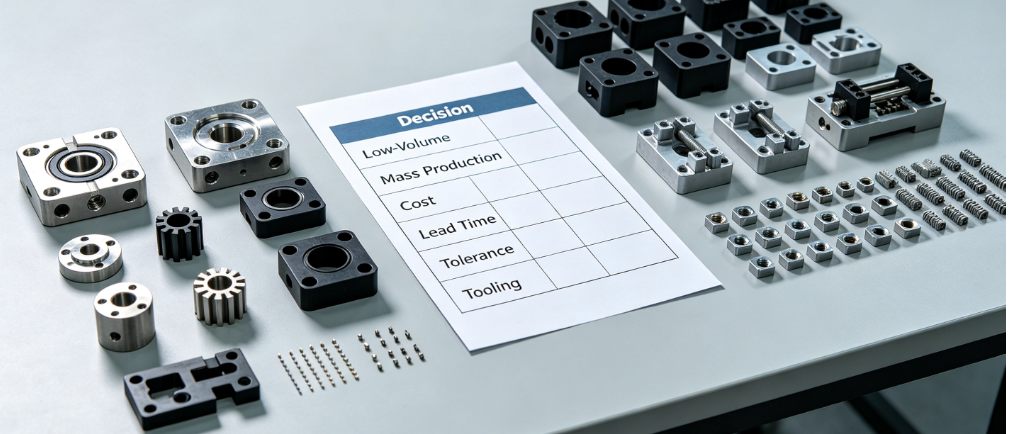
Core Evaluation Criteria (Scoring Baseline for Every Part)
All options shall be assessed against these unified dimensions before final process selection:
- Annual / Program Volume (peak quantity, total lifetime order quantity)
- Target lead time (prototype validation → pre-production → formal serial delivery)
- Non-recurring engineering (NRE) / tooling investment budget
- Unit piece cost sensitivity at target batch size
- Dimensional tolerance & surface finish requirements
- Material restrictions (biocompatible grade, high-performance polymer, flame retardant, low-outgassing alloy, CFRP)
- Secondary operations complexity (deburr, precision cleaning, coating, welding, assembly, sterilization)
- Regulatory compliance (IATF16949 / AS9100 / ISO13485, PPAP, FAI, traceability, biocompatibility)
- Design iteration risk (frequent CAD revisions, aerodynamic tuning, DFM adjustment)
- Minimum order quantity & inventory holding risk
Volume Segment Definition (Industry Standard Split)
- Prototype / Ultra-Low Volume: 1 ~ 50 units
- Low Volume: 51 ~ 500 units
- Mid-Volume: 501 ~ 5,000 units
- Mass Production: >5,000 units / stable long-running program
Process Option Comparative Matrix
| Manufacturing Route | Best Volume Window | Typical NRE Tooling Cost | Strengths | Critical Limitations |
|---|---|---|---|---|
| 3D Printing (FDM / SLA / SLM) | 1–200 | Very low (no hard tool) | Fastest lead time, supports complex lattices, free design iteration | High unit price, limited material selection, anisotropy, poor surface finish, not ideal for high-load long-term structural parts |
| CNC Precision Machining (Milling/Turning/5-axis) | 1–800 | Low to moderate (fixture only, no dedicated mold) | Broad material range, tight tolerance, excellent surface quality, fully traceable | Unit cost rises significantly with large quantities; longer cycle time per piece |
| Sheet Metal Laser Cut + Brake Forming | 1–2,000 | Low | Fast iteration, low fixture cost for simple enclosures | Limited complex 3D geometry; high labor for many bent features |
| Composite Hand Layup / Vacuum Bag CFRP | 1–300 | Medium (master plug) | Lightweight high stiffness; suitable for racing / aerospace prototypes | Labour intensive, inconsistent repeatability, long cycle, not for mass scale |
| Composite Autoclave Molded CFRP | >2,000 | High (hard mold) | Stable quality, consistent fiber orientation | Huge upfront mold investment, slow to implement changes |
| Die Casting (Al / Zinc) | >10,000 | Very high | Ultra-low unit price at high volume, complex thin-wall geometry | Long lead time for mold; costly design changes after tool steel cut |
| Stamping (Progressive Die) | >20,000 | Very high | Extremely fast cycle, lowest sheet metal unit cost | Almost impossible to modify geometry post tooling |
| Single / Multi-Cavity Injection Molding | >3,000 | High | Low piece price in mass runs, consistent surface & dimension | Expensive mold revisions, long initial lead time |
| LSR Injection Molding | >2,000 | High | Stable elastomer sealing performance for medical/auto | High hot runner mold cost; long curing cycle |
Decision Rules – Low Volume (1 ~ 500 Units)
Preferred Processes
- 5-axis / 3-axis CNC Machining (Top Choice for Metal & High-Performance Plastics)
- SLA / SLM / CF-FDM Additive Manufacturing (only for complex internal geometry, lightweight non-primary structural parts)
- Sheet Metal Laser & Forming for housing enclosures
- Hand-layup / vacuum bag CFRP for lightweight racing & aerospace components
Strict Selection Principles
Avoid hard mold-based processes (injection molding, die casting, progressive stamping) unless multi-year locked large follow-up orders are confirmed
Accept higher unit cost to eliminate expensive tooling NRE
Prioritize lead time and design flexibility over per-piece cost
Expect more manual secondary operations (deburr, manual assembly, batch inspection)
Plan frequent CAD revision capability without heavy rework charges
Typical Low-Volume Risk Warnings
- Do not invest in multi-cavity molds for programs without formal forecast binding
- Avoid processes requiring long process validation cycles (mold trials, PPAP)
- Budget higher QC labour cost; automated inline inspection cannot be justified on small batches
Decision Rules – Mid-Volume (501 ~ 5,000 Units)
This is the transition zone with multiple viable hybrid strategies.
Two Strategic Paths
Path A – Short Program Lifespan / Uncertain Future Demand
Stay with CNC machining or large-format additive manufacturing; postpone hard tool investment.
Path B – Confirmed repeat orders / stable design with minimal future changes
Invest in simple single-cavity molds, low-complexity casting tools.
Balanced Process Choices
- Metals: CNC machining or low-pressure casting
- Thermoplastics: Single-cavity hot/cold runner injection mold
- Elastomers: Simple LSR mold or CNC-cut solid rubber (if part geometry permits)
- Lightweight structures: Switch from hand layup to semi-mechanized composite molding
Mid-Volume Key Tradeoff
Calculate break-even quantity:
Break-Even Qty = Total Tooling Cost ÷ (Mass-Production Unit Saving − Low-Volume Unit Price)
If forecast quantity exceeds break-even number → invest in mold; otherwise keep machining.
Decision Rules – Mass Production (>5,000 Units, Stable Serial Program)
Preferred Processes
- Multi-cavity injection molding (thermoplastics)
- Progressive stamping / high-speed die casting (metallic housings and brackets)
- Automated composite molding (continuous CFRP processes for high-volume mobility)
- Automated CNC cells only for ultra-complex high-precision components that cannot be molded
Mandatory Mass Production Principles
Optimize for minimum unit cost and maximum hourly output
Deploy automation: robot pick & place, inline vision inspection, automated deburr
Invest in tool durability: high-grade mold steel, conformal cooling, balanced hot runner systems
Complete full process validation: moldflow, PFMEA, control plan, PPAP, long-run capability study (Cpk)
Standardize secondary operations to eliminate manual labour
Mass Production Common Pitfalls
Starting tool construction before design freeze → expensive ECN mold modifications
Over-specifying cavity count (64/128 cavities) without verified annual demand → idle asset cost
Break-Even Analysis Template Logic (Practical Sourcing Tool)
Input Data:
- NRE Tooling Cost (Mold / Die / Fixture)
- Unit Cost – Low Volume Process (e.g. CNC)
- Unit Cost – Mass Process (e.g. injection molding)
- Estimated total program lifetime quantity
Formula:
Break-Even Quantity = NRE ÷ (Cost_LowVolume − Cost_Mass)
Example:
Mold NRE =
$28,000
CNC Unit = $42
Molding Unit =
$16
Saving per piece = $26
Break-even = 28000 ÷ 26 ≈ 1,077 units
If total forecast >1,077 → mold investment is economically viable.
Industry-Specific Special Constraints
Medical Devices (ISO13485 / Biocompatible)
- Ultra-low volume implants: CNC PEEK / Ti6Al4V machining
- Low-volume disposables: CNC or SLA
- Mass production single-use devices: injection molding / LSR molding
- Note: Mold validation, extractable testing and cleaning validation add large hidden costs to molding programs.
Aerospace & UAV (AS9100)
- Prototypes & small batches: CNC, CF-FDM, hand layup CFRP
- Certified serial structural components: Autoclave composite molding or high-spec CNC cell production
- Hard composite molds carry extremely high NRE; only justified for multi-year platform programs.
Racing Automotive
- Continuous iteration phase: CNC + CF-FDM composite parts
- Limited race-season batch runs: avoid expensive permanent molds; favour machining
- Customer mass aftermarket components: shift to injection molding / die casting
General Automotive (IATF16949)
Any program above 10,000 units almost always requires molding / stamping.
PPAP and long-term dimensional stability requirements make additive manufacturing only viable for prototype validation.
Standard Decision Flowchart (Step-by-Step Workflow)
- Confirm finalised design maturity: How likely are future geometry changes?
- Clarify total lifetime quantity and minimum forecast commitment
- Calculate break-even quantity between machining and mold-based processes
- Evaluate material specification restrictions
- Check lead time target (mold manufacturing typically takes 4–12 weeks extra)
- Review compliance requirement (PPAP, FAI, biocompatibility, traceability)
- Select primary manufacturing route
- Define fallback alternate process if demand deviates from forecast
Common Costly Mistakes to Avoid
Build expensive multi-cavity molds for low-volume prototype programs
Rely on CNC machining for tens of thousands of identical parts (poor long-term cost competitiveness)
Ignore hidden costs: mold trial fees, rework charges, compliance validation expenses
Lock mass-production process too early before design freeze
Neglect lead-time difference: mold fabrication creates long initial project delays
Underestimate manual labour cost for secondary operations on low-volume batches
FAQ
When should I choose additive manufacturing over CNC for low volume?
Select AM only if parts contain complex internal lattices, conformal cooling channels, or topology-optimized geometry impossible to machine. For simple block/bracket geometry, CNC usually delivers better tolerance, surface finish and material consistency.
What if program volume sits exactly at the break-even threshold?
Adopt a phased strategy: start with CNC for initial pre-production batches, trigger mold construction once firm purchase orders exceed break-even quantity.
Can low-volume injection molding (single cavity) act as a bridge solution?
Yes. Single-cavity molds balance moderate NRE and medium unit cost, ideal for mid-volume transition phases, while allowing simpler mold revisions than high-cavity tools.
How does compliance (PPAP / ISO13485) change the process decision?
Mold-based mass processes require lengthy formal validation (mold trials, process capability, cleaning validation). If only small batches are needed, the validation overhead often makes molding uneconomical even if theoretical break-even looks favourable.
Is hand-laid CFRP suitable to scale up to mid-volume?
Rarely. Labour cost and consistency variation rise rapidly above 200–300 units. For higher volumes, switch to automated prepreg molding once demand is secured.