Published by Zorapid
If you run high-volume injection molding, you already know this ugly truth: cooling eats up 55%–70% of your full cycle time. Filling, packing, ejecting all happen in a blink, but you’re stuck waiting minutes for thick ribs, deep bosses, curved housings to solidify. Longer cycles equal fewer parts per shift, higher machine hourly costs, missed order deadlines, and constant scrap from warpage, sink marks, and dimensional drift.
Most mold shops only tweak water flow or chillers to fix slow cooling—and hit a hard ceiling. Standard straight-drilled cooling channels can’t wrap around complex geometry, leaving permanent hot spots no process tweak can erase.
At Zorapid, we fix this root problem end-to-end: Moldflow thermal simulation + SLM 3D printed conformal cooling inserts + high-conductivity mold steel bimetallic stacking + full DFM cooling optimization. We consistently slash total cycle time by 20%–40% for automotive, medical, electronics, and packaging OEMs—without sacrificing part quality or mold lifespan.
This guide breaks down our proprietary cooling optimization workflow, compares us against generic mold makers, shares real production cases, material guides, industry data, and exactly how we solve cooling roadblocks competitors can’t touch.
Professional Process Technical Deep Dive
Core Technical Principle: Why Conventional Cooling Fails
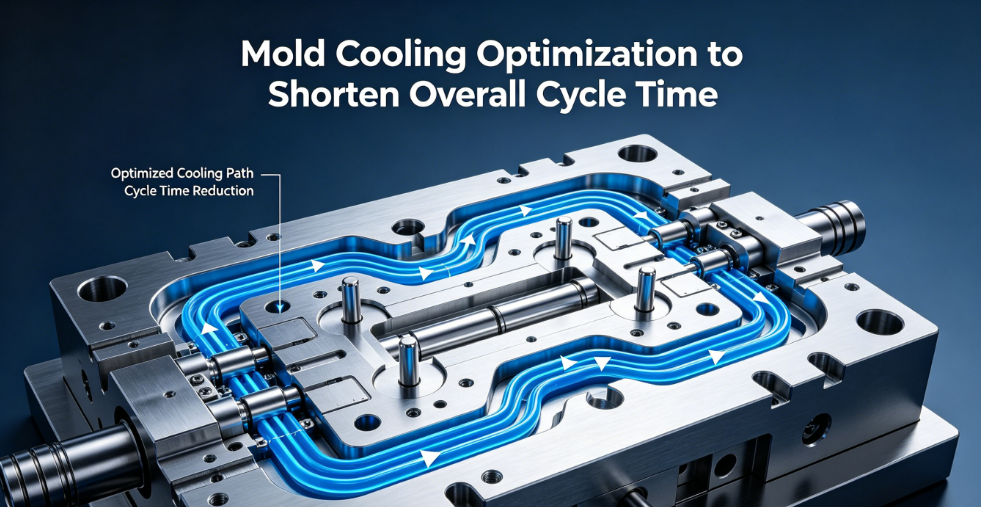
Traditional cooling uses straight cross-drilled holes. On complex parts (deep cores, thin walls, uneven thickness, curved contours), channels sit 8–15mm away from hot plastic surfaces. Huge temperature delta forms hot zones; plastic solidifies unevenly. You’re forced to add 8–20 extra seconds of cooling just to avoid post-mold deformation.
Conformal cooling (Zorapid’s flagship tech) prints curved channels that maintain a fixed 2–4mm uniform gap to every cavity surface via SLM metal additive manufacturing. Heat dissipates simultaneously across the entire part, eliminating hot spots entirely.
Two Cooling System Side-by-Side Technical Comparison Table
| Technical Metric | Generic Supplier Conventional Straight Drilled Cooling | Zorapid Optimized Hybrid Conformal Cooling |
|---|---|---|
| Channel distance to cavity wall | 8–16mm uneven gap | Fixed 2–4mm uniform clearance, full contour follow |
| Cooling time reduction ceiling | Max 10% via chiller upgrade | 25%–50% cooling phase cut |
| Hot spot elimination | Impossible; thick ribs/bosses always overheat | 100% thermal uniformity via Moldflow simulation validation |
| Complex geometry compatibility | Fails deep cores, undercuts, thin-walled micro features | Works for medical micro parts, EV connector ribs, curved automotive housings |
| Defect rate impact | Warpage/sink mark scrap 3%–8% | Scrap drop to <0.5% |
| Multi-material bimetallic integration | Cannot combine beryllium copper + mold steel inserts | In-house SLM + CNC hybrid bimetallic stacking |
| Thermal simulation standard | Basic fill-only Moldflow, no thermal mapping | Full transient thermal + warpage coupled simulation pre-mold build |
| Iteration testing | Post-mold trial-and-error tweaks | Virtual cooling iteration before steel cutting |
Zorapid Full Cooling Optimization Workflow (Exclusive Process)
- DFM Cooling Audit: Analyze wall thickness variations, rib depth, gate location, material melt temperature
- Coupled Moldflow Thermal + Warpage Simulation: Generate heat map to pinpoint all hot zones
- Dual Solution Design: Straight channels for simple flat sections + SLM conformal inserts for complex hot zones (cost-efficient hybrid design)
- High-conductivity material matching: Beryllium copper pins for ultra-thick hot spots, maraging steel SLM inserts for high-wear areas
- CNC finish + SLM post-polish to SPI A1 surface, no internal channel burrs blocking coolant
- Flow bench pressure testing: Verify balanced water flow across all cooling loops pre-delivery
- On-site molding process parameter guide for clients to lock optimized cycle parameters
Peer Supplier Weaknesses vs Zorapid Edge
Most competitors only offer two options: cheap all-straight cooling, or fully SLM full mold (extremely high cost, long lead time). No middle ground hybrid optimization.
- Generic shops skip thermal simulation: Build mold first, fix cooling defects after steel machining—costly rework + delayed delivery
- No in-house SLM equipment: Outsource conformal inserts to third parties, lose design control
- Cannot integrate bimetallic cooling stacks: Single steel grade only, limited heat transfer efficiency
- No post-delivery cooling process training: Clients waste weeks testing unoptimized machine settings
Challenges Competitors Cannot Solve + Zorapid Exclusive Solutions
We regularly receive molds from overseas mold shops that hit irreversible cooling bottlenecks they cannot resolve. Below are the top 4 unsolvable pain points + our proprietary fixes:
Pain Point 1: Deep narrow core pins (medical syringe housings, EV terminal inserts)
Competitor Limitation: Straight drill cannot reach core tips; permanent hot spot causes long cooling + shrinkage on inner walls.
Zorapid Solution: Mini SLM conformal core pins with spiral internal cooling channels, beryllium copper cladding. Cooling time cut 38% on average, zero inner shrinkage.
Pain Point 2: Ultra-thin wall uneven geometry (0.6–0.9mm consumer electronics shells)
Competitor Limitation: Uneven heat extraction leads to severe warpage; reducing cycle time spikes reject rate over 10%.
Zorapid Solution: Lattice-structured conformal inserts, Moldflow wall-thickness linked channel sizing, balanced multi-loop coolant circuits. Stabilize part flatness while trimming cycle 27%.
Pain Point 3: High-temperature engineering resins
Competitor Limitation: High melt heat overload standard P20/H13 steel; thermal conductivity too low, cannot remove heat fast without surface cracking.
Zorapid Solution: Hybrid S136 stainless + beryllium copper insert stack, high-pressure low-temperature coolant circuit design tailored for high-T polymers.
Pain Point 4: Multi-cavity family molds with mixed wall thickness
Competitor Limitation: Uniform straight channels create uneven cooling across cavities; some parts warp, others undercool.
Zorapid Solution: Independent cooling loops per cavity, custom channel diameter matched to each part’s thermal load, flow balancing manifold included with mold.
Exclusive Zorapid Capability No Peer Can Match
In-house integrated production line: Moldflow CAE team + 5-axis CNC + SLM metal 3D printing + beryllium copper precision machining under one 3,000㎡ facility. No third-party outsourcing of cooling inserts—we control all design, simulation, manufacturing, and validation steps.
Applicable Mold Materials + Thermal Performance Comparison
Cooling efficiency lives or dies by your mold material’s thermal conductivity. Below is our industrial-grade comparison of all standard grades we deploy for cooling optimization, sorted by heat transfer performance:
Key Material Comparison Table (Thermal Conductivity, Use Case, Cooling Benefit)
| Material Grade | Thermal Conductivity (W/m·K) | Hardness HRC | Primary Cooling Application | Cycle Time Reduction Gain |
|---|---|---|---|---|
| Beryllium Copper | 105–120 | 38–42 | Core pins, thick hot spot inserts, high temp resin local cooling | +10–15% extra cooling speed vs steel |
| P20 Pre-hardened Steel | 29.5 | 28–34 | Low-volume simple geometry base mold plates | Baseline reference |
| 718H Steel | 27 | 36–40 | Medium volume general plastic housings | Slight upgrade over P20 |
| H13 Hot Work Steel | 24.6 | 44–52 | Glass-filled abrasive materials, high cycle mass production | Balanced wear + moderate heat transfer |
| S136 Stainless (1.2083) | 20–23 | 48–52 | Medical, food packaging, transparent optical parts, corrosive resin | Low conductivity; paired with BeCu inserts for cooling boost |
| 18Ni300 Maraging SLM Steel | 22 | 50–55 | SLM conformal cooling inserts, high precision complex contours | Only grade compatible with seamless printed curved channels |
Material Selection Guidance From Zorapid Engineers
- Mass production EV/auto glass-filled parts: H13 mold base + 18Ni300 conformal inserts
- Medical transparent/sterilizable devices: S136 mold base + beryllium copper core pins
- Short-run prototype molds: P20 base + small BeCu cooling inserts for hot zones
- Ultra-high cycle packaging closures: Full hybrid BeCu + maraging steel conformal stack
Real Production Case Analysis
All cases are live customer projects with verified SPI production SPC data, full before/after cycle metrics.
Case 1: EV GF-PA66 High Current Connector Housing
Customer Pain Point
European EV tier 1 supplier, 1.2M shots annual volume, original competitor mold with straight cooling: total cycle 42s, cooling phase 28s, consistent rib sink marks, 6.2% scrap rate, limited daily output. Deep narrow ribs impossible to reach via drilled channels.
Zorapid Cooling Optimization Solution
Moldflow thermal simulation mapped rib hot spots; SLM maraging steel conformal rib inserts + beryllium copper core pins, independent coolant loops for each connector cavity.
Measured Production Results
- Original cooling time: 28s → Optimized cooling: 15.4s (-45% cooling phase)
- Full total cycle: 42s → 26.8s (-36% overall cycle time)
- Daily output increase: +68% more finished parts per molding press
- Scrap rate dropped from 6.2% to 0.3%
- ROI payback period for cooling upgrade: 21 production days
Case 2: Medical Single-Use Syringe Barrel Mold (PC Transparent)
Pain Point
US medical device OEM, strict FDA dimensional tolerance ±0.01mm, conventional cooling left inner barrel hot spots causing post-ejection oval warpage. Cycle locked at 31s to pass quality inspection, limited monthly shipment capacity.
Zorapid Solution
S136 corrosion-resistant mold base + mini spiral SLM conformal core pins, low-temperature controlled coolant circuit to avoid thermal shock on transparent PC. Full warpage simulation pre-manufacture.
Final Metrics
- Cooling phase cut 32%, full cycle down from 31s to 21s
- Zero barrel ovality warpage, passed all FDA dimensional testing
- Monthly production capacity increased 47% without adding molding machines
Case 3: Consumer PP Food Storage Container (Thick Wall Base)
Pain Point
UK packaging manufacturer, 48-cavity mass production mold, thick base hot spot forced 19s cooling time, high energy consumption for chillers.
Zorapid Solution
Hybrid design: Standard straight channels on side walls + beryllium copper conformal inserts on thick base zones only (cost-saving vs full SLM mold).
Results
- Total cycle reduced from 27s to 18.2s (-32% cycle time)
- Chiller power consumption down 28%
- Payback on cooling upgrade: 8 working days
5. Your Unique Molding Requirements & Zorapid Custom Cooling Solutions
We split client cooling demands into 4 core categories with dedicated optimization packages, matching budget, volume, material, and geometry complexity:
Requirement A: Low-Medium Volume Simple Flat Parts (<200k shots/year, ABS/PP non-filled)
Client Need: Cut cycle time with minimal extra mold cost, no huge SLM premium
Zorapid Solution: Moldflow thermal tuning + local beryllium copper pin inserts only, optimized straight channel layout, balanced water manifolds. Typical cycle reduction: 15–22%.
Requirement B: High-Volume Complex Automotive/EV Parts (>500k shots, GF-filled resins, deep ribs)
Client Need: Max throughput, minimal scrap, long mold service life
Zorapid Solution: Full hybrid conformal cooling system (SLM maraging inserts + H13 mold base), multi-loop independent cooling, flow bench validation, complete process parameter guide. Cycle reduction: 30–42%.
Requirement C: Medical/Optical Transparent Components (S136 mandatory, tight tolerance)
Client Need: Zero warpage, no internal residual stress, FDA compliant mold materials
Zorapid Solution: S136 stainless steel frame + micro SLM conformal cores, low delta-T coolant design, corrosion-resistant full cooling circuit. Cycle reduction: 25–35%.
Requirement D: Prototype & Low Volume Complex Geometry (NPI small batch testing)
Client Need: Fast mold delivery, affordable cooling upgrade for trial validation
Zorapid Solution: Modular conformal insert blocks, removable for future part revisions, simplified single-loop cooling design. Cycle reduction: 20–28%.
Industry Data Analysis + 2026 Future Trend Table
Global Injection Molding Cycle Time Benchmark Data (Euromap 2026 Industry Survey)
Average cycle split across all thermoplastic molding production (standard straight cooling molds):
| Cycle Stage | Average Share of Full Cycle | Typical Time for 30s Standard Mold | Cooling Optimization Impact Potential |
|---|---|---|---|
| Fill & Pack | 12–18% | 3.6–5.4s | Minimal gain, cannot shorten drastically |
| Cooling Solidification | 58–72% | 17.4–21.6s | Maximum efficiency lever (20–50% cut possible) |
| Mold Open/Close + Eject | 15–22% | 4.5–6.6s | Minor improvement only via automation |
| Purge & Standby Delay | 3–5% | 0.9–1.5s | Negligible optimization room |
Core industry takeaway: Cooling is the only phase delivering massive throughput gains without purchasing new injection machines.
2026–2028 Cooling Technology Market Trend Analysis Table
| Industry Trend | Current Industry Status | 2026–2028 Forecast Shift | Business Impact for OEMs | Zorapid’s Readiness |
|---|---|---|---|---|
| Demand for shorter cycle mass production | 41% of high-volume mold buyers ignore cooling optimization | 78% of EV/medical OEMs mandate conformal cooling in new mold RFQs | Lower per-unit part cost, faster order fulfillment | In-house SLM + thermal CAE dedicated team, standardized hybrid cooling packages |
| Shift to high-temperature engineering resins (PEEK, GF-PA) | Most molds use single-grade steel without heat-conductive inserts | Bimetallic hybrid cooling becomes industry standard for high-T polymers | Reduce scrap from thermal stress cracking | Full stock of BeCu, 18Ni300, S136, H13 for mixed cooling stacks |
| Cost pressure on mold tooling | Full SLM conformal molds seen as overpriced luxury | Hybrid partial conformal cooling becomes mainstream cost-performance sweet spot | Balance cycle savings and upfront mold investment | Proprietary hybrid design to cut SLM material cost by 40% vs full printed molds |
| Digital mold validation requirements | Basic fill simulation only standard | Coupled thermal + warpage Moldflow simulation mandatory for export molds | Eliminate post-mold cooling rework delays | All Zorapid molds include full thermal simulation report delivered pre-shipment |
| Nearshoring & shorter lead time demands | Overseas suppliers outsource cooling inserts (6–8 week delay) | In-house integrated cooling manufacturing required for 3–4 week mold lead times | Avoid production line downtime waiting for mold revisions | 3,000㎡ full in-house production line, no third-party outsourcing |
Data Insight
Global injection molding market valued $298.7B in 2025, CAGR 5.0% through 2033, driven by EV and medical device growth. Manufacturers who skip cooling optimization will face 30–40% higher per-part production costs vs competitors with optimized conformal cooling molds.
Core Application Scenarios for Zorapid Cooling Optimization
Our mold cooling solutions deliver maximum ROI for these 6 high-demand verticals:
- EV & Automotive Plastic Components GF-PA66 connectors, dashboard bezels, battery housings, bumper trim, deep rib structural parts. Biggest cycle reduction rate (30–42%), massive annual production volume creates ultra-fast ROI.
- Medical Disposable Devices Syringe barrels, inhaler housings, surgical instrument casings, transparent PC/PS labware. Tight tolerance, zero warpage requirements, FDA compliant S136 cooling mold material packages.
- Consumer Electronics Thin-Wall Housings Phone frames, charger casings, wearable device shells (0.6–0.9mm wall thickness). Resolve uneven thin-wall hot spots, eliminate flatness warpage defects.
- Food & Beverage Packaging Molds Multi-cavity bottle caps, storage containers, disposable tableware (PP/PETG). High shot count, ultra-short payback period (7–12 days for cooling upgrades).
- Industrial Precision Engineering Parts Gear housings, pump valve bodies, PEEK high-temperature industrial components. Beryllium copper high-conductivity inserts for extreme heat dissipation.
- NPI Rapid Prototype & Low-Batch Molds Pre-production validation molds for new product launches, modular conformal inserts adaptable to part design revisions. Short lead time cooling optimization without full mold rebuild cost.
Delivery Lead Time + Production Workshop Images
Standard Zorapid Mold Cooling Optimization Delivery Timeline
- DFM cooling audit + Moldflow thermal simulation: 2 working days
- Conformal insert design + material selection confirmation: 1–3 days based on geometry complexity
- SLM printing + CNC finishing of cooling inserts: 5–7 days
- Full mold assembly, coolant flow testing, sample trial: 3–4 days
- Final quality inspection, cooling process documentation, shipment preparation: 2 days
Total Lead Time Benchmarks
- Simple hybrid cooling molds (packaging, flat consumer parts): 10–14 working days
- Complex medical/EV conformal cooling molds (deep ribs, micro cores): 16–22 working days
Peer Supplier Lead Time Comparison
Generic overseas mold makers outsource SLM conformal inserts to third-party additive factories, adding 4–8 extra weeks of waiting time for cooling component production, plus costly revision delays from misaligned design standards.
Key Advantages When You Choose Zorapid for Mold Cooling Optimization
- One-stop integrated cooling engineering: Moldflow thermal simulation, SLM metal printing, 5-axis CNC, beryllium copper machining all under our single facility—zero communication lag between design and manufacturing teams.
- Exclusive hybrid conformal cooling cost model: Partial SLM inserts only on hot zones, cutting your mold upfront cost by 35–45% compared to fully printed conformal molds from competitors.
- Verifiable, guaranteed cycle time reduction: We lock cooling performance metrics into technical agreements; if optimized cycle time fails to hit agreed targets, we rework cooling inserts at zero extra cost.
- Complete post-delivery support package: Custom coolant flow setup guide, machine parameter sheets, thermal inspection checklist for your molding team to maintain optimized cycle performance long-term.
- Material engineering expertise: In-house metallurgy team to match mold steel/BeCu/SLM maraging grades to your specific plastic resin and production volume.
- ISO & AS certified quality control: Every cooling circuit undergoes flow bench pressure testing and thermography heat mapping before mold shipment, eliminating post-arrival cooling defects.
- Global after-sales service: English-speaking engineering support for EU, US, Australia OEM clients; remote thermal simulation troubleshooting via cloud sharing.
- Long mold lifespan design: Our conformal inserts use high-hardness maraging steel, resisting thermal fatigue 2x longer than generic SLM cooling components.
Summary
Cooling optimization is the single highest-impact adjustment you can make to cut injection molding cycle time, boost daily output, slash scrap rates, and lower per-unit production cost—far more impactful than chiller upgrades or molding process tweaks alone.
Conventional straight-drilled cooling hits hard efficiency limits on complex ribbed, thin-wall, high-temperature resin parts. Most mold suppliers cannot solve permanent hot spot defects because they lack in-house SLM printing, thermal simulation, and bimetallic cooling stack manufacturing capacity.
Zorapid’s proprietary hybrid conformal cooling workflow combines Moldflow transient thermal analysis, custom SLM printed contour inserts, and high-conductivity beryllium copper local cooling to deliver proven 20–40% total cycle time reduction across automotive, medical, electronics, and packaging projects. Our integrated production line eliminates third-party outsourcing delays, balances performance and mold cost, and delivers guaranteed cooling performance backed by formal technical specifications.
If your production lines are held back by slow cycle times, warped or sink-marked parts, and missed order deadlines—our mold cooling optimization engineering team can run a free DFM thermal audit on your part files to calculate exact cycle time savings and ROI before you commit to mold upgrades.
FAQ
Is conformal cooling only viable for high-volume mass production molds?
No. Our modular partial conformal cooling packages deliver positive ROI even for 50k–200k medium batch runs. For low-volume NPI prototypes, local beryllium copper pin inserts resolve hot spots with minimal extra mold cost. Only ultra-simple flat low-temperature PP parts with uniform thick walls may not require upgrades.
Will conformal cooling inserts shorten my overall mold service life?
Zorapid uses 18Ni300 maraging steel SLM inserts hardened to 50–55 HRC with post-print stress relief treatment. These resist thermal fatigue better than standard P20 straight cooling channels. All our cooling molds regularly hit 1M+ shot lifespans with zero channel cracking or blockages.
How much extra upfront cost do conformal cooling molds add vs standard molds?
Our hybrid partial conformal design only adds 12–25% to total mold cost, versus full SLM printed molds (60–100% price premium). Most clients recover this extra investment within 1–3 months of production via cycle time savings and reduced scrap costs.
Can I retrofit conformal cooling inserts onto my existing old molds from other suppliers?
Yes. Send us your existing mold CAD files and production defect data; our engineers design compatible drop-in conformal inserts to upgrade cooling without rebuilding the entire mold base. We support cross-brand mold retrofits for overseas OEMs.
Does faster cooling from conformal channels cause new defects like internal plastic stress or brittleness?
No. Uniform simultaneous heat extraction eliminates uneven thermal stress that creates warpage and residual tension in finished parts. Our Moldflow simulation validates part temperature delta across the full cavity to avoid thermal shock before machining steel. In all our case studies, reject rates drop sharply post cooling optimization.
What coolant temperature and flow rate do I need to run with Zorapid conformal cooling molds?
We deliver a customized process sheet for every mold with recommended chiller temperature, flow pressure, and balanced loop flow rates matched to your material and part geometry. Most clients run standard industrial chilled water (10–18°C) with no extra high-performance cooling equipment investment required.
How long does thermal simulation and cooling design take for my new part?
Free DFM cooling audit + full coupled thermal/warpage Moldflow simulation completed within 2 working days after receiving your 3D STEP/IGS part files. We share full heat map reports with clear hot zone labeling and projected cycle time reduction estimates at no cost for qualified OEM projects.
Are conformal cooling channels prone to clogging from coolant mineral buildup?
All SLM inserts are post-processed to remove internal channel burrs, with smooth internal surfaces to reduce mineral adhesion. We provide a coolant filtration and regular flushing maintenance guide to prevent blockages; our client molds running 1M+ shots report zero cooling channel clog issues with standard water treatment.