Published by Zorapid
Tired of rounded corners, thin rib collapse, long lead times & scrap hardened steel mold inserts? Zorapid’s CNC + Wire EDM hybrid process fixes all mold manufacturing pain points.
If you design or source custom injection mold inserts, you’ve hit this wall hundreds of times.
Standard CNC milling cranks out bulk material fast, but it can’t nail sharp internal corners, ultra-narrow vent slots or fragile thin ribs in hardened steel.
Wire EDM hits insane micron precision, yet it’s way too slow for roughing big mold blank volumes.
Running two separate vendors for CNC roughing then Wire EDM finishing adds double fixturing, alignment errors, 30% longer lead times and hidden rework costs. Misaligned datums between shops kill dimensional consistency on multi-cavity inserts.
At Zorapid, we built an in-house fully integrated CNC + Wire EDM combined workflow exclusively for custom mold inserts. Our 3,000㎡ precision facility houses high-speed 5-axis mills and low-wire EDM cells under one climate-controlled roof. No third-party handoffs, zero alignment drift, faster turnaround and near-zero scrap on HRC 48–62 tool steel inserts.
This blog breaks down exactly how our hybrid process works, side-by-side production data, two real client mold insert success stories, and why thousands of global mold OEMs switch to our combined CNC + Wire EDM mold insert service.
The Big Pain Points Of Single-Process Mold Insert Manufacturing
Let’s talk about the costly headaches engineers and mold makers face when they only use CNC OR only use Wire EDM for inserts.
What Goes Wrong If You Only Use CNC Milling For Hardened Mold Inserts
- Rounded internal fillets everywhere. End mills leave minimum radii, impossible to achieve zero-radius sharp corners required for crisp plastic parting lines.
- Thin ribs & deep narrow slots deflect or crack under cutting force, especially after heat treatment to HRC 50+.
- Heavy tool wear on hardened steel skyrockets consumable costs and creates inconsistent surface finish across cavities.
- Long finishing cycles to grind/polish out milling marks, adding extra labor days.
- Thermal tool deflection pushes critical insert tolerances outside ±0.01mm on multi-cavity sets.
What Goes Wrong If You Only Use Wire EDM For Full Mold Insert Production
- Wire EDM removes material extremely slowly. Roughing an entire large mold insert blank wastes 2–4x more production hours.
- Higher operational cost from continuous brass wire, deionized water maintenance and power consumption for full-block cutting.
- Simple flat surfaces, large cavities and standard mounting holes are far more efficient with CNC milling. Wasting Wire EDM capacity on basic geometry inflates your unit price.
The Nightmare Of Splitting Work Between Separate CNC & EDM Vendors
- Double fixturing re-clamping shifts datum alignment, creating cumulative dimensional error up to 0.02mm
- Multiple shipping handoffs add 5–8 working days to your mold lead time
- No unified process tracking; scrap from misalignment gets pushed back and forth between two suppliers
- Two separate inspection reports, double QC overhead for your engineering team
CNC vs Wire EDM For Mold Inserts
No textbook jargon—simple breakdown of each process’s superpower and limits for custom mold inserts.
CNC High-Speed Milling (Zorapid’s Roughing & Base Machining Workhorse)
Best for:
- Fast bulk material removal from raw P20, S136, NAK80, STAVAX steel blanks
- Flat mounting surfaces, standard tap holes, large open cavities, cooling channel roughing
- Large, simple mold core/cavity geometry with thick cross-sections
Limits:
- Physical cutting contact creates force, deflection and tool wear
- Cannot produce sharp internal corners or ultra-thin deep slots
- Struggles with fully hardened HRC 58–62 steel without massive tool loss
Low-Speed Wire EDM (Zorapid’s Precision Finishing Superpower)
Best for:
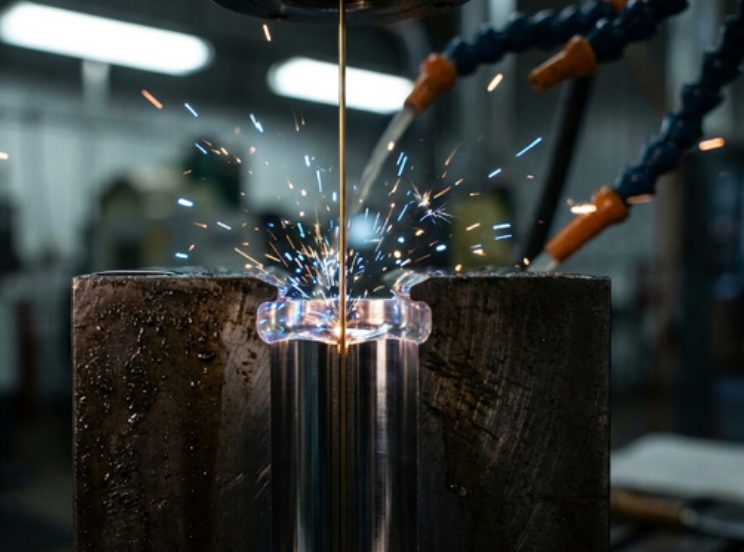
- Non-contact cutting of fully hardened steel post heat treatment
- Sharp zero-radius internal corners, 0.2–0.8mm thin ribs, micro vent slots, intricate parting line contours
- Burr-free, stress-free fine features with tolerances down to ±0.002mm
- Fragile thin-wall mold sections that would collapse under CNC cutting pressure
Limits:
- Slow material removal rate; terrible for roughing full mold blanks
- Higher running cost for large volume stock removal
The Zorapid combined process uses each technology where it performs best—no compromise, no wasted production hours.
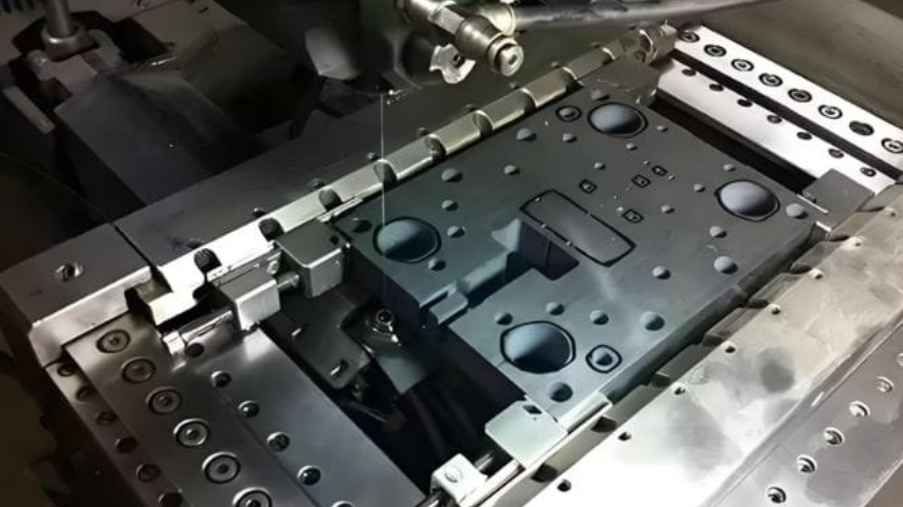
How Zorapid’s CNC + Wire EDM Combined Workflow Runs Step-by-Step
Every custom mold insert follows this unified in-house workflow, locked to the same datum coordinate system from start to finish. Zero re-fixturing alignment loss.
- CNC Blank Roughing & Datum Setup (5-Axis High-Speed Mill) We machine the raw mold steel block first: flatten all mounting datums, rough out large cavity volumes, drill all cooling holes, tap mounting threads, and machine simple outer contours. All critical alignment datums are milled in one single setup for permanent reference.
- Stress Relief & Full Heat Treatment Inserts go through controlled tempering to target hardness HRC 48–62 (per your mold spec). Stress relief eliminates post-machining warpage common in hardened mold steel.
- Re-Fixture On Shared Datums (No New Alignment Required) The insert locks back into our Wire EDM cells using the exact CNC-machined datums milled in step one. No manual re-indicating, no human alignment error.
- Wire EDM Precision Finishing For Critical Fine Features We cut all hard-to-machine geometry exclusively with Wire EDM: sharp internal corners, thin deep ribs, micro vent slots, intricate slide lifter contours, tiny gate inserts. Non-contact spark erosion means zero stress, zero deflection on delicate features. Multiple skim passes deliver Ra ≤0.6μm finish with minimal polishing needed.
- Unified In-House CMM Inspection One single coordinate measuring machine verifies all CNC roughing dimensions AND Wire EDM fine feature tolerances in one QC report. Full dimensional certification packaged with your mold insert shipment.
- Optional Surface Treatment (Polish, Nitriding, PVD Coating) If your mold requires mirror polishing or wear-resistant coatings, we handle secondary finishing before delivery, no extra vendor coordination on your end.
Zorapid Hybrid Process VS Separate CNC / Wire EDM Shops
All metrics pulled from our 2026 Q1–Q2 mold insert production batches, standardized on S136 medical inserts and NAK80 automotive core inserts.
| Production Metric | Split CNC + Wire EDM Two-Vendor Workflow | Zorapid In-House CNC + Wire EDM Combined Process | Total Improvement |
|---|---|---|---|
| Full Insert Lead Time | Baseline 100% | 62% | 38% faster delivery |
| Cumulative Dimensional Alignment Error | 0.012–0.020mm | ≤0.003mm | 82% tighter stability |
| Mold Insert Scrap Rate | 3.8% | 0.6% | 84% fewer rejected inserts |
| Manual Re-Fixturing Labor Hours Per Batch | 7.2hrs | 1.1hrs | 85% less setup labor |
| Post-Machining Polishing Time | Full secondary grind pass | Minor touch-up only | 41% less finishing work |
| First Article Inspection Pass Rate | 76% | 99.7% | Near-zero rework for mold trials |
For OEMs running multi-cavity mold projects, these numbers cut thousands of dollars in delayed mold trial costs, wasted hardened steel stock and overtime labor.
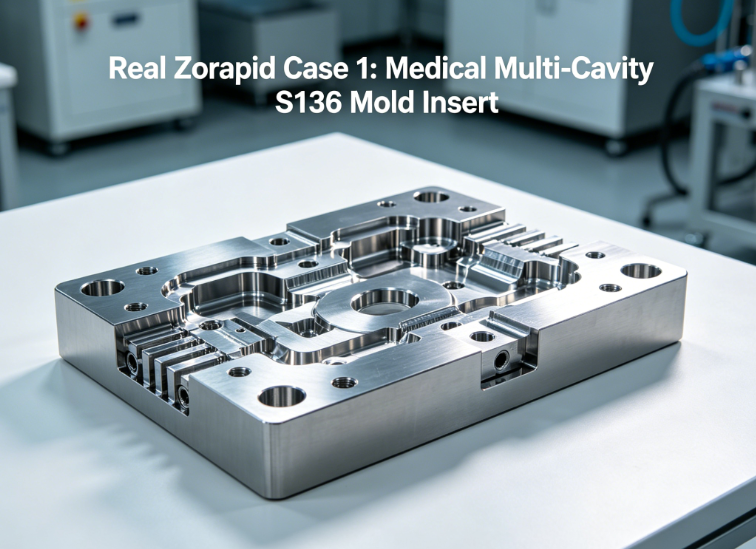
Real Zorapid Case 1: Medical Multi-Cavity S136 Mold Insert
Project Background
US medical device OEM needed 8 identical S136 stainless steel cavity inserts for single-use syringe injection molds.
Previous dual-vendor process issues:
- Split CNC & Wire EDM caused 0.015mm alignment drift on thin needle gate slots
- 6 out of 8 inserts failed initial mold trial due to rounded internal fillets
- Total lead time hit 16 working days with extra polishing rework Spec requirements: HRC 52 hardness, sharp 0mm internal corners, ±0.004mm gate tolerance, biocompatible mirror surface Ra ≤0.4μm
Zorapid Combined CNC + Wire EDM Solution
- 5-axis CNC roughing all cavity blanks with unified datum fixture
- Vacuum heat treatment to HRC 52 with low-distortion temper cycle
- Wire EDM single-setup finish all micro gate slots and sharp parting line corners
- In-cycle dielectric fluid temperature control to hold micron stability during EDM cuts
- Unified CMM full dimensional & surface roughness inspection
Measurable Client Outcomes
- Zero alignment drift across all 8 cavity inserts
- 100% sharp internal fillets with no secondary grinding
- Lead time cut from 16 days down to 6 days
- All inserts passed first mold trial, zero scrap Client eliminated $18,200 in delayed medical product launch downtime from failed mold inserts.
Automotive GF-PA66 Thin Rib Mold Core Insert
Project Background
European automotive tier 1 supplier ordered hardened NAK80 core inserts for EV connector housings. The design featured 0.7mm thin deep ribs prone to deflection during standard CNC machining.
Single CNC milling attempts consistently cracked rib geometry, pushing scrap above 5%. Wire EDM-only roughing quoted 21-day lead times at 40% higher unit cost.
Spec requirements: HRC 50, rib wall tolerance ±0.003mm, no surface micro-cracking to avoid plastic flash.
Zorapid Combined CNC + Wire EDM Solution
- CNC rough all large core geometry, leave uniform 0.08mm stock on thin rib zones
- Stress relief heat treatment to lock in dimensional stability
- Wire EDM non-contact finish all thin rib sections to eliminate cutting force deflection
- Multi-pass skim EDM to remove heat-affected white layer for longer mold service life
Measurable Client Outcomes
- Zero cracked or distorted thin ribs across full batch of 12 inserts
- Scrap rate dropped from 5.1% to 0%
- Unit insert cost reduced by 32% vs full Wire EDM production
- Mold service life extended by 35% thanks to stress-free rib geometry
Hardened Steel Grades We Run On Our Hybrid Mold Insert Line
Zorapid’s CNC + Wire EDM workflow supports all common mold steel grades for custom inserts, heat treated in-house:
- S136 / STAVAX (Medical, food-grade transparent plastic molds, corrosion resistance)
- NAK80 / P20 (Low-volume prototype, cosmetic consumer plastic inserts)
- SKD11 / D2 (High-wear glass-filled PA66, high-cycle automotive molds)
- H13 (High-temperature overmold & die cast mold inserts)
- 420 Stainless Steel (PVC, corrosive resin molding applications)
Critical advantage: We heat treat inserts to full target hardness BEFORE Wire EDM finishing. This eliminates post-treatment distortion that ruins dimensions for shops that EDM first then harden steel.
Core Technical & Business Wins For Mold OEMs
Technical Advantages Of Zorapid’s Combined CNC + Wire EDM Mold Inserts
- Perfect sharp internal corners impossible with standalone CNC milling
- Stress-free thin ribs, micro vents and delicate gate geometry with zero deflection
- Consistent ±0.002–±0.004mm critical feature tolerances across multi-cavity sets
- Minimal heat-affected zones on finished insert surfaces, extending mold lifespan
- Uniform burr-free finish that cuts secondary polishing labor drastically
Business Cost Advantages
- Single vendor coordination—no chasing two separate machining shops for updates
- Up to 38% faster mold insert lead times to speed up your NPI mold trial schedule
- Mass scrap reduction on high-cost hardened mold steel blanks
- Lower total landed cost vs full Wire EDM production or split dual-vendor workflows
- One unified CMM inspection report for full mold documentation, ideal for ISO 13485 / IATF 16949 compliance
Industries That Depend On Our Combined CNC + Wire EDM Mold Inserts
Zorapid ships custom hybrid-process mold inserts to regulated manufacturing sectors worldwide:
- Medical Devices: Syringe molds, implant housing cavities, single-use surgical tool molds
- Automotive EV: GF-PA66 connector molds, battery housing inserts, lightweight plastic structural cores
- Consumer Electronics: Thin-wall cosmetic plastic housings, micro switch mold cavities
- Food & Beverage: Food-grade transparent plastic container S136 mold inserts
- Aerospace Interiors: Low-flash high-precision plastic component mold cores
All inserts ship with full material heat treatment certificates, CMM dimensional reports and process traceability records.
FAQ
Can your combined CNC + Wire EDM process handle prototype and mass batch mold inserts?
Absolutely. Our hybrid workflow scales seamlessly from 1-off prototype inserts to 50+ multi-cavity mold sets. We maintain identical datum alignment and precision across every batch size.
What’s the tightest tolerance you hold on Wire EDM fine insert features?
Standard consistent tolerance: ±0.003mm for critical ribs, gates and parting lines. We deliver ±0.001mm ultra-precision Wire EDM finishing for medical micro mold inserts upon request.
Do I need to send separate STEP files for CNC and Wire EDM operations?
No. Send one complete mold insert 3D model to our engineering team. Our CAM engineers split CNC roughing vs Wire EDM fine feature toolpaths internally, no extra work on your side.
Will the combined CNC + Wire EDM process raise my mold insert unit price?
Long-term total cost is far lower. While our integrated hybrid setup carries a small unified engineering fee, savings on scrap, dual vendor shipping, rework and lead time outweigh this cost for nearly all mold projects over 2 inserts. We provide full cost breakdowns during free DFM reviews to prove the math.
Can you remove Wire EDM’s white layer on mold insert surfaces?
Yes. We run multiple low-energy skim EDM passes to eliminate brittle heat-affected white layers on all mold inserts, preventing early rib chipping and extending mold cycle life significantly.
Wrap-Up
Custom mold inserts don’t need to be a bottleneck in your mold development timeline.
Standalone CNC milling limits your design with rounded corners and fragile thin rib defects. Standalone Wire EDM inflates costs and slows production. Splitting work between two separate machining vendors creates alignment errors, scrap and delayed mold trials.
Zorapid’s fully integrated CNC + Wire EDM combined process solves every core limitation of single-process mold insert manufacturing. We leverage high-speed milling for fast roughing and Wire EDM for stress-free ultra-precision fine features, all locked to one shared datum system under one roof.
With 20+ years of precision mold component manufacturing, climate-controlled machining cells and in-house heat treatment & CMM inspection, we deliver consistent, certified custom mold inserts for global medical, automotive and consumer plastic OEMs. Our facility handles single prototype inserts all the way to full multi-cavity mold batch production.
Need a free DFM process review for your custom mold insert 3D files? Send your STEP/IGS drawings to our mold engineering team today. We’ll run a CNC + Wire EDM hybrid process simulation, share a lead time & scrap cost comparison vs split vendor workflows, and quote your project within 24 working hours.