A Pro Guide for Precision CNC Shops
Let’s cut to the chase: Titanium is hard to machine. It’s not just “hard”—it’s a material that fights back. High heat, extreme tool wear, and nasty workpiece deflection are just a few of the headaches. But here’s the good news: At Zorapid, we’ve cracked the code. While others struggle with burnt tools and scrapped parts, we deliver precision titanium components on time, every time.
In this guide, we’re diving deep into the real-world machining of titanium. We’ll cover the critical cutting parameters, the speeds and feeds that actually work, and how we overcome the challenges that stop most shops cold.
Titanium Machining: The Core Challenge & Why It’s So Hard
Before we jump into parameters, let’s understand why titanium (especially Ti-6Al-4V / TC4 Grade 5) is the bane of many machinists’ existence. It boils down to four brutal material properties:
- Terrible Thermal Conductivity: Heat gets trapped at the cutting edge, reaching 800–1000°C in seconds. This melts tools and ruins surface finish fast.
- Low Elastic Modulus: Titanium is “springy” (110 GPa vs. 210 GPa for steel). It deflects under load, causing chatter, poor tolerance, and work hardening.
- High Chemical Reactivity: At high temps, titanium welds itself to carbide tools, creating built-up edge (BUE) and catastrophic tool failure.
- Severe Work Hardening: The heat and pressure harden the workpiece surface as you cut. If you pause or run too slow, you’re cutting into hardened metal.
The Result for Most Shops: Slow speeds, frequent tool changes, high scrap rates, and missed deadlines.
The Zorapid Edge: What Others Can’t Do, We Master
Here’s where we separate ourselves from the competition. While other shops avoid titanium or farm it out, we specialize in it. We don’t just machine titanium—we engineer the process from the ground up.
Our Unmatched Capabilities:
- Ultra-Precision Machining: Holding ±0.002 mm tolerances on complex 5-axis titanium parts, even for thin-walled geometries (<0.5 mm) that most shops can’t touch.
- Hardened Titanium Expertise: Machining HRC 40+ titanium alloys without compromising surface integrity or fatigue life.
- High-Volume & Rapid Prototyping: From 1-off prototypes to 10k+ batches, we maintain consistent quality and speed.
- Advanced Tooling & Cooling: Proprietary high-pressure coolant (HPC) systems (≥70 bar) and premium coated carbide/CBN tools that slash tool wear by 60%+.
- Deep Cavity & Small Hole Mastery: Drilling φ0.05 mm micro-holes and machining deep cavities with 15:1 depth-to-width ratios—something few shops dare to attempt.
In short: If it’s a tough titanium job that others say “no” to, bring it to Zorapid.
Titanium Alloys We Machine: The Full Material Range
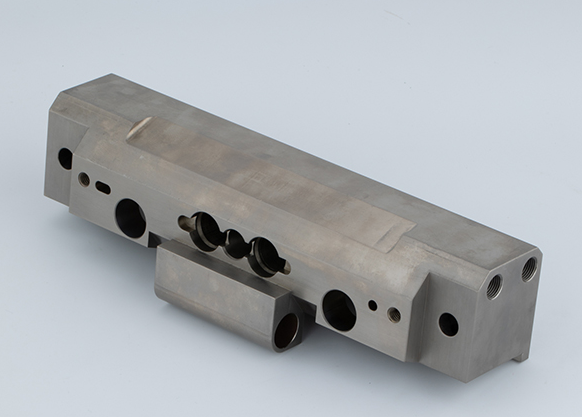
We work with every major titanium grade used in aerospace, medical, and industrial applications. No material is too exotic for our team.
Common Grades & Applications
| Material Grade | Composition | Key Properties | Typical Applications |
|---|---|---|---|
| Grade 1 (TA1) | Pure Ti (99.5%) | Soft, ductile, excellent corrosion resistance | Chemical processing, marine, medical implants |
| Grade 2 (TA2) | Pure Ti (99.2%) | Balanced strength & corrosion resistance | Heat exchangers, medical, aerospace non-structural |
| Grade 5 (TC4/Ti-6Al-4V) | 6% Al, 4% V | Workhorse alloy: High strength, heat treatable | Aerospace (airframes, landing gear), medical, automotive |
| Grade 23 (Ti-6Al-4V ELI) | Low interstitial (O, N) | High toughness, biocompatible | Medical implants (hips, knees), aerospace cryogenic parts |
| Grade 7 (Ti-0.15Pd) | Pure Ti + Palladium | Superior corrosion resistance (reducing acids) | Chemical, oil & gas, marine components |
We also machine: Ti-10V-2Fe-3Al (Grade 19), Ti-5Al-2.5Sn (Grade 6), and Ti-15Mo (Grade 32) for high-performance aerospace and medical projects.
Critical Cutting Parameters: Speed, Feed & Depth (For Ti-6Al-4V)
Let’s get to the numbers—the speeds and feeds that work for Ti-6Al-4V (Grade 5), the most common titanium alloy. These are Zorapid’s field-proven settings for carbide tools (TiAlN coating) on rigid CNC mills/lathes.
Cutting Speed (Vc) – The #1 Parameter for Tool Life
Rule: Run slower than steel, but not too slow.
- Roughing (Carbide): 30–60 m/min (100–200 SFM)
- Why? Balances heat generation and material removal rate (MRR).
- Finishing (Carbide): 80–120 m/min (260–390 SFM)
- Why? Higher speed reduces contact time and work hardening for a better surface finish.
- High-Speed Finishing (CBN): 150–250 m/min (490–820 SFM)
- Why? CBN handles extreme heat for mirror finishes (Ra ≤ 0.2 μm).
- Never run below 25 m/min (80 SFM)—this causes severe work hardening and tool smearing.
4.2 Feed Rate (f) – For Surface Finish & Chip Control
Rule : Keep feed moderate—avoid tiny feeds that cause rubbing.
- Roughing: 0.15–0.3 mm/tooth (0.006–0.012 IPT)
- Why? Thick chips carry away heat; prevents BUE.
- Finishing: 0.05–0.15 mm/tooth (0.002–0.006 IPT)
- Why? Smooth surface; reduces deflection on thin walls.
- Critical Note: Never go below 0.05 mm/tooth—this causes “plowing” and rapid tool wear.
4Depth of Cut (ap/ae) – Maximize Stability
Rule : Use deeper cuts (for rigidity) and avoid light, sketchy passes.
- Axial Depth (ap) – Milling: 1–3 mm (roughing) / 0.2–0.5 mm (finishing)
- Radial Depth (ae) – Milling: ≤ 30% of tool diameter (critical for heat dissipation)
- Turning: 2–4 mm (roughing) / 0.1–0.3 mm (finishing)
Tooling & Coolant: Non-Negotiables
- Tools: WC-Co carbide (TiAlN/AlCrN coating) for most jobs; CBN for hard material finishing.
- Coolant: High-pressure (≥70 bar) synthetic coolant with extreme-pressure (EP) additives. Flood the cut—never mist or MQL for heavy cuts.
Summary for Ti-6Al-4V:
Slow speed (30–120 m/min), moderate feed (0.05–0.3 mm/tooth), deep cuts, and flood coolant.
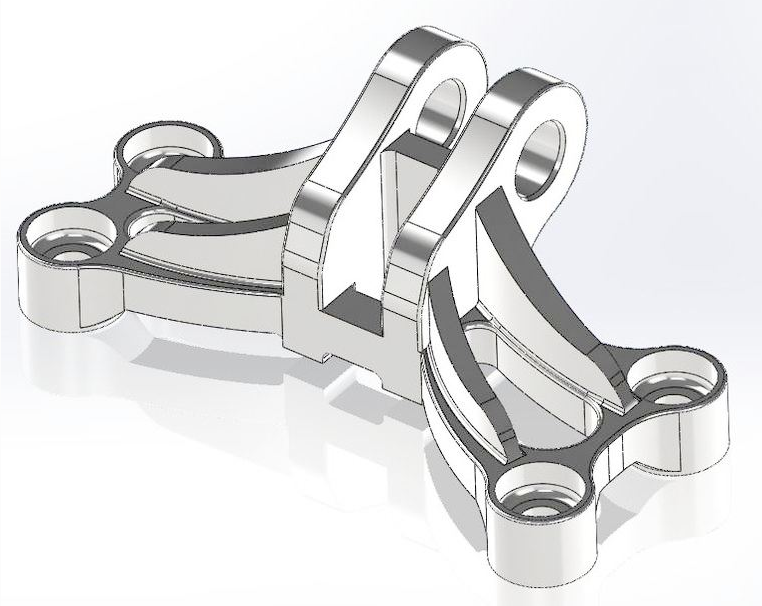
5. Real-World Case Study: Aerospace Titanium Bracket
Project: 5-axis complex aerospace bracket
Material: Ti-6Al-4V (Grade 5)
Challenges:
- Thin walls (0.8 mm) with tight ±0.005 mm tolerance
- Deep pockets with difficult chip evacuation
- High fatigue life requirement (aerospace standard)
Zorapid’s Solution:
- Tooling: 10 mm solid carbide end mill (4-flute, TiAlN coating)
- Parameters:
- Roughing: 45 m/min, 0.2 mm/tooth, 2 mm depth
- Finishing: 100 m/min, 0.08 mm/tooth, 0.3 mm depth
- Process: 5-axis simultaneous machining with 80 bar high-pressure coolant, constant chip load, and zero dwell time.
Result:
- Perfect dimensional accuracy: ±0.003 mm (beat tolerance!)
- Surface finish: Ra 0.18 μm (mirror-like)
- Zero tool failure, 20% faster than initial estimate
- Passed all aerospace non-destructive testing (NDT)
Customer Feedback: “We’ve tried 3 shops for this part—Zorapid is the only one who got it right on the first try.”
Applications: Where Our Titanium Parts Go
Our precision titanium components power critical projects across aerospace, medical, defense, and industrial sectors.
Aerospace & Defense (50% of our titanium work)
- Aircraft structural components (frames, brackets, landing gear parts)
- Jet engine components (compressor blades, housings)
- Missile & satellite parts (lightweight, high-temperature stability)
Medical & Healthcare
- Implants: Hip/knee stems, bone plates, screws (Grade 23 ELI)
- Surgical instruments: Forceps, scalpels, drill bits (lightweight, autoclavable)
- Dental implants & prosthetics
Industrial & Marine
- Chemical processing equipment (corrosion-resistant reactors, valves)
- Marine components (subsea housings, propeller parts)
- Oil & gas (downhole tools, pressure vessels)
High-Performance Automotive & Sports
- Racing parts (connecting rods, valve springs, exhaust systems)
- Luxury sports equipment (golf club heads, bicycle frames)
Delivery Speed: Fast Prototypes & High-Volume Runs
We know speed is critical for your business. Zorapid delivers titanium parts faster than most shops—without sacrificing quality.
- Rapid Prototyping: 24–48 hour turnaround for 1–5 parts (perfect for design validation)
- Small Batch Production: 3–5 days for 10–500 parts
- High-Volume Manufacturing: 7–15 days for 1,000–10,000+ parts
- On-Time Delivery Rate: 99.7% (we hate delays as much as you do!)
How we do it: Dedicated titanium machining cells, optimized tooling libraries, and a streamlined process from DFM analysis to final inspection.
Why Choose Zorapid for Your Titanium Machining?
We’re not just another CNC shop—we’re your titanium machining partner. Here’s why customers worldwide trust us:
- Titanium Specialists: 10+ years focused exclusively on hard-to-machine metals (titanium, Inconel, stainless steel). We don’t dabble—we dominate.
- Unmatched Precision: ±0.002 mm tolerance capability, certified inspection (CMM, optical comparator) for every part.
- Advanced Equipment: 5-axis CNC mills, high-torque lathes, and 80 bar high-pressure coolant systems built for titanium.
- Cost-Effective: Our optimized processes cut tool wear and scrap rates by 50%, saving you money on every project.
- Full-Service Support: From DFM analysis and material selection to surface finishing (anodizing, passivation) and assembly—we handle it all.
- Global Quality Standards: ISO 9001, AS9100 (aerospace), ISO 13485 (medical) certified. Your parts meet the strictest international requirements.
Final Thoughts: Master Titanium with Zorapid
Titanium machining is not for the faint of heart. It demands deep expertise, rigid processes, and a team that lives and breathes hard metal.
While other shops avoid titanium or struggle with poor quality and slow lead times, Zorapid delivers precision titanium parts on time, every time. We’ve mastered the parameters, solved the heat and tool wear problems, and built a reputation as the go-to partner for the toughest titanium jobs.
Ready to take your titanium project to the next level? Get in touch with our team today for a free quote and DFM analysis.
FAQ: Your Titanium Machining Questions Answered
What’s the biggest mistake people make when machining titanium?
Running too slow! Speeds below 25 m/min cause severe work hardening, which destroys tools and makes the part impossible to finish.
Can you machine titanium with standard steel tooling?
No. High-quality carbide tools with TiAlN/AlCrN coating are mandatory. HSS tools will burn up in minutes.
What surface finishes can you achieve on titanium?
Up to Ra 0.05 μm (mirror polish) for medical and aerospace applications. Standard finishing is Ra 0.2–0.8 μm.
Do you offer material traceability for aerospace/medical parts?
Yes! We provide full material certificates (CoC), heat treatment records, and inspection reports for every batch.
What’s the minimum order quantity (MOQ)?
piece—we specialize in low-volume, high-mix projects. No MOQ required.