A turbocharger is one of the key components. It can boost power output, reduce fuel consumption and cut emissions. In an engine, the turbine wheel and compressor impeller are critical for harnessing exhaust gas energy to compress intake air. It is essential to understand the fundamental properties of materials and their manufacturing processes. A proper understanding of turbochargers enables them to operate more efficiently, durably and reliably. This guide focuses on all key details regarding the design, advantages, disadvantages and applications of turbine wheels.
What Is a Turbocharger Impeller?
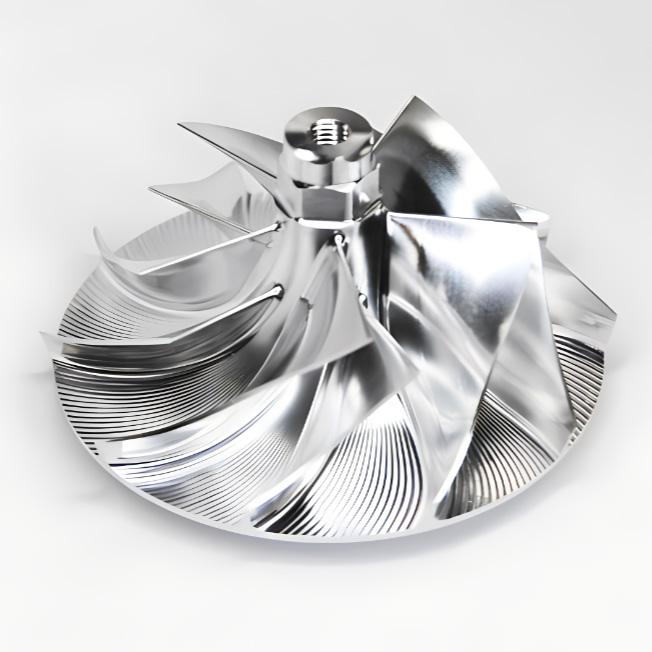
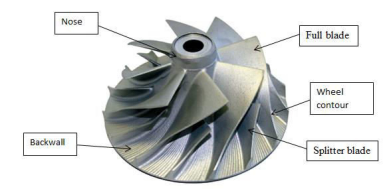
It is a vital rotating component inside the turbocharger, designed to compress air entering the engine. The compression process increases the engine’s oxygen supply, thereby improving fuel combustion efficiency and raising torque and power. Designed based on aerodynamic principles, the impeller can withstand high pressure and extreme temperatures.
Turbine Wheel vs Compressor Impeller
A turbocharger assembly consists of a turbine wheel and a compressor impeller, connected by a common shaft. Driven by engine exhaust gas, the turbine wheel rotates and transmits power to the compressor impeller via the shaft. Air is drawn in, compressed, and delivered to the engine by the compressor impeller, optimizing combustion performance and power output.
Difference: Impeller vs Other Turbocharger Components
The impeller is the rotating wheel in a turbocharger responsible for compressing intake air. Other turbocharger parts such as the turbine housing, compressor housing and turbine shaft serve distinct functions. The turbine drives the compressor impeller, which draws power from exhaust gases, while the housings guide the airflow path.
How Does a Turbocharger Impeller Work?
The impeller is the core component of a turbocharger, located on the intake side. It draws in and compresses air, feeds the airflow into the engine, promotes fuel combustion, and delivers high power output. In short, the impeller is critical to boosting engine power.
How Turbocharger Impellers Improve Engine Efficiency
Also known as compressor impellers, they compress air forcefully and force it into the engine to enhance overall efficiency. This allows the engine to produce the same power output with a smaller displacement, ultimately improving fuel economy and reducing emissions.
How Impeller Speed and Flow Rate Affect Power
Impeller rotational speed and flow rate are directly correlated with power consumption. High rotating speed and large impeller diameter generate high flow rate, which leads to higher power demand. This correlation is not always linear.
Why Impeller Size Is Critical to Turbo Performance
Impeller size is vital to turbocharger performance, directly affecting airflow, boost pressure and engine power output. A well-optimized impeller delivers efficient airflow and higher boost output, while avoiding performance limitations such as engine overloading and turbo lag.
Turbocharger Impeller Design: Key Considerations
Multiple factors determine the design and performance of turbocharger impellers.
Factors Affecting Impeller Shape and Size
Impeller design depends heavily on blade profile, angle, diameter, width, curvature and flow velocity — key factors defining energy use, pressure performance and operational efficiency.
Blade Profile and Geometry
Blade profile and geometry affect the performance of the centrifugal pump, directly influencing head pressure, power output and efficiency. shape, angle, curvature and quantity determine the internal flow pattern and energy transfer inside the pump. Optimizing these parameters can greatly improve pump efficiency and performance.
Importance of Blade Angle
Blade angle dominates impeller performance, flow characteristics and efficiency. The blade inlet angle controls how fluid enters the impeller; an optimized angle minimizes turbulence and improves fluid delivery efficiency. The blade outlet angle defines how fluid exits the impeller and affects the generated pressure and head.
Radial vs Axial Impeller Design
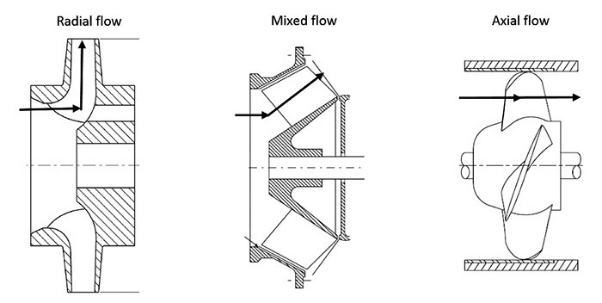
Radial and axial impellers feature distinct design differences. They differ in airflow direction, efficiency, and pressure generation, making them suitable for various applications.
Axial impellers allow fluid to flow parallel to the shaft, ideal for high-flow and low-pressure scenarios such as ventilation.
Radial impellers move fluid outward from the center, ideal for ducted airflow and high-pressure applications.
Types of Turbocharger Impellers
Turbocharger impellers are classified into several categories according to airflow direction.
Axial Flow Impeller
With this type of impeller, fluid flows parallel to the shaft from top to bottom. It is known for generating strong vertical flow, making it ideal for mixing liquids and suspending solid particles.
Advantages
- Designed to handle large volumes of fluid.
- Suitable for low-pressure, high-capacity applications.
- Powerful vertical flow keeps solids suspended in liquid and prevents sedimentation.
- Able to maintain layered liquid levels in tanks.
- Achieves high RPM with relatively low energy consumption.
Disadvantages
- Not suitable for high-viscosity fluids.
- Improper baffle installation may cause fluid swirling and poor mixing performance.
- Large propeller blade size leads to higher costs.
Applications
- Fluid mixing and blending where solid suspension is required.
- Large-volume water extraction for irrigation and flood control with low head pressure.
- Circulating water in power plant cooling systems.
- Liquid circulation for evaporation, crystallization and other processes in the chemical industry.
- Sewage digestion and liquid circulation in wastewater treatment.
Radial Flow Impeller
The blades of this impeller are perpendicular to the impeller shaft, pushing fluid radially outward to produce high pressure with low flow rate.
Advantages
- Generates high pressure, suitable for high-altitude and high-resistance pumping scenarios.
- Delivers strong shearing force, ideal for mixing pigment pastes and caulking compounds.
- Versatile in handling fluids of varying temperatures and viscosities.
- Efficiently converts mechanical energy into fluid flow.
- Also applicable for gas dispersion processes.
Disadvantages
- Sensitive to changes in fluid viscosity, which directly affects operating performance.
- Lower flow capacity compared with other impeller types.
- Strong vortex formation limits its suitability for certain applications.
Applications
- Water supply and irrigation requiring high pressure.
- Fire service systems due to excellent high-pressure performance.
- Industrial and commercial equipment such as circulation pumps, machine tools and boiler feed pumps.
- Mixing and dispersion to form homogeneous mixtures.
- Delivering high discharge pressure in multi-stage pumps.
- Industrial pumping applications demanding low flow and high pressure.
Mixed Flow Impeller
This impeller combines the characteristics of both radial and axial designs, featuring neither pure radial nor pure axial flow patterns. It offers wide versatility and is commonly used in water supply and cooling systems.
Advantages
- Handles fluids with diverse densities and viscosities.
- Highly efficient for medium head pressure applications.
- Capable of pumping turbid or contaminated liquids containing suspended solids.
- Combined radial and axial flow enables flexible flow patterns.
Disadvantages
- More complex structure than radial and axial impellers, resulting in higher manufacturing costs.
- Not suitable for extremely low or extremely high head applications.
- Operating speed range is fixed between radial and axial designs, limiting application flexibility.
Applications
- Water intake, supply and distribution across various industries.
- Well-suited for large-scale irrigation systems.
- Widely adopted in cooling systems thanks to its mixed flow characteristics.
- Capable of handling turbid and contaminated liquids efficiently.
- Extensively used for pulp pumping in paper mills.
- Applied in areas requiring dehydration processes.
- Ideal for marine jet propulsion systems.
Common Materials for Turbocharger Impellers
Turbocharger impellers are typically stainless steel or titanium alloy. High-temperature, lightweight applications use nickel-based alloys and advanced composites.
Stainless Steel Alloys
Stainless steel impellers offer good strength and corrosion resistance, making them ideal for high-temperature and high-pressure applications. Examples include AISI 4063 steel and low-carbon C1045ss. Low-carbon C1045ss is carbon steel and is not directly used for impellers in the same way as stainless steel.
Nickel-Based Alloys and Aluminum Alloys
Nickel-based alloys are among the preferred materials for turbine wheels, featuring high temperature resistance and exceptional strength. Inconel 718 is a common example. Aluminum alloys, due to their low density, are mainly used for compressor impellers. Aluminum alloys reduce inertia and improve engine response.
Titanium Alloys for Impellers
Titanium-based alloys combine high strength, corrosion resistance, and light weight, and are widely used in high-temperature and high-speed applications. Titanium alloys are favored for both compressor and turbine impellers because of their high strength-to-weight ratio.
Composite Materials in Lightweight Impellers
Composite materials such as carbon fiber reinforced polymer (CFRP) and fiberglass are used to manufacture lightweight impellers. They offer significant weight reduction compared with conventional metal impellers, along with high strength and durability. They are less common than stainless steel and are only used for specific applications to avoid failures in turbocharger impellers.
Turbocharger Impeller Coatings
Coatings help improve the performance and durability of impellers. Common coating materials include PVD and PACVD, which protect against scratches, wear, and frictional oxidation. Carbon-based coatings are also widely used due to their low friction coefficient and suitability for low-lubrication conditions.
How to Manufacture Precision Impellers?
Impellers feature complex geometric profiles, and their manufacturing relies heavily on 5-axis CNC machining. This process comes with certain challenges, including high initial investment costs and the need for professional technical training.
5-Axis CNC Machining for Impellers
This manufacturing method adopts 5-axis CNC machining centers to produce complex and precision components such as impellers. The machining center enables synchronized control over multiple axes including A, B, X and Y, capable of fabricating intricate geometries that cannot be achieved by conventional 3-axis machining.
Advantages
5-axis impeller machining delivers a wide range of benefits:
It provides high precision and accuracy, enabling excellent control over tool movement.
The cutting tool can move in multiple directions to form the complex profiles of impeller blades.
It offers higher efficiency, shorter setup time, and reduced manual intervention.
It achieves superior surface finish, which is critical for aerodynamic performance.
Disadvantages
This method also has several drawbacks:
The initial investment cost is higher than that of three 3-axis machines.
Specialized training and professional expertise are required for operation.
Material deformation may occur when machining thin-walled components.
Main Processes of Impeller Machining
There are many reasons to choose 5-axis impeller machining, such as tight tolerances, better surface finish, reduced setup time, and the capability to manufacture complex parts like impeller blades.
The main procedures of 5-axis impeller machining are as follows:
- Create a 3D model of the impeller via CAD.
- Select suitable materials such as titanium, aluminum, or stainless steel according to requirements.
- Choose cutting tools including ball end mills and end mills based on performance needs.
- Generate CNC programming code from the CAD model.
- Clamp the workpiece on the worktable and complete machine setup.
- Machine the impeller through a series of roughing and finishing operations.
- Perform full inspection on the finished impeller.
How to Choose the Right Turbocharger Impeller for Your Engine
Selecting the right turbocharger impeller requires consideration of several key factors, including your engine type, the impeller style that matches your demands, and suitable material selection.
Choose Impeller Based on Engine Type
The size and type of engine determine the required airflow and boost pressure. Smaller impellers deliver faster boost response, while larger ones provide higher peak power. It is necessary to take your vehicle application and fuel type into account.
Match Impeller Type with Performance Goals
Impeller categories including compressor impeller and turbine impeller, together with impeller size, profile, blade quantity, blade angle, and compatibility with the turbine housing, all directly affect overall performance targets.
Material Considerations for Impeller Durability
Turbocharger impellers are commonly made of stainless steel, aluminum alloy, or titanium alloy, each with distinct strength, corrosion resistance and lightweight properties. Impeller materials must be robust enough to withstand high rotational speed and extreme high-temperature operating conditions.
Conclusion
Turbocharger impellers are key components for enhancing engine power and efficiency. The optimized design of turbocharger impellers enables effective intake air compression, thereby improving fuel combustion efficiency and torque output. Its manufacturing process covers complete procedures including design, material selection, and 5-axis precision machining.
FAQ
How Does Impeller Blade Angle Affect Turbocharger Performance?
Blade angle determines the efficiency with which a turbocharger compresses intake air, and directly influences engine performance.
Can I Use a Larger Impeller for More Power?
Yes. A larger impeller diameter of a centrifugal pump delivers higher pressure and flow rate, while requiring greater input power.
What Is the Difference Between a Turbine Impeller and a Propeller?
A turbine impeller is an integral part of the turbocharging system. It is specially designed to compress air and boost engine power.
A propeller generates thrust to propel a vehicle moving in a fluid medium.