Swiss turning originated from the watchmaking industry, built for machining miniature precision parts. Such tiny components are widely used in aerospace and electronics. This guide covers Swiss turning’s advantages, types and more.
What Is a Swiss Lathe?
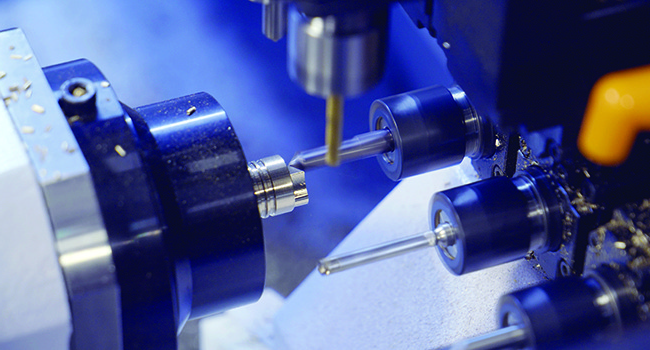
Also called Swiss-type lathe or Swiss screw machine, this CNC equipment specializes in small, complex precision parts. Fitted with multiple tools to run simultaneous operations, it differs from standard lathes and excels at intricate miniature component production.
Understanding the Swiss Turning Process
Swiss turning follows reverse operational logic to conventional lathes with the same core machining principle. The workpiece moves axially in a guide bushing while the cutting tool stays fixed. It completes turning, milling and threading in one setup.
Swiss Turning Capabilities
Swiss lathes deliver tight tolerances and high precision, boosting component durability and reliability. Accurate dimensions and fine surface finish cut production costs and material waste.
The Role of Precision in CNC Swiss Lathes
Precision is fundamental to the reliable application of components across all industries. High-precision parts help prevent equipment failure, personal injury, and economic losses.
Why Swiss Machining Reduces Material Waste
Part precision relies heavily on machining stability. Workpiece vibration causes dimensional errors and even tool breakage. CNC Swiss lathes effectively eliminate such precision issues.
The guide bushing, a key component of Swiss lathes, stabilizes the workpiece right next to the cutting zone. This exceptional stability reduces material waste and tool deflection.
History and Evolution of Swiss Lathes
Let’s discuss the history of Swiss lathes in greater detail.
Origin of Swiss Lathes in the Watchmaking Industry
The 19th century saw a booming Swiss watchmaking industry. Early Swiss machines had low standards for part precision and durability. To improve dimensional accuracy, Swiss engineers developed an upgraded lathe with a guide bushing to stabilize workpieces during machining.
From Manual to CNC Swiss Lathes
In the mid-20th century, CNC Swiss lathes began to emerge. Early Swiss lathes were manually operated, requiring highly skilled operators and featuring low production efficiency.
Development of Swiss-Type Machines
The evolution of Swiss-type machine tools is closely linked to diverse industries and market demands. These machines vary in configuration with features such as powered tooling and automatic bar feeders.
Benefits of Using a Swiss-Type Lathe
There are several key advantages of using a Swiss lathe:
High Precision and Accuracy
The machine design incorporates a guide bushing and a sliding headstock. These components of Swiss machines ensure the workpiece remains fully stable during machining, greatly improving precision and dimensional accuracy.
Shorter Cycle Time and Higher Efficiency
With stable workpiece performance and minimal vibration, repeated re-machining is unnecessary. This reduces cycle time and boosts overall production efficiency.
Superior Surface Finish and Tight Tolerances
Excellent surface finish and precise tolerances are critical to component durability. Swiss machining delivers outstanding surface quality and consistent tolerance control.
Limitations of Swiss-Type CNC Turning
Here are some limitations of Swiss CNC turning:
High Initial Setup Cost of Swiss CNC Machines
Swiss CNC machines are fully advanced tools equipped with numerous features, making them high-cost equipment with relatively high setup expenses.
Material Limitations in Swiss-Type Machining
Swiss-type machining is a versatile process capable of machining various materials, including composites and polymers. However, material selection is still limited. Extremely hard and brittle materials such as high-carbon steel are challenging for these machines, as they accelerate tool wear and reduce workpiece reliability.
What Materials Can Be Used in Swiss CNC Machining?
Swiss CNC machining is compatible with a wide range of common materials:
- Metals: Aluminum, brass, stainless steel, titanium, copper
- Plastics: Delrin, PEEK, nylon
- Composites: Carbon fiber and glass fiber
Complexity of Swiss CNC Machine Operation
Swiss CNC machines are highly complex in terms of operation and maintenance. As advanced CNC-programmed equipment, they require highly skilled operators.
Swiss Turning vs. Conventional Turning
We have only mentioned conventional turning so far; now you will gain a deeper understanding of the differences between them.
What Is the Difference Between a Swiss Lathe and a Conventional Lathe?
The main difference lies in the machine design and its functions.
Swiss Lathe
- Equipped with a guide bushing that supports the workpiece close to the cutting tool
- This stable design makes machining small, complex parts easier and more precise
- Reduces tool deflection and dimensional errors
- Commonly used in watchmaking and electronics industries
Conventional Lathe
- A chuck holds the workpiece, which rotates while the cutting tool moves
- Stability is difficult to maintain for slender parts
- Manual operation and easy to use
- Applied in threading, facing, and other operations
How Does Swiss CNC Machining Deliver Higher Precision?
Swiss CNC machines come with many advanced features, including guide bushings, high-resolution encoders, and control systems. They provide superior precision because:
- Guide bushings offer exceptional stability for the workpiece
- Multi-axis functionality enables complex cutting and tight tolerance control
Function of the Guide Bushing in Swiss Lathes
The guide bushing is a key component of CNC Swiss lathes, which supports the workpiece close to the cutting tool. Workpiece stability effectively reduces workpiece vibration and tool deflection. This component ensures high precision for miniature parts used in watchmaking, electronics and other industries.
Working Principle of CNC Swiss Lathes
This section helps you understand the working principle of CNC Swiss lathes.
CNC Swiss Turning Process
The turning process is straightforward. Simply load the raw bar stock into the machine spindle. As the workpiece feeds through the machine, the guide bushing supports it right next to the cutting tool.
Swiss lathes are equipped with multiple cutting tools such as milling cutters and drill bits, enabling multiple machining operations to be performed simultaneously. This simultaneous processing shortens cycle time and reduces material waste.
Schematic Diagram and Key Components of Swiss Lathe
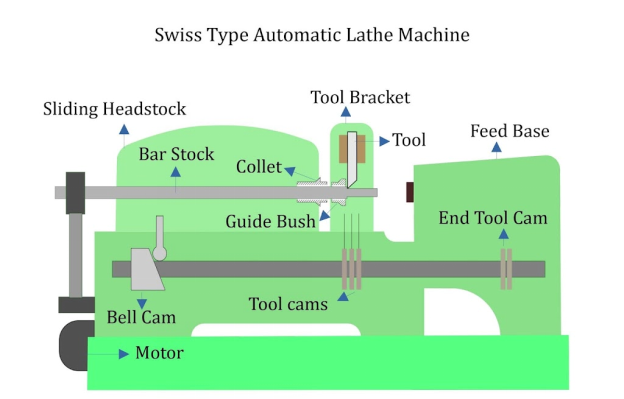
There are many components inside the machine that ensure smooth operation of CNC Swiss lathes, all manufactured with high precision and tight tolerances. Among all parts, the guide bushing, feed base, bar stock, and spindle are the most critical ones.
Capabilities of CNC Swiss Lathes
CNC Swiss lathes deliver versatile performance and are capable of machining miniature parts with precision as high as 0.0001 inches. They can perform multiple operations simultaneously, reducing cycle time while maintaining reliable quality control. Featuring powerful performance, they are widely applied in critical industries such as aerospace, medical, and electronics.
Applications of Swiss Precision Turned Parts
Detailed information regarding the applications of CNC Swiss lathes.
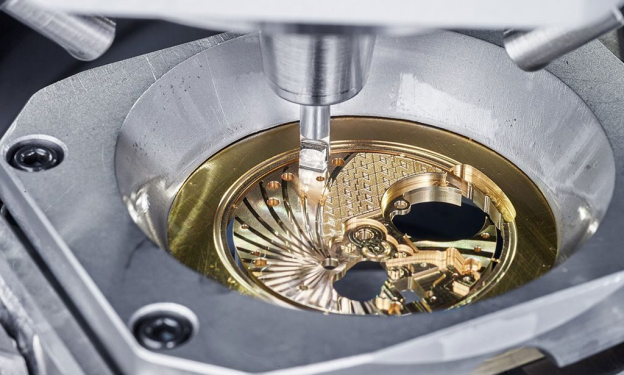
CNC Machining for Swiss Watchmaking: Machining Swiss Screws
Swiss machines were originally developed in Switzerland for the watchmaking industry. Watch components are extremely tiny and difficult to machine with conventional lathes.
Aerospace Components & Medical Devices
Aerospace and medical are critical industries with extremely high safety standards. Meeting these standards requires ultra‑tight tolerances and high precision. Reliable machining can be achieved using Swiss‑type lathes. Parts ranging from turbine blades to medical devices are manufactured on CNC Swiss lathes.
Automotive Industry & Small Precision Parts
Components such as fuel injectors and sensors are miniature. Swiss CNC lathes are used to ensure their precision machining.
Swiss Machining for Swiss Turned Components
Swiss-type machines are the optimal choice for producing Swiss turned components. These parts are used across industries from aerospace and medical to electronics and telecommunications.
High‑Precision Parts via Swiss Turning
Small, complex, high‑precision components are manufactured using Swiss turning technology. Such high‑precision parts include medical implants, fuel injectors, sensors, and more.
Advanced Features of CNC Swiss Lathes
The wide application of CNC Swiss lathes stems from the following advanced functions.
Multi-axis CNC Swiss Lathes for Complex Geometry Machining
Swiss lathes are capable of producing intricate and sophisticated shapes thanks to their advanced functional design.
How Swiss Lathes Double Productivity
Swiss machines are equipped with multiple tools that can perform various operations such as drilling and milling simultaneously, which is why they can double production efficiency.
Versatility of Swiss Lathes in Small Parts Production
Swiss lathes can process a wide range of materials, including metals, plastics and composites (excluding ceramic materials), with high machining precision and excellent surface finish. They serve as highly versatile equipment for manufacturing small-sized parts.
Comparison Between CNC Swiss Lathes and Other CNC Machine Tools
Although the initial investment for purchasing and installing a Swiss lathe is higher, its overall operating cost is lower compared with other CNC machines. Its advantages include superior surface finish and surface roughness performance, higher precision, and lower comprehensive costs.
Selecting the Right CNC Swiss Lathe for Your Application
Best CNC Swiss Lathes for Precision Parts Machining
If your parts require superior precision, a CNC Swiss lathe is the ideal choice. Before selecting a machine, you should take into account factors such as machining speed, material and design versatility, and precision capability.
Swiss Lathe vs CNC Swiss Lathe: Which Is Better?
The choice depends entirely on the intended use of the workpiece.
For small workpieces with high precision requirements, choose a conventional Swiss lathe.
For larger workpieces that demand high accuracy, opt for a CNC Swiss lathe.
Ready to try Swiss machining?
Swiss machining is a reliable solution for manufacturing small parts, so you can confidently use it for your critical components.
Partner with Zorapid for Swiss Machining
Zorapid delivers premium machining services. We adopt state-of-the-art CNC machines to ensure all parts comply with strict safety standards. We provide high-quality services at competitive prices with the shortest lead time.
FAQ
What’s the difference between Swiss turning and conventional CNC turning?
Conventional lathes have long workpiece overhang with vibration and deflection. Swiss turning cuts close to the support bushing with superior rigidity, minimal runout, and completes turning, milling, drilling and tapping in one setup.
What precision can Swiss turning achieve?
Dimensional tolerance up to ±0.005mm with excellent roundness and concentricity, delivering superior surface finish for strict medical, semiconductor and aerospace tolerances.
What are the key advantages of Swiss turning?
Minimal deflection for slender parts with high stability;
Micron-level accuracy and perfect concentricity;
Complete turn-mill machining in one setup;
Excellent batch consistency and high efficiency for small parts;
Perfect for tiny diameter parts with large length-to-diameter ratio.
Does Zorapid offer custom Swiss turning services?
Zorapid provides Swiss-type machining for micro shafts, medical components, semiconductor and connector parts. Available for prototype and small-batch production with stable precision and fast lead time.