Published:Zorapid.Ltd
Titanium Ti6Al4V is the primary structural alloy for modern aircraft, satellites and UAVs. It delivers unmatched strength-to-weight ratio, corrosion resistance and low thermal expansion. But titanium is notoriously difficult to machine, and aerospace flight-critical parts feature complex curved geometries, deep undercuts, thin wall ribs and compound angled mounting holes.
Standard 3-axis CNC requires multiple re-clamping operations to machine all part faces. Every fixture change creates stacked alignment tolerance drift, which fails strict AS9100 dimensional and repeatability requirements. Multiple setups also extend cycle time, raise scrap risk and break consistent batch traceability required for aerospace audit trails.
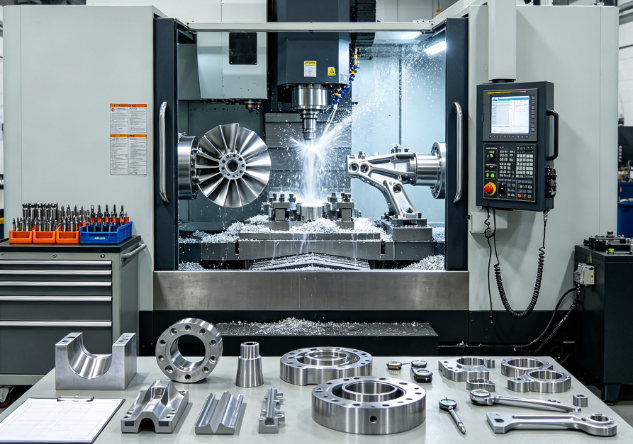
Simultaneous 5-axis machining accesses all complex part surfaces in a single clamp. Combined with AS9100 standardized quality control, stress relief and full non-destructive testing, it is the only validated production method for flight-grade titanium components. This guide breaks down every compliant process step, material-specific cutting parameters, defect prevention and supplier qualification criteria for aerospace OEM and Tier 1 programs.
Unique Challenges of Machining Titanium Ti6Al4V for Flight-Critical Parts
Titanium’s metallurgy creates manufacturing hurdles that demand specialized 5-axis machining workflows and strict AS9100 oversight:
- Low thermal conductivity Cutting heat stays concentrated on the tool edge instead of dissipating into chips. High heat causes rapid tool wear, surface burning and micro-cracks that fail aerospace NDT crack inspection.
- High chemical reactivity at high temperatures Hot titanium welds to carbide cutting tools, creating built-up edge that ruins surface finish and dimensional stability.
- Low elastic modulus (springback) Thin aerospace titanium ribs deflect under cutting force, leading to dimensional inaccuracies if light 5-axis trochoidal cutting paths are not used.
- High residual stress after material removal As stock is cut away, locked casting/forging stress releases, causing warpage days after machining without mandatory vacuum stress relief.
- Strict AS9100 zero-defect standards Even tiny surface burrs, micro pits or dimensional deviations can trigger full batch rejection, as flaws act as fatigue crack initiation points during flight cycling.
6 Core Advantages of Simultaneous 5-Axis Titanium Machining for Aerospace
Single Setup Eliminates Stacked Tolerance Error
All curved contours, angled holes, undercut pockets and rib features are machined in one zero-point fixture lock. No repeated part repositioning, so GD&T positional tolerances stay consistent across the entire titanium blank — critical for AS9102 First Article Inspection compliance.
Short, Rigid Tools Reduce Titanium Heat & Tool Wear
5-axis tilting orients the blank so short, stiff end mills stay perpendicular to cutting surfaces. Long extended tools required for 3-axis deep pockets generate excessive heat and chatter. Shorter cutters extend tool life by 40–60% and eliminate surface chatter marks that degrade fatigue performance.
Light Trochoidal Cutting Minimizes Thin-Wall Springback
5-axis software generates optimized constant-chip-load trochoidal roughing paths. Light, evenly distributed cutting forces reduce titanium rib deflection and springback, eliminating post-machining dimensional drift on lightweight lattice and thin-wall airframe structures.
Shorter Total Cycle Time for Complex Aero Geometry
Eliminates hours of operator re-fixturing, re-indicating and re-probing between machining stages. Complex titanium brackets that take 12–16 hours on 3-axis run in 6–9 hours on 5-axis, accelerating NPI gate deadlines for aerospace prototype and pilot batches.
Superior Surface Finish Boosts Fatigue Life
Continuous 5-axis tool contact produces smooth, uniform as-machined surfaces with minimal feed marks. Smoother titanium surfaces reduce fatigue crack initiation risk, meeting aerospace durability test requirements and lowering post-process polishing labor.
Full Batch Repeatability Required for AS9100 Audit Trails
Locked digital 5-axis CAM toolpaths run identical cutting sequences for every titanium part in a batch. Operator skill variation is removed, so dimensional data from CMM inspection maintains consistent records auditable under AS9100.
AS9100 Compliant 5-Axis Titanium Machining Full In-House Workflow
Every stage follows AS9100D quality management standards, with full traceability from raw titanium bar/forging to finished flight-ready component.
Aerospace-Focused DFM & Stress Simulation
Before cutting any titanium stock, our aerospace engineering team completes a dedicated AS9100-aligned DFM review:
- Run finite element residual stress simulation to predict warpage from uneven material removal
- Optimize rib thickness, internal radii and undercut angles for stable 5-axis light cutting
- Rationalize GD&T tolerances: only hold micron tight specs on flight-critical datum surfaces
- Adjust geometry to reduce deep hard-to-reach pockets that require long tool overhang
- Generate annotated CAD revisions and a documented risk assessment for OEM engineering sign-off
Temperature-Stabilized 5-Axis Equipment Setup for Ti Alloys
All 5-axis machining centers operate inside a temperature-controlled workshop (±0.5°C constant temperature) to eliminate thermal expansion drift on titanium:
- Granite machine base, heavy box guideways and high-torque low-runout spindles for rigid titanium cutting
- Full real-time thermal compensation software to offset spindle and axis heat buildup during long cycles
- Zero-point modular fixturing for fast, repeatable blank clamping without manual alignment
- Tool length and wear probes that auto-compensate cutting offsets mid-batch to prevent dimensional drift
- Calibration logs updated every 6 months per AS9100 metrology requirements
Optimized Titanium Roughing & Finishing Cutting Cycles
All cutting parameters are alloy-specific and locked for repeatable aerospace batches:
- Roughing stage: High-speed trochoidal milling with constant chip load to limit cutting force and heat buildup
- Semi-finish light stock removal pass, followed by full blank cool-down to normalize temperature
- Precision finish 5-axis simultaneous passes at low feed rates for smooth fatigue-resistant surfaces
- Coolant high-pressure flood delivery directly to cutting zone to draw heat away from titanium and tool edges
Mandatory Stress Relief & Vacuum Heat Treatment
AS9100 requires controlled stress relief for all structural titanium aerospace parts to prevent post-machining warpage:
- Vacuum furnace stress relief at standardized temperature hold and slow cooling ramp for Ti6Al4V forgings
- Full heat treatment batch log linked to raw material heat lot numbers for end-to-end traceability
- Hardness testing post-treatment documented and attached to each batch’s FAIR packet
Precision Deburring & Aerospace-Grade Surface Finishing
Sharp titanium burrs create fatigue failure initiation points and violate AS9100 surface quality rules:
- Automated ultrasonic micro deburring for internal pocket edges and thin rib intersections
- Manual precision hand deburr for critical datum and mating surfaces with controlled media
- Optional aerospace finishing: passivation, electropolishing, dry film lubricant coating for corrosion resistance
- Full solvent ultrasonic cleaning to remove all cutting fluid residue, no residual contamination for flight assembly
AS9100 Level 3 FAIR, CMM & NDT Inspection
Every titanium batch undergoes 100% inspection for flight-critical aerospace hardware:
- Temperature-controlled bridge CMM full GD&T scanning of all critical dimensions
- Surface roughness testing to verify fatigue-safe finish Ra values
- NADCAP-aligned non-destructive testing: penetrant PT, ultrasonic UT to detect micro-cracks and subsurface voids
- Complete Level 3 AS9102 FAIR report including material MTR, heat treatment logs, NDT results and CMM deviation data
- All inspection records digitally archived for minimum 7 years to meet OEM aerospace audit retention rules
Critical DFM Design Rules to Reduce Titanium Machining Scrap & Cycle Time
Apply these rules during CAD development to cut 5-axis titanium production cost and lower AS9100 rejection risk:
- Minimum internal radius ≥0.8mm for all pockets; small radii force tiny slow-cutting end mills and extend cycle time
- Maintain uniform wall thickness for all titanium ribs to balance stress release and avoid springback
- Limit maximum unsupported thin wall height-to-thickness ratio below 8:1 to prevent deflection during cutting
- Angle all deep pocket walls to accessible 5-axis orientations, eliminate blind undercuts requiring long tool extensions
- Add generous chamfers or radii to all external sharp edges to simplify deburring and eliminate burr initiation points
- Separate critical high-precision datum planes from heavy stock removal zones to avoid stress-induced distortion
- Design symmetrical part geometry where possible to evenly distribute residual stress during machining
Common AS9100 Aerospace Titanium Components Made With 5-Axis
These flight-grade titanium parts rely exclusively on simultaneous 5-axis machining to pass OEM qualification:
- Airframe structural brackets & lugs
- Landing gear lightweight sub-components
- Satellite & UAV sensor mounting frames
- Engine cold-section titanium housings and support arms
- Hydraulic manifold blocks with complex internal flow channels
- Missile and rocket lightweight structural fittings
- Medical aerospace transport fixture titanium frames
5-Axis Titanium vs 3-Axis Machining Side-by-Side Comparison Chart
| Evaluation Metric | Simultaneous 5-Axis Titanium Machining (AS9100 Compliant) | Standard 3-Axis CNC Titanium Machining |
|---|---|---|
| Required Part Setups For Complex Aero Geometry | 1 single zero-point clamp | 3–6 re-clamping cycles |
| GD&T Tolerance Consistency | Stable ±0.003–0.01mm full part | Stacked drift, higher dimensional deviation |
| Titanium Tool Wear & Heat Generation | Low (short rigid cutting tools) | Severe (long extended tools, high thermal load) |
| Thin Wall Springback Risk | Minimal via light trochoidal cutting | High, frequent dimensional scrap |
| As-Machined Surface Finish | Smooth low Ra, fatigue compliant | Visible chatter lines, extra polishing required |
| Total Machining Cycle Time | 40–60% faster for complex Ti parts | Long, multi-stage operator dependent |
| AS9100 Batch Repeatability | Digitally locked identical cutting paths | Operator alignment variation between batches |
| Best Aerospace Fit | Flight-critical complex titanium structural hardware | Simple flat low-complexity non-structural titanium blanks |
Real Client Case: AS9100 Ti6Al4V Aircraft Landing Gear Bracket Batch
A Tier 1 aerospace supplier required 18 Ti6Al4V forged landing gear brackets for aircraft NPI qualification, fully compliant with AS9100D standards.
Original 3-Axis Sourcing Pain Points
- Five separate re-clamping setups created consistent 0.02–0.04mm positional tolerance drift on mounting lugs, failing FAIR GD&T checks
- Long overhang tools generated extreme titanium heat, causing micro surface cracks detected during PT NDT testing (32% scrap rate)
- No integrated stress relief workflow; unrelieved forging stress caused warpage after machining
- Outsourced CMM and NDT added 5 extra days of lead time and disjointed audit documentation
Zorapid AS9100 5-Axis Titanium Solution
- Single-setup simultaneous 5-axis machining completed all curved lugs, angled holes and deep pockets without re-fixturing
- Optimized short-tool trochoidal cutting reduced thermal load, eliminating micro crack NDT failures
- In-house vacuum furnace stress relief standardized for titanium forgings to stabilize geometry
- Full in-house CMM, PT penetrant NDT and heat treatment with unified AS9102 FAIR batch documentation
- Temperature-controlled machining environment eliminated thermal expansion dimensional drift
Final Outcome
Zero dimensional scrap, all brackets passed OEM fatigue and NDT testing on first submission. Total lead time cut by 48% vs the previous 3-axis supplier, and all audit documentation fully aligned with the customer’s AS9100 program requirements.
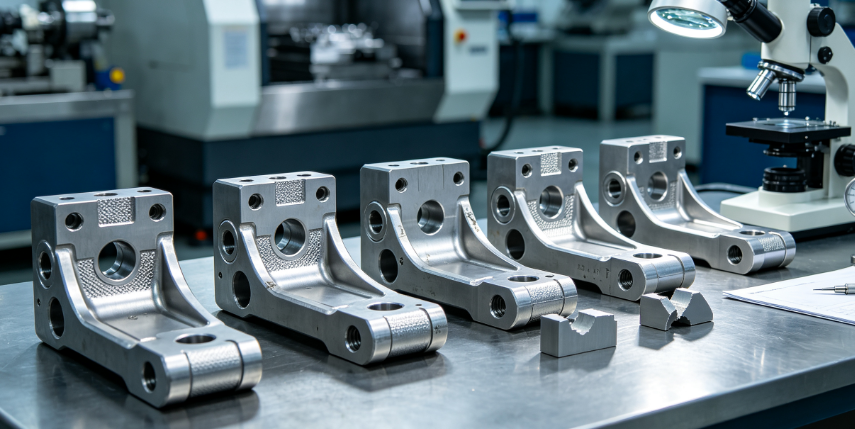
Most Frequent Titanium Machining Defects & Aerospace Approved Fixes
- Micro surface cracks detected by PT NDT Root cause: Excessive cutting heat, long overhang tools AS9100 Fix: Switch to 5-axis short rigid tool paths, high-pressure coolant flood, reduce cutting speed
- Thin titanium rib springback & dimensional out-of-tolerance Root cause: Heavy single-pass roughing, uneven cutting force AS9100 Fix: Trochoidal constant chip-load roughing, semi-finish cool-down cycle before final cuts
- Chatter marks on critical fatigue surfaces Root cause: Long tool extensions, unstable 3-axis fixturing AS9100 Fix: 5-axis part tilting to use shortest possible end mills, increase spindle rigidity
- Post-machining warpage weeks after production Root cause: Unrelieved residual forging stress AS9100 Fix: Mandatory vacuum stress relief heat treatment before any stock removal
- Hard burrs on internal intersecting edges Root cause: Unoptimized tool entry/exit paths AS9100 Fix: 5-axis controlled entry cuts + automated ultrasonic micro deburring post-machining
AS9100 Sourcing Checklist for 5-Axis Titanium Suppliers
Screen vendors against these mandatory aerospace criteria before awarding titanium component orders:
- Valid full-site AS9100D certification covering all 5-axis machining production lines
- Dedicated temperature-controlled 5-axis cells calibrated for titanium alloy processing
- In-house vacuum heat treatment furnaces for standardized titanium stress relief
- NADCAP accredited NDT lab (PT/UT) with Level II certified inspectors
- Full traceability system linking titanium forging heat lots to finished serialized parts
- Standardized AS9102 Level 3 FAIR documentation workflow for all flight batches
- Proven portfolio of structural titanium airframe/engine 5-axis machined components
- All cutting, heat treatment and inspection processes fully documented for OEM audit trails
- Ability to archive all batch manufacturing records for minimum 7 years
FAQ
Is 5-axis machining mandatory for AS9100 structural titanium parts?
Not legally mandatory, but it is the only process that reliably meets tight GD&T tolerances, low scrap rates and repeatability requirements for complex flight-critical titanium hardware. Most aerospace OEMs mandate 5-axis for multi-contour structural brackets to eliminate 3-axis setup drift risk.
Does every titanium aerospace part require vacuum stress relief under AS9100?
Yes for all load-bearing structural titanium forgings. Unrelieved residual stress causes post-machining warpage, which will fail long-term dimensional stability testing and OEM audit reviews.
What surface roughness standard is required for AS9100 titanium flight parts?
Critical fatigue surfaces typically require Ra ≤0.8 μm as-machined or post-deburr; high-load landing gear hardware often requires electropolishing down to Ra ≤0.2 μm to minimize crack initiation risk.
Can a supplier outsource NDT or heat treatment and still meet AS9100 titanium requirements?
All subcontractors must hold matching NADCAP accreditation, and the primary 5-axis vendor must maintain full end-to-end batch traceability linking every heat treatment and NDT step to your finished titanium components.
What documentation ships with every AS9100 titanium 5-axis batch?
Full packet including titanium MTR material certificate, vacuum heat treatment log, PT/UT NDT test reports, full CMM GD&T scan data and signed AS9102 Level 3 FAIR report with full batch traceability records.
Wrap-Up
Titanium aerospace hardware combines difficult-to-machine metallurgy with zero-tolerance AS9100 flight safety standards. Traditional 3-axis CNC creates avoidable scrap, tolerance drift and thermal defects that delay aerospace NPI and trigger costly OEM audit non-conformances.
Simultaneous 5-axis machining solves titanium’s core manufacturing challenges via single-setup rigid cutting paths, reduced heat load and minimal thin-wall springback. When paired with in-house vacuum stress relief, NADCAP-aligned NDT and full AS9100 traceability workflows, it delivers consistent, audit-ready flight-grade titanium components for airframe, engine and satellite programs.
Zorapid holds full AS9100D certification, operates temperature-stabilized 5-axis machining cells dedicated to Ti6Al4V aerospace parts, and manages every process stage in-house — from DFM stress simulation to heat treatment, precision deburring and full FAIR/CMM/NDT inspection. We eliminate third-party outsourcing gaps and deliver fully compliant low-volume prototype and pilot titanium batches aligned with global aerospace OEM quality rules.
Request Your Free AS9100 Titanium DFM Review & 5-Axis RFQ Quote
Submit your titanium component CAD, forging heat lot specs, GD&T drawing requirements and batch quantity. Our aerospace engineering team will run a full stress & manufacturability analysis, outline compliant 5-axis process steps, and provide a transparent itemized quote including heat treatment, NDT and full AS9100 audit documentation.