Published:Zorapid.Ltd
Automotive supply chains operate under zero-tolerance safety standards, tight production schedules, and rigid regulatory rules (IATF 16949, PPAP, FMEA). Unlike general industrial CNC shops, auto-grade manufacturers must deliver consistent, traceable parts for braking systems, EV battery frames, suspension components, powertrain housings and sensor brackets.
Unvetted CNC suppliers create catastrophic supply chain risks: dimensional scrap halting assembly lines, missing PPAP documentation delaying OEM launches, untraceable raw material batches triggering full product recalls, and delayed shipments disrupting just-in-time (JIT) production schedules.
This standardized checklist is built for Tier 1 and OEM procurement teams to screen, audit, and qualify CNC machining vendors for automotive mass production, pilot batches and NPI prototypes. Every item aligns with global automotive quality standards and EV component manufacturing requirements.
Pre-Qualification Quick Screening Checklist
Complete this digital review before scheduling on-site audits to filter unqualified vendors early:
- Valid IATF 16949 certification (not only generic ISO 9001) with non-expired audit certificate
- Verifiable automotive customer references (Tier 1 / OEM EV or combustion vehicle programs)
- Clear component portfolio matching your part types: EV aluminum frames, suspension parts, powertrain housings, sensor connectors
- Confirmed ability to generate full Level 3 PPAP submissions for production batches
- Documented JIT delivery program and historical on-time delivery (OTD) rate ≥96% for auto orders
- No active automotive recall liabilities or major customer non-conformance penalties in past 3 years
- Dedicated automotive engineering & SQE team with fluent English technical communication
- Clear material segregation system for auto-grade aluminum, cast iron, magnesium, copper alloys
Any unchecked item eliminates the vendor from formal automotive qualification.
Mandatory Certification & Automotive Compliance Checklist
Request physical certificate copies and verify audit validity during document review:
- IATF 16949:2016 full site certification covering all CNC machining lines
- ISO 14001 environmental management certification
- ISO 45001 workplace health & safety certification
- NADCAP accreditation for mandatory special processes (if applicable):
- Heat treatment for structural auto alloys
- Anodizing, hard coat, passivation, powder coating
- Magnetic particle / penetrant NDT for safety-critical parts
- RoHS & REACH compliance for all coating and raw material stock
- Conflict mineral compliance reporting framework for metal bar stock
- ITAR / export control documentation if supplying North American automotive programs
- Formal counterfeit material prevention program per automotive industry standards
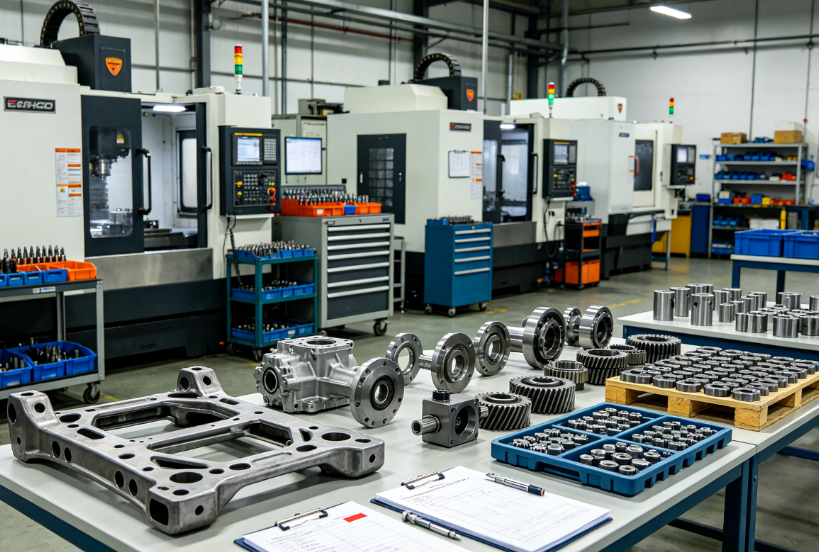
CNC Production Equipment & Process Capacity Audit Checklist
Match your auto component specs to verified equipment; demand 6-month calibration records for all machinery:
3/5-Axis CNC Capacity for Auto Structural & EV Parts
- Simultaneous full 5-axis machining centers with thermal compensation for complex EV contour frames
- Large gantry CNC for heavy cast iron engine bases and battery tray blanks
- Swiss turning cells for micro shaft sensor pins, valve cores and connector terminals
- Equipment calibration logs updated every 6 months for spindles, linear guides and axes
- Proven capacity to hold automotive GD&T tolerances ±0.002–0.01 mm on critical safety datums
- Separate dedicated production cells for prototype NPI batches and serial mass production
- High-volume automation: bar feeders, zero-point modular fixturing for stable cycle repeatability
Special Processes: Heat Treatment, Surface Coating, Deburring
All special processes must be controlled in-house or via NADCAP-certified traceable subcontractors:
- Vacuum stress relief furnaces for EV thin-wall aluminum frames to eliminate post-machining warpage
- Automated micro deburring lines to remove sharp edges without damaging auto sealing surfaces
- In-house hard anodizing Type II/III, powder coating, passivation for corrosion resistance
- Laser part marking for permanent serialized traceability per automotive standards
- Ultrasonic solvent cleaning to remove cutting fluid residue for clean EV battery assembly
In-House Tooling & Fixture Development
- Internal fixture design & CNC build team for custom automotive part holding jigs
- Standardized fixture changeover procedures to cut production downtime between auto SKUs
- Tool wear monitoring system with scheduled replacement to prevent dimensional drift mid-batch
- Fixture storage labeling system to avoid mix-ups across different automotive programs
Material Control & Full Automotive Traceability Checklist
Material mix-ups and broken traceability are top causes of automotive production line shutdowns and recalls. Verify these systems fully:
- Segregated raw material storage zones labeled by alloy grade, heat lot, batch number
- Locked inventory control to prevent cross-contamination of similar automotive aluminum/steel grades
- Full Material Test Report (MTR / COA) supplied with every shipment, linked to finished part serial numbers
- One-to-one lot traceability: raw bar stock → CNC production batch → finished auto component
- Unique serialized part marking for safety-critical brake, suspension and EV structural hardware
- Spectroscopy material verification process to detect counterfeit alloy stock upon receiving raw materials
- Segregated scrap bins with documented disposal logs for defective auto parts
- Controlled bulk alloy stock purchasing without forcing small-batch NPI customers to buy full unused bars
Quality Management & Automotive QA Checklist
Dimensional Metrology & CMM Inspection
- Temperature-controlled inspection room with bridge CMM machines for full GD&T scanning
- Annual third-party calibration for all calipers, micrometers, optical vision measuring systems
- 100% full inspection policy for safety-critical automotive batches; sampling plan documented for non-critical parts
- Dimensional deviation heat map reporting for large EV battery tray frames
- Digital archive of all CMM scan data for minimum 10 years per OEM audit requirements
PPAP, FMEA, Control Plan Documentation
- Standardized Level 3 PPAP package template aligned with AIAG automotive standards
- DFMEA / PFMEA process completed for every new automotive component before mass production
- Formal production control plan listing in-line inspection frequency, acceptance criteria and reaction plans
- Full documented run-at-rate capability studies (Cpk ≥1.67 for critical auto dimensions)
- Digital secure storage of all PPAP, FMEA, control plan records for easy OEM audit access
Non-Destructive Testing & In-Line Defect Prevention
- In-house or NADCAP outsourced NDT: ultrasonic testing, magnetic particle inspection for crack detection
- Level II certified NDT inspectors with active, valid certification cards
- Real-time in-process dimensional probing on CNC machines to catch drift during production runs
- Formal non-conformance containment procedure activated immediately upon defective part discovery
- 8D corrective action reporting process for all automotive batch rejection events
NPI & Automotive Engineering DFM Support Checklist
Qualified auto CNC suppliers provide proactive design optimization, not just machining services:
- Dedicated automotive mechanical engineering team familiar with EV lightweight alloy design rules
- Free pre-production DFM analysis focused on reducing warpage, scrap and Cpk risk
- DFM optimization for thin-wall EV aluminum frames, balanced wall thickness to minimize thermal stress
- Ability to adjust CAD geometry to simplify PPAP validation and lower mass production cost
- Formal engineering change control process with full revision traceability for auto program updates
- Past portfolio of EV battery trays, suspension brackets, powertrain housings and sensor hardware
- Fast iteration turnaround for NPI prototype batches to hit OEM gate deadlines
Production Batch Delivery & Supply Chain Stability Checklist
- Formal JIT scheduling system with scheduled weekly delivery windows for serial production
- Historical OTD performance tracking, target ≥96% on-time shipment for automotive orders
- Capacity surge planning for NPI ramp-up and seasonal vehicle production peaks
- Clean, scratch-proof protective packaging for EV aluminum cosmetic A-class surfaces
- Expedited dedicated production shifts for critical OEM gate deadline batches
- Separate prototype and mass production scheduling queues to avoid prototype delays behind large auto runs
- Batch lot labeling fully matching OEM receiving traceability requirements
Contingency & Risk Mitigation Checklist (Auto Supply Chain Disruption Guardrails)
Evaluate how the vendor mitigates production halts and program delays:
- Redundant CNC machining equipment for core automotive production lines
- Backup certified raw material suppliers for EV aluminum, magnesium and structural steel
- Facility disaster recovery plan for power outages, equipment breakdown or factory shutdown
- Cybersecurity controls for secure storage of OEM proprietary automotive CAD program files
- Non-disclosure agreement framework for restricted vehicle program IP protection
- Backup NADCAP subcontractors for heat treatment and coating if in-house lines go offline
- Long-term raw material stock buffer for active serial production automotive programs
On-Site Facility Audit Scoring Rubric
Score each section 0–10 (10 = fully compliant, 0 = critical gap requiring immediate corrective action)
- IATF & Automotive Certifications: ____ /10
- Material Traceability & Counterfeit Prevention: ____ /10
- CNC Equipment Calibration & Auto Process Capacity: ____ /10
- Special Processes (Heat Treat / Coating / NDT): ____ /10
- QA Metrology, PPAP & PFMEA Documentation: ____ /10
- NPI DFM Engineering & Technical Support: ____ /10
- JIT Delivery & Batch Packaging Control: ____ /10
- Facility Cleanliness & Contamination Control: ____ /10
- Supply Chain Contingency & Risk Planning: ____ /10
- Record Archiving & OEM Audit Readiness: ____ /10
Total Qualification Score: ____ / 100
- 90–100: Fully approved supplier, eligible for safety-critical mass production batches
- 70–89: Conditional approval; formal corrective action plan required before serial production
- Below 70: Disqualified; cannot be used for automotive component sourcing
Critical Red Flags: Disqualify CNC Vendors Immediately
Any single item below automatically removes a vendor from automotive supply chain qualification:
- Cannot provide valid, non-expired IATF 16949 certification
- Outsources heat treatment, NDT or coating to uncertified subcontractors with no full batch traceability
- No formal material lot traceability system; unable to link finished parts to raw heat lots
- Refuses to generate complete AIAG Level 3 PPAP submissions for production batches
- CMM, CNC and NDT equipment calibration logs expired over 6 months
- Scrap rate >4% on past automotive runs with no documented root-cause 8D reports
- Mixes automotive-grade raw alloy stock with general industrial metal in shared unmarked storage
- No Level II certified in-house NDT inspectors for safety-critical structural components
- Unable to archive batch inspection and PPAP records for the mandatory 10-year OEM retention window
- Poor facility contamination control (loose metal chips, unsegregated scrap, unlabeled material bins)
Post-Qualification Continuous Supplier Monitoring Checklist
Vendor qualification is not a one-time audit; quarterly reviews maintain approved automotive supplier status:
- Monthly OTD on-time delivery performance tracking
- Monthly non-conformance rate & 8D corrective action follow-up
- Annual recertification check for IATF 16949 and NADCAP accreditations
- Random lot spot audit: verify MTR, PPAP and CMM report completeness
- Bi-annual mini on-site facility walkthrough for material segregation and contamination control
- Full re-qualification audit every 12 months for safety-critical component suppliers
- Quarterly SQE satisfaction review with engineering and production feedback scoring
FAQ
Is IATF 16949 the only mandatory certification for automotive CNC suppliers?
IATF 16949 is the core mandatory standard, but vendors also need NADCAP accreditation for special processes like heat treatment and NDT, plus full material traceability and PPAP documentation workflows to pass full OEM qualification.
Can a CNC supplier outsource heat treatment or coating and still remain automotive qualified?
Yes, but all subcontractors must hold matching NADCAP certificates, and the primary CNC vendor must maintain end-to-end batch traceability linking every special process step to your finished auto components.
How long does full automotive CNC vendor qualification typically take?
Initial document screening takes 1–2 weeks. On-site facility audit, corrective action follow-up and final approval generally complete within 30–45 calendar days for new suppliers.
What documentation must ship with every automotive CNC batch?
Complete packet including material COA/MTR, heat treatment logs, NDT test reports, full CMM dimensional inspection records and serialized batch traceability logs. For first production runs, a full Level 3 PPAP package is required.
Do automotive NPI prototype CNC vendors follow this same qualification checklist?
Yes. Even prototype EV and combustion vehicle hardware requires traceable, auditable records, as lab test data feeds into formal OEM vehicle launch qualification programs. Looser QA standards for prototypes create compliance risks downstream.
Wrap-Up
This checklist eliminates subjective guesswork when qualifying CNC machining vendors for automotive supply chains, standardizing every compliance, quality and production requirement your OEM SQE audit teams will verify. Generic job shops fail multiple critical checklist items; only dedicated automotive CNC manufacturers build their entire workflow around IATF 16949, PPAP, full traceability and JIT delivery rules.
Zorapid holds full IATF 16949 certification, maintains NADCAP-aligned special process controls, and operates fully traceable CNC lines (3-axis, 5-axis, gantry and Swiss turning) for EV battery trays, suspension brackets, powertrain housings and automotive sensor hardware. Every batch ships with complete audit-ready documentation fully aligned with this supplier qualification checklist.
If your procurement team needs to source automotive structural or EV CNC components, our facility is pre-audit compliant against all checklist criteria, ready for your formal vendor qualification review.
Request Your Full Automotive CNC Vendor Qualification Documentation Packet
Share your automotive program compliance requirements, and we will supply all certification copies, equipment calibration logs, sample PPAP/CMM inspection reports and automotive customer references to speed up your vendor approval process.