Published:Zorapid.Ltd
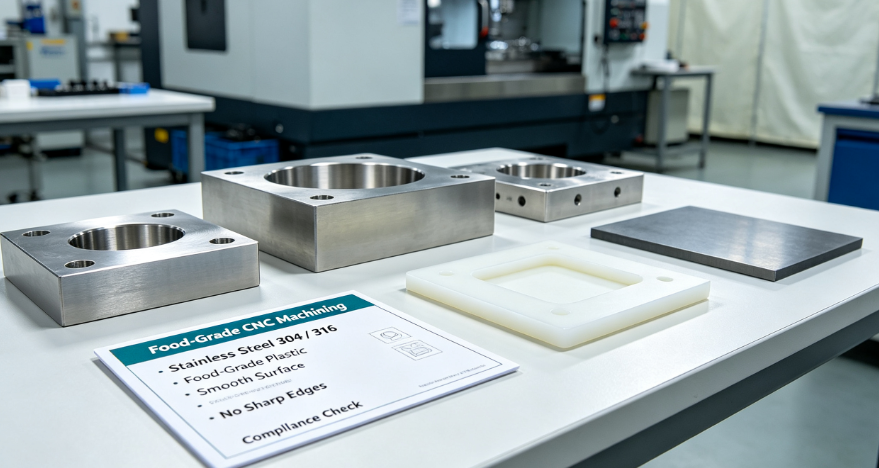
Food-grade CNC machining covers custom milled/turned components that directly or indirectly touch raw food, beverages, dairy, seasonings, and cleaning sanitizers. Unlike general industrial CNC parts, these components must satisfy dual requirements:
- Material safety: No toxic heavy metal leaching, no chemical migration into food, odor/taste transfer prohibited
- Machining hygiene: Smooth cleanable surfaces, zero dead corners, complete burr removal, compatible with CIP (Clean-in-Place) / SIP (Sterilize-in-Place) automated cleaning systems
Global buyers require traceable certifications rather than vague “food-safe” labels. This guide sorts mainstream CNC machinable food-grade materials, clarifies worldwide mandatory compliance frameworks, defines CNC-specific hygiene machining rules, lists common compliance failures, and provides actionable design & production standards for food processing shafts, valves, pump bodies, conveyor fittings, mold inserts and sanitary hardware.
Global Mandatory Compliance Frameworks (Critical for Export CNC Parts)
Four major regulatory systems govern food-contact CNC machined components; compliance is market-specific and non-interchangeable.
United States Compliance Rules
- FDA 21 CFR (Core Federal Regulation) Covers all food-contact metals, plastics, elastomers. Key clauses:
- Metals: 21 CFR 175.300, 175.390 for stainless steel, aluminum, brass
- Plastics: 21 CFR Part 177 series for PEEK, POM, HDPE, PP, PTFE Threshold of Regulation (ToR): Substance migration below 0.5 ppb is exempt from strict approval; carbide cutting tools receive FDA TOR exemption for repeated food equipment use.
- NSF/ANSI 51 (Most Widely Required by US Food Factories) Third-party certification for commercial food machinery materials. Validates long-term sanitation, cleanability, corrosion resistance, mandatory annual factory audits. Required for dairy, meat processing, commercial bakery equipment.
- 3-A Sanitary Standards Strict dairy/beverage-specific certification. Governs both material grade and CNC geometry: smooth radii, drainable slopes, sealed threads. Mandatory for milk, juice, beer filling equipment.
- USDA Recognition: FDA-compliant materials are accepted for meat/poultry production lines with valid Certificate of Conformance (CoC) records.
European Union Compliance System
- EC 1935/2004 (Overarching EU Framework Regulation) All food-contact products sold in EU must comply. Mandates GMP (Good Manufacturing Practice), prohibits material altering food color, smell, taste or safety; full traceability required for all raw materials and CNC batches.
- EU 10/2011 Detailed migration limits for all food-grade plastics, defines overall migration limit 60 mg/kg food or 10 mg/dm² surface area.
- German LFGB (Strictest EU Regional Standard) Enforced in Germany, Switzerland, Austria. Adds strict odor/sensory testing; heavy metal limits are 30%–50% tighter than baseline EU rules. Common for premium kitchen and beverage equipment exports to German-speaking regions.
Domestic China Compliance
GB 4806 national series (GB 4806.7 metal, GB 4806.7 plastic) for domestic food machinery sales. GB 16798-2023 governs food machinery structural hygiene and CNC part design requirements
Compliance Document Checklist All CNC Suppliers Must Provide
- Material test certificate (MTC 3.1 full traceability, heat batch number)
- FDA/LFGB/EU 10/2011 compliance CoC
- NSF 51 / 3-A certification copy (if end-user requires)
- Surface roughness Ra inspection report
- Passivation / electropolishing certification for stainless steel
Approved CNC Machinable Food-Grade Materials (Classified: Metals / Engineering Plastics / Elastomers)
All listed grades support CNC milling, turning, drilling, tapping; clearly matched to food application scenarios, corrosion resistance and compliance status.
Food-Grade Metals (Most Common CNC Structural Materials)
| Material Grade | Compliance Approval | CNC Machining Features | Ideal Food Applications | Limitations |
|---|---|---|---|---|
| 304 / 304L Stainless Steel | FDA, EU 1935/2004, LFGB, NSF 51 | Excellent general machinability; avoid heavy deep cuts to reduce work hardening; easy polishing/passivation | Indoor dry food, bakery, grain processing, general sanitary shafts, housings, clamps | Poor resistance to salt, tomato/citric acid, bleach sanitizer |
| 316L Stainless Steel | Full global certification | Slightly harder to machine vs 304; low carbon prevents intergranular corrosion post-welding/machining | Seafood pickling, dairy, wine, salty food, CIP chemical cleaning equipment, valve bodies, pump CNC components | 20%–30% higher material cost than 304 |
| Food-Grade 6061 Aluminum | FDA compliant (anodized only) | Fast high-speed CNC turning/milling, lightweight | Dry food conveyor rollers, low-load structural brackets | Bare aluminum forbidden for acidic/salty food; must have hard food-safe anodizing |
| C932 SAE660 Bearing Bronze | FDA, EU approved | Easy CNC turning for bushings, self-lubricating | Food pump bushings, low-speed wear sleeves | Not for long structural shafts; avoid contact with strong acid |
| C360 Free-Cutting Brass | FDA compliant | Premium threading performance for sanitary fittings | Water pipe threaded connectors, beverage quick couplings | Restricted from acidic food; cannot touch vinegar, citrus regularly |
Prohibited Metals for Food Contact: Regular carbon steel, leaded steel (12L14), uncoated copper, 416 stainless (sulfur additive risks food odor transfer).
Food-Safe CNC Engineering Plastics (Wear Parts, Non-metal Contact Surfaces)
All plastics require unfilled natural base resin; colored, glass-filled grades need additive-by-additive FDA/EU validation before use.
- POM Delrin (Acetal) Compliance: FDA 21 CFR 177.2470, EU 10/2011, NSF 51 CNC traits: Clean chip formation, stable dimensional accuracy, easy precision turning/milling Use: Conveyor stars, food guide wheels, low-friction sliding blocks, sanitary gaskets Advantage: Resists hot water cleaning; no moisture absorption
- Natural PEEK (Unfilled) Compliance: FDA 21 CFR 177.2415, LFGB, NSF 51, high-temperature certified CNC traits: Moderate cutting speed required; rigid, minimal warping Use: High-temperature sterilized food parts, baking machinery components, repeated SIP autoclave parts Only natural unfilled PEEK allowed; glass-filled PEEK needs special migration certification
- HDPE / UHMW-PE Compliance: FDA, NSF 51, USDA approved CNC traits: Soft, prone to melting; use single-flute plastic end mills with air cooling Use: Cutting boards, food scraper blades, liner plates, wear strips for meat processing Low temperature tolerance; cannot run above 80°C continuous
- PP Polypropylene Compliance: Full global food certification CNC traits: Low melting point, high RPM + fast feed mandatory to avoid melting Use: Cold beverage piping fittings, frozen food machinery disposable custom CNC parts Not suitable for hot oil or high-heat sterilization
- PTFE Teflon Compliance: FDA, LFGB, EU compliant CNC traits: Soft, prone to edge chipping; low cutting force Use: Food valve sealing seats, non-stick forming dies, high acid contact components
- PVDF Compliance: FDA food contact CNC traits: Chemical resistant, rigid Use: Strong acid food processing (vinegar, fruit acid) equipment internal CNC parts
Forbidden Plastics: Regular ABS, PVC general grade, nylon with unapproved additives, all recycled mixed plastic without full migration testing.
Silicone (CNC Machined Solid Silicone Parts, Gaskets, Seals)
Solid food-grade silicone rubber can be CNC milled into custom gaskets, bumpers, hose connectors. Compliance: FDA 21 CFR 177.2600, LFGB, NSF 51 Machining tips: Sharp high-helix tools, low spindle speed, air cooling to prevent rubber tearing Application: Food lid seals, high-temperature oven machinery silicone components, beverage pipe gaskets
Non-Negotiable CNC Machining Compliance Rules (Hygiene & Sanitation Standards)
Material certification alone cannot guarantee compliance; CNC processing techniques determine cleanability and bacterial risk. These standards apply to all food-contact machined surfaces.
Mandatory Surface Roughness (Ra) Standards
Surface texture controls biofilm buildup; rougher surfaces trap bacteria, residues and cleaning chemicals.
| Part Zone | Required Maximum Ra Value | Post-CNC Treatment |
|---|---|---|
| Direct food contact (product zone) | Ra ≤ 0.8 μm (32 μin) universal standard | Polishing, electropolishing, precision finishing |
| High-hazard zones (dairy, sticky sauce, meat) | Ra ≤ 0.4 μm | Electropolishing (EP) + passivation for stainless steel |
| Non-contact structural surfaces | Ra ≤ 1.6 μm | Standard finish acceptable |
Critical rule: All tool marks, feed lines, microscopic grooves must be eliminated on contact surfaces. Electropolishing is preferred over mechanical polishing for sanitary stainless steel CNC parts because it smooths micro-peaks uniformly and boosts corrosion resistance.
Burr Removal & Edge Hygiene
- All CNC holes, milled pockets, thread openings must be fully deburred (no micro-burrs). Tiny burrs trap food debris and breed bacteria.
- External sharp edges: Add 0.3–1 mm radius or chamfer; sharp right-angle edges are prohibited on contact surfaces per 3-A/EHEDG guidelines.
Internal Geometry: Eliminate Dead Legs & Retention Pockets
CNC DFM mandatory design rules for food machining:
- All internal corners ≥R3 mm; sharp 90° internal angles trap food residue and cannot be fully cleaned by CIP/SIP.
- Design drain slopes ≥1.5° on horizontal machined surfaces so cleaning liquid flows out completely with no pooling.
- Avoid blind narrow deep holes; redesign through holes or add drain holes.
Stainless Steel Post-Machining Mandatory Treatment
All CNC stainless steel food parts require two post-process steps for compliance:
- Passivation per ASTM A967: Removes free iron particles from CNC cutting, rebuilds protective chromium oxide anti-rust layer; prevents surface rust and metal particle shedding into food.
- Weld areas on CNC assemblies must be ground and polished to match base Ra; remove heat tint oxidation which causes pitting corrosion.
CNC Production Cross-Contamination Prevention (GMP Requirement)
FDA/EU GMP bans mixing food-grade and regular metal machining on shared equipment:
- Dedicated CNC machines or dedicated cutting tool sets for food-grade materials; carbon steel chips must never contaminate stainless/plastic food blanks.
- Cutting fluids: Food-contact parts use food-grade soluble oil coolant only; regular industrial coolant with sulfur/chlorine additives is forbidden. Dry air cutting recommended for most food plastics.
- Fixturing: Vise jaws, fixtures used for food parts must be stainless steel or food-grade HDPE; carbon steel fixtures cannot touch food blanks.
Thread & Fastener Hygiene Rules for CNC Turned Bolts
- Prefer fully sealed threads; open exposed threads collect food grime. Design thread relief shanks so threads sit outside food contact zones.
- Avoid fine shallow threads prone to residue trapping; coarse threads are easier to sanitize.
Material Selection Decision Table by Food Working Environment
| Operating Condition | #1 Recommended CNC Material | Secondary Option | Key Compliance Note |
|---|---|---|---|
| Dry grain, bakery, room-temperature neutral food | 304 Stainless Steel | HDPE/Delrin plastic | NSF 51 required for commercial bakery |
| Acidic food (tomato, citrus, vinegar) | 316L Stainless Steel | PVDF plastic | LFGB certification mandatory for EU acid food export |
| Salty food, seafood, brine processing | 316L Stainless Steel | UHMWPE | Passivation after CNC machining is non-negotiable |
| High-temperature baking, autoclave SIP sterilization | 316L / Natural PEEK | Food silicone | PEEK must be unfilled natural grade |
| Cold frozen food, low-load wear components | UHMW-PE, Delrin POM | 304 stainless | Avoid aluminum in thaw cycles with moisture |
| Dairy, yogurt, sticky viscous products | Electropolished 316L | PEEK | Strict 3-A certification + Ra ≤ 0.4 μm |
| Chemical heavy CIP/SIP cleaning cycles | 316L EP passivated | PTFE/PVDF | Resists repeated bleach, alkaline sanitizer erosion |
Top Common Compliance Failures in Food CNC Machining
- Using general 304 without passivation after CNC cutting Consequence: Free iron causes surface rust; metal particles contaminate food, failing FDA inspection.
- Glass-filled PEEK/Nylon used without additive certification Glass fibers shed micro-particles; unapproved fillers violate EU migration limits.
- Rough surface Ra 1.6 μm or higher on dairy contact parts Biofilm forms; risk of Listeria/Salmonella growth leading to factory shutdown and product recalls.
- Machining food stainless steel with shared carbon steel tools Carbon steel cross-contamination creates rust specks on stainless surfaces.
- Sharp internal CNC corners with zero radius Residue cannot be flushed by CIP; repeated sanitation fails audit standards.
- Leaded brass / 12L14 accidentally used for food fittings Lead leaching violates all global food laws; immediate product recall required.
Design for CNC Hygiene (DFM Checklist for Designers)
All contact internal radii ≥3 mm; no sharp internal corners
Sloped surfaces for full liquid drainage
Complete burr removal on all holes and edges
Specify Ra value clearly on 2D drawings (differentiate contact vs non-contact surfaces)
List exact material grade + required certifications on CAD print (FDA/NSF/LFGB)
Mark passivation/electropolishing requirements for stainless steel
Locate threads outside food contact areas where possible
Do not design blind deep recesses and horizontal dead pockets
Avoid mixed material batches without separate traceability numbers
Do not specify colored plastic without full additive compliance documents
FAQ for CNC Manufacturers & Product Designers
Does “FDA compliant” equal NSF certified?
No. FDA is a government regulatory standard proving material safety. NSF 51 is third-party independent certification including factory audit, periodic re-testing and sanitation validation. Most large US food processors require NSF certification beyond basic FDA paperwork.
Can glass-filled PEEK/Nylon be used for food contact CNC parts?
Only if every filler additive has formal FDA/EU migration approval. Most glass-filled plastics fail food compliance; unfilled natural PEEK/nylon is the default safe choice.
What is the cheapest fully compliant stainless steel for food CNC machining?
304/304L stainless steel works for 80% of indoor dry food applications, balancing compliance, CNC machinability and cost. Upgrade to 316L only for salt/acid/chemical cleaning exposure.
Do all food plastic CNC parts need dry air cooling only?
Yes. Liquid flood coolant causes moisture absorption (nylon) and dimensional swelling, plus risk of coolant chemical contamination. Compressed dry air is the standard cooling method for food-safe plastic milling/turning.
Why is electropolishing specified for dairy CNC stainless parts?
Electropolishing lowers surface roughness consistently to Ra ≤0.4 μm, eliminates micro crevices for bacterial growth, improves corrosion resistance against dairy lactic acid, and meets strict 3-A sanitary codes.
What documentation do customs/auditors check for exported CNC food parts?
Material heat certificate traceability; 2) FDA/LFGB/EU CoC; 3) surface roughness inspection report; 4) passivation certificate for stainless; 5) NSF/3-A certificate if required by buyer.
Final Conclusion
Food-grade CNC compliance relies on three pillars: verified certified material grades, controlled hygienic CNC manufacturing processes, and sanitary geometric design optimized for cleaning.
- Metal selection rule: 304 for general use, 316L for corrosive salt/acid environments; passivation/electropolishing are mandatory post-CNC treatments for stainless steel.
- Plastic rule: Stick to unfilled natural FDA/EU-approved resins (Delrin, HDPE, PEEK, PTFE); avoid filled/colored plastics without full additive certification.
- Machining hygiene core: Enforce Ra ≤0.8 μm for all food-contact surfaces, eliminate burrs/dead corners, use dedicated tooling and food-grade coolant, separate food-grade machining from regular industrial metal processing.
- Match certification to target market: FDA+NSF for USA, EC1935+LFGB for Europe, GB 4806 for domestic China. Full traceability documentation is required for all production batches to pass third-party audits and customs clearance.