Shaft machining is a manufacturing process for processing cylindrical parts. It can also fabricate components with complex shapes with the highest precision and accuracy. Thanks to such high precision, these parts can be used in critical application fields such as aerospace and automotive industries. There are many types of shaft machining processes, several of which are introduced as follows.
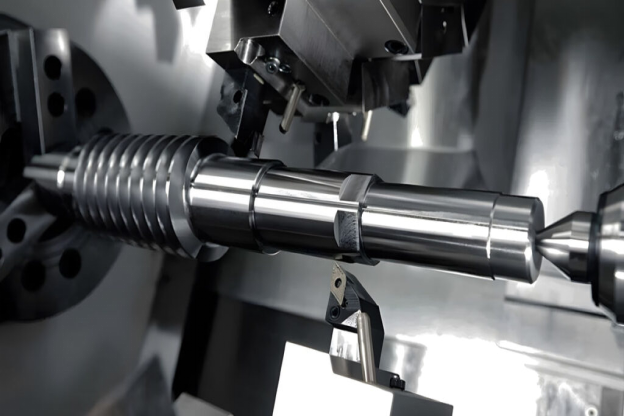
What is Shaft Machining?
Shaft machining involves three steps: cutting, shaping, and final processing to form a shaft. In short, shaft machining is a manufacturing process that converts raw materials into desired cylindrical components.
A shaft is an essential part of any machine, used to transmit torque and power to connected components. Custom shaft machining is also adopted to produce parts with special design requirements.
What are the applications of machined shafts?
Machined shafts transmit power, torque and motion between components, while withstanding mechanical stress during operation.
Common applications of machined shafts include:
- Vehicles
- Propeller shafts
- Armature shafts in electric motors
Precision Shaft Machining Processes
There are various operations for shaft machining, including 10 key types. We will cover which operation suits the corresponding applications.
1. CNC Turning
CNC turning ensures high precision for the production of custom drive shafts. It is used to machine cylindrical parts.
Machining Principle
The workpiece rotates continuously while a stationary cutting tool removes material.
Applications
- Cylindrical shafts
- High-precision custom shafts
Features
One of the best operations for manufacturing cylindrical profiles with tight tolerances.
2. CNC Milling
CNC milling produces parts with complex shapes by removing material. It is a shaft machining process that uses multiple milling cutters during operation.
Machining Principle
The working principle is opposite to CNC turning.
The workpiece remains stationary while rotating cutting tools remove material from it.
Applications
- Complex geometries
- Profiles such as spline shafts
Features
It is considered a versatile shaft machining operation for producing complex shapes and profiles.
3. CNC Grinding
CNC grinding is used to create smooth surfaces for mechanical products. With automated functions, it maintains a smooth and flawless finish.
Machining Principle
A grinding wheel removes excess material from the surface.
Applications
Production of precision shafts with smooth surfaces
Features
An excellent choice for achieving tight tolerances and smooth surface finishes.
4. EDM (Electrical Discharge Machining)
An unconventional machining process that removes surface material using electrical sparks. This method only works for electrically conductive materials.
Machining Principle
The workpiece is placed between two electrodes. An electric field is applied, generating electrical sparks between the electrodes to erode and remove material.
Applications
Suitable for complex components requiring minimal material deformation.
- Surgical instruments
- Precision gear manufacturing
- Prototype production
Features
EDM is the ideal process for hard, conductive, and complex-shaped parts.
5. Thread Rolling
A cold forming process in which hardened steel dies replicate the required thread profile. The metal blank is plastically deformed into threaded shape, enhancing thread strength and fatigue resistance.
Machining Principle
Wire or metal bar passes between two flat dies — one moving and one stationary — both engraved with thread profiles.
Applications
- Threaded fasteners
- Pipe fittings
- Stud production
Features
Recommended for producing strong, durable threads without material removal.
6. Broaching
Broaching uses a toothed cutting tool to remove material in a single pass, forming internal or external profiles in one operation.
Machining Principle
A serrated cutting tool moves linearly to strip material from the workpiece.
Applications
- Keyway cutting
- Spline cutting
- Turbine disk slots
- Automotive steering shafts
Features
High precision makes this process ideal for machining internal features.
7. Gear Hobbing
Gear hobbing is a dedicated milling process for gear cutting, performed as a continuous machining operation.
Machining Principle
A gear hob cuts the workpiece teeth down to the required dimension.
Applications
- Gear shafts
- Sprockets
- Gear sets
Features
A highly efficient process for producing high-precision gear teeth.
8. Deep Hole Drilling
This machining process drills holes along the thickness direction of workpieces using specialized drill bits.
Machining Principle
The drill bit is positioned at the drilling location, then the machine is activated to penetrate the material.
Applications
- Hollow shafts
- Aircraft landing gear components
- Injection mold holes
Features
Ideal for achieving straightness and precision in deep bore holes.
9. Cold Roll Forming
Cold roll forming produces finished parts by rolling sheet metal through two or more rollers at room temperature.
Machining Principle
Metal sheet is fed through a series of rollers to be gradually formed into the target profile.
Applications
- Lightweight shafts
- Railway components
- Tubes and piping
Features
Increases part strength through work hardening while delivering a smooth surface finish.
10. Swaging
In the swaging process, rotating hammers or dies shape metal into the desired form.
Machining Principle
Metal stock is placed between rotating hammers or dies for gradual forming.
Applications
- Tubular parts
- Bars and wires
- Tapered shafts
Features
Produces smooth, concentric, tapered profiles with excellent surface quality.
Precision Shaft Machining Process Chart
| Process Application | Machining Principle | Typical Applications |
| CNC Turning | Rotating workpiece, cutting tool | Custom drive shafts, cylindrical shafts |
| CNC Milling | Rotating tool, fixed workpiece | Spline shafts, complex geometries |
| CNC Grinding | Grinding wheel | Precision shafts, smooth surface finishes |
| EDM | Electrical spark erosion | Complex parts, minimal deformation |
| Thread Rolling | Material deformation | Threaded shafts |
| Broaching | Linear cutting motion | Internal splines, automotive axles |
| Gear Hobbing | Hob cutting tool | Gear shafts |
| Deep Hole Drilling | Drilling deep holes | Hollow shafts |
| Cold Rolling Forming | Room-temperature deformation | Lightweight shafts |
| Rotary Swaging | Rotating tool for diameter reduction | Tapered shafts |
Types of Machined Shafts and Their Applications
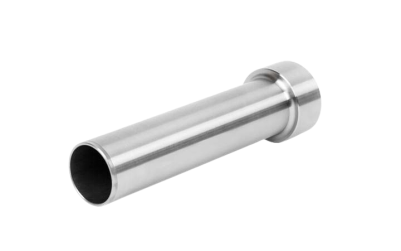
Hollow Shaft
Applications
Golf club shafts, PTO shafts
Features
Lightweight and high efficiency, suitable for special-purpose scenarios.
Threaded Shaft
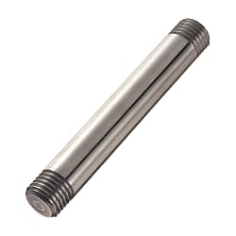
Features
An essential component for safe mechanical connection.
Applications
- Drive shafts
- Electrical industry
- Piping industry
Key Shaft
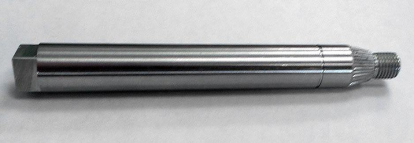
This shaft firmly connects the motor to the shaft assembly, ensuring smooth torque transmission.
Features
An essential component for safe torque transfer in mechanical systems.
Applications
- Power transmission
- Assembly and disassembly
Spline Shaft
The shaft is machined with teeth or ridges along its surface. These teeth help lock it securely to other mating components.
Features
Commonly used in powertrain systems and transmission applications.
Applications
- Powertrain systems
- Automotive systems
Tapered Shaft
A type of shaft with a diameter that gradually increases or decreases along its length. The tapered design ensures a tight, secure connection.
Features
It provides secure connection under high-pressure applications.
Application Fields
- Precision applications such as drive shaft manufacturing
- Golf club shafts
- Hydraulic hubs
Shaft Manufacturing Process: From Design to Production
The complete shaft manufacturing workflow from design through final production.
Design and Programming
CAD/CAM software is adopted for design work.
Mastercam software is used for programming shaft machining operations.
Machine Setup
Prepare the shaft machining equipment for the required operations.
Verify all settings are fully configured and ensure no components are missing.
Machining and Finishing
Multiple techniques are applied in machining, including turning, milling and more.
Finishing processes involve heat treatment or surface treatment.
What Are the Common Materials for Shafts?
You will find a variety of materials used for shaft machining, each with unique properties to meet different shaft performance requirements.
Steel
Features
- High strength and durability
- Good corrosion resistance
Applications
- Steel drive shafts
- Gear shafts
Aluminum Alloy
Features
- Lightweight design
- High strength-to-weight ratio
- Good ductility, durability, and corrosion resistance
Applications
- Aerospace industry (aluminum drive shafts)
Stainless Steel
Features
Stainless steel is an extremely durable material, mainly used for shafts in heavy machinery. It offers excellent corrosion resistance due to its chromium passivation layer.
Applications
- Shaft seal manufacturers and drive shaft components
Titanium
Features
- Excellent fatigue strength
- High strength-to-weight ratio
Applications
- Aerospace shafts (i.e., rotor shafts)
- Marine shafts
- Propeller shafts
Nickel Alloy
Features
- Excellent mechanical properties
- Suitable for extreme conditions
Applications
- Marine shaft systems
- Aerospace shaft systems
Surface Finishing Options for Custom Machined Shafts
To prevent issues such as corrosion or erosion, various surface treatment methods can be used.
Anodizing
This is an electrochemical process that increases the thickness of the natural oxide layer.
- Protective coating for PTO shafts and other sensitive applications
Polishing
This surface finishing process improves surface smoothness through chemical treatments such as nitric acid or sulfuric acid.
- Enhances appearance and reduces wear on machined shafts
Electroplating
In this process, an electric current is used to deposit a very thin layer of metal onto the surface of the base material.
- Improves corrosion resistance for drive shaft components
Passivation
In this process, free iron in stainless steel is removed, and a protective oxide layer is formed to enhance the corrosion resistance of the shaft.
- Prevents corrosion, especially suitable for stainless steel shafts
Sand Blasting
The stainless steel workpiece is placed in a chamber.
Fast-moving beads are projected onto the workpiece.
Creates a uniform surface texture for machined shaft parts.
What Is Large-Scale Shaft Machining?
Large-scale shaft machining refers to the processing of shafts whose diameter, length and weight are much larger than standard sizes.
How Large Can Large-Scale Shaft Machining Be?
Specialized equipment such as heavy-duty lathes is required to handle these oversized shafts.
Materials and Processes for Large-Scale Shaft Machining
Large shafts are mainly processed by CNC turning or precision grinding.
Available materials include aluminum, titanium and steel, selected according to actual application requirements.
Common Shaft Types and Their Industrial Applications
Different types of shafts and their industrial applications.
Drive Shaft
This shaft enables motion by transmitting power from the engine to the wheels.
Applications
- Automobiles
- Agricultural machinery
- Powertrain systems
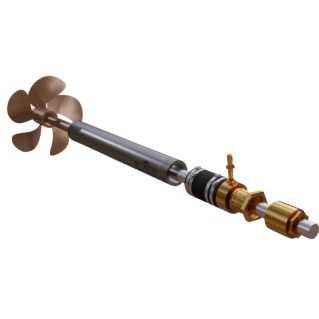
Propeller Shaft
Applications• Marine and aerospace industries
Axle
This shaft transmits the rotational force of the transmission system to the drive wheels and other components. It is regarded as a load-bearing part.
Applications
Used in vehicles and heavy machinery.
Armature Shaft
It has two key functions. First, it conducts electric current in a magnetic field to generate shaft torque inside operating machinery. Second, it produces electromotive force. Armature shaft manufacturers mainly produce this type of shaft.
Applications
Mainly used in electric motors.
Golf Club Shaft
When playing golf, the swing generates energy, and the golf club shaft transfers this energy to the ball.
Applications
Customized to meet specific performance requirements for sports such as golf.
Choose the Right Shaft Manufacturer for Your Project
You should first clarify the required materials, dimensions, precision and application requirements. Then evaluate the manufacturer’s equipment advancement and professional expertise, and finally compare production costs.
Shaft Manufacturer
Zorapid delivers custom shafts with high precision and tight dimensional tolerances.
Global Supplier
Factors such as cost, lead time, and manufacturer expertise help in selecting among global suppliers.
Professional Shaft Manufacturer
These manufacturers specialize in niche products such as ductile iron shafts and drive shaft gear rings.
Zorapid Shaft Machining Capabilities
Zorapid fully complies with all manufacturing standards for high-precision drive shafts. We have experienced manufacturing teams and advanced equipment, capable of producing custom drive shafts, PTO drive shafts and more. We deliver your orders with short lead times and competitive pricing.
4 Tips for Designing and Manufacturing Custom Shafts
Following these tips can greatly improve the precision of custom shaft manufacturing.
Dimensional Accuracy
Ensure tight tolerances and precise fit, especially in the machining of long shafts.
Material Selection
Choose materials according to application requirements, such as aluminum drive shafts for lightweight applications.
Shaft Alignment
Maintain proper alignment throughout the manufacturing process to prevent mechanical failure.
Stress Analysis and Load Consideration
Conduct adequate testing, especially for drive shaft components, to guarantee service life and overall performance.
FAQ
What is a shaft in a machine?
It transmits power or motion to connected components within machinery.
What are the most common materials for shaft manufacturing?
The most widely used materials for shaft machining include steel, titanium, and nickel-based alloys.
How do I choose the best machining technology for my shaft?
The required precision level of the shaft is critical when selecting the optimal machining process. CNC machine tools are recommended to achieve the best results.
What is the cost of custom or replacement drive shafts?
The cost of a custom drive shaft is determined by material selection and design complexity throughout the engineering and manufacturing process.