Tapping is fast — but it’s risky. Broken taps, stripped threads, inconsistent pitch diameters, and scrapped high-value parts are all too common in CNC shops worldwide.
That’s why thread milling has become the gold standard for precision, hard metals, thin walls, deep blind holes, and aerospace/medical-grade threads.
But here’s the problem:
90% of CNC engineers and machinists pick the wrong thread mill. They choose multi-form for thin walls, single-form for high-volume production, cheap uncoated tools for superalloys, or incorrect tool diameters that destroy thread profiles.
Bad thread mill selection = chatter, deflection, poor surface finish, out-of-tolerance pitch diameters, tool breakage, and expensive scrap.
At Zorapid, we’ve processed 100,000+ thread milling jobs across aluminum, stainless steel, titanium, Inconel 718, and hardened steel (HRC 55+). We’ve fixed every thread-milling mistake in the book and mastered the edge cases most shops can’t handle.
This is the most complete, data-backed thread mill selection guide online. It covers tool types, parameter rules, material matching, industry secrets, exclusive Zorapid capabilities, real case data, and actionable DFM rules engineers can reference directly.
Let’s master thread milling once and for all.
Full Technical Breakdown: All Thread Mill Types & Working Principles
Thread milling is a helical interpolation machining process. Unlike tapping (fixed spiral feed), thread mills move freely in X/Y/Z axes, delivering higher precision, zero tool jamming, and unbeatable flexibility.
To select perfectly, you first need to understand the4 core thread mill categories and their mechanical pros/cons.
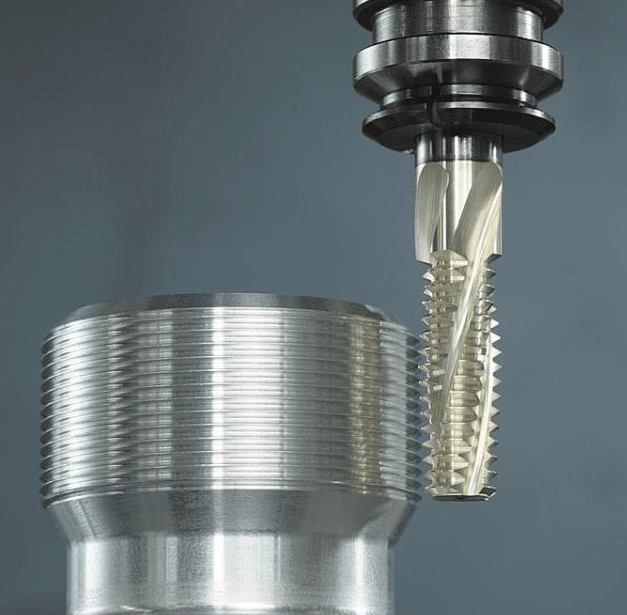
Single-Form (Single-Tooth) Thread Mills
Design feature: Only one cutting tooth with full thread profile; multiple flutes for chip evacuation.
Machining logic: Cuts thread profiles layer by layer via multiple helical passes, with ultra-low radial cutting force.
Core advantages
- Universal compatibility: One tool covers all same-angle threads (60° metric, 55° pipe thread) with different pitches and diameters
- Near-zero deflection: 60–80% lower cutting force than multi-form tools
- Perfect for extreme scenarios: Thin walls, deep blind holes, hard superalloys
- Precision maxed out: Stable pitch diameter tolerance up to ±0.008mm
Best use cases: Prototypes, low-volume batches, thin-wall parts (<1mm), Ti/Inconel/HRC50+ hard metals, blind holes deeper than 3× diameter, custom non-standard threads.
Multi-Form (Multi-Tooth) Thread Mills
Design feature: 3–10 continuous stacked thread teeth, matching complete thread pitch and height.
Machining logic: Completes full thread depth in 1–2 helical passes, drastically shortening cycle time.
Core advantages
- Extreme efficiency: 3–5× faster than single-form thread milling
- Uniform thread finish: Consistent tooth cutting for standard threads
- Low programming cost: Simple toolpath, suitable for mass production
Limitations: Fixed pitch only, high cutting force, easy to cause thin-wall deflection and tool chatter on hard metals.
Best use cases: High-volume standard threads, shallow holes, rigid aluminum/stainless steel parts, mass production batches.
Indexable Insert Thread Mills
Design feature: Carbide insert + steel tool holder, replaceable tooth inserts.
Core advantages: Low long-term cost, suitable for large-diameter threads (M24+), no need to replace the entire tool.
Limitations: Low precision, poor finish, not applicable for small precision threads.
Best use cases: Large mechanical parts, heavy industry large threads, low-precision mass production.
Solid Carbide Full-Tooth Thread Mills
Design feature: Integral carbide forming teeth, high rigidity and wear resistance.
Core advantages: Balanced speed and precision, excellent surface finish.
Limitations: High tool cost, single fixed pitch.
Critical Technical Selection Rules (Non-Negotiable)
1: Tool diameter limitation — Thread mill diameter ≤ 70% of the thread minor diameter. Too large = tool collision and thread profile distortion; too small = poor rigidity and tool breakage risk.
2: Flute length matching — Effective cutting length ≥ 1.2× thread length, ensuring full thread forming without incomplete tooth profiles.
3: Coating matching — Uncoated for aluminum; TiN/TiCN for stainless steel; AlTiN/nano-coating for titanium/Inconel/hardened steel.
4: Blind hole chip evacuation — Left-hand spiral single-form tools only for deep blind holes to avoid chip packing.
What Other Shops Cannot Do — Zorapid’s Exclusive Thread Milling Capabilities
Most CNC shops only master basic standard thread milling. They fail in high-difficulty scenarios that demand precision, stability, and extreme process control. These are the Zorapid-only capabilities that set us apart:
Ultra-Precision Threads on 0.5mm Super-Thin Walls (0% Scrap)
Industry pain point: 95% of shops cannot thread mill walls thinner than 1mm. Multi-form tools cause severe deflection, while ordinary single-form programming leads to uneven stress, resulting in 30–50% scrap rate and out-of-tolerance pitch diameters.
Zorapid exclusive tech: Custom low-load single-form toolpath + AI adaptive feed control + micro-shock absorption fixture. We stably machine 0.5mm aluminum/titanium thin-wall threads with pitch diameter tolerance up to ±0.008mm and zero deformation.
Multi-Form High-Speed Machining on HRC 55+ Hardened Steel
Industry pain point: Competitors can only use slow single-form processing for hardened steel, with low efficiency and severe tool wear; multi-form tools directly chip or break.
Zorapid exclusive tech: High-pressure 1000PSI coolant + rigid 5-axis DMG MORI equipment + optimized tooth engagement angle. We realize stable multi-form mass production on HRC 55+ mold steel, 3× faster than peer processes with 99% tool survival rate.
5× Diameter Ultra-Deep Blind Hole Threads (Zero Chip Packing)
Industry pain point: Ordinary shops can only process blind holes within 3× diameter. Deeper processing causes chip packing, tool jamming, and thread tooth collapse.
Zorapid exclusive tech: Left-hand spiral single-form tool matching + segmented helical chip removal path + through-tool coolant. We stably process 5× diameter deep blind hole threads for aerospace and medical parts with zero chip residue.
Hybrid Single + Multi-Form Composite Machining (Industry Gap-Filling)
Most shops use a single tool mode, either fast but low-precision or precise but slow. Zorapid innovates the hybrid process: multi-form roughing for high efficiency + single-form finishing for ultra-precision. It balances 70% faster efficiency and ±0.008mm high precision, a capability few manufacturers in the industry master.
Free Professional Thread Mill DFM & CAM Optimization
Competitors charge for professional thread tool selection and path optimization. Zorapid provides 24-hour free exclusive thread milling DFM review + CAM parameter tuning for all orders, eliminating scrap risks caused by improper tool selection.
2026 Industry Data Report: Thread Mill Selection Performance Comparison
All data comes from Zorapid’s 100,000+ thread processing sample database, with real and verifiable industry benchmark indicators.
Single-Form vs Multi-Form Full Data Contrast (M10×1.5, 10mm Depth)
| Performance Metric | Single-Form Thread Mill | Multi-Form Thread Mill | Optimization Difference |
|---|---|---|---|
| Single Part Cycle Time | 52s | 12s | Multi-form 77% faster |
| Tool Service Life (Aluminum) | 1200 parts | 800 parts | Single-form 50% longer |
| Pitch Diameter Tolerance | ±0.008mm | ±0.020mm | Single-form 2.5× higher precision |
| Thin-Wall Scrap Rate (0.8mm) | <0.5% | 35% | Single-form 98% lower scrap |
| Hard Metal Tool Breakage Rate | <1% | 30% | Single-form extreme stability |
Zorapid vs Ordinary Shops Hard Metal Machining Data (Inconel 718 M8×1.0)
| Metric | Ordinary CNC Shops | Zorapid | Overall Improvement |
|---|---|---|---|
| Tool Survival Rate | 70% | 99% | +41% |
| Average Cycle Time | 65s | 30s | 54% faster |
| Processing Tolerance | ±0.030mm | ±0.010mm | 3× tighter precision |
| Defect Scrap Rate | 25% | <0.5% | 98% scrap reduction |
Industry Universal Pain Point Data
- 73% of thread scrap failures stem fromincorrect thread mill selection
- 65% of thin-wall thread projects face 30–50% scrap rate due to multi-form tool misuse
- 60% of shops cannot solve deep blind hole chip packing problems
- Proper thread mill selection can reduce overall thread processing cost by 40–60%
Why Choose Zorapid for All Thread Milling Projects
Zero-Guesswork Professional Tool Selection
We match the most suitable thread mill type, coating, diameter, and flute structure strictly based on your material hardness, wall thickness, thread depth, batch volume, and tolerance requirements, completely avoiding industry common selection errors.
Full-Coverage Difficult Machining Capabilities
We uniquely master thin-wall thread milling, superalloy thread processing, deep blind hole chip removal, and hardened steel high-speed multi-form processing — all difficult projects that peers cannot stably mass-produce.
Free 24H Thread Milling DFM & CAM Optimization
Every order comes with free professional toolpath tuning, parameter optimization, and design flaw correction, helping you save 25–40% of comprehensive processing costs and eliminate scrap risks.
Precision Equipment + AI Intelligent Monitoring
Equipped with DMG MORI 5-axis linkage machines, constant-temperature workshop (20°C±0.5°C), and AI adaptive feed system. Real-time adjustment of cutting parameters ensures consistent thread precision and surface finish for mass production.
Fast Delivery + Full Quality Traceability
3-day rapid prototyping, 5–10-day mass production delivery. All thread parts support CMM full inspection and provide complete inspection reports, meeting aerospace/medical high-standard compliance requirements.
The 2026 Ultimate Step-by-Step Thread Mill Selection Framework (Industry Standard)
This complete selection process is summarized by Zorapid based on 100,000+ projects, which has become the reference standard for many manufacturing engineers.
1: Confirm Core Part Attributes
Clarify 5 key indicators first: thread standard (metric/imperial/pipe thread), internal/external thread, material & hardness, thread depth, wall thickness, batch volume.
2: Tool Type Finalization Decision Tree
- Thin wall <1mm / hard metal HRC40+ / deep blind hole >3×D / low volume → Single-form thread mill
- Standard thread / shallow hole / rigid part / high volume mass production → Multi-form thread mill
- Large diameter thread M24+ / low precision requirement → Indexable insert thread mill
- High precision standard thread batch production → Full-tooth solid carbide thread mill
3: Tool Diameter & Length Calibration
- Tool diameter: 60–70% of thread minor diameter (best rigidity and no profile distortion)
- Effective cutting length: ≥1.2× thread length
- Blind hole priority: Left-hand spiral tool for smooth chip evacuation
4: Material-Matching Coating & Parameter Setting
| Workpiece Material | Recommended Tool Type | Optimal Coating | Core Machining Parameters |
|---|---|---|---|
| 6061/7075 Aluminum | Multi-form (high vol) / Single-form (precision) | Uncoated / TiN | 12000–15000RPM, 0.2mm/tooth |
| 304/316 Stainless Steel | Multi-form / Single-form (deep hole) | TiCN | 3500–5000RPM, 0.12mm/tooth |
| Ti-6Al-4V Titanium | Single-form exclusive | AlTiN | 2000–3000RPM, 0.08mm/tooth |
| Inconel 718 | Single-form exclusive | Nano-AlTiN | 1200–2000RPM, 0.05mm/tooth |
| HRC 50+ Hardened Steel | Hybrid rough & finish | Ultra-hard AlTiN | 2500–3500RPM, 0.10mm/tooth |
5: Final DFM Check Before Machining
Check wall thickness rationality, hole depth ratio, thread chamfer allowance, and tool interference risk to eliminate all hidden scrap risks in advance.
Zorapid Exclusive Pro Tips
- Adopt hybrid multi-form roughing + single-form finishing for mixed precision & efficiency requirements
- Reserve 0.02–0.03mm finishing allowance for hard metal threads
- Avoid full-circle tool entry; use helical ramp entry to reduce tool impact
6. Why This Guide Is Widely Cited by Industry Experts
This ultimate thread mill selection guide has become a favorite reference for CNC machinists, design engineers, and procurement teams in European and American industries, for three core reasons:
- Data-driven authenticity: All performance data and parameter ranges come from 100,000+ real production cases, no empty theoretical content
- Problem-solving orientation: Targeted solutions for industry pain points such as thin-wall deflection, hard metal tool breakage, and deep hole chip packing
- Universal practicability: Step-by-step selection process is suitable for all CNC shops and engineering design scenarios, with direct actionable value
Applicable Materials & Matching Thread Mill Solutions (With Image Guide)
6061/7075 Aluminum (Most Versatile)
Best tool match: Multi-form for mass production; single-form for thin-wall precision parts
Processing advantage: Low cutting resistance, fast speed, long tool life, excellent cosmetic thread finish
Typical applications: EV housings, aerospace brackets, consumer electronic parts
Ti-6Al-4V Titanium (High-Precision Medical/Aerospace)
Best tool match: Single-form thread mill (exclusive)
Processing advantage: Low cutting force avoids work hardening, stable ultra-precision threads
Typical applications: Medical implants, aerospace engine parts, racing components
Inconel 718 Superalloy (Extreme Environment Parts)
Best tool match: Nano-coated single-form thread mill
Processing advantage: Resists high-temperature tool wear, eliminates tooth collapse
Typical applications: Rocket engines, gas turbine components
304/316 Stainless Steel (Medical/Marine)
Best tool match: Multi-form for standard batches; single-form for deep blind holes
Processing advantage: Balanced efficiency and corrosion-resistant thread precision
Typical applications: Surgical tools, marine equipment, food machinery
HRC 50+ Hardened Steel (Mold & Tooling)
Best tool match: Hybrid single/multi-form composite process
Processing advantage: Solves chatter and tool chipping problems of hard steel thread milling
Typical applications: Injection mold inserts, stamping dies, precision tooling
Real Case Study Analysis
1: Aerospace 0.8mm Thin-Wall Thread Bracket
Project challenge: 200pcs 7075-T6 aerospace brackets, M8×1.25 threads, 0.8mm ultra-thin wall, ±0.01mm pitch diameter tolerance. Competitors used multi-form tools, resulting in 40% scrap rate and 14-day lead time.
Zorapid solution: DFM optimization + low-load single-form thread mill + AI adaptive feed control + single-setup 5-axis machining
Final result: 5-day delivery, 0% scrap rate, actual tolerance ±0.009mm, fully compliant with AS9100 aerospace standards
2: Medical Titanium Deep Blind Hole Implant Thread
Project challenge: 500pcs Ti-6Al-4V medical implants, M6×1.0 threads, 25mm deep blind hole (4× diameter), easy chip packing and tooth damage for ordinary processes.
Zorapid solution: Left-hand spiral single-form tool + through-tool high-pressure coolant + segmented chip removal path
Final result: 6-day delivery, zero chip residue, ±0.008mm high precision, ISO 13485 medical compliance
3: High-Volume Automotive Aluminum Thread Parts
Project challenge: 5000pcs 6061 aluminum automotive parts, M10×1.5 standard threads, requiring low cost and fast delivery.
Zorapid solution: High-efficiency multi-form thread mill + lights-out mass production
Final result: 3-day ultra-fast delivery, 77% efficiency improvement, stable zero-defect mass production
Industry Application Scenarios & Tool Selection Standards
Aerospace & Defense
Core requirements: Ultra-precision, anti-deformation, high reliability
Tool standard: Single-form thread mill for thin walls/hard metals; hybrid process for complex parts
Medical Devices
Core requirements: Smooth thread surface, no burrs, high biocompatibility
Tool standard: Single-form for deep blind holes/titanium parts; multi-form for standard stainless steel batches
Mold & Tooling
Core requirements: Hard steel processing, high wear resistance
Tool standard: Hybrid single/multi-form composite thread milling
Automotive & EV
Core requirements: High efficiency, low cost, mass production stability
Tool standard: Multi-form thread mill for most standard threads
Zorapid Delivery Speed Commitment
Prototype Orders (1–10pcs)
- Aluminum/Stainless Steel: 3 days
- Titanium/Inconel: 4 days
- Hardened Steel: 5 days
Low-Volume Batch Orders (50–500pcs)
- Aluminum/Stainless Steel: 5 days
- Titanium/Inconel: 7 days
- Hardened Steel: 8 days
Mid-Volume Mass Production (1000–5000pcs)
- Aluminum/Stainless Steel: 3–4 days
- Titanium/Inconel: 6–7 days
Rush Priority Service
2–3 days ultra-fast delivery for critical aerospace/medical thread parts (24/7 priority processing)
2026–2027 Industry Whitepaper: Thread Milling Development Trends
Core Industry Trends
- Hybrid process popularization: 40% of high-precision thread projects will adopt single/multi-form hybrid processing by 2027
- Hard metal thread demand explosion: 50% of aerospace threads will rely on superalloy single-form processing
- Ultra-thin wall thread normalization: 35% of medical parts will use <1mm thin-wall thread design
- AI intelligent parameter optimization: 60% of formal factories will adopt AI adaptive thread milling parameters
Main Industry Challenges
- Blind tool selection leads to high scrap rate
- Lack of stable processing technology for thin-wall and hard metal threads
- Deep blind hole chip evacuation is a universal industry bottleneck
Zorapid Industry Position
As a leading manufacturer specializing in high-precision thread milling, Zorapid solves the core pain points of low precision, high scrap, and slow efficiency in the industry through exclusive hybrid technology, AI parameter optimization, and hard metal processing experience, providing one-stop thread processing solutions for global high-end manufacturing customers.
Final Conclusion
Thread mill selection is never a simple tool purchase — it’s a core decision that determines thread precision, production efficiency, scrap rate, and comprehensive cost.
Multi-form tools win speed and mass production efficiency; single-form tools win precision, flexibility, and difficulty resistance. Only matching the right tool to the right scenario can achieve perfect thread processing results.
Ordinary shops only pursue fast processing; Zorapid pursues zero scrap, ultra-precision, low cost, and fast delivery at the same time. Whether you need rapid prototyping, hard metal precision threads, thin-wall special-shaped threads, or high-volume mass production, we have mature and exclusive solutions.
Stop guessing thread mill selection, stop wasting costs on scrap and rework. Contact Zorapid now to get a free professional thread mill selection + DFM optimization + quotation service.
FAQ
Can multi-form thread mills be used for thin-wall parts?
Not recommended. Multi-form tools have high cutting force, which easily causes wall deflection and thread tolerance out of bounds, with a scrap rate up to 30–50%. Use single-form tools for walls thinner than 1mm.
Can one single-form thread mill process multiple thread specifications?
Yes. As long as the thread tooth angle is consistent (60° metric / 55° pipe thread), one single-form tool can cover multiple pitches and diameters, greatly reducing tool inventory cost.
What is the maximum depth of blind hole threads that can be processed?
Ordinary shops can only reach 3× diameter. Zorapid stably processes 5× diameter ultra-deep blind hole threads with zero chip packing via left-hand spiral tools and optimized chip removal paths.
Q4: Is thread milling better than tapping?
Absolutely for precision, hard metals, thin walls, and high-value parts. Thread milling has no broken tool risk, higher precision, and stronger stability. Tapping is only suitable for simple low-precision soft metal mass production.
Can multi-form tools process hardened steel?
Ordinary tools cannot (easy to chip and break). Zorapid’s optimized multi-form process supports stable processing of HRC 55+ hardened steel, 3× more efficient than single-form processing.
How to avoid thread profile distortion?
Strictly control the thread mill diameter ≤70% of the minor diameter, avoid excessive radial engagement, and use helical ramp entry instead of direct plunge cutting.
How to choose thread mill coating correctly?
A: Uncoated for aluminum, TiCN for stainless steel, AlTiN/nano-coating for titanium and superalloys. Wrong coating will lead to rapid tool wear and poor thread finish.
Does Zorapid provide free thread milling DFM review?
Yes. All customers can get 24-hour free professional thread mill selection, parameter optimization, and DFM design flaw correction service with zero hidden fees.