Published:Zorapid.Ltd
If you develop orthopedic implants, you are likely familiar with one persistent clinical problem: stress shielding.
Solid titanium Ti6Al4V implants carry a Young’s modulus around 110–120 GPa — drastically stiffer than human cortical bone (10–30 GPa). When implanted, the rigid prosthesis absorbs nearly all mechanical load. Surrounding bone receives minimal stimulation, gradually resorbs, and over time the implant risks loosening and failure.
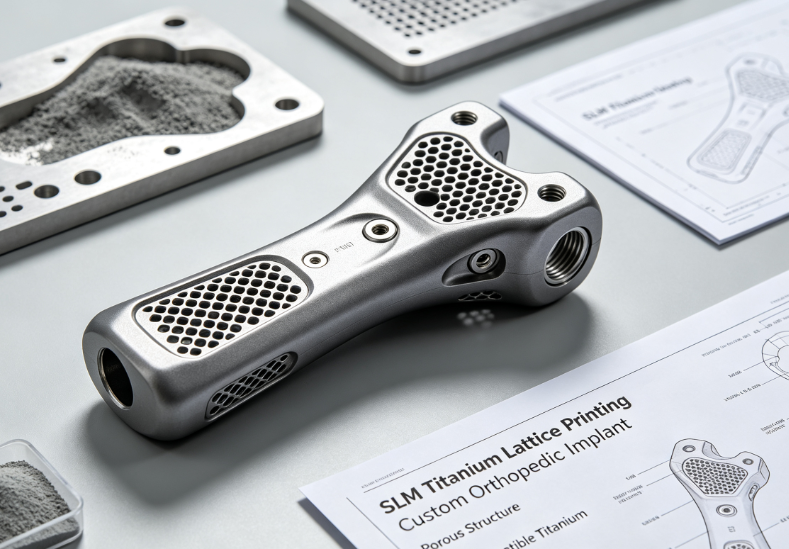
Selective Laser Melting (SLM) titanium lattice structures change the game.
By building controlled, porous lattice architecture directly into custom orthopedic implants, engineers tune the elastic modulus to closely match native bone. The open interconnected pores enable bone ingrowth (osseointegration), creating permanent biological fixation instead of mechanical anchoring. This technology powers patient-matched reconstruction plates, spinal fusion cages, joint augmentations, tumor resection implants and trauma devices.
But printing functional lattice implants is far more complex than standard metal AM. Poor lattice design, unstable SLM parameters, trapped residual powder, inadequate heat treatment or incomplete post-cleaning can generate unsafe, non-compliant parts.
In this guide, we break down everything you need to know about SLM titanium lattice manufacturing for custom orthopedic devices. We cover lattice design best practices, common production failures, critical post-processing requirements, and how Zorapid delivers repeatable, high-quality patient-specific lattice implants for medical device developers.
What Makes SLM Lattice Implants Transform Orthopedic Surgery
Traditional manufacturing methods (CNC machining, casting) cannot fabricate interconnected 3D porous networks. SLM powder bed fusion is the only mature industrial technology capable of integrating engineered lattices seamlessly into custom implant geometry.
Two core clinical benefits drive widespread adoption:
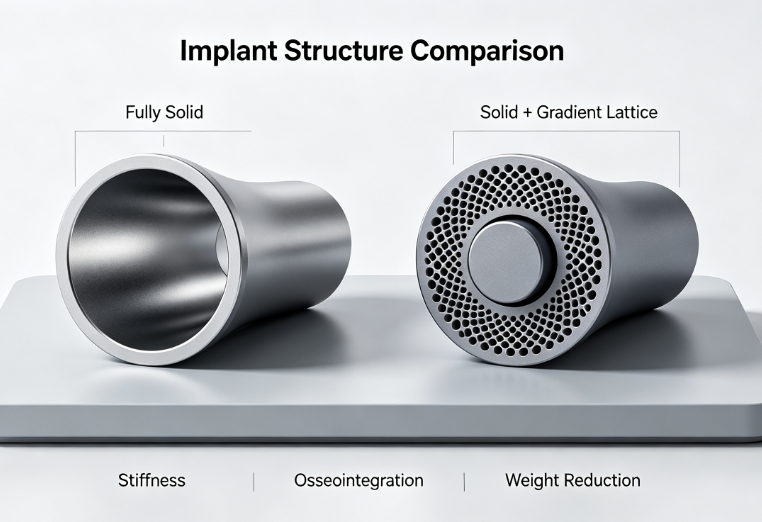
- Eliminate stress shielding via modulus tailoring Unit cell type, strut thickness, pore size and porosity directly control mechanical stiffness. Engineers design gradient lattices — solid load-bearing outer regions transition gradually into compliant porous zones — matching the heterogeneous properties of human bone.
- Enable reliable osseointegration Clinically validated windows for bone ingrowth:
- Pore size: 300–600 μm
- Porosity: 50%–70%
- Fully interconnected open pores
These parameters allow vascularization and osteoblast migration deep inside the implant structure, forming direct bone-to-implant contact.
Common orthopedic applications for SLM lattice implants:
- Spinal fusion cages
- Patient-specific tumor resection reconstruction implants
- Acetabular augment & revision hip components
- Trauma fracture plates with porous contact surfaces
- Cranio-maxillofacial reconstruction scaffolds
- Osteotomy wedges and bone void fillers
SLM Lattice Basics: Unit Cell Types for Orthopedic Devices
Not all lattice structures perform equally for implantation. Designers typically select from three major families:
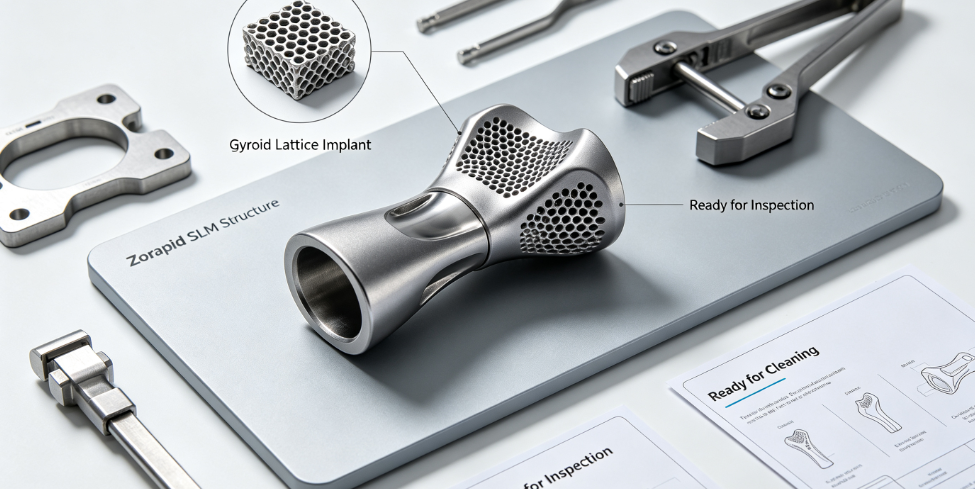
1. TPMS Lattices (Gyroid, Diamond, Primitive)
Triply Periodic Minimal Surface structures are sheet-based, smooth, continuous architectures.
Advantages: Uniform stress distribution, no sharp strut junctions, excellent permeability, superior fatigue resistance. Ideal for load-bearing spinal and joint implants.
2. Strut-Based Periodic Lattices (Octet-Truss, BCC, Dodecahedron)
Straight strut networks with defined node connections.
Advantages: Easy parameter tuning, predictable compressive behavior, widely used for low-to-medium load reconstruction scaffolds.
Risk: Sharp node junctions create stress concentration, increasing fatigue failure risk under cyclic loading.
3. Stochastic / Trabecular Mimic Lattices
Randomized porous geometry mimicking natural cancellous bone.
Advantages: Biomimetic architecture, excellent cell infiltration; frequently used for bone graft substitutes.
Critical design rule: Avoid mixing lattice types without smooth gradient blending. Abrupt transitions create severe stress risers that lead to fracture under cyclic body loads.
Key SLM Manufacturing Challenges for Titanium Lattice Implants
Lattice geometry pushes SLM processes to their limits. These are the most frequent failure modes we observe across the industry:
- Unmelted / trapped residual powder inside closed-off lattice zones Loose Ti6Al4V powder trapped within pores cannot be removed and poses a severe biological hazard if dislodged after implantation.
- Strut thickness inconsistency & dimensional drift Thin struts (< 300 μm) suffer from laser overmelting or incomplete fusion, causing deviation from designed mechanical performance.
- High residual stress & distortion Complex lattice networks amplify thermal stress during printing. Parts warp, struts crack, and overall implant geometry drifts out of tolerance.
- Poor surface quality at strut junctions Partially sintered particles adhere to lattice surfaces. Unremoved spatter impairs osseointegration and creates debris risks.
- Anisotropic mechanical performance SLM builds layer-by-layer. Lattice strength and fatigue life vary depending on build orientation. Without process tuning, test results will not match simulation predictions.
Standard Production Workflow for Custom SLM Lattice Orthopedic Implants
Successful lattice implant manufacturing follows a rigid, gated workflow:
- CT/MRI anatomical segmentation & implant CAD design
- Lattice unit cell generation + gradient porosity setup
- FEA mechanical simulation to verify modulus & strength
- SLM build preparation: support strategy, orientation optimization
- SLM printing with medical-grade Ti6Al4V ELI powder under inert argon atmosphere
- Wire EDM removal from build plate
- Vacuum stress relief heat treatment to reduce residual stress
- Multi-stage powder removal: vibration, ultrasonic cleaning, high-pressure air purging
- Surface finishing: sandblasting, chemical etching to remove sintered spatter
- Dimensional inspection, micro-CT pore validation, mechanical sampling testing
- Final precision cleaning, particulate control, packaging
Skipping or rushing any stage creates non-viable implants for clinical use. Powder removal alone can consume multiple iterative cleaning cycles for dense lattice structures.
Why Most AM Suppliers Struggle With Orthopedic Lattice Projects
Many metal 3D printing shops can print simple lattice samples. Delivering clinical-grade, repeatable custom orthopedic implants requires specialized knowledge most general AM providers lack:
- No internal expertise balancing lattice geometry, print orientation and support structures
- Generic SLM parameters not optimized for thin strut fabrication
- Limited multi-stage cleaning protocols to eliminate trapped powder
- Incomplete quality documentation for medical regulatory submissions
- No capability to validate pore size, porosity and strut dimensions via micro-CT
- No DFMEA approach to assess fatigue risk for load-bearing implant applications
Core Zorapid Advantages for SLM Titanium Lattice Orthopedic Implants
Zorapid has refined SLM lattice manufacturing specifically for medical implant developers, supporting early R&D prototypes all the way to pilot clinical batches.
Lattice DFM & Design Consultancy Upfront
Our engineering team reviews your CAD and lattice geometry at quotation stage. We evaluate unit cell selection, strut thickness limits, gradient transitions, build orientation and support layout. We flag unprintable features, high-risk stress zones and recommend design adjustments to improve manufacturability and fatigue life.
Medical-Grade Ti6Al4V ELI SLM Process Library
We run validated, locked SLM parameter sets tuned for thin lattice struts. Controlled oxygen levels inside the build chamber minimize material embrittlement. We maintain full powder traceability for every production run.
Multi-Stage Residual Powder Elimination Workflow
We combine high-pressure pulsed air, vibration cycling, ultrasonic solvent cleaning and internal inspection to remove trapped powder deep within interconnected lattice networks. For critical implant components, we provide micro-CT scanning options to verify zero trapped particles.
Controlled Heat Treatment & Surface Treatment for Implant Performance
Custom vacuum stress-relief cycles reduce distortion and residual stress. We offer targeted chemical etching and sandblasting to remove partially sintered surface particles, creating topography favorable to osteoblast adhesion without damaging delicate thin struts.
Full Inspection & Traceability Packages for Regulatory Needs
We deliver comprehensive documentation: material certificates, build logs, dimensional reports, surface roughness data and micro-CT analysis reports. All records support ISO 13485 and global medical device submission requirements.
Flexible Batch Scaling Path
We support single-piece custom prototypes for preclinical testing, small pilot batches and scaled production runs. The same validated SLM process parameters transfer seamlessly from R&D to clinical production, eliminating costly requalification.
Hybrid Solid + Lattice Implant Expertise
Most custom orthopedic implants combine solid mounting flanges, screw holes and porous lattice zones. Zorapid masters hybrid design printing, ensuring seamless transitions between solid and porous regions to avoid premature fracture.
FAQ
What is the minimum reliable strut thickness we can specify for SLM Ti6Al4V lattices?
Under stable production conditions, 300 μm is our safe lower limit for load-bearing orthopedic implants. Struts thinner than 250 μm suffer high dimensional variation, increased risk of incomplete fusion and poor fatigue performance. We can advise minimum strut thickness based on your selected unit cell and build orientation.
Can we create gradient lattices with varying porosity across one single implant?
Yes. Gradient lattices are one of the biggest advantages of SLM. We can program gradual transitions from low-porosity high-strength solid sections to high-porosity compliant lattice zones to mimic native bone properties. Abrupt hard edges between different lattice zones should be avoided.
How do I confirm no loose powder remains trapped inside the lattice?
Standard visual inspection is insufficient. Micro-CT scanning is the gold standard for validating internal cleanliness. Zorapid offers micro-CT inspection services for critical implant batches to verify pore integrity and absence of trapped particulate.
Which lattice architecture delivers better fatigue life for load-bearing implants?
TPMS gyroid and diamond structures typically outperform strut-based BCC lattices under cyclic loading, thanks to smooth nodal connections that reduce stress concentrations. Strut-based lattices remain cost-effective for low-load bone void fillers.
Does build orientation impact lattice mechanical properties?
Significantly. SLM creates anisotropic material behavior. Our team optimizes implant orientation to align critical load directions with the strongest print axis and minimizes required support structures on lattice surfaces.
Can SLM lattice implants replace PEEK cages for spinal applications?
Titanium lattice implants offer superior osseointegration compared to PEEK. The main tradeoff is higher modulus; carefully tuned gradient lattices mitigate stress shielding. Many OEMs now develop hybrid or fully porous titanium spinal cages as next-generation alternatives.
What documentation does Zorapid provide to support medical device regulatory filings?
We supply raw powder certificates, build parameter records, heat treatment logs, post-processing workflow records, dimensional inspection reports and micro-CT test data upon request. All processes follow traceability protocols aligned with ISO 13485 expectations.
How long is the typical lead time for a custom SLM lattice orthopedic implant prototype?
After final CAD approval, printing and full post-processing normally takes 2–4 weeks. Lead time extends if micro-CT inspection or multiple iterative cleaning cycles are required. We can provide expedited schedules for urgent preclinical projects.
Closing Thoughts
SLM titanium lattice technology has redefined the limits of custom orthopedic implant design. When executed correctly, lattice structures reduce stress shielding and drive robust bone ingrowth, improving long-term surgical outcomes for patients.
However, successful translation from simulation to clinical device depends entirely on disciplined manufacturing, rigorous powder removal and careful lattice process optimization. Cutting corners on production or post-processing introduces serious clinical risks.
If you are developing patient-specific orthopedic implants, spinal cages or reconstruction devices with porous titanium lattice architecture, Zorapid’s SLM team can support your project from initial lattice design review through prototype and pilot production.
Share your implant CAD file today for a complimentary lattice DFM assessment and quotation.