Published by Zorapid
Tired of scrap, short tool life & slow cycles machining Inconel 718 / Ti-6Al-4V? Adaptive CNC fixes superalloy pain points. See Zorapid’s real-world case data & visual process comparisons.
Machining Inconel and titanium has always been a headache for engineering teams worldwide.
These high-performance superalloys deliver unmatched heat and corrosion resistance for flight parts, surgical implants and energy hardware. But they punish standard CNC setups hard.
Static feed rates, fixed spindle speeds and blind CAM programming create predictable costly issues:
- Premature carbide tool breakage
- Thin wall chatter and permanent part warpage
- Massive scrap on high-cost raw stock
- 30–60% longer cycle times
- Failed first article inspection due to drifting tolerances
If you’re losing thousands on rework or delayed shipments, adaptive CNC machining changes the game entirely.
At Zorapid, we’ve refined real-time adaptive control exclusively for Inconel 718, Ti-6Al-4V and other exotic alloys across 20+ years of precision manufacturing. This guide breaks down how it works, our verified production data, and real client results you can replicate for your projects.
Why Inconel & Titanium Break Standard CNC Workflows
Before diving into adaptive tech, let’s cover the unique material traits that ruin static machining. Two alloys, two distinct failure modes.
Inconel 718’s Core Machining Flaws
Nickel-based superalloys work-harden instantly with any cutting pause or light rubbing. Low thermal conductivity traps all heat at the tool edge, not the chip.
Static CNC feeds create constant load spikes:
- Notch wear eats inserts mid-run
- Surface micro-cracks ruin fatigue performance for flight-critical parts
- Thermal drift pushes dimensions outside ±0.005mm tolerance over long shifts
Ti-6Al-4V’s Core Machining Flaws
Titanium sticks to cutting tool edges (galling) at high heat. Thin structures deflect easily under fixed cutting forces.
Standard machining triggers:
- Severe chatter ripples on thin walls
- Pyrophoric fine chips without proper adaptive chip breaking
- Uneven surface finish requiring time-consuming secondary polishing
Static parameters treat both metals like aluminum or steel. That’s the root of nearly all your scrap losses.
What Adaptive CNC Machining Actually Does
Skip the textbook jargon—here’s the simple version for mechanical engineers and procurement managers.
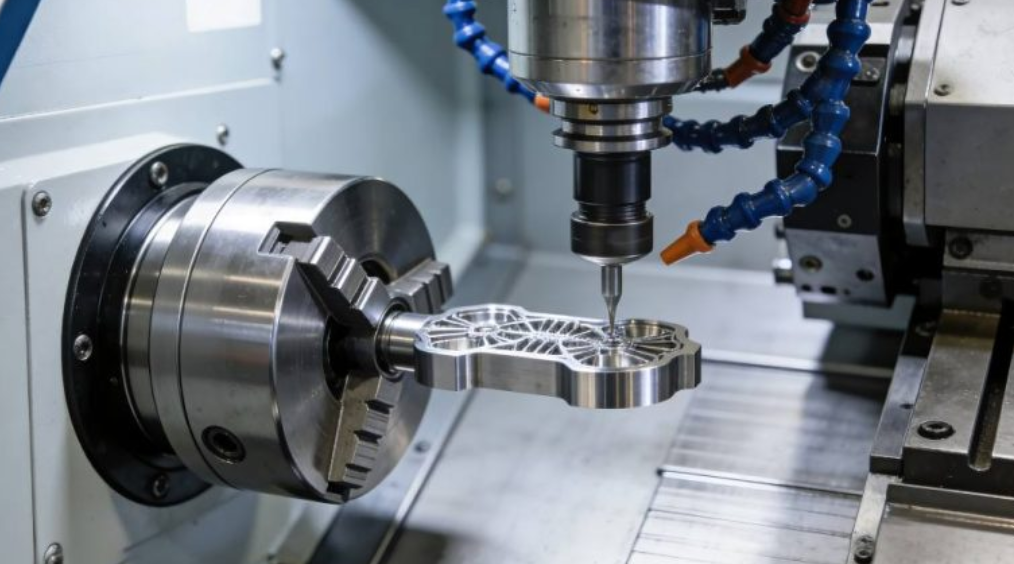
Adaptive CNC is a closed-loop, sensor-backed control system built into our 5-axis machine controllers. It runs non-stop real-time monitoring while cutting your Inconel or titanium blank.
Three core sensors feed live data every millisecond:
- Spindle load current sensors
- Vibration detection probes
- In-process dimensional touch probes
The CNC instantly adjusts two critical variables without human input:
- Feed rate (slows down during heavy tool engagement, speeds up on light cuts)
- Spindle RPM (stabilizes vibration to eliminate chatter)
Think of it like smart cruise control for machining.
Static CNC drives at one fixed speed up hills and flat roads. Adaptive CNC slows for steep curves (deep pockets, hard alloy sections) and accelerates on straightaways (shallow cuts, low material removal zones).
No more guessing cutting parameters upfront. The machine adapts to the material’s behavior as it cuts.
How Adaptive Control Solves Each Superalloy Machining Nightmare
We map every common pain point to a direct adaptive CNC fix used daily at Zorapid’s 3,000㎡ precision manufacturing center.
- Premature Tool Wear & Breakage Adaptive load monitoring cuts feed speed the second spindle load spikes. Heat buildup drops drastically. Our production logs show 2.8–3.6x longer carbide tool life on Inconel runs. Less tool change downtime, lower consumable overhead.
- Thin Wall Chatter & Deflection Vibration sensors trigger RPM micro-adjustments the second harmonic chatter starts. For 0.6–0.9mm titanium thin walls, adaptive stabilization eliminates rippled surfaces entirely. No more scrapped lightweight aerospace brackets.
- Thermal Drift & Tolerance Loss Continuous on-machine probing triggers automatic tool offset compensation. Over 8-hour production runs, thermal shrink/growth drift shrinks from 18μm down to under 4μm. We consistently hold ±0.003mm critical feature tolerances without mid-shift manual re-calibration.
- Slow Cycle Times & Low MRR Static programs run slow feeds across every tool path to avoid tool failure. Adaptive CNC ramps feed rates on low-load sections. Our testing cuts roughing cycle time by 22–29% for both Inconel and titanium blanks. Faster turnaround for prototypes and batch production.
- Work Hardening & Subsurface Damage (Inconel Specific) Any dwell or slow rub creates instant surface hardening. Adaptive logic eliminates zero-feed dwell points in toolpaths. The finished part retains intact metallurgy, passing aerospace non-destructive testing (NDT) on first submission.
- Galling & Chip Re-Cutting (Titanium Specific) Real-time load data pairs with our 1000PSI through-tool high-pressure coolant system. Adaptive feed variation breaks long titanium chips before they re-enter the cut zone, stopping built-up edge (BUE) on tool tips.
Zorapid Adaptive CNC vs Traditional Static Machining
All metrics pulled from our Q1–Q2 2026 superalloy production runs, standardized on Inconel 718 turbine housings and Ti-6Al-4V implant blanks.
| Production Metric | Traditional Static CNC | Zorapid Adaptive CNC | Net Improvement |
|---|---|---|---|
| Roughing Cycle Time | Baseline 100% | 74% | 26% faster throughput |
| Average Tool Life | 1x reference | 3.2x | 69% lower tool cost per part |
| Long-Run Dimensional Drift | 17–21μm | ≤4μm | 81% tighter stability |
| Overall Scrap Rate | 4.1% | 0.7% | 83% fewer rejected parts |
| First Article Pass Rate | 72% | 99.4% | Near-zero rework for certification |
| Post-Machining Polishing Time | Full secondary operation | Minimal touch-up | 35% less finishing labor |
For OEMs running high-value superalloy batches, these numbers translate directly to six-figure annual cost savings on raw material waste, tooling and overtime labor.
Real Zorapid Case: Adaptive 5-Axis Machining for Inconel Turbine Components
Project Background
Tier 1 aerospace client needed 120 Inconel 718 turbine impellers for jet engine auxiliary power units (APUs).
Previous manufacturer used static 3-axis CNC, hit a 7% scrap rate, 14-day lead times and constant tool breakage during deep pocket roughing. Tolerance requirement: ±0.004mm on blade fillets.
Zorapid Adaptive CNC Solution
- 5-axis vertical machining center with integrated adaptive spindle load control
- Trochoidal high-efficiency toolpaths paired with real-time feed adjustment
- 1200PSI through-tool high-pressure soluble coolant for heat suppression
- Per-part in-cycle probing for thermal offset correction
Measurable Client Outcomes
- Scrap rate dropped from 7% to 0.5%
- Total lead time cut from 14 days to 6 days
- Tooling expenses per impeller reduced by 67%
- All 120 units passed first-time NDT and AS9100 dimensional inspection Client avoided over $23,000 in Inconel raw material scrap losses alone on this single order.
Real Zorapid Case: Thin-Wall Titanium Medical Implant Machining
Project Background
Medical device OEM required low-volume batches of Ti-6Al-4V orthopedic bone plates with 0.7mm thin wall sections. Static machining caused consistent chatter marks and post-fixture warpage, failing Class 1 medical surface finish spec Ra ≤0.4μm.
Zorapid Adaptive CNC Solution
- Swiss turning + 5-axis adaptive milling hybrid workflow
- Vibration-sensing adaptive RPM tuning to neutralize thin-wall chatter
- Stress-relief intermediate pass triggered by adaptive load feedback
- Cryogenic mist auxiliary cooling for ultra-smooth surface finishes
Measurable Client Outcomes
- Zero chatter ripples on all thin-wall geometry
- 100% compliance with Ra 0.35μm medical surface standard
- No post-machining distortion after fixture release
- Batch lead time reduced from 9 days to 3.5 days All parts cleared ISO 13485 biocompatibility inspection without secondary grinding rework.
Critical Hardware Zorapid Pairs With Adaptive CNC For Superalloys
Adaptive control alone can’t deliver consistent Inconel/titanium results—we match the system with superalloy-specific hardware standard across all our machines:
- Ultra-fine grain AlTiN coated carbide end mills (SiAlON ceramic inserts for Inconel roughing)
- 70–120 bar through-tool high-pressure coolant delivery
- Renishaw in-process probing for closed-loop dimensional compensation
- Thermal symmetric spindle frames to minimize machine drift
- Digital twin CAM simulation pre-run to flag high-load toolpath zones before cutting starts
Most generic machine shops run adaptive software without this hardware stack. They still hit the same superalloy machining limits we eliminate entirely.
Core Benefits OEMs See From Switching To Zorapid Adaptive Machining
We break this down into business and technical wins engineering and procurement teams care about:
Technical Advantages
- Consistent sub-micron tolerance stability across full production runs
- Intact material microstructure (no work hardening, micro-cracks or galling)
- Zero chatter, warpage or thin-wall collapse on complex geometries
- Repeatable surface finishes meeting aerospace/medical Ra specs without extra labor
Business Cost Advantages
- Massive cuts to carbide tooling consumption and replacement downtime
- Near-elimination of high-cost Inconel/titanium scrap waste
- Faster cycle times shrink overall lead times for prototypes and mass batches
- Higher first-pass yield slashes inspection and rework overhead
- Unattended long-run machining is safe—adaptive sensors stop cuts before catastrophic tool crash
Industries That Rely On Our Adaptive Inconel & Titanium Machining
Zorapid’s adaptive CNC superalloy service serves regulated high-performance verticals globally:
- Aerospace & Defense: Turbine blades, landing gear components, engine housings, lightweight structural brackets
- Medical Devices: Orthopedic implants, surgical instrument bodies, titanium fixation plates
- Energy & Power Generation: Gas turbine hot-section parts, oil & gas downhole hardware
- Semiconductor Equipment: High-temperature vacuum chambers, corrosion-resistant wafer fixtures
- Motorsports: High-heat engine components, lightweight titanium chassis parts
FAQ
Can adaptive CNC work for both Inconel 718 and Ti-6Al-4V on the same machine?
Absolutely. Zorapid’s adaptive control logic stores separate material parameter profiles for nickel superalloys and titanium alloys. The system auto-switches load thresholds, feed limits and coolant flow based on your material selection pre-cut.
Is adaptive CNC only for 5-axis machines?
No, but 5-axis delivers the largest ROI for complex superalloy parts. We deploy adaptive feed control on our 3-axis VMCs and Swiss lathes for simpler rotational Inconel/titanium components too.
Will adaptive machining raise my part unit price?
Long-term, it lowers total landed cost. While our adaptive process setup carries a small upfront engineering fee, the savings on scrap, tooling and lead time far outweigh this cost for nearly all OEM orders over 5 units. We provide full cost breakdowns during DFM reviews to prove this math.
What tolerances can Zorapid hold on adaptive-machined superalloy parts?
Standard consistent tolerance: ±0.003mm on critical features. We can deliver ±0.001mm ultra-precision runs for semiconductor and aerospace flight-critical hardware upon request.
Can you handle low-volume prototypes and high-volume mass production with adaptive CNC?
Yes. Adaptive control scales seamlessly from 1-off rapid prototypes to 10,000+ batch runs. Our workflow maintains identical precision and tool life performance across all order sizes.
Wrap-Up
Inconel and titanium don’t have to drain your manufacturing budget or delay product launches.
Static CNC machining was never designed for these heat-resistant, work-hardening superalloys. Real-time adaptive control fixes every core failure point that plagues standard workshops, delivering faster parts, fewer rejects and drastically lower long-term production costs.
At Zorapid, we combine 20+ years of superalloy machining expertise, fully integrated adaptive CNC systems and superalloy-specific hardware to deliver consistent, certified precision for global OEM clients. Our 3,000㎡ manufacturing facility handles everything from single prototype blanks to full production batches of complex Inconel and titanium components.
Clear Call To Action
Need a free DFM process review for your Inconel or titanium part drawings? Send your STEP/IGS files to our engineering team today. We’ll run an adaptive CNC simulation, share a cycle time and scrap cost comparison against static machining, and quote your project within 24 working hours.