Published by Zorapid
Tired of costly flood coolant waste, hazardous fluid disposal and rising carbon footprints? Zorapid breaks down dry cutting and MQL machining for eco-friendly CNC production. Cut fluid costs by 90%, lower VOC pollution, extend tool life, and meet EU & US green manufacturing standards without sacrificing part tolerance or surface finish.
If you run CNC workshops or outsource precision machined parts, flood cooling has always been your default choice.
But here’s the harsh reality.
Massive coolant tanks burn extra electricity. Used cutting fluid counts as hazardous waste. Chemical oil mist triggers strict workplace health regulations. Aerospace, medical and automotive OEMs now demand carbon-neutral supply chains.
You need cleaner machining without ruining dimensional accuracy or slowing down production.
Dry cutting and MQL (Minimum Quantity Lubrication) are the two most practical green alternatives. No more gallons of synthetic coolant dumped every month. No more expensive waste treatment bills.
At Zorapid’s 3,000㎡ 5-axis CNC workshop, we’ve run thousands of low-volume and pilot production jobs with dry and MQL processes for North American and European clients. We’ve balanced environmental goals, part quality and production cost perfectly.
Let’s break down exactly how these two eco-friendly methods work, when to use them, and how to avoid common beginner mistakes.
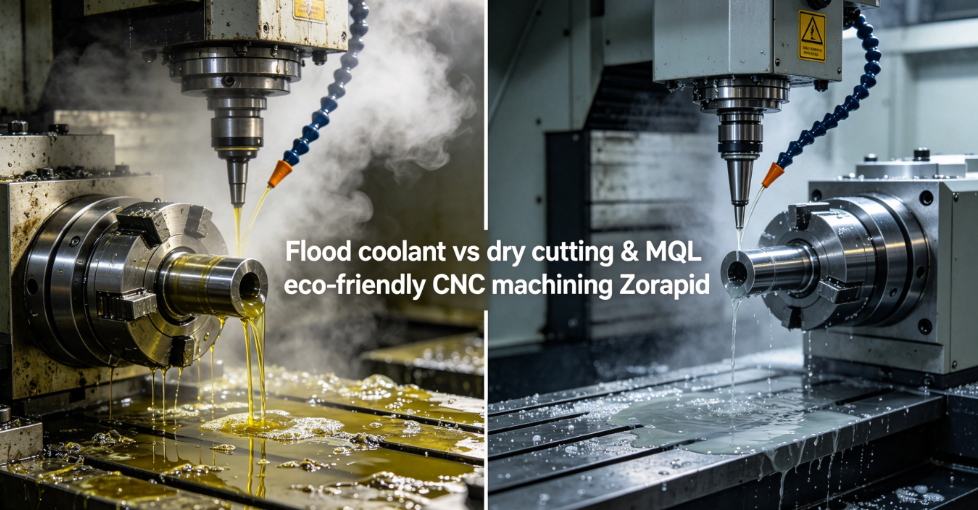
What Is Dry Cutting? Zero-Coolant CNC Machining
Dry cutting means machining with zero liquid coolant. No flood fluid, no oil mist, no water-based lubricants.
You only rely on high-performance coated cutting tools to handle high cutting temperatures.
Core Green Benefits
- 100% elimination of cutting fluid consumption. No purchase, no storage, no hazardous waste disposal.
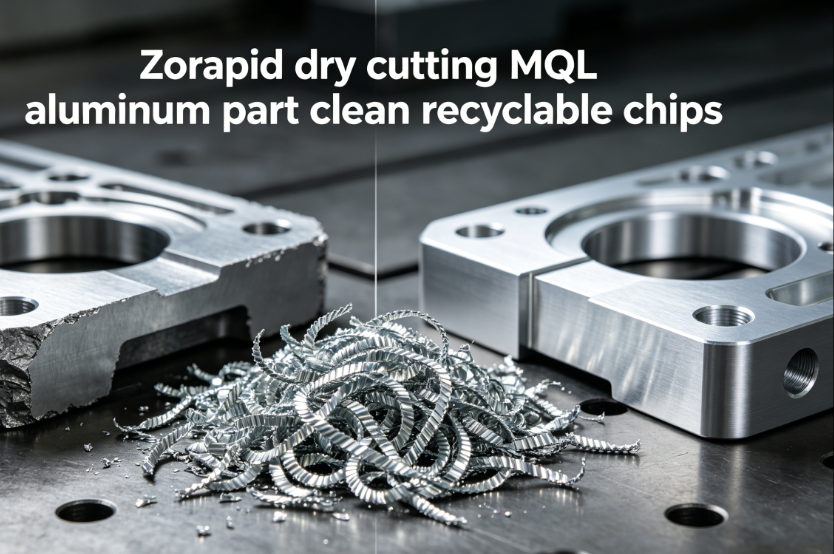
- Chips stay clean and oil-free. You can fully recycle aluminum, steel and titanium scrap without decontamination. Scrap value jumps 15–22%.
- No oil vapor or VOC fumes. Operators breathe cleaner air, and you skip expensive ventilation upgrades to meet OSHA & EU workplace rules.
- Less thermal shock on workpieces. Parts hold tighter dimensional stability after machining.
The Catch You Can’t Ignore
Heat builds up fast in the cutting zone.
Standard uncoated HSS end mills burn out in minutes. You cannot run dry cutting on every material.
Zorapid Rule: Only run dry cutting with TiAlN, AlCrN or DLC coated carbide tools. These coatings resist oxidation at 900°C+ cutting heat.
MQL Minimal Quantity Lubrication: The Middle Ground Between Dry & Flood Cooling
Dry cutting works great for soft metals, but tough alloys like 17-4 PH stainless and Ti-6Al-4V need a tiny bit of lubrication. That’s where MQL shines.
MQL sprays an ultra-fine mist of biodegradable plant-based oil directly onto the cutting edge.
Flood cooling uses 20 liters of fluid per hour.
MQL only uses 30–50 milliliters per hour. That’s a 97% cut in lubricant usage.
How MQL Operates
- Compressed air mixes with small volumes of vegetable oil (rapeseed or soybean base, fully biodegradable).
- Precision nozzles target the tool-chip contact point only.
- The oil evaporates almost completely during cutting. No leftover fluid pools on the machine table.
Key Eco & Cost Wins
- Coolant waste drops by more than 90%. Monthly disposal fees almost disappear.
- Clean, dry swarf that requires no cleaning before recycling.
- Less machine downtime spent draining and replacing old contaminated coolant.
- Lower energy use: you shut down large coolant circulation pumps, cutting power consumption by roughly 25–35% per shift.
Most sustainable manufacturing projects at Zorapid switch to MQL first before testing full dry cutting. It delivers green results without risking poor surface finish or rapid tool wear.
Side-by-Side Performance Comparison
We ran standardized 6061 aluminum and 304 stainless tests in our workshop. Here is the real-world data OEM buyers care about.
| Machining Method | Coolant Consumption | Recycle-Ready Chips | Typical Ra Finish | Monthly Waste Cost |
|---|---|---|---|---|
| Traditional Flood Cooling | 20 L/h | Oil-contaminated | Ra 0.35 μm | High (hazardous waste fee) |
| MQL (Vegetable Oil Mist) | 0.05 L/h | 100% clean | Ra 0.38 μm | Near-zero |
| Full Dry Cutting | 0 L/h | 100% clean | Ra 0.42 μm | Zero |
Key takeaway: MQL keeps surface finish nearly equal to flood cooling while hitting your sustainability targets. Dry cutting works best when cosmetic surface requirements are moderate.
Material & Process Matching: When To Use Dry Cutting, When To Use MQL
Choosing the wrong cooling method leads to burnt tools, poor dimensional tolerance and scrapped parts. Here is our field-tested Zorapid selection guide.
Best Applications for Dry Cutting
6061 / 7075 aluminum roughing & semi-finish milling
POM, PEEK, PA66 engineering plastic CNC machining (plastics melt with liquid coolant)
Low-carbon steel (1018, 1045) interrupted milling
Thin-wall sheet metal CNC profiling with coated carbide cutters
Do NOT run dry on titanium, Inconel 718 or high-tensile stainless steel. Extreme heat will crater your tool edges in minutes.
Best Applications for MQL Lubrication
Ti-6Al-4V titanium aerospace components
17-4 PH, 316L stainless medical precision parts
Hardened 4140 alloy steel mold inserts
High-speed finish milling where you need low Ra without flood fluid
MQL balances heat reduction and eco-friendliness for nearly all hard-to-machine alloys.
Critical Parameter Tweaks To Avoid Failure In Green Machining
Most shops fail at dry & MQL not from equipment, but from unchanged flood-cutting feed and speed values.
Dry Cutting Optimization Rules
- Raise cutting speed (SFM) by 15–25%. Higher speed reduces built-up edge (BUE) on aluminum.
- Lighten the depth of cut to control heat buildup.
- Always use positive rake tool geometry to lower cutting resistance.
- Blow continuous compressed air across the cutting zone to clear hot chips.
MQL Optimization Rules
- Aim the air-oil nozzle directly at the tool flank, not just the top surface.
- Keep air pressure between 0.4–0.6 MPa for consistent fine mist.
- Stick strictly to biodegradable plant oil. Synthetic mineral oil leaves sticky residue and breaks recycling rules.
- Avoid over-spraying. Extra oil defeats the zero-waste purpose of MQL.
Zorapid engineers preload these optimized dry & MQL parameter sets into our 5-axis CNC machines. We cut trial-and-error time for new green machining jobs by 70%.
Common Pitfalls We See With Dry Cutting & MQL
1: Aluminum chips stick tightly to cutting edges (BUE)
Fix: Switch to polished DLC-coated end mills + higher spindle RPM for dry runs. We eliminate aluminum smearing without coolant.
2: Surface roughness gets worse without flood fluid
Fix: Use MQL instead of full dry cutting for finishing passes. The micro oil film delivers a smooth finish without waste fluid.
3: Tool life drops sharply on stainless steel dry runs
Fix: Never dry-cut stainless finish passes. Reserve dry cutting only for rough stock removal, then switch to MQL for finishing.
4: MQL mist turns into sticky residue on workpieces
Fix: Only use food-grade biodegradable lubricant. It evaporates fully and leaves no film on precision mating surfaces.
Real Zorapid Green Machining Case Study
Client Requirement
Low-volume prototype batch: 120 pcs 6061 aluminum automotive sensor brackets.
Client goal: Reach ISO 14001 green production standards, cut coolant spending and improve scrap recycling value.
Original Old Process
Flood cooling with synthetic oil. Monthly fluid cost + waste disposal hit $380. Aluminum chips came out soaked and could only be sold at 65% of market scrap price.
Zorapid Eco Upgrade
- Switched rough milling to full dry cutting with AlCrN coated carbide tools.
- Applied low-volume vegetable-oil MQL only for finish milling passes.
- Added continuous air blast for chip removal.
Measurable Results
- Coolant consumption reduced by 96%. Fluid & waste bills dropped from $380 down to just $18 per batch.
- All aluminum chips stayed oil-free. Scrap resale value rose 21%.
- Dimensional tolerance stayed within ±0.008 mm, fully meeting the client’s GD&T requirements.
- No oil mist pollution, so the workshop passed EU environmental audit on the first try.
Tooling & Equipment Setup Checklist For Your CNC Shop
If you want to roll out dry cutting and MQL on your own machines, follow this simple checklist:
- Upgrade tooling: Stock TiAlN, AlCrN and DLC coated carbide end mills for high-heat dry cuts.
- Install compact MQL aerosol nozzles on 3-axis & 5-axis machining centers.
- Stock only biodegradable vegetable-based MQL oil, no synthetic mineral fluid.
- Add high-pressure air lines for chip blowing during dry machining.
- Revise CAM feeds and speeds to increase SFM and reduce cut depth for dry runs.
- Separate dry-cut chips from wet-cut chips to keep scrap batches clean for recycling.
Long-Term Business Benefits Beyond Environmental Compliance
Going green with dry cutting and MQL is not just for passing audits. It directly boosts your bottom line:
- Cut annual coolant purchase + hazardous waste disposal cost by 75–92%.
- Higher clean scrap revenue from oil-free metal chips.
- Less machine maintenance. No sludge buildup in coolant tanks, fewer pump failures.
- Win more EU medical, aerospace and automotive orders. Most top OEMs now require proof of low-carbon manufacturing.
- Reduce energy use by shutting down large coolant pump systems.
Zorapid now runs more than 60% of prototype and small-batch CNC jobs with dry or MQL processes, keeping our pricing competitive while satisfying global sustainability rules.
FAQ
Can dry cutting hold tight CNC tolerances like flood cooling?
Yes, with coated carbide tools and optimized feeds. We regularly hold ±0.005 mm positional tolerance on dry-machined aluminum parts. MQL easily maintains micron-level precision on stainless and titanium alloys.
Is MQL more expensive than regular flood coolant?
No. Even premium biodegradable plant oil costs far less because you use less than 50ml per hour. The total running cost is a fraction of flood fluid plus waste treatment fees.
Can we machine medical-grade stainless steel with dry cutting and MQL?
MQL is ideal for medical stainless steel. The evaporating plant oil leaves zero chemical residue, so parts stay clean for passivation and sterilization. We avoid dry cutting on stainless finish passes to prevent thermal discoloration.
Does dry cutting shorten tool life?
With high-temperature AlCrN coatings, tool life on aluminum dry runs is comparable to flood cooling. The reduction in thermal shock often improves tool lifespan on interrupted cuts.
Closing
Eco-friendly CNC machining no longer means sacrificing quality or raising prices. Dry cutting eliminates fluid waste entirely, and MQL delivers the perfect middle ground for hard alloys.
These two processes let you cut pollution, slash running costs, and win sustainable supply chain contracts from Europe and North America.
If you need prototype or low-volume CNC parts made with dry cutting and MQL green processes, send your CAD files to Zorapid today. We will include a free DFM review plus green machining process recommendations in your quote.