Published by Zorapid
Most CNC headaches start long before the cutting tool touches metal.
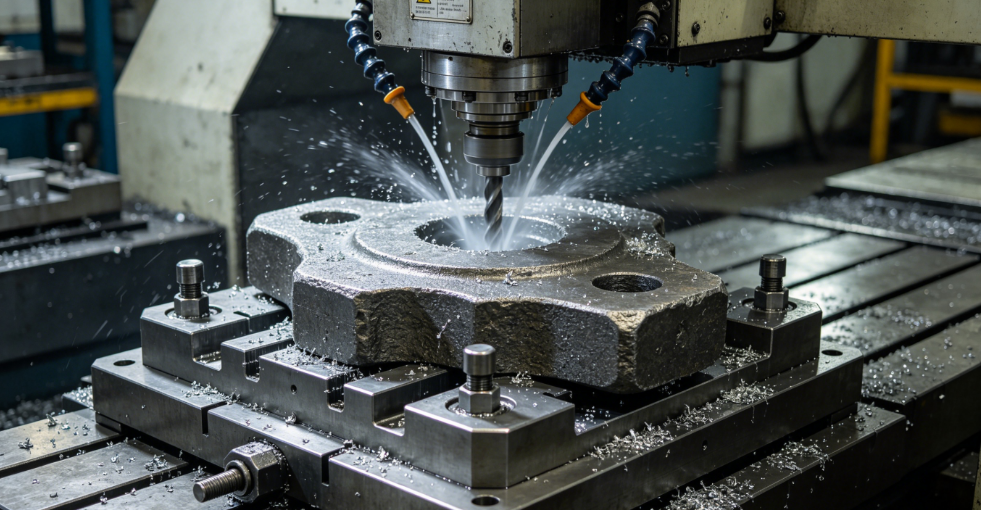
It all begins with irregular blanks: cast housings, forged brackets, sand-cast raw stock, uneven offcuts with no flat parallel edges.
Stick this odd-shaped blank into a standard machine vise, and you will run into the same mess every time:
- The workpiece shifts under cutting force
- Tight GD&T tolerances drift out of spec
- You waste 15+ minutes re-indicating the zero point on every single piece
- Thin sections bend from uneven clamping pressure
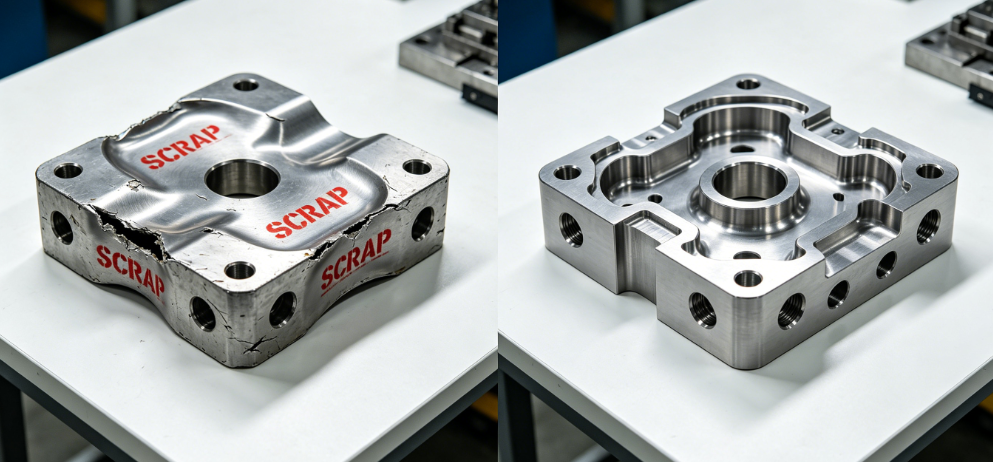
Many shops treat fixture design as an afterthought. They grab soft jaws and hope for the best. The result? 15–25% scrap, repeated re-clamping, and blown-out prototype lead times.
At Zorapid, we machine hundreds of irregular casting and forging blanks every month for aerospace, medical, and semiconductor OEMs. We’ve refined fixture design specifically for non-uniform raw material stock.
This practical buyer’s guide breaks down core design rules, common failure points, low-cost workholding options, and real ROI data you can plug directly into your next RFQ.
What Makes Irregular Raw Blanks So Hard to Fixture?
Standard fixturing is built for square, rectangular, parallel billets. Irregular blanks break every basic rule. Let’s list the four biggest pain points one by one.
1. No stable primary datum plane
Cast and forged blanks have uneven draft surfaces, curved contours, and warped rough edges. You cannot simply rest the part flat on a fixture plate. Contact points become uneven, and the part rocks during heavy rough milling.
2. Unpredictable blank-to-blank variation
Even within the same batch, cast raw stock has dimensional inconsistencies of 0.2mm–0.8mm. A vise that grips one piece tight will leave the next one loose. Repeatability collapses without dedicated locating nests.
3. Uneven clamping force causes part distortion
If you only grip two small raised lugs on an asymmetrical blank, cutting torque will twist the workpiece. Over-tighten to stop slippage, and thin-walled sections bend permanently. This creates positional error across multi-face features.
4. Zero-point alignment takes forever
Without pre-built locating pins, operators spend minutes dialing in the work coordinate system on every new blank. For small-batch NPI runs, this non-cutting time eats up 30% of total machine capacity.
The Cost of Bad Fixturing (Zorapid Industry Benchmark)
| Trial-and-Error Vise Setup | Custom Designed Fixture for Irregular Blanks |
|---|---|
| Setup time: 12–18 minutes per piece | Setup time: 60–90 seconds per piece |
| Scrap rate: 18% average for cast blanks | First-pass yield: 99.5% |
| 3–5 re-clamping cycles for multi-side milling | Single-setup clamping only |
| Tolerance drift up to ±0.03mm | Positional repeatability ±0.006mm |
When engineers skip fixture planning for irregular blanks, they trade low upfront tooling cost for massive downstream waste.
Core Design Rule — Stick Strictly to the 3-2-1 Locating Principle
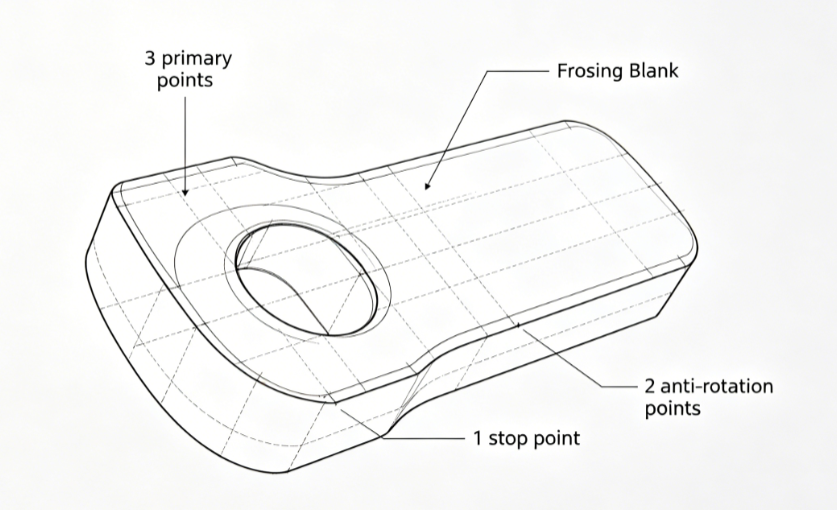
This is the golden rule for irregular blank fixture design. Every workpiece has six degrees of freedom. Your fixture must lock all six without over-constraining the rough blank.
- 3 support pads (Primary Datum / Z axis) Place three small hardened steel pads on the blank’s most stable rough surface. Three isolated contact points avoid rocking on uneven casting surfaces. Never use a full flat plate for rough cast blanks. Spacing the pads as far apart as possible maximizes rigidity against milling forces.
- 2 locating pins (Secondary Datum / X axis) Install two cylindrical stop pins against one consistent raw edge of the blank. This stops side-to-side sliding and rotational twist during climb milling.
- 1 diamond pin (Tertiary Datum / Rotation lock) Add one diamond-shaped locating pin to block rotational movement. The diamond profile accommodates minor blank size variation between parts, so you never jam oversize cast stock into fixed holes.
Critical Zorapid engineering note:
Build locators only on un-machined raw blank surfaces. Do not use future machined pockets or holes for initial positioning. That way, blank variation will not break your whole locating scheme.
Big Mistake We See Every Day: Over-Constraining the Blank
If you add 5 or 6 fixed contact points on an irregular casting, minor size differences will bind the workpiece tight. Residual stress from forging plus clamping pressure will bend the part the second you start cutting.
Always leave small clearance gaps on non-critical contact surfaces for raw blank tolerance variation.
4 Practical Fixture Types for Irregular Milling Blanks
We split our workholding solutions into four tiers, matched to blank material, batch size, and tolerance requirements. No need to build expensive dedicated tooling for short prototype runs.
Machined Soft Jaws (Best for 1–25 piece NPI Prototypes)
Machine standard aluminum soft jaws to match the outer contour of your irregular blank.
- Cut a partial nest matching the rough casting profile
- Add two stop pins for X-Y alignment
- Low cost: $80–250 total tooling expense
- Best material: Aluminum castings, low-torque finish milling
Conformal Nest Fixture (Zorapid’s Go-To for Most Irregular Blanks)
Machine a solid aluminum or POM fixture block into a cradle that perfectly follows the blank’s rough outer shape.
The whole workpiece sits down into the pre-machined cavity, eliminating rocking entirely.
We add quick-release side clamps that only press on rigid bosses, never on thin walls.
- Repeatability: ±0.005mm between parts
- Eliminates re-indicating the zero point
- Works seamlessly on 3-axis and 5-axis single-setup milling
- One fixture fits the full batch despite minor blank size variation
This is our most widely used solution for cast aluminum housings and asymmetrical forged components.
Modular Pin Fixture (For Multiple Blank Variants & Small Batch Families)
Instead of a solid nest, build the fixture with adjustable hardened support pins, stop pins, and swing clamps.
You reposition the pins to match different irregular blank profiles without rebuilding the whole tooling plate.
Perfect if you run multiple similar casting revisions during NPI development.
Saves you from making a brand-new fixture for every engineering revision.
Vacuum Workholding + Support Pads (For Thin, Warped Irregular Blanks)
Some thin cast blanks flex if you clamp them with hard mechanical pressure.
We combine distributed support pins with vacuum suction to pull the blank flat against the fixture plate without squeezing the part out of shape.
No jaw marring, zero clamping distortion, ideal for thin-wall cast magnesium and aluminum blanks.
Quick Selection Checklist
Prototype low volume (1–30 pcs): Custom machined soft jaws or simple conformal nest
Mid-batch (30–200 pcs, tight GD&T): Dedicated 3-2-1 conformal fixture
Multiple part revisions: Modular pin fixture system
Thin warped cast blanks: Vacuum fixture with multi-point support pads
Key Design Adjustments for Cast & Forged Raw Blank Variation
Irregular blanks are never dimensionally identical. Build these features into every fixture to avoid jamming or poor seating:
- Add relief gaps everywhere Leave 0.3–0.6mm clearance along all non-locating casting surfaces. This prevents high spots on the rough blank from lifting the workpiece off your primary support pads.
- Separate locating surfaces from clamping surfaces Locating pins define the zero position. Clamps only push on thick, rigid bosses. Never clamp directly against your datum points. Clamping pressure will shift your whole coordinate system.
- Use spring-loaded floating supports on curved blank bottoms On uneven curved cast surfaces, floating pads automatically follow the blank profile. No more three-point rocking.
- Keep clamps out of the tool path We simulate full 3D toolpaths inside the fixture CAD file before machining the tooling. We eliminate fixture interference so you can machine all faces in one setup without re-clamping. This is where 5-axis milling paired with good fixture design cuts your lead time dramatically.
Zorapid Real-World Case Study — Fixture Fixed a Chronic Scrap Problem
A European automotive client sent us 45 irregular aluminum cast bracket blanks for 5-axis milling.
Their first attempt used standard soft jaws, with these results:
- 22% scrap due to blank shifting during rough milling
- 4 re-clamping cycles to machine all angled features
- 11-day lead time, with constant downtime for re-indicating zeros
Our fixture engineering team redesigned the workholding from scratch:
- Built a conformal aluminum nest following the exact rough casting outer profile
- Applied strict 3-2-1 locating on three stable raw casting lugs
- Mounted low-pressure swing clamps only on thick reinforced bosses
- Locked the blank in one single fixture position for full 5-axis simultaneous machining
Final results after fixture optimization:
- Zero workpiece shift, zero scrap
- No re-clamping needed
- Setup time dropped from 14 minutes down to 75 seconds per blank
- Lead time shortened to 4 working days
- Total project cost fell by 21% once we eliminated rework and rejected parts
The client now uses this same fixture design for all their cast blank NPI projects.
6 Cost-Saving Fixture Design Tips From Zorapid’s Tooling Engineers
- Design the fixture before writing your CNC program If you build tooling after programming, you will run into tool path interference and forced re-clamping. Always finish fixture layout first for irregular blanks.
- Build locators on raw stock, not future machined features Do not rely on holes you will mill later for positioning. Cast blank variation will break your entire locating scheme.
- Avoid fully enclosed solid nests on high-volume runs Add quick side openings so you can blast chips out without removing the whole blank. Chip buildup under the blank lifts positioning accuracy over time.
- Use POM plastic nests for soft non-ferrous blanks Plastic conformal fixtures prevent jaw marks on aluminum and copper castings, no secondary polishing required.
- Limit clamping force on asymmetrical geometry Add torque-limited screw clamps so operators cannot over-tighten and bend irregular thin sections. More grip does not equal better precision.
- Share blank sample + raw material drawing with your fixture engineer Photos alone are not enough. Send actual raw blank samples, not just 3D finished models. We build fixtures around the rough casting, not the final machined part.
When You Can Skip a Fully Custom Dedicated Fixture
Custom tooling adds upfront cost. Save money with simpler workholding when these conditions apply:
- Only 5–10 prototype pieces with loose tolerance (above ±0.025mm)
- The irregular blank has at least two thick flat raw surfaces you can grip reliably
- No deep angled 3D features requiring multi-face milling
In these cases, machined soft jaws with stop pins will get the job done without heavy fixture investment.
For anything above 25 pieces or tight GD&T requirements, the conformal fixture always delivers better total landed cost long term.
Final Verdict
Irregular blank milling failures rarely come from bad programming or dull cutters.
90% of dimensional drift, scrap, and long setup times trace back to poorly planned fixture layout.
Stick to the 3-2-1 locating rule, build support points around the raw casting geometry, separate locating points from clamping points, and leave relief for blank-to-blank variation.
For NPI small batches, start with low-cost soft jaws or simple conformal nests. For production runs, lock in a dedicated fixture to cut setup time and eliminate re-clamping entirely.
At Zorapid, our fixture engineers complete a full workholding layout alongside your DFM analysis for every irregular casting or forging project. We simulate blank seating, clamping distortion, and tool path interference before we cut the first piece of material.
Send over your raw blank drawing and STEP file, and we will deliver a fixture layout + cost breakdown within 12 working hours.
FAQ
How do I stop an irregular cast blank from rocking on the fixture plate?
Replace full flat support surfaces with three isolated hardened support pads following the 3-2-1 rule. Three contact points eliminate rocking on uneven rough casting surfaces.
Can I machine irregular blanks in one 5-axis setup with the right fixture?
Absolutely. A well-designed conformal nest locks the blank in a fixed datum. No re-clamping is required, which eliminates tolerance stack-up from repeated re-fixturing.
Should I build the fixture around the finished part or the raw blank?
Always design locators based on the un-machined rough blank. Finished feature positions will shift as you remove material.
How much variation can a good irregular-blank fixture accommodate?
With diamond locating pins and relief gaps, our standard conformal nests handle ±0.7mm batch variation on cast blanks without jamming or poor seating.
Will a custom fixture pay itself off on low-volume prototypes?
For batches over 15 pieces, the savings on setup labor and scrap easily cover the fixture cost. For 5–10 pcs, modified soft jaws remain the budget option.