Published by:Zorapid.Ltd
Every machine shop faces the same basic question: stick with a classic manual lathe, or step up to a modern CNC turning center?
Both machines spin raw bar stock and cut cylindrical parts. But that’s where the similarities end.
A conventional lathe runs on the skill of your machinist. A CNC turning center runs on G-code, servo motors, and full automation.
Here at Zorapid, we run both types of equipment daily. We use manual lathes for one-off repair jobs and quick prototypes, and multi-axis CNC turning centers for high-volume aerospace, medical, and automotive shaft production.
We have seen first-hand how the choice between these two machines changes your tolerance consistency, lead time, labor cost, and scrap rate.
This guide breaks down every practical difference, no fancy textbook jargon. We cover control structure, precision, production speed, part complexity, cost, and ideal use cases. By the end, you will know exactly which machine fits your next turning project.
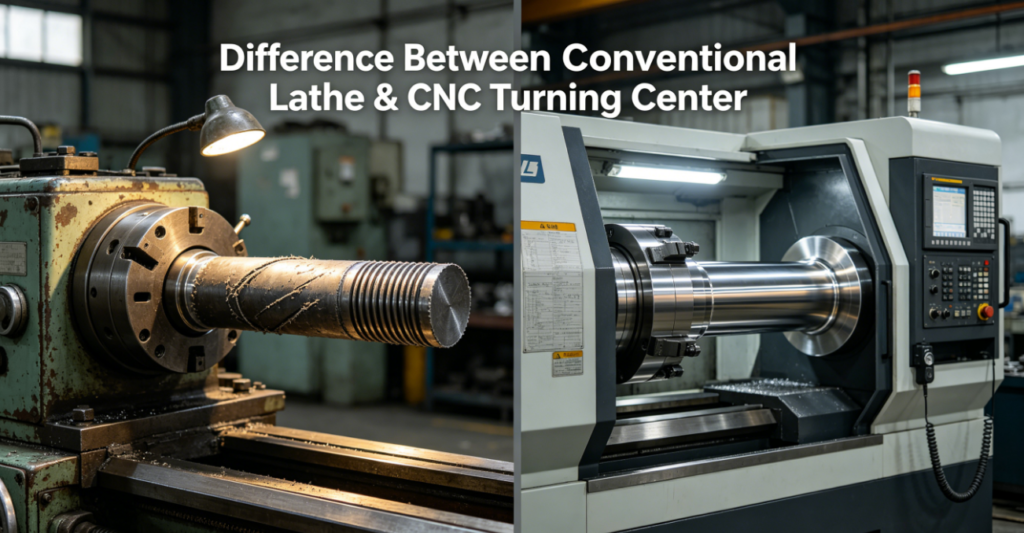
Core Operating & Structural Difference
Conventional Lathe (Manual Parallel Lathe)
The whole machine runs on mechanical gears, handwheels, and manual levers.
- The machinist manually turns cross-slide and longitudinal feed handles to move cutting tools.
- Spindle speed and feed rates are adjusted with gear levers on the machine bed.
- Most models have an open frame with minimal safety shielding.
- Transmission relies on gearboxes and lead screws without digital positioning feedback. Every single cut, every depth of cut, every arc and thread depends entirely on the operator’s steady hands and experience.
CNC Turning Center
Everything is driven by a computer control system and servo ball screws.
- Tool paths are written as G-code programs. The machine runs automatically after setup.
- Most modern turning centers have slant beds, fully enclosed safety guards, automatic chip conveyors, and hydraulic power chucks.
- Servo motors control X, Z axes, and many add live tooling, Y-axis and C-axis for milling and cross-drilling in one clamping.
- Digital encoders constantly calibrate tool position, eliminating drift during long runs.
Zorapid Quick Takeaway:
Manual lathes are human-controlled. CNC turning centers are digitally controlled. This single divide creates every other gap in performance.
Precision & Repeatability
Conventional Lathe
Even with a top-tier machinist:
- Stable tolerance sits around ±0.002 inch (±0.05 mm) at best.
- Dimensional drift creeps in after hours of work due to hand movement, eye measurement, and operator fatigue.
- Batch consistency is poor. Part #1 and part #50 will almost always have measurable variation.
- Surface finish relies strictly on steady feed movement; chatter marks are hard to avoid on long shafts.
CNC Turning Center
Once the program is locked and tool offsets set:
- Consistently hold tight tolerances down to ±0.0002 inch (±0.005 mm) repeatedly.
- Zero human variation. 100 or 10,000 identical shaft parts all match the CMM drawing perfectly.
- Smooth programmed feed motion eliminates inconsistent feed lines and chatter. We regularly hit Ra ≤ 0.2 μm on stainless steel and titanium turned parts.
- Tool wear can be monitored and offset automatically to keep dimensions stable across full production runs.
| Metric | Conventional Lathe | CNC Turning Center |
|---|---|---|
| Best Stable Tolerance | ±0.05 mm (skilled machinist) | ±0.005 mm mass production |
| Batch Repeatability | Low, operator-dependent | 100% consistent batch quality |
| Surface Finish Consistency | Variable | Uniform from start to finish |
| Long-Run Dimensional Drift | Noticeable | Almost non-existent |
Production Speed & Labor Efficiency
Conventional Lathe
Every step requires constant operator attention:
- Manually position tools, take measurements with calipers, adjust depth after every cut.
- Pauses happen constantly for checking dimensions, resetting feeds, and repositioning stock.
- One machinist can only run one manual lathe at a time. No lights-out operation possible.
- Simple shafts take 2–3 times longer compared to CNC automation.
CNC Turning Center
Productivity jumps drastically:
- After programming and setup, the machine runs unattended. One operator can supervise 3–6 turning centers at the same time.
- Automatic tool changers switch turning tools, drills, and live milling cutters without stopping the spindle.
- No manual measurement pauses. The machine follows programmed toolpaths non-stop.
- Lights-out overnight production is fully achievable for bar-fed jobs. For batch runs over 20 pieces, CNC turning centers cut total cycle time by 50% up to 70% compared to manual lathe work.
Real Shop Observation from Zorapid:
A 100-piece batch of 316L stainless stepped shafts takes 18 hours on manual lathes. Our bar-fed CNC turning center finishes the same batch in just 6 hours with minimal labor input.
Part Complexity & Machining Capacity
What a Conventional Lathe Can Do Well
Only basic 2D rotary geometry:
- Straight outer diameters, simple bores, short tapers, single-start threads, basic facing, and simple grooving. Every curved radius or complex contour requires painstaking hand feeding. Multi-start threads, irregular profiles, and cross-hole features are extremely difficult or impossible to finish accurately on a manual lathe. Multiple operations need repeated re-clamping, which introduces alignment errors.
What a CNC Turning Center Handles Effortlessly
Modern multi-axis turning centers break past basic rotary turning:
- Complex blended arcs, long tapered profiles, multi-start precision threads, irregular contoured shafts.
- Live tooling adds cross-drilling, slot milling, and flat milling without re-fixturing the workpiece.
- Sub-spindle models finish both ends of bar stock in a single setup, eliminating second-operation rework. We run turbine shafts, threaded medical pins, and semiconductor pin fittings with complex mixed turning and milling features exclusively on our CNC turning centers. These parts are not practical to produce consistently on manual lathes.
Setup Time & Job Flexibility
Conventional Lathe
Perfect for one-off work:
- No CAM programming required. Clamp the bar stock, pick your feeds, and start cutting within minutes. Ideal for emergency repair parts, custom single prototypes, and small N=1 test pieces. Downside: Switching between different part designs means manually re-adjusting gears, tool positions, and stops. Changeover time grows longer with each new job.
CNC Turning Center
- Short changeover for repeated batches: just load a new program and tweak tool offsets.
- Switch between 10 different shaft designs in minutes by calling up saved G-code files.
- Downside: Simple one-off pieces lose time to CAM programming and tool offset setup. For a single simple bolt, a manual lathe is still faster.
Cost Breakdown: Upfront Price VS Long-Term Expense
Upfront Investment
- Conventional lathe: Low purchase price, simple mechanical parts, cheap routine maintenance. Great for small repair workshops and job shops with low startup budget.
- CNC turning center: Higher initial cost, plus servo drives, CNC control systems, and bar feeders raise the equipment budget. Maintenance requires electronic troubleshooting alongside mechanical service.
Long-Term Operating Cost
Manual lathes become expensive in mass production:
- High labor cost tied to full-time skilled machinists.
- Higher scrap rates caused by human error and dimensional inconsistency.
- Slow throughput limits your total monthly output.
CNC turning centers save money long-term:
- Less direct labor per finished part.
- Tight repeatability cuts scrap loss drastically.
- Higher throughput brings down per-unit machining cost for medium and high-volume orders.
Zorapid Cost Rule of Thumb:
- 1–5 pieces: Conventional lathe = lower overall cost.
- 20+ identical turned parts: CNC turning center delivers much cheaper per-piece pricing.
Material & Surface Machining Performance
- Conventional lathe: Feed and spindle speed are manually controlled. Hard alloys like Ti-6Al-4V, 17-4PH stainless steel, and hardened tool steel easily create chatter and poor surface finish without extreme operator care.
- CNC turning center: Program constant chip load, optimized spindle RPM and feed rate. We run high-speed turning parameters for titanium, Inconel, and aluminum bar stock with stable cutting conditions, less tool wear, and burr-free turned surfaces.
Ideal Applications For Each Machine
Best Use Cases for Conventional Lathe
- One-off custom prototypes & emergency repair components
- Simple short-run turned parts under 5 pieces
- Basic OD/ID facing, single-start threads, simple grooving
- School workshops, maintenance departments, small local repair shops
Best Use Cases for CNC Turning Center
- Medium & high-volume batch shaft production (20 pieces and above)
- Complex contoured profiles, multi-start threads, blended tapers
- Turn-mill jobs with cross holes, flats, and slots via live tooling
- Precision medical, aerospace, automotive parts requiring ±0.005 mm repeatability
- Bar-fed continuous production and lights-out unmanned machining
At Zorapid, we combine both workflows: manual lathes handle quick prototype blanks, and our multi-axis CNC turning centers take over all batch precision turning to hold tight drawing tolerances for global OEM clients.
Common Myths We Hear Every Day
- Myth: Manual lathes can hit the same tolerance as CNC machines. Fact: Even top machinists cannot maintain micron-level consistency across dozens of parts. Human hand movement always creates variation.
- Myth: CNC turning centers are only for big factories. Fact: Compact bench turning centers fit small job shops and drastically cut labor on small batch repeated parts.
- Myth: Complex turning always needs 5-axis mills. Fact: Multi-axis CNC turning centers with live tooling finish most shaft-style components in one clamping without moving to a milling machine.
- Myth: Manual lathes are always cheaper. Fact: Labor and scrap waste make manual turning far more expensive once your order size grows past 10 pieces.
Real Zorapid Turning Project Comparison
Part: Titanium Ti-6Al-4V threaded bone pin
Tolerance: ±0.006 mm OD, fine multi-start thread, surface Ra < 0.4 μm
Batch size: 60 pieces
Conventional Lathe Production
- Total runtime: 11 hours of full-time operator work
- 8 out of 60 parts failed thread and OD inspection due to manual feed variation
- Extra deburring and rework added 3 more hours of labor
- High carbide tool wear from inconsistent cutting loads
CNC Turning Center Production
- Program once, run automatically with bar feeder
- Total machine time: 3.5 hours, minimal operator supervision
- 100% pass rate on thread and diameter CMM checks
- Uniform programmed cutting extended tool life by 38%
- Zero secondary rework required
This gap explains why nearly all precision medical and aerospace turned parts move over to CNC turning centers.
Final Conclusion
Conventional manual lathes still have a solid place in modern manufacturing. They are unbeatable for quick one-off parts, simple turning tasks, and low-investment workshop setups.
But if you need batch repeatability, tight micron tolerances, complex contoured shafts, turn-mill secondary operations, or lower per-unit cost for volume orders, a CNC turning center is non-negotiable.
Zorapid runs both manual prototyping lathes and multi-axis CNC turning centers (including Swiss-type lathes) to cover NPI prototypes all the way through low-to-medium volume precision shaft production. We deliver consistent turned parts for medical implants, aerospace fasteners, semiconductor pins, and automotive shaft components worldwide.
Send over your turning drawing, and we will quote both manual prototype pricing and CNC batch production cost for your project.
FAQ
Can a CNC turning center replace all manual lathe work?
Not entirely. For single unique repair pieces with zero repeat runs, programming time makes CNC less cost-effective. We keep manual lathes strictly for N=1 prototype blanks and simple emergency turning jobs.
What is the main difference between a CNC lathe and a full turning center?
Basic CNC lathes only handle X/Z 2-axis turning. A turning center adds live tooling, C-axis rotation, and sub-spindles to combine turning and milling in one setup.
Does manual turning still have advantages over CNC?
Yes. Experienced machinists can make real-time cutting adjustments for odd material stock without rewriting G-code. This flexibility makes manual lathes perfect for custom one-off work.
How much repeatability improvement do you get switching from manual lathe to CNC turning?
Dimensional variation drops by over 90%. Most manual batches show ±0.04–0.06 mm deviation; CNC holds deviation below ±0.005 mm consistently across hundreds of parts.