Published by:Zorapid.Ltd
If you run pockets and long slots day in and day out, you already know where the production time vanishes.
Zig-zag toolpaths bouncing back and forth, constant full retracts between sections, massive air cutting, sudden tool overload in tight corners, and conservative feed settings that drag out runtime for hours.
Standard pocket and slot milling strategies work fine for simple shallow features. But once you tackle deep blind pockets, narrow long slots, multiple internal islands, hardened steel mold cavities, and thin-wall aluminum pockets, default CAM settings turn into a massive productivity bottleneck.
At Zorapid, we machine hundreds of pocket and slot features every week for aerospace components, medical fixtures, semiconductor jigs, and automotive mold bases. We have stripped out wasted motion from Mastercam toolpaths, consistently cutting pocket & slot cycle times by 30–60% while extending carbide tool life and holding tight ±0.005mm dimensional tolerance.
This guide is packed with shop-proven, click-by-click CAM tweaks and machining rules. No textbook theory—only the optimization workflows we run on our 3-axis and 5-axis VMCs every single production shift.
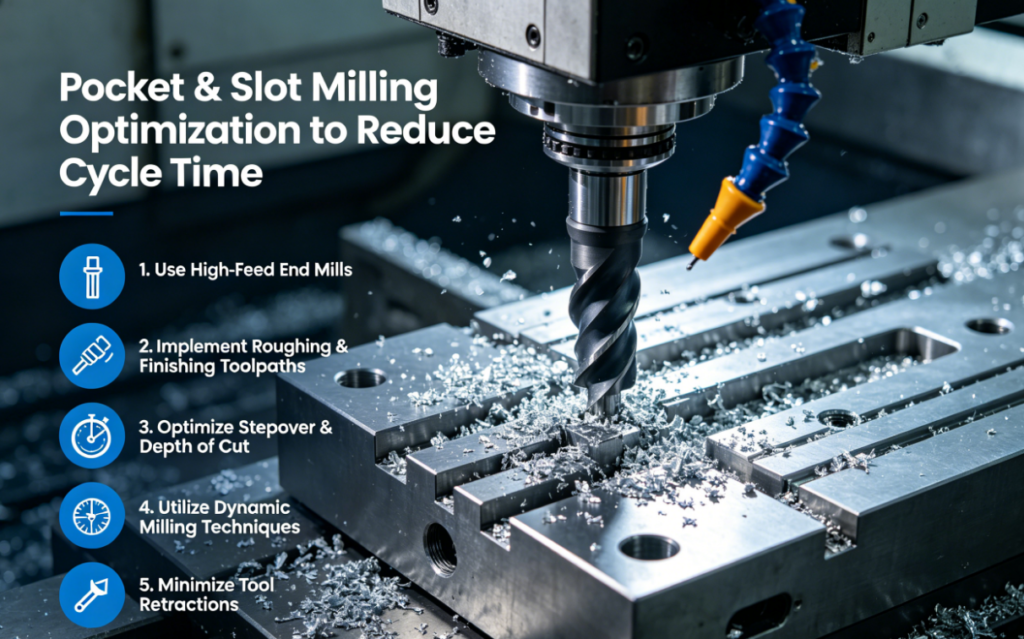
The Root Cause of Slow Pocket & Slot Machining
Most programmers waste cycle time on three avoidable problems:
- Uncontrolled cutter engagement Traditional zig-zag pocketing slams the full width of the endmill into material on every pass. Spindle load spikes, so you have to slow feeds drastically to avoid tool breakage.
- Excessive non-cutting air travel Constant full retracts to the safety plane between separate pocket regions add minutes of empty G00 movement on multi-feature parts.
- Unoptimized slot plunging Straight full-width slot plunging creates extreme cutting pressure. You are forced to drop feed rates low, turning short slot features into long machining cycles.
Zorapid Golden Rule:
Cutting cycle time does not come from cranking up spindle RPM. It comes from stabilizing tool load, deleting air cuts, and picking the right high-efficiency toolpath first.
Pick The Correct Toolpath Strategy (Biggest Time Saving)
Stop relying only on basic 2D Pocket and Standard Slot toolpaths. We split pocket and slot jobs into four dedicated strategies based strictly on feature geometry.
| Feature Type | Zorapid Preferred Mastercam Toolpath | Core Productivity Gain |
|---|---|---|
| Open & closed rough pockets with islands | Dynamic Motion Pocket (Adaptive Roughing) | Constant low radial engagement, 2–4x deeper axial depth, 40–60% faster roughing |
| Long narrow deep slots | Trochoidal Slot Milling | Avoid full-width plunging; keep cutter load consistent, no tool overload |
| Cleanup leftover stock in pocket corners | Rest Remachining Pocket | Machine only residual material; skip all finished empty stock entirely |
| Finishing pocket walls + floors | High-Speed Spiral Pocket + Contour Finish | Smooth arc motion, no sharp direction reversal, zero dwell marks on surfaces |
Critical Difference Between Old & New Pocketing
Conventional zig-zag pocketing uses 60–75% stepover. The cutter hits full material width repeatedly. You must slow feeds to survive heavy cutting loads.
Dynamic pocketing locks radial engagement at only 15–25% of tool diameter. This lets you run full deep cuts, ramp up feed speed drastically, and never overload the tool.
We apply this workflow to 6061 aluminum, 17-4PH stainless steel, H13 mold steel, and even Ti-6Al-4V titanium pockets with zero chatter.
Slot Milling Upgrade: Ditch Full-Width Plunging
Never run a standard slot toolpath on long narrow slots deeper than 3× tool diameter.
Switch directly to trochoidal slotting. The tool follows a circular oscillating path, only cutting a small portion of the cutter width on every pass. You can run aggressive feeds without bending the endmill or burning cutting edges.
Mastercam Pocket Optimization: Cut Air Travel By 70%
Even with a perfect roughing path, unnecessary retracts eat up massive runtime on multi-pocket parts. These are our locked-in production settings for all pocket programs.
Optimize Linking Moves (The Most Underrated Tweak)
Mastercam defaults lift the tool all the way up to the safety Z-height between separate pocket sections. This creates endless rapid air moves.
Zorapid Standard Settings:
- Turn on Micro Lift with only 0.15mm clearance between cutting passes
- Disable full retracts unless the tool will cross over finished part geometry
- Merge disconnected pocket chains into a single continuous toolpath where possible
- Keep linking moves at cutting feed instead of G00 rapid to eliminate machine jerking
For multi-island pockets, we enable “Stay at Depth” linking wherever stock allows. On a fixture plate with 8 separate pockets, this single setting can shave 12–18 minutes off total runtime.
Spiral Direction & Corner Smoothing
- Always use outside-in spiral roughing for closed pockets. Inside-out creates trapped leftover stock and extra cleanup passes.
- Enable corner rounding on all sharp internal turns. Abrupt 90° direction reversals force the CNC control to pause and slow down. Smooth blended arcs maintain constant feed speed all the way through the pocket.
- Turn off sharp corner feed reduction unless machining ultra-hardened tool steel. Feed ramping, not full feed stop, keeps cycle time steady.
Arc Filter For Smoother G-Code
Imported STEP geometry often breaks pocket boundaries into thousands of tiny line segments. The machine stutters while processing thousands of G01 blocks.
We always activate 2D arc filtering on all pocket roughing and finishing passes. The CAM software replaces short linear moves with continuous G02/G03 circular motion.
Result: G-code file size shrinks by nearly half, spindle motion stays consistent, and you hold better wall straightness in deep pockets.
Split Roughing, Semi-Finish & Finishing To Avoid Rework
Uneven leftover stock ruins finishing efficiency and forces extra light cuts. We follow a strict three-stage pocket workflow on all precision jobs:
- Dynamic Rough Pocket Leave a uniform 0.20–0.30mm stock on all pocket walls and floors. No variable scallops, no uneven leftover material. Uniform stock means the finishing tool runs with identical cutting load across the entire feature.
- Semi-Finish Cleanup Pass Run a light spiral pass to level roughing scallops. This removes high spots left by dynamic roughing, so the final finishing cut runs smoothly without sudden material hits.
- High-Speed Finishing Pass Use a spiral pocket path for the pocket floor, plus a separate contour toolpath for vertical walls. Split floor and wall finishing to eliminate Z-axis dwell marks and achieve Ra ≤ 0.4μm surface finish without hand sanding.
For blind deep pockets with thin ribs:
Machine in shallow Z slices. Do not take full-depth cuts in one pass. Side pressure pushes thin walls out of tolerance and adds rework time.
Trochoidal Slotting Optimization For Long Narrow Slots
Long deep slots are one of the biggest time wasters in CNC programming. Here is our optimized slotting workflow:
- Use a trochoidal slot toolpath instead of full-width slot milling
- Limit radial engagement to 10–20% of the tool diameter
- Use tangential arc ramp entry, never straight vertical plunging into solid material
- Keep the tool oscillating along the slot length; avoid stopping and restarting repeatedly
- Enable micro linking between oscillating arcs to eliminate constant lifting
For 100mm+ long slots in 316L stainless steel, this method cuts slotting time in half and eliminates endmill breakage caused by full-width overload.
Common Slotting Mistake We See Every Week
Programmers use a tool the full width of the slot and plunge straight down the entire depth. Cutting pressure spikes, feed rates drop to a crawl, and the tool bends. You waste 2–3x more time than trochoidal slotting.
Tooling Selection To Support Faster Pocket & Slot Machining
Optimized toolpaths only deliver results if your tooling can handle higher feeds and deeper cuts. Our shop standard tooling rules:
- Use the shortest possible tool overhang. Less stickout equals less vibration, higher allowable feed rates, and fewer finishing passes.
- For aluminum pockets: 2–3 flute high-helix endmills for fast chip evacuation.
- For steel and stainless pockets: 4-flute coated carbide roughing tools to maintain rigidity under constant dynamic motion.
- For narrow deep slots: neck-reduced long-reach endmills to avoid side rubbing.
Balanced tool holders with minimal runout let you push MRR (material removal rate) far higher than standard ER collet setups. At Zorapid, all high-efficiency pocket jobs use heat-shrink tool holders to keep runout under 0.002mm.
Real Zorapid Case Study: Pocket & Slot Cycle Time Reduction
Part Info
Material: H13 hardened mold steel (48–52 HRC)
Features: 4 closed deep pockets with internal islands + 6 long narrow through slots
Tolerance: ±0.008mm wall accuracy, Ra ≤ 0.8μm
Machine: 3-axis vertical machining center
Before Optimization (Default Zig-Zag Pocket + Standard Slotting)
- Total program cycle time: 72 minutes
- Frequent full retracts between pockets
- Heavy cutter overload in island corners, feed rates kept low to prevent tool chipping
- Uneven roughing stock required two extra finishing cleanup passes
- 1 out of 5 parts failed CMM inspection due to wall deflection
After Our Pocket & Slot Optimization Workflow
- Switched all roughing to Mastercam Dynamic Motion Pocket
- Replaced standard slotting with trochoidal slot toolpaths
- Enabled micro-lift linking + corner smoothing + arc filtering
- Set uniform rough stock and added a semi-finish leveling pass
- Optimized tool overhang and upgraded to high-feed carbide endmills
Measurable Results:
Total cycle time dropped from 72 minutes down to 34 minutes (53% time reduction)
Zero cutter overload or corner chipping
No extra cleanup passes needed
100% consistent CMM dimensional results
Carbide tool life extended by 42% with steady cutting load
The 6 Biggest Pocket & Slot Milling Mistakes Killing Your Productivity
- Sticking to old zig-zag pocketing instead of adaptive dynamic roughing, forcing low feed rates due to heavy tool load
- Leaving full Z retracts between multiple pockets, stacking up minutes of empty air travel
- Running full-width straight plunges on long slots instead of trochoidal oscillating paths
- Leaving uneven roughing stock, adding extra semi-finish passes you do not need
- Skipping arc filtering, leaving thousands of tiny linear G-code segments that make the machine stutter
- Using long tool overhangs that create vibration and force you to slow down feeds
Fix just these six issues, and you will immediately trim 30%+ runtime from every pocket and slot program.
Post-Processing & Simulation To Avoid Downtime
Even optimized toolpaths will cost you time if you crash the tool into islands or pocket walls. Our final pre-machining steps:
- Clean up redundant G-code blocks; delete unnecessary dwell commands and repeated positioning lines
- Lock circular interpolation G02/G03; prevent the post processor from forcing linear moves
- Run full VERICUT simulation to check for gouging into island geometry and verify linking moves
- Group all pocket and slot features by tool number to minimize ATC tool changes
On multi-feature mold plates, grouping operations by tool saves far more time than tweaking individual feed settings. We always rearrange the operation list to run every feature with one tool before swapping cutters.
Closing Wrap-Up
Pocket and slot milling optimization follows a clear step-by-step formula:
Clean geometry → Select dynamic/trochoidal toolpaths → Cut retract air travel → Stabilize cutter engagement with corner smoothing and arc filtering → Control uniform rough stock → Group operations to reduce tool changes.
You do not need expensive new machine hardware to slash cycle times. Most productivity gains come from reworking your CAM pocket and slot strategies and eliminating wasted non-cutting motion.
Zorapid specializes in high-efficiency NPI machining and low-volume precision production for global OEMs in aerospace, medical, mold making, and semiconductor industries. We deliver optimized Mastercam programming, DFM feature refinement, and lights-out ready pocket & slot machining with tight tolerances and fast turnaround.
Send over your STEP file with pocket and slot features, and we will deliver a free cycle time comparison between your original toolpath and our optimized version.
FAQ
Will dynamic pocketing work on deep blind pockets with multiple islands?
Yes. Mastercam Dynamic Motion automatically navigates around internal islands while maintaining consistent radial engagement. Just enable “Minimize Burial” to avoid digging into narrow gaps between islands and pocket walls.
Does trochoidal slotting work for through slots as well as blind slots?
It works even better for through slots. The oscillating path reduces side pressure, prevents slot wall tapering, and lets you run much higher feed speeds compared to full-width slot milling.
Can arc filtering mess up pocket dimensional tolerance?
Not if you set arc tolerance tighter than your drawing spec. We use 0.001mm arc deviation for precision pockets. Smoother circular motion improves wall straightness instead of hurting accuracy.
How do I stop pocket walls from deflecting during roughing?
Keep radial engagement low with dynamic pocketing, split deep cuts into Z-level slices, and leave uniform stock all around the pocket. Avoid heavy full-width cuts that push thin ribs out of tolerance.