Publisher: Zorapid.Ltd
Tiny medical components — micro bone screws, endoscope slender shafts, PEEK implant sleeves, dental abutments and cross-drilled sealing pins — push standard CNC lathes to their absolute limit.
On conventional fixed-head lathes, small slender bar stock bends severely under cutting force.
You finish OD turning, then re-clamp the part for cross milling and side drilling. Every re-clamp creates small cumulative offset, breaking concentricity between outer diameter and cross holes.
Secondary manual deburring leaves micro burrs that fail biocompatibility visual inspection.
Multiple operations stretch lead time and cause large batch dimensional scatter.
For FDA and ISO 13485 certified implant parts, inconsistency and edge flash will stop your batch release cold.
Swiss type turn-mill sliding headstock machines solve all these problems in one continuous cycle.
At Zorapid, we run multi-axis Swiss turn-mill cells exclusively for miniature medical components made from Ti‑6Al‑4V, 316L stainless and unfilled medical-grade PEEK for European and North American medical OEMs.
We hold batch repeatability within ±0.003mm, eliminate secondary deburring entirely, and cut total cycle time by more than 60%.
Today we break down the core advantages, key process settings and proven turn-mill workflows built specifically for tiny high-spec medical parts.
What Makes Swiss Turn-Mill Perfect For Miniature Medical Parts
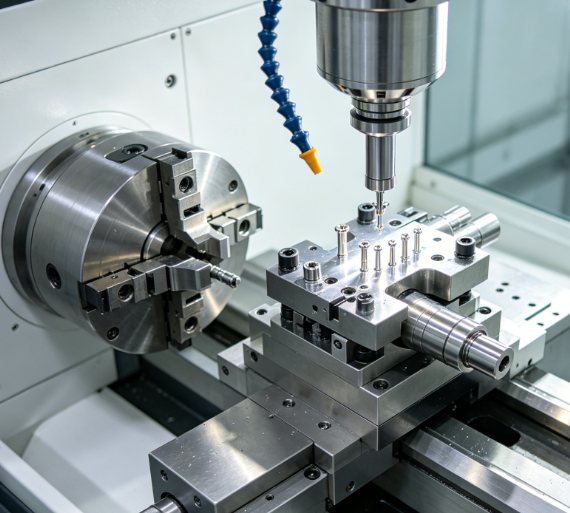
The biggest difference lies in the sliding headstock and precision guide bushing system.
- Workpiece support right at the cutting zone The bar stock passes through a hardened guide bushing just 0.1~0.3mm away from the cutting edge. There is no long unsupported overhang. Even slender parts with L/D up to 25:1 stay rigid without bending or chatter. Thin-wall hollow endoscope tubes maintain perfect straightness.
- Multi-axis live tooling for full-feature single-setup machining Modern Swiss turn-mill lathes carry 6~9 axes with driven live tools. OD turning, ID boring, cross milling, radial cross-hole drilling, slotting and thread whirling all finish in one clamping. No tear-down, no re-alignment, no cumulative tolerance stack-up between concentric features.
- Bar feeding + automatic part separation for clean unattended runs Bar feeders feed continuous raw rod stock automatically. After machining, the part is parted off and dropped into sealed collection bins without human handling. This avoids surface contamination critical for implant-grade materials.
- Ultra-low thermal drift for micro-tolerance batch stability Thermally stabilized spindle structure keeps dimensional drift minimal during long lights-out runs. Overnight production maintains the same micron-level accuracy as the first piece off the bar.
Conventional lathe = multiple clamps + deflection + secondary hand work
Swiss turn-mill = one clamp + rigid support + complete part finished in-cycle
Zero Deflection On Slender Micro Medical Shafts
Long thin endoscope guide pins and implant slender sleeves always vibrate and bend on fixed-head lathes.
The Swiss guide bushing eliminates overhang deflection almost completely.
We regularly machine 0.6mm diameter titanium pins with length over 15mm without mid-span bowing.
Critical process rule for medical micro bars:
Match the guide bushing clearance precisely to bar stock tolerance. Too much clearance causes wobble; too tight creates friction and work hardening on 316L and titanium.
We use floating split bronze guide bushings for small diameter medical bar stock to keep runout below 0.002mm.
Result:
OD straightness stays within 0.004mm across the full length, no post-machining straightening required.
Single-Setup Turn-Mill Eliminates Cross-Hole Concentricity Error
Most miniature medical parts combine round turning with radial cross holes, flat milling and anti-rotation slots.
Traditional workflow requires 2 or 3 separate operations: turn OD → re-clamp → drill cross holes → re-clamp again for milling.
Each re-fixture breaks concentricity between the outer circle and side features, leading to rejected assemblies.
Swiss turn-mill synchronous multi-axis motion solves this completely:
- Turn main OD and tapered contours with main spindle rotation
- Bring live cross-tool into position without unclamping the bar
- Drill radial micro holes, mill flats and machine drive slots while the bar remains fixed in the guide bushing
- Finish internal bore and parting cut in the same program
No re-clamping means cross-hole position and OD concentricity hold stable within ±0.003mm consistently for the full batch.
This is non-negotiable for threaded implant abutments and fluid-carrying micro manifolds.
In-Cycle Deburring For Burr-Free Implant-Grade Edges
Micro whisker burrs on sharp corners are a major headache for medical device quality control.
Manual tumbling or hand scraping can scratch sealing surfaces and leave loose particles on implant components, violating biocompatibility requirements.
We build burr elimination directly into the Swiss turn-mill program with three in-cycle tricks:
- Program small lead-in chamfers on all exit edges before parting or cross drilling
- Use high positive-rake sharp inserts to shear material cleanly instead of plowing and tearing edges
- Add a tiny finishing wiper pass on sharp corners right before part separation
No secondary bench work is needed. Sharp edges stay crisp and burr-free directly from the machine.
For unfilled medical PEEK sleeves, zero-edge-hone polished inserts eliminate polymer stretching and whisker burrs entirely.
Stable Surface Finish Without Thermal Damage On Medical Alloys
Medical grade 316L stainless, Ti‑6Al‑4V and virgin PEEK are all sensitive to heat and work hardening.
Swiss turn-mill’s short rigid tool projection minimizes vibration, so we achieve Ra 0.2~0.4μm as-machined surface without extra polishing.
Our material-specific turn-mill settings for tiny medical parts:
1) Titanium Ti‑6Al‑4V bone screws
- Low-friction AlCrN coated positive-rake inserts
- High feed to avoid rubbing and built-up edge
- Through-spindle high-pressure MQL minimum quantity lubrication to prevent thermal surface hardening
2) 316L stainless micro pins
- 3-flute parabolic small-diameter micro drills for cross holes
- Low-frequency pecking on deep micro bores to avoid work hardening
- Continuous chip evacuation to stop stringy swarf from scratching the bore wall
3) Virgin medical PEEK sleeves
- Uncoated polished solid carbide cutters with +15° high positive rake
- Dry compressed-air cooling only, no liquid coolant contamination
- Light ultra-shallow finishing passes to prevent melting and edge tearing
All surface finishes meet ISO medical device roughness requirements without secondary abrasive processing.
Lights-Unattended Bar-Fed Batch Production For High-Volume Micro Parts
Small medical components are mostly high-volume bar-fed jobs.
Swiss turn-mill lathes pair perfectly with automatic bar feeders, part catchers and bin separation.
One operator can supervise 4~6 machines running overnight lights-out production.
Continuous bar stock feeding cuts material waste drastically: we only leave a tiny bar remnant at the end of each rod, far less than blank-to-blank CNC machining.
Measurable shop-floor improvement:
Old multi-operation lathe process: 7 minutes per piece + manual handling + secondary deburring
Swiss turn-mill single-cycle process: 2.5 minutes fully unattended, zero human contact with finished implant parts.
Contamination risk drops sharply, fully fitting ISO 13485 clean production rules.
5 Common Tiny Medical Part Defects & Swiss Turn-Mill Fixes
| Defect | Root Cause | Swiss Turn-Mill Correction |
|---|---|---|
| Slender shaft bends mid-length | Excessive unsupported overhang | Fit precision guide bushing close to cutting zone; reduce bar free span |
| Cross-hole offset loses concentricity | Multiple re-clamp operations | Complete turning + cross drilling in one multi-axis turn-mill cycle |
| Fine whisker burrs on sharp edges | Dull tool + exit tearing | Add lead chamfers; use zero-hone sharp positive-rake inserts + in-cycle wiper pass |
| Titanium surface work hardening | Tool rubbing + poor lubrication | Raise feed rate; switch to MQL mist cooling with low-friction coated tools |
| Batch dimension drifts overnight | Thermal spindle shift | Activate machine thermal compensation; stabilize workshop temperature at 20±1°C |
Zorapid Standard Swiss Turn-Mill SOP For Micro Medical Components
Copy this workflow for consistent implant-grade micro parts:
- Pre-stabilize medical bar stock (PEEK annealed; titanium stress-relieved)
- Set matched guide bushing clearance to eliminate bar wobble and friction
- Load bar into automatic feeder; seal part collection bin to avoid contamination
- Program full turn-mill cycle: OD turning → cross milling → radial drilling → corner deburring → parting off
- Use material-matched sharp inserts with optimized rake angle and MQL/air cooling
- Run light finishing passes to lock Ra 0.2~0.4μm surface and zero edge burrs
- Activate thermal compensation for long unattended runs
- First-article CMM inspection for concentricity, diameter and edge quality before batch release
Measurable Production Result:
Conventional multi-operation lathe: 18% scrap from re-clamp error and burr rejection
Swiss turn-mill single-cycle production: First-pass yield >98.5%, tolerance locked within ±0.003mm batch-wide.
Real EU Client Case Study
A Belgian dental OEM ordered miniature Ti‑6Al‑4V abutments with tapered OD, radial anti-rotation slots and micro threaded holes.
Their original two-step lathe process faced two critical issues:
- Re-clamping caused 0.008mm concentricity offset between OD and cross slots, failing assembly fit
- Sharp thread edges formed micro burrs that failed biocompatibility visual screening, requiring tedious hand deburring
We switched the entire job to our 7-axis Swiss turn-mill cell and revised the process:
- Machined turning, slot milling, radial drilling and threading all inside one bar-fed clamping cycle
- Installed matched precision guide bushings to eliminate bar deflection
- Programmed in-cycle chamfering and sharp shear cutting to remove exit-edge burrs completely
- Used AlCrN sharp inserts with MQL cooling to prevent titanium surface hardening
Final outcome:
Concentricity error reduced below 0.0025mm. Parts came out fully burr-free with no manual finishing.
Cycle time dropped by 65%, and the full batch passed FDA-level visual and dimensional inspection without a single rejection.
Conclusion
For tiny complex medical components — slender shafts, implant screws, PEEK sleeves and cross-feature micro fittings — Swiss type turn-mill sliding headstock technology is not just an upgrade; it becomes the only reliable way to hit medical-grade precision.
The core value breaks down into five solid advantages:
- Guide bushing rigid support eliminates slender part bending and chatter
- Multi-axis live tooling completes turning, milling and cross drilling in one setup to eliminate concentricity error
- In-cycle sharp shearing removes edge burrs without secondary bench work
- Optimized tooling keeps alloy surfaces free of work hardening and thermal damage
- Bar-fed unattended production cuts cycle time and contamination risk for ISO-certified batches
You eliminate tolerance scatter, scrap from re-clamping and costly post-processing labor all at once.
At Zorapid, our multi-axis Swiss turn-mill workshop specializes in miniature medical components from titanium, 316L and implant-grade PEEK for European and North American medical device OEMs. We deliver burr-free, concentricity-stable micro parts with full FAI documentation for regulatory approval.
If you keep fighting deflection, cross-hole misalignment and edge burrs on small implant parts, send your 3D model and material grade. Our Swiss turn-mill programmers will build a full single-cycle multi-axis program to consolidate all features into one clamping operation.
FAQ
Do I need a guide bushing for short small medical parts?
For slender bar stock (L/D>8:1), the guide bushing is mandatory to avoid bending. For short blanks, we switch to a chucking Swiss mode without a bushing, still keeping multi-axis single-setup turn-mill capability.
Can Swiss turn-mill eliminate all micro burrs on implant edges?
Yes. With lead chamfers, sharp positive-rake tooling and programmed wiper passes, we can machine zero-burr sharp edges directly on the lathe, completely avoiding tumbling or hand scraping that risks surface contamination.
What material is better for micro implant machining on Swiss lathes: solid carbide or coated inserts?
Titanium and stainless steel use low-friction AlCrN coated micrograin carbide. Unfilled PEEK uses uncoated polished carbide with zero edge hone to shear cleanly without polymer tearing.
Why is concentricity far better on Swiss turn-mill than two-operation lathe work?
The bar never leaves the guide bushing fixture. All turning and cross-feature machining runs on the same fixed spindle datum. There is zero re-clamp shift, so OD and radial holes stay perfectly concentric across the whole batch.