Publisher: Zorapid.Ltd
If you’ve ever stared at two CNC quotes side-by-side and scratched your head wondering why one supplier hits you with a steep 5-axis hourly premium while another swears 5-axis cuts your total part cost, this breakdown is built exactly for you.
Most procurement folks only fixate on the per-hour machine rate—and that’s the biggest costing mistake you can make. 3-axis mills look cheaper upfront, but hidden labor, fixturing, rework and multi-setup waste quietly inflate your final invoice for complex geometries. Meanwhile, 5-axis machining’s higher hourly price tag often disappears once you tally every hidden expense tied to repeated flipping, alignment and scrap losses.
At Zorapid, we process thousands of custom CNC parts monthly for aerospace, medical, automotive and semiconductor clients across North America and Europe. We built a data-backed cost comparison chart based on real production runs, not generic industry estimates. Today we’re breaking down every line item so you can instantly judge which machine fits your project without guessing.
Quick Baseline: Standard Hourly Rate Gap
Let’s start with the obvious number every RFQ highlights: machine hourly cost. These are real market rates we see from US, EU and Asia-based precision shops in 2026:
- 3-Axis Milling: $40–70/hour (standard aluminum, steel prismatic work)
- 5-Axis Simultaneous Machining: $100–180/hour (high-end industrial 5-axis centers with collision simulation)
On paper, 5-axis runs 1.5x to 3x more expensive per cutting hour. But this single metric tells less than half the costing story. Think of it like hiring a contractor: a specialist charges more per hour but finishes the whole job in one visit, while a cheaper generalist takes 4 trips with extra supply fees.
Why 5-axis Hourly Rates Are Higher (No Fluff, Transparent Breakdown)
- Massive machine capital investment: Industrial 5-axis centers cost 2–3x more than equivalent 3-axis mills, with years-long depreciation schedules
- Advanced CAM programming: HyperMill, UG NX simultaneous 5-axis toolpath simulation adds heavy software licensing fees
- Skilled labor premium: 5-axis programmers and operators require 6–12 months specialized training vs basic 3-axis operation
- Higher maintenance: Dual rotary axes demand frequent precision calibration, specialized lubrication and spare rotary components
- Premium workholding: Zero-point fixtures, compact precision vises built for multi-angle access cost far more than standard 3-axis clamps
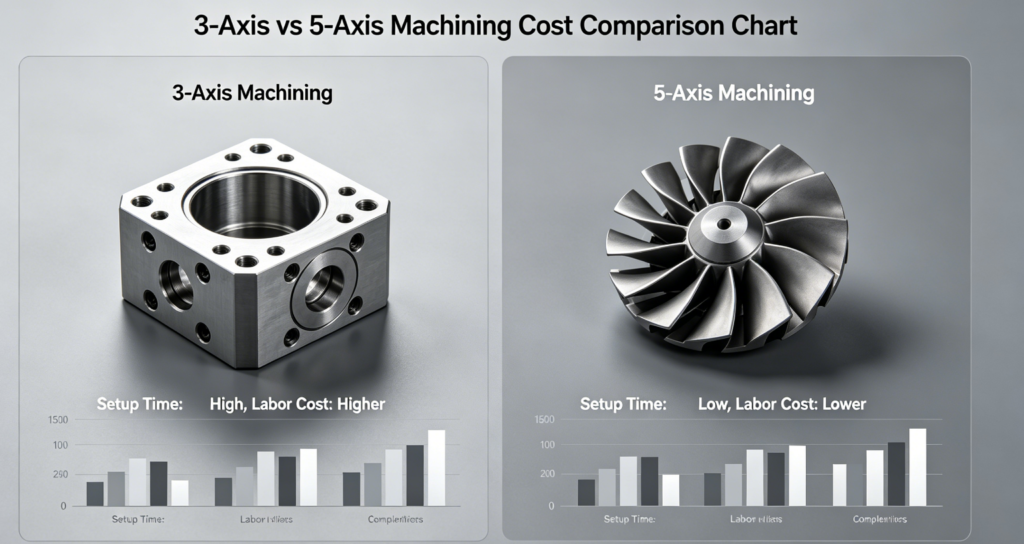
Core Cost Comparison Chart: 3-Axis vs 5-Axis Full Line Item Breakdown
This is our proprietary Zorapid costing table built from identical complex aerospace bracket test runs (Ti-6Al-4V alloy, 6 machined faces, inclined threaded holes, curved draft surfaces, ±0.005mm critical tolerance). We ran the exact part through both machining workflows to capture every cost variable, no theoretical guesswork.
| Cost Component | 3-Axis Machining Total Cost Per Unit | 5-Axis Simultaneous Machining Total Cost Per Unit | Net Cost Difference | Key Notes |
|---|---|---|---|---|
| Machine Hour Charges | $96 | $84 | -12$ (5-axis cheaper) | 4 separate 3-axis setups = longer total cycle time |
| Custom Fixturing Amortization | $38 | $6 | -32$ (5-axis cheaper) | 3-axis required custom soft jaws; 5-axis used standard vise |
| Manual Setup & Alignment Labor | $42 | $8 | -34$ (5-axis cheaper) | 4 flips, manual datum re-calibration on 3-axis |
| Programming One-Time Fee | $22 | $36 | +14$ (3-axis cheaper) | Complex multi-angle toolpath simulation adds CAM labor |
| Rework & Scrap Risk Buffer | $28 | $3 | -25$ (5-axis cheaper) | Datum shift across setups pushed 3-axis first-pass yield to 84%; 5-axis yield 99.7% |
| Secondary Polishing/Finishing | $16 | $4 | -12$ (5-axis cheaper) | Single continuous cut eliminates setup witness lines |
| Final Total Per Part Cost | $242 | $141 | -$101 / 41.7% Total Cost Savings With 5-Axis | Complex multi-face parts flip the hourly rate math entirely |
Critical Takeaway From Our Chart
For any component that needs 3+ separate clamping operations on a 3-axis mill, 5-axis machining delivers dramatic total cost reduction—even with the higher hourly machine fee. The labor, fixture and scrap overhead from repeated repositioning crushes the small programming premium you pay for 5-axis CAM work.
For simple flat, single-sided blocks (only 1 machined face, no angles/curves), 3-axis remains the budget-friendly pick. No setup flips mean zero hidden overhead to offset higher hourly rates.
Two Real-World Project Examples To Illustrate The Cost Gap
Case 1: Simple Aluminum Enclosure (1 Machined Face, Low Complexity)
- 3-axis total unit cost: $32
- 5-axis total unit cost: $58
- Verdict: Stick to 3-axis. No multi-face access required; higher 5-axis hourly rates add unnecessary expense.
Case 2: Medical PEEK Orthopedic Implant (5 curved surfaces, deep inclined cavities, tight biocompatible tolerances)
- 3-axis workflow: 5 fixture setups, custom soft jaws, 18% scrap rate, heavy manual post-polishing → $186 per implant
- 5-axis single-setup workflow: Standard zero-point vise, zero reposition drift, minimal secondary finishing → $112 per implant
- Verdict: 40% cost reduction with 5-axis, plus faster lead time (7.2hr total cycle vs 12hr 3-axis runtime)
Zorapid’s engineering team always runs this complexity check during DFM reviews: if your drawing contains inclined holes, continuous curved geometry or more than 2 machined faces, we automatically flag 5-axis as the cost-optimized solution before quoting.
Hidden 3-Axis Costs Most Buyers Miss In Standard Quotes
CNC suppliers rarely itemize these overhead charges on basic RFQ spreadsheets, and they’re the #1 reason your final invoice balloons when selecting 3-axis for complex parts:
- Custom fixture amortization: Unique soft jaws, holding blocks and special clamps only usable for your single part design
- Datum alignment labor: Every workpiece flip requires operator re-probing, 30–60 minutes lost production per setup
- Scrap waste from positional drift: Micron-level offset errors across multiple setups lead to full batch rejection on tight tolerance jobs
- Extended lead times: Queue gaps between separate machining operations stretch delivery windows by 30–50%
- Secondary manual finishing: Visible step marks from repeated clamping demand time-consuming hand polishing or grinding
5-axis machining eliminates all five of these hidden cost buckets with one single workpiece clamp. The tool tilts to reach every angle and cavity without removing the blank from the workholding.
Quick Decision Rule Of Thumb
We created an easy 3-step checklist our US/EU OEM clients use to instantly pick between 3-axis and 5-axis without complex costing models:
- If your part has ≤2 machined flat faces, no inclined features: Choose 3-axis for lowest total cost
- If your part has 3+ machined sides, curved surfaces or angled holes: Choose 5-axis to cut total spend by 30–45%
- If your drawing calls for ultra-tight tolerances (≤±0.005mm) or medical/aerospace compliance: 5-axis is non-negotiable to avoid costly rework batches
FAQ
Does 5-axis always cost more per part?
Absolutely not. Hourly machine rates are higher, but multi-setup 3-axis labor, fixture and scrap overhead easily overtake that premium on complex components, as our comparison chart proves. Simple flat parts are the only exception where 3-axis stays cheaper.
Can Zorapid adjust pricing to minimize 5-axis programming fees for repeat orders?
Yes. For recurring production runs, we amortize one-time CAM programming costs across thousands of units, slashing per-unit 5-axis overhead drastically for medium/high volume OEM projects.
What volume range sees the biggest 5-axis cost savings?
Low-to-medium volume (1–500 units) prototypes and custom components gain the largest financial benefit. High mass production simple parts with standardized fixtures still favor 3-axis milling.
Will 5-axis cut my lead time alongside reducing cost?
Typically 30–40% faster cycle time. Eliminating repeated workpiece flipping and secondary finishing steps collapses total production timelines for tight-deadline NPI launches.
How Zorapid Optimizes Your Machining Cost Regardless Of Axis Choice
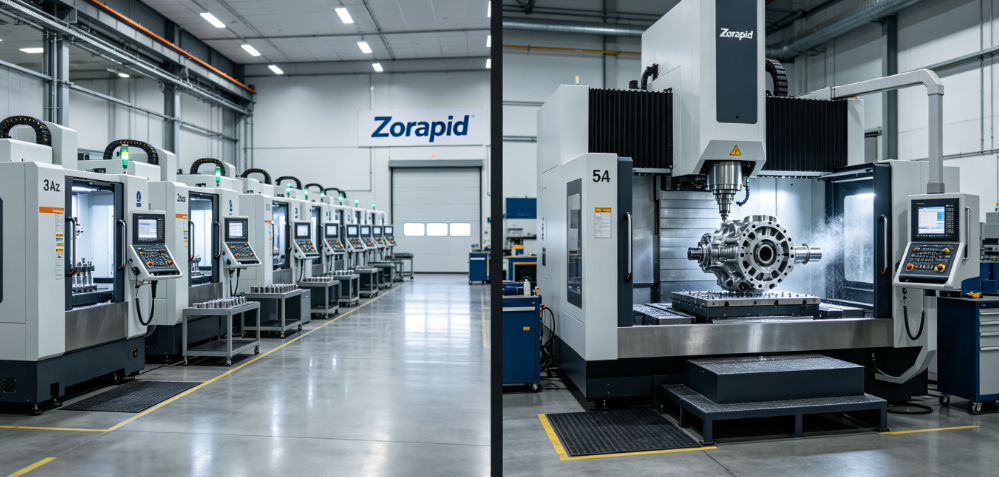
As a 3000㎡ precision manufacturing center with both full 3-axis milling banks and simultaneous 5-axis machining cells, we don’t push one technology over the other to inflate quotes. Our process for every RFQ:
- Free DFM engineering review to map part complexity, tolerance demands and volume targets
- Dual cost quote: Separate 3-axis and 5-axis full breakdowns with transparent line items matching our comparison chart
- Fixture optimization: Standard workholding prioritized to cut custom tooling amortization fees
- CAM toolpath simulation to minimize cycle time, tool wear and scrap risk
- ISO 9001 & AS9100 compliant inspection to lock in first-pass yield, eliminating hidden rework charges
We specialize in Ti-6Al-4V, IN718, PEEK, 316L stainless and aluminum precision components for aerospace, medical implant, semiconductor and new energy clients across Europe and North America.
Closing Wrap-Up
Don’t judge your CNC quote purely by hourly machine rates—that outdated mindset leaves thousands of dollars in avoidable overhead on the table for complex custom parts. Our 3-Axis vs 5-Axis Machining Cost Comparison Chart proves the total unit price is what truly moves your procurement budget, not surface-level per-hour fees.
If you’re drafting an RFQ for prototype or production components and unsure which machining technology delivers the lowest all-in cost, send your STEP file to Zorapid today. Our engineering team will deliver a side-by-side 3-axis/5-axis cost breakdown tailored to your design, material and volume requirements—no hidden fees, no generic estimates.