Published:Zorapid.Ltd
If you’re a design or manufacturing engineer, you’ve faced this call dozens of times: mill the part, or turn it?
Grab the wrong process early in your design cycle, and you’ll stack avoidable losses:
- 20–50% longer machining cycle times
- Extra secondary setups and rechucking errors
- Higher unit costs for mass production runs
- Compromised surface finish or tight tolerance control
- Delayed prototype validation and production launches
This guide skips dry textbook definitions. We speak engineer-to-engineer, with real shop-floor data, clear decision rules, and industry part examples you’ll recognize instantly.
By the end, you’ll have a repeatable framework to decide milling vs turning in 60 seconds flat for any CAD drawing you pull up.
Core Mechanical Difference: Milling vs Turning In Plain English
Let’s lock in the foundational rule first—everything else flows from this one motion contrast.
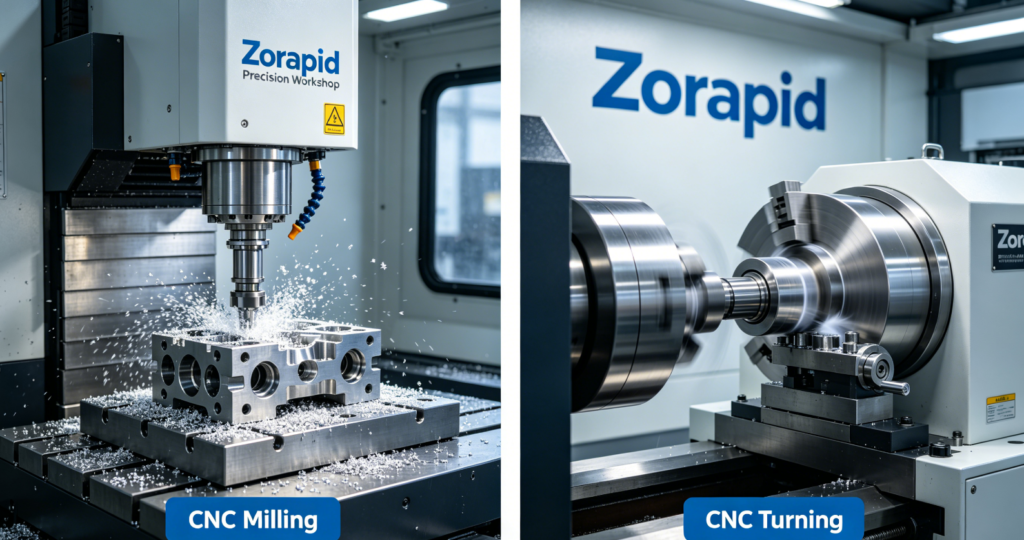
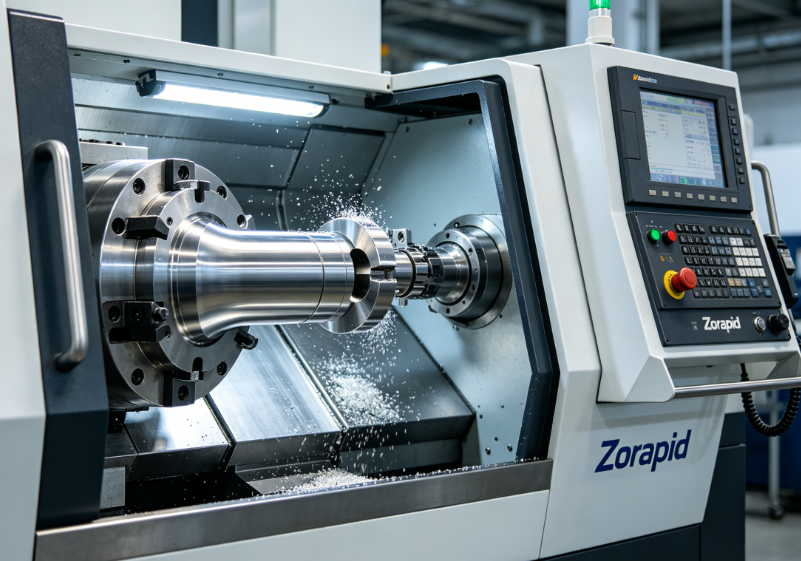
CNC Turning (Lathe / Swiss Lathe)
- Workpiece spins rapidly on the spindle
- Single-point cutting tool stays fixed, moves linearly along X/Z axes
- Built exclusively to shape rotationally symmetric geometry: cylinders, cones, threads, rounded shafts
Think: The part spins; the tool cuts stationary.
CNC Milling (3/4/5-Axis Machining Center)
- Workpiece clamped firmly to a static table (no rotation)
- Multi-flute cutting tool spins at high RPM, travels X/Y/Z + rotational axes
- Carves flat planes, pockets, slots, undercuts, freeform 3D contours, uneven non-round shapes
Think: The part stays still; the spinning tool sculpts every surface.
Quick Side-by-Side Comparison Table
| Metric | CNC Turning | CNC Milling | Best For |
|---|---|---|---|
| Core Geometry | Rotationally symmetric (shafts, pins, bushings) | Prismatic, irregular, complex 3D contours | Round = Turn; Odd/Flat = Mill |
| Typical Tolerance | ±0.005 mm (Swiss precision) | ±0.01 mm (5-axis high-end) | Ultra-tight round features: Turning |
| Surface Finish | Ra 0.2–0.8 μm (fine turning inserts) | Ra 0.4–1.6 μm (ball end mill finishing) | Medical implant smoothness: Turning |
| Production Volume Strength | High-volume bar feed runs (10k+ units) | Low/medium volume prototypes & small batches | Mass round parts: Turning; Prototypes: Milling |
| Setup Complexity | Minimal fixturing, fast changeover | Custom fixtures, longer setup times | Fast repeated runs: Turning |
| Material Waste | Low (bar stock feeding) | Higher (solid block stock) | Cost-sensitive high-volume: Turning |
| Key Limitation | Poor for non-round cross-sections | Slow for full cylindrical outer diameters | Mixed round + flat features: Mill-Turn |
When You Should Choose CNC Turning (All Rotational Part Scenarios)
Pick turning if your part hits any of these criteria—Zorapid’s production engineers default to lathes here for cost and speed.
1. Fully Rotationally Symmetric Main Body
Any part that looks identical when spun around its central axis:
- Drive shafts, hydraulic pins, bearing sleeves
- Threaded fasteners, valve spools, piston blanks
- Medical bone screws, hip implant stems
2. High-Volume Serial Production
Bar-fed CNC lathes (including Swiss-type turning centers) cut unit costs by 25–40% vs milling identical round parts in bulk runs.
Perfect for automotive transmission hardware, fluid control fittings, mass consumer hardware.
3. Micro Precision Tiny Parts
Swiss turning achieves micron-level tolerances down to ±0.005 mm for miniature medical and electronics pins—milling struggles with tiny delicate round stock without vibration.
4. Ultra-Smooth Circular Surfaces
Polished OD/ID bores, mirror-finish sealing surfaces for fluid systems rely on turning’s consistent single-point cutting to avoid milling chatter marks.
When CNC Milling Is Your Best Bet
Milling wins when symmetry goes out the window. Reach for 3, 4, or 5-axis machining centers for these common engineering components.
1. Non-Round, Prismatic Base Shapes
Housings, brackets, manifolds, heat sinks, gear blanks with uneven outer profiles—no spindle rotation can replicate multi-plane features here.
2. Complex 3D Contours & Freeform Surfaces
Aerospace turbine blades, injection mold cavities, semiconductor test chambers require 5-axis simultaneous milling to reach deep undercuts and curved profiles.
3. Multiple Offset Features On One Block
Pockets, cross holes, keyways, mounting slots, angled bosses—all impossible to machine cleanly on a standard lathe without secondary milling operations.
4. Low-Volume Prototyping & One-Off Test Parts
Milling’s flexible fixturing cuts rework when iterating CAD designs. At Zorapid, we turn around prototype milled parts in as fast as 3 business days for R&D validation.
5. Hardened Tool Steel Machining
Milling centers with high-rigidity spindles reliably cut H13, S136, NAK80 mold steel above 45 HRC—standard lathes lack the multi-axis tool access for deep mold cavities.
Real-World Industry Part Examples
Turning-Dominant Components
- Medical: Titanium bone screws, PEEK implant sleeves, stainless surgical pins
- Automotive: Crankshaft blanks, piston pins, wheel spindle hubs
- Energy: Hydraulic valve bodies, wind turbine bearing shafts
- Electronics: Precision connector pins, copper bushing terminals
Milling-Dominant Components
- Aerospace: Wing ribs, turbine blisks, lightweight aluminum chassis
- Medical: Surgical instrument housings, implant fixture jigs
- Tool & Mold: Injection mold cores, die casting cavities, electrode holders
- Consumer & Semiconductor: Device heat sinks, wafer test mounting blocks
Hidden Factors Engineers Miss: Tolerance, Volume, Material & Lead Time
Geometry isn’t the only decision driver—these four variables flip your process pick constantly.
- Production Volume Threshold Under 500 units: Milling often cheaper due to zero bar feed setup overhead. Over 1,000 identical round parts: Turning slashes per-piece cost drastically.
- Material Machinability Soft aluminum, brass bar stock = turning shines. Hard alloy blocks, titanium plate, solid PEEK slabs = milling preferred.
- Critical Tolerance Zones Circular OD/ID sealing surfaces: Turning holds tighter consistency. Orthogonal flat datums, cross-hole positional tolerances: 5-axis milling superior.
- Project Lead Time Goals Quick prototype turnaround: Milling flexible for frequent design changes. Mass production long-run delivery: Lathe bar feed runs 24/7 lights-out for faster throughput.
Mill-Turn Hybrid: The Middle Ground For Mixed-Feature Components
Most engineers overlook mill-turn centers, our most underutilized machine at Zorapid.
If your part has a round main shaft + non-round features (flanges, cross slots, radial holes), mill-turn eliminates two separate machining setups.
Key Mill-Turn Benefits
- Zero rechucking alignment errors (single clamping for full part completion)
- Cuts secondary operation labor by 30% vs separate lathe + mill runs
- Preserves tight positional tolerances between rotational and prismatic features
Common mill-turn parts: Flanged hydraulic shafts, threaded medical implant flanges, automotive gear shafts with keyways.
Zorapid Engineer’s 5-Step Process Selection Checklist
Run through this before sending your CAD for quotation to avoid costly DFM rework:
- Draw axis check: Is the main body fully rotationally symmetric? If yes, start with turning.
- Feature audit: Count non-round cross holes, slots, pockets, angled bosses. More than 2 = add milling or mill-turn.
- Volume review: <500 prototypes = milling; >1,000 round parts = standard/Swiss turning.
- Tolerance map: Critical circular sealing surfaces prioritize turning; multi-plane datums prioritize 5-axis milling.
- Cost-lead balance: If mixed geometry exists, ask your supplier for mill-turn vs split mill+turn comparative quotes.
Common DFM Mistakes From Misselecting Milling/Turning
We fix these errors daily for overseas engineering clients:
- Specifying a lathe for a shaft with offset radial slots → requires secondary milling, longer lead time.
- Sending a simple round pin to a 5-axis mill → bloated unit cost, unnecessary setup time.
- Designing mixed round/flange parts without mill-turn capability → two separate setups introduce alignment drift.
- Demanding Ra <0.4 μm sealing surfaces on milled cylinders → visible tool step lines ruin fluid tightness.
- Overspecifying milling for high-volume bar stock parts → 40% higher production pricing.
FAQ
Can you machine round parts on a milling center?
Technically yes, via rotary 4th axis, but cycle time and cost jump dramatically vs dedicated turning. Only viable for low-count prototypes with extra non-round features.
Is Swiss turning better than standard lathes?
Swiss turning delivers tighter micro tolerances and reduced vibration for parts under 32 mm diameter. Standard lathes handle larger diameter shafts cost-effectively.
When should I request mill-turn instead of separate milling + turning?
Any component combining a rotational core and 2+ non-round features, or applications requiring ultra-consistent positional tolerance across all features.
Does Zorapid offer both milling and turning services in-house?
Yes. Our 3,000㎡ precision workshop operates 3/4/5-axis milling centers, standard CNC lathes, Swiss turning machines, and mill-turn hybrid equipment, all ISO 9001 & AS certified for aerospace/medical grade production.
How do I reduce part cost by choosing the correct CNC process?
Share full production volume targets and critical feature tolerances during DFM analysis. Our engineers will auto-select the lowest-cycle-time process and flag design tweaks to cut machining hours.
Wrap-Up: Partner With Zorapid For Optimized CNC Machining
Choosing between CNC milling and turning isn’t just a geometry call—it directly impacts your prototype timeline, mass production cost, part quality, and compliance for regulated industries like medical and aerospace.
At Zorapid, our in-house manufacturing engineers run free DFM analysis on every CAD file we receive. We automatically flag suboptimal process choices, suggest mill-turn hybrid alternatives, and deliver side-by-side cost/lead time quotes for milling vs turning before you lock your design.
Whether you need 1-off 5-axis prototypes, thousands of precision turned medical pins, or complex mill-turn mixed-geometry components, our 20+ years of precision CNC experience eliminates guesswork from your process selection workflow.
Send your STEP/IGS files today for a no-obligation technical review and quotation.