Published:Zorapid.Ltd
If you’re sourcing sheet metal enclosures, brackets, cabinet panels or equipment housings for aerospace, medical, automotive or industrial gear—you’ve definitely hit this big decision: laser cut or CNC punch press?
Lots of buyers pick one blindly and end up overpaying for tooling, waiting weeks longer on lead times, or getting rough edges that add extra deburring cost. At Zorapid, we run both fiber laser cutters and high-speed CNC turret punches daily for North American & European OEMs. We’ve broken down real-world cost, speed, edge quality and batch fit in plain language—no confusing engineering jargon.
This guide covers every factor you need to quote smarter, hit faster delivery windows, and cut unnecessary production expenses.
Quick Basics: How Laser Cut & CNC Punch Actually Work
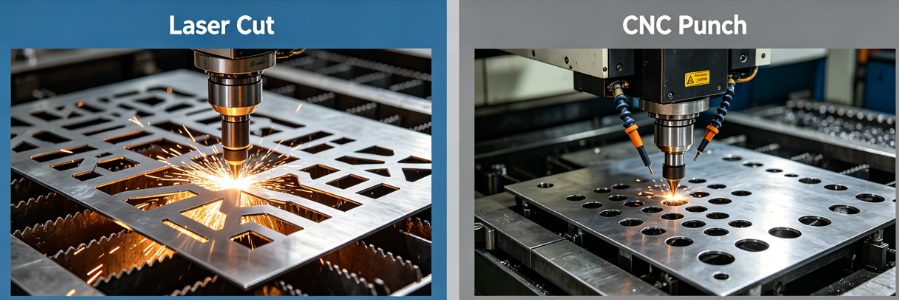
Fiber Laser Cutting
Laser cutting uses a focused high-power light beam to melt/vaporize metal without touching the sheet. All shapes live in digital software—swap designs in 2 minutes, zero custom dies. Works on thin to thick steel, aluminum, stainless steel, copper. Great for curves, irregular cutouts, tiny fine features.
CNC Turret Punching
CNC punch presses use a rotating turret loaded with standard round holes, squares, louvers, emboss tools. It slams metal with mechanical force to stamp features one hit at a time. Punching shines on repeated standard holes, ventilation grids, and formed features like dimples or countersinks. Complex curves require slow “nibbling” which kills speed and edge finish.
Head-to-Head Cost & Speed Comparison Table
All data based on Zorapid’s real production runs for 0.5–4mm mild steel, stainless & aluminum sheet metal (EU/US standard material gauges)
| Evaluation Factor | Fiber Laser Cutting | CNC Turret Punch | Best For Your Batch |
|---|---|---|---|
| Upfront Tooling Cost | $0 – no custom dies needed | $300–$3,000+ custom tool charges for unique shapes | Laser: Prototypes / one-off designs; Punch: Stable repeat standard holes |
| Per-Part Cost (Low Volume <500pcs) | Low-moderate (only programming + cutting time) | High (tooling amortized over tiny quantity) | Laser is clear winner |
| Per-Part Cost (High Volume >10,000pcs, standard holes) | Moderate (longer cycle for dense hole patterns) | Very low (millisecond punch strokes, no gas consumption) | CNC Punch cuts unit cost by 20–35% |
| Speed: Simple Panel with 100 identical holes | Slow (laser pierces each hole one by one) | Extremely fast (150–380 holes per minute) | CNC Punch |
| Speed: Complex Curved Contours / Irregular Cutouts | Fast (continuous single pass cutting) | Very slow (nibbling hundreds of small punch hits) | Laser Cut |
| Setup & Changeover Time | 5–10 mins (just upload new CAD file) | 30–90 mins (swap turret tools, align sheet) | Laser for frequent design revisions |
| Operating Expenses (Hourly) | Higher (nitrogen/oxygen gas, lens maintenance, power draw) | Lower (minimal consumables, mechanical power only) | Punch for long stable production runs |
| Secondary Finishing Cost | Minimal (smooth burr-free nitrogen cut edges) | Extra deburring required (fractured edges, burr buildup) | Laser saves post-processing labor |
| Material Thickness Limit | Up to 25mm mild steel, 12mm stainless steel | Max 6mm thin sheet; thick stock risks tool breakage | Laser for thicker metal sheets |
| Design Flexibility | Unlimited organic shapes, micro slots <1mm | Restricted to pre-made turret tool sizes | Custom, evolving part designs = Laser |
Breakdown – When Laser Cutting Saves You Money & Time
We see most EU prototype and small-batch customers lean laser, and here’s exactly why:
- No tooling fees for design iterations If your engineering team tweaks CAD files 2–3 times during NPI testing, CNC punch adds separate tool charges every revision. Laser just re-programs—zero extra cost for design changes. Perfect for medical device housings, aerospace prototypes, custom automation brackets.
- Clean edges skip deburring labor Nitrogen-assisted laser cuts deliver oxide-free, near-burr-free edges. Punching tears metal, creating sharp burrs that require sanding, grinding or tumbling as an extra step. For cosmetic exposed panels, laser eliminates 1 full secondary operation.
- Fast sample turnaround (24–48hr lead times) No waiting weeks for custom punch die fabrication. Upload your STEP/DXF file, and we cut first articles the same day—critical for EU product launch timelines and quick client validation.
- Handles complex geometry effortlessly Curved cutouts, narrow slots, custom cable ports, asymmetrical outlines—laser runs these in one continuous path. Punch has to nibble complex shapes piece by piece, doubling or tripling cycle time.
Real-World Laser Win Example (Zorapid Client Case)
A German industrial control panel OEM needed 320 prototype enclosures with unique curved cutouts and mixed micro-slots. CNC punch quote included $1,200 custom tooling + 7-day lead time for die build. Laser cutting had zero tool fees, shipped samples in 36 hours, and removed $1,400 in post-deburring labor costs.
Breakdown – When CNC Punch Beats Laser On Cost & Speed
Don’t write off punching entirely—it dominates high-volume stable production with repetitive standard features:
- Blazing fast for dense hole grids Server rack panels, HVAC ventilation sheets, electrical junction boxes covered in hundreds of identical mounting holes: CNC punch hits each hole in milliseconds. Laser must pierce every hole individually, which drags total runtime way up.
- Built-in forming features reduce secondary presses Turret tools add louvers, embosses, dimples, countersinks and lance tabs in one machine pass. Laser only cuts flat outlines—all forming needs a separate press brake station, adding handling time and labor cost.
- Low hourly running cost for mass runs Once tooling is paid off over thousands of parts, punch hourly overhead drops drastically. No expensive assist gas consumption, fewer regular consumable replacements vs fiber lasers.
- Consistent repeatability for identical mass parts For 50,000+ identical thin-gauge cabinet panels with fixed hole patterns, punch maintains tighter positional tolerance across full production runs with steady cycle times.
Real-World CNC Punch Win Example (Zorapid Client Case)
US HVAC manufacturer ordered 75,000 thin aluminum air vent panels with uniform 8mm hole grids. Laser cutting unit cost hit $0.82 per piece; CNC punch amortized tooling down to $0.47 per unit—total production savings over $26,000. Full order finished 4 days faster than laser production timeline.
Hybrid Laser + Punch – The Hidden Cost Saver Most OEMs Miss
Many sheet metal parts mix two feature types:
- Standard repetitive holes/louvers (punch fast & cheap)
- Custom curved outer perimeters / unique cutouts (laser clean & flexible)
Zorapid’s combined laser-punch machine lines process one sheet with both technologies in a single load. This hybrid approach slashes total production cost by 15–25% vs all-laser or all-punch processing for mixed-feature panels (server racks, power distribution enclosures, medical equipment frames).
Quick Decision Checklist – Pick The Right Process In 30 Seconds
Choose Laser Cutting If Any Apply:
- Batch size <1,000 units / prototype NPI stage
- Frequent CAD design revisions expected
- Complex curves, organic shapes, micro thin slots
- Cosmetic visible surfaces requiring smooth edges
- Material thickness >4mm stainless / mild steel
- Fast sample delivery required (under 3 days)
Choose CNC Punch If All Apply:
- Stable design with zero planned changes
- Volume >10,000 identical thin-gauge parts (0.5–3mm)
- Part full of standard round/square holes, ventilation grids
- Need integrated formed features (louvers, embosses)
- Cost per unit is your top priority post-tooling payoff
FAQ
Is laser cutting cheaper than CNC punching overall?
It depends entirely on volume and design stability. Laser wins prototypes & low-mix custom jobs with zero tooling cost. Punch becomes cheaper at high volume with repetitive standard features once custom dies are amortized over thousands of parts.
Which process is faster for sheet metal orders?
Punch is far quicker for dense identical hole patterns. Laser is faster for complex outlines, thick stock, and mixed unique cutouts with no repeated features. Hybrid lines balance both speed benefits.
Does CNC punching always leave burrs?
Yes—mechanical stamping creates a fracture zone edge that requires secondary deburring. Nitrogen fiber laser cuts produce nearly burr-free surfaces that skip extra finishing steps.
Can I switch from punch to laser mid-production if my design changes?
Absolutely. Zorapid frequently shifts clients to laser cutting mid-order once engineering updates CAD files, avoiding costly rework of custom punch tooling.
Final Takeaway From Zorapid’s Sheet Metal Experts
There’s no universal better process—only the right fit for your volume, design complexity, budget and lead time targets.
Laser cutting is your flexible, low-risk choice for prototyping, small batches, custom geometry and fast product iteration for EU/US OEMs. CNC punching delivers rock-bottom per-unit pricing for stable high-volume thin sheet jobs packed with standard holes and formed features. If your parts mix both feature types, our hybrid laser-punch workflow delivers the best of both worlds to cut cost and speed up delivery.
CTA
Need a free sheet metal cost & lead time comparison quote for your DXF/STEP files? Send your CAD drawings to Zorapid’s dedicated EU/US manufacturing team today. We’ll break down laser vs punch pricing, production timeline and finishing options tailored to your batch size, material and tolerance requirements.