Published:Zorapid.Ltd
Here’s a secret most people don’t talk about: the biggest bottleneck in electric vehicle performance isn’t the battery. It’s keeping everything cool.
Push an EV hard, and you’ll hit thermal limits before you hit anything else. Battery gets too hot? It charges slower and dies faster. Motor gets too hot? Power drops like a rock. Inverter gets too hot? Say hello to reduced range.
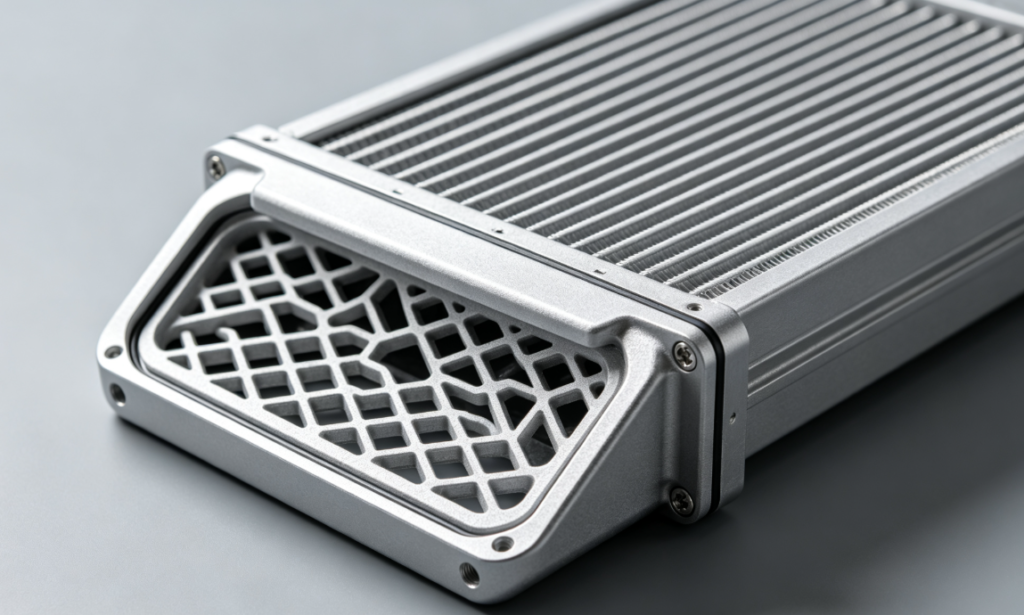
The solution? Better heat exchangers. But here’s the problem — traditional manufacturing can only do so much. You’re stuck with flat plates, simple channels, and assemblies that leak.
What if you could print complex, conformal cooling channels in a single piece? And then finish the critical sealing surfaces with 5-axis precision?
That’s exactly what hybrid manufacturing does. And it’s changing how EV companies build thermal systems.
Why Traditional Heat Exchangers Suck (And Everyone Knows It)
Let’s be honest. Traditional heat exchanger design is basically a compromise after compromise.
You’ve got:
- Brazed plate designs — leak-prone, limited geometry, slow to prototype
- Tube-and-fin setups — bulky, heavy, not great for tight spaces
- Machined blocks — expensive, material waste, can’t do internal complexity
The worst part? You can’t optimize the flow path. Want a twisted channel that swirls coolant for better heat transfer? Good luck with traditional methods. Want variable channel sizes that match heat load across the part? Forget it.
And don’t even get us started on assembly. A typical cold plate might have 8-12 separate parts. More parts = more leak points = more failure modes.
EV engineers have been making the best of bad options for years. But not anymore.
Hybrid Manufacturing: The Best of Both Worlds
Here’s the big idea: use 3D printing for the complex internal geometry, then 5-axis CNC for the critical surfaces that need tight tolerances.
It’s not one technology or the other. It’s both. Working together.
Step 1: SLM 3D Print the Body
Selective Laser Melting (SLM) prints the main heat exchanger body in one single piece.
What does that get you?
- Conformal cooling channels that follow the exact shape of your battery module or motor housing
- Lattice structures inside that massively increase surface area without adding weight
- Integrated ports and mounts that eliminate fittings and connectors
- Topology-optimized shapes that fit in spaces traditional parts never could
We’re talking about heat exchangers that transfer 30-40% more heat in the same footprint. Or the same performance in a package 30% smaller and lighter.
In EVs, where every gram and every millimeter counts? That’s huge.
Step 2: 5-Axis Finish the Critical Surfaces
3D printing is amazing for complexity, but it can’t hit the tolerances you need for sealing surfaces. A printed flange might have Ra 6-12μm surface finish. For a leak-proof seal? You need Ra < 0.8μm, and flatness within 0.02mm.
That’s where 5-axis CNC comes in.
- Finish-machined sealing faces — perfectly flat, perfectly smooth
- Tight-tolerance port threads — no leaks, no thread chasing
- Precision mounting holes — drop-in fit every time
- Critical datum surfaces — Cpk > 1.33 on all key dimensions
You get the design freedom of 3D printing with the precision of CNC machining. It’s the best of both worlds.
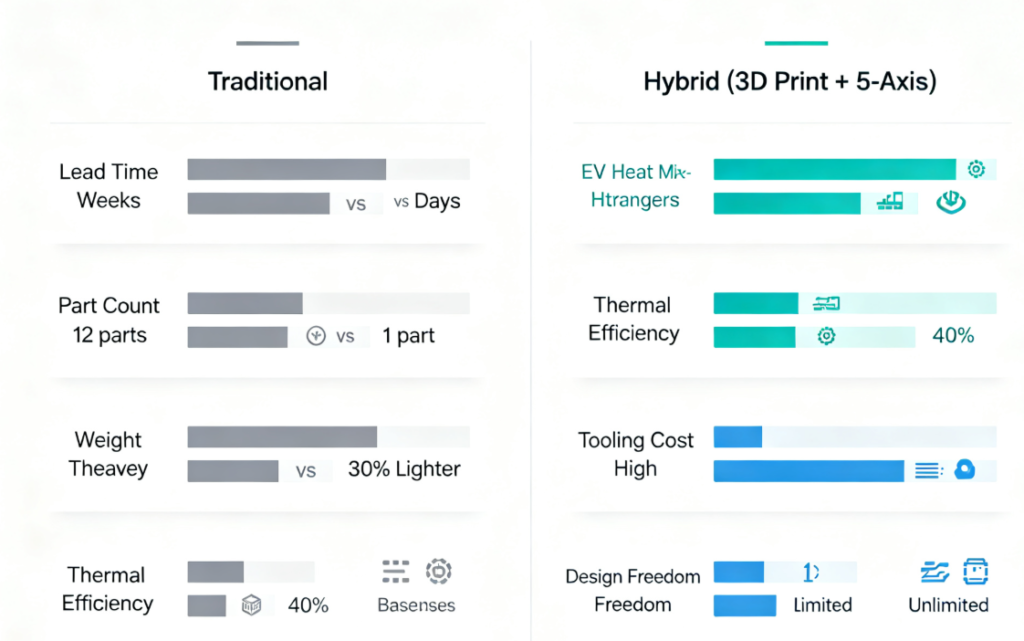
Real Numbers: What Hybrid Actually Delivers
Let’s stop talking theory and look at actual results from a recent EV battery cooler project.
| Metric | Traditional (Brazed) | Hybrid (3D Print + 5-Axis) | Improvement |
|---|---|---|---|
| Lead Time | 6-8 weeks | 10-14 days | 70% faster |
| Part Count | 11 pieces | 1 piece | 10 fewer parts |
| Weight | 1.8 kg | 1.2 kg | 33% lighter |
| Thermal Performance | Baseline | +38% | 38% better cooling |
| Pressure Drop | 1.2 bar | 0.8 bar | 33% lower |
| Leak Rate | 2-3% field failure | 0% (single piece) | Eliminated |
| Tooling Cost | $15,000+ | $0 | No tooling needed |
Those aren’t incremental improvements. Those are game-changing numbers.
Why This Matters for EVs Specifically
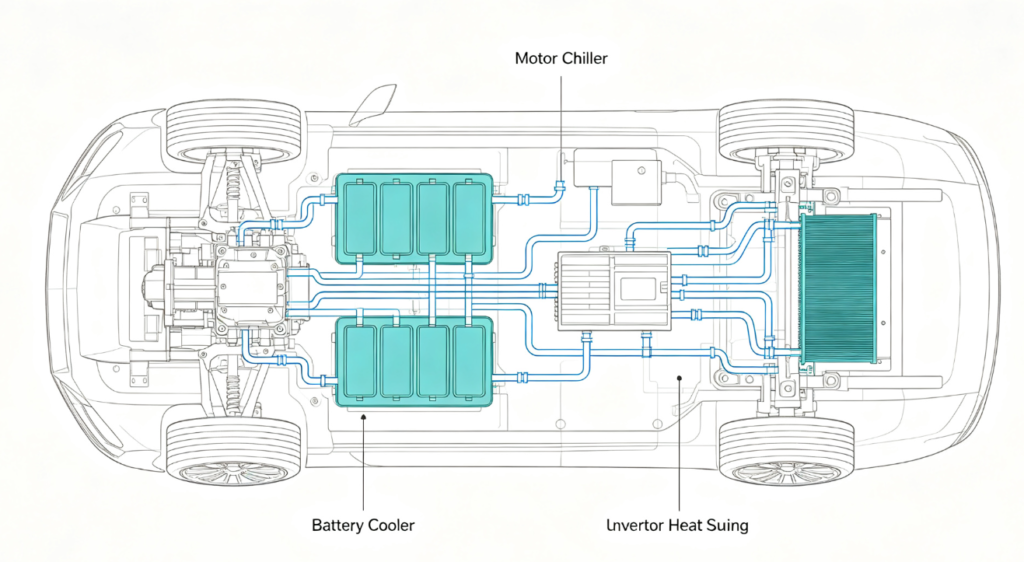
Electric vehicles have unique thermal challenges. And hybrid manufacturing solves all of them.
Battery Cooling: The Priority
Batteries are picky. They want to stay between 25-35°C. Too cold? Range drops. Too hot? Degradation accelerates.
Hybrid heat exchangers let you:
- Match channel size to cell heat output across the pack
- Put cooling exactly where the hot spots are
- Reduce temperature variation across the pack to <2°C
- Integrate cooling plates with structural battery components
The result? Longer battery life, faster charging, more consistent range.
Motor & Inverter Cooling: Power Density
EV motors and inverters are getting smaller and more powerful. Which means more heat in less space.
Traditional cold plates can only do so much. Hybrid designs? You can:
- Print cooling channels that wrap around stator windings
- Integrate heat sinks directly into inverter housings
- Use internal fins and turbulators that boost heat transfer
- Reduce thermal resistance by 40%+
More cooling = more power density = smaller, lighter, more efficient drivetrains.
The Packaging Problem
EVs are packed. There’s barely room for everything. Every millimeter matters.
Hybrid manufacturing lets you:
- Fit cooling into spaces traditional parts can’t reach
- Combine multiple functions into one part (cooling + structure + mounting)
- Reduce part count and assembly complexity
- Iterate packaging designs without waiting for tooling
When you’re fighting for every millimeter of range and interior space, this stuff matters.
Materials That Work
Not every material works for 3D-printed heat exchangers. Here’s what we use, and why.
Aluminum AlSi10Mg — The Workhorse
- Excellent thermal conductivity — ~160 W/m·K (as printed), ~200 W/m·K (heat treated)
- Lightweight — 2.67 g/cm³
- Great printability — consistent, reliable, well-understood
- Good strength — more than enough for most coolant pressures
- Cost-effective — the best balance of performance and price
This is our go-to for 90% of EV heat exchanger projects. It’s proven, it works, and it delivers great performance.
Copper CuCrZr — For Maximum Performance
- Outstanding thermal conductivity — ~320 W/m·K
- Higher strength than pure copper
- Great for high-heat applications like motor cooling
- More expensive and trickier to print
When you need absolute maximum heat transfer and weight isn’t the top concern, copper is amazing. It’s roughly twice as conductive as aluminum.
Stainless Steel 316L — For Corrosive Environments
- Excellent corrosion resistance — great for harsh coolants or marine EVs
- Strong and durable — handles high pressure
- Lower conductivity — about 15 W/m·K, so you need to design for it
Most EVs don’t need stainless, but for specialty applications, it’s the right call.
Real-World Case Study: 50% Faster Charging Battery Cooler
An EV startup came to us with a problem. Their battery cooler design was maxed out. They wanted 50% faster charging, but their existing cold plate couldn’t pull heat away fast enough.
The challenge:
- 800V battery pack, 180kW fast charging target
- Max 5°C temperature delta across the pack
- Must fit in the same packaging space
- Weight neutral or better
Here’s what we did:
1: Design Optimization (2 days)
- Ran thermal simulation on their current design
- Identified hot spots and flow bottlenecks
- Proposed a hybrid 3D-printed design with conformal channels and internal lattice structures
2: 3D Printing (5 days)
- Printed 3 prototype units in AlSi10Mg
- Built in optimized channel geometry
- Integrated mounting features directly into the part
3: 5-Axis Finishing (2 days)
- Machined all sealing surfaces to Ra < 0.8μm
- Drilled and tapped mounting holes
- Verified flatness within 0.015mm
Phase 4: Testing & Validation (3 days)
- Pressure tested to 10 bar (no leaks)
- Thermal tested on their battery pack
- CMM inspection on all critical dimensions
Total time: 12 days from kickoff to tested prototypes.
The results?
- 42% better thermal performance — hit their 180kW charging target
- 28% lighter — saved 450 grams per cooler
- 3°C max delta across the pack (down from 8°C)
- Zero leak points — single piece design eliminated failure modes
They went back to their investors with a working prototype in two weeks. Traditional methods would have taken 8-12 weeks and cost 10x more.
The Zorapid Hybrid Advantage
Lots of shops can 3D print. Lots of shops can do 5-axis machining. But very few do both well — and even fewer specialize in thermal components.
Here’s why we’re different:
We Understand Thermal Design
We don’t just print what you send us. Help you optimize it. Our thermal engineers will review your design and suggest improvements based on real-world testing data.
We Control the Whole Process
From powder to finished part, everything happens in our facility. No outsourcing, no handoffs, no finger-pointing when something goes wrong.
We Have the Right Equipment
- SLM metal 3D printers with build volumes up to 250×250×325mm
- 5-axis CNC machining centers with in-process probing
- Thermal simulation and testing capabilities
- Cleanroom assembly and packaging
We’re Certified for Automotive
- IATF 16949:2016
- ISO 9001:2015
- RoHS and REACH compliant
- Full material traceability
We Scale With You
From 1 prototype to 10,000 production parts, we’ve got the capacity. And because there’s no tooling, you can ramp up fast without huge upfront investment.
FAQ
How much does a hybrid 3D-printed heat exchanger cost?
It depends on size, complexity, and quantity. For a typical battery cold plate prototype, expect $800-$2,500 per part. Production quantities (1000+) can drop to $150-$400 each. The big savings are in tooling — traditional brazed heat exchangers need $15k-$50k in tooling, while hybrid has zero tooling cost.
What’s the typical lead time?
Prototypes: 7-14 days from approved design. Production runs: 3-4 weeks for first batch, then 2-3 weeks for repeat orders. If you need something faster, ask about our expedite options — we’ve turned around simple parts in 3 days before.
How big can you make heat exchangers?
Our standard build envelope is 250×250×325mm. For larger parts, we can print in sections and weld them together, or use multiple smaller exchangers plumbed together. Need something bigger? Let’s talk — we’ve done custom builds up to 500mm across.
What materials can you use?
Most common: AlSi10Mg aluminum (great balance of cost, weight, and conductivity). We also do CuCrZr copper (maximum thermal performance), 316L stainless (corrosion resistance), and Inconel 718 (high-temperature apps). Have a specific material in mind? Just ask.
How do you verify thermal performance?
We start with CFD simulation during the design phase to predict performance. Then we build physical prototypes and test them on our in-house thermal test rig — we can measure heat transfer, pressure drop, and temperature distribution under real-world conditions. We can also work with your test team for full system validation.
What pressures can these handle?
Depends on wall thickness and material, but typical designs handle 6-10 bar with 3x safety factor. We’ve built high-pressure units that handle 25 bar for specialty applications. Every prototype gets pressure tested before it ships.
Do you provide design help?
Absolutely. In fact, we recommend it. Send us your requirements — heat load, pressure drop, space constraints, coolant type — and our engineers will propose an optimized design. DFM review is free with every quote.
Can you replace my existing brazed heat exchanger with a hybrid design?
Usually yes, and you’ll get better performance in the same package. We’ll take your current specs and design a drop-in replacement that fits the same mounting points and connections. Most customers see 20-40% better thermal performance just by switching to a hybrid design.
What about leak testing?
Every part gets pressure tested before shipping. Standard is 1.5x working pressure held for 30 minutes with zero detectable leak. We can also do helium leak testing for applications that require absolute leak-tightness (like refrigerant systems).
Is this technology production-ready?
100%. We’re currently in production with multiple EV programs, from low-volume supercars to mass-market EVs. The technology is mature, the materials are qualified, and the process is repeatable. IATF 16949 certified for automotive production.
What’s the minimum order quantity?
One. We do everything from single R&D prototypes to 10,000+ piece production runs. No order is too small. Pricing gets much better at volume, but we’re happy to quote 1 piece if that’s what you need for testing.
How do I get started?
Send us your requirements. Tell us what you’re cooling, how much heat, what space you have, and how many you need. We’ll come back with a design proposal, quote, and lead time within 48 hours. No obligation, no sales pitch — just engineering.
Ready to Build Better Heat Exchangers?
If you’re an EV engineer who’s tired of:
- Waiting 8 weeks for heat exchanger prototypes
- Dealing with leaky brazed assemblies
- Compromising on thermal performance
- Paying tens of thousands for tooling
Then let’s talk.
Hybrid manufacturing isn’t the future — it’s what the top EV companies are using right now to build better, lighter, more efficient thermal systems.
Send us your specs today. We’ll review them, suggest optimizations, and give you a real quote with a real timeline.
No fluff. No buzzwords. Just better heat exchangers, delivered fast.
Zorapid — Hybrid Manufacturing for EV Thermal Excellence
3000㎡ Smart Manufacturing Center | Zhongshan, Guangdong